
Coating and Paint Defects
Orange Peel in Paint: Causes, Repair and Surface Tension Checks That Prevent Orange Peel Texture
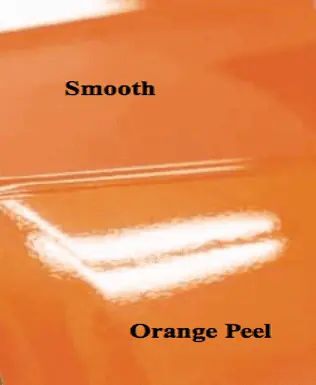
The orange peel effect is a bumpy paint finish resembling the skin of an orange. It forms when a coat does not level before it sets. Spray technique and film build cause most of it; paint surface tension drives the levelling. Checking surface tension on each batch catches a paint that will not flow out before it reaches the spray gun.

Written by
Gurdeep Singh Saini
Holds a BASc in Mechanical Engineering from Ryerson University (now Toronto Metropolitan University) and an MASc from York University. He develops the automatic edge and baseline detection behind the Dropometer's analysis.
COO at Droplet Lab
Read More

Technical Review by
Droplet Lab Team
Droplet Lab builds precision instruments and software for surface science measurement, specialising in contact angle analysis and surface tension characterisation. Used by researchers across materials science, pharmaceuticals, coatings, and advanced manufacturing, Droplet Lab's Dropometer has contributed to studies published in peer-reviewed journals including Advanced Functional Materials (Impact Factor 19). The team combines instrument engineering with deep domain knowledge in wettability science with a focus on practical accuracy.
Read More
Reviewed By
Droplet Lab Team
Droplet Lab builds precision instruments and software for surface science measurement, specialising in contact angle analysis and surface tension characterisation. Used by researchers across materials science, pharmaceuticals, coatings, and advanced manufacturing, Droplet Lab's Dropometer has contributed to studies published in peer-reviewed journals including Advanced Functional Materials (Impact Factor 19). The team combines instrument engineering with deep domain knowledge in wettability science with a focus on practical accuracy.



Validated measurement approach for paint surface tension
How the Dropometer itself has been validated, and where customers have published with it.
Peer reviewed method
The Dropometer drop shape method is published in Review of Scientific Instruments and Colloids and Surfaces A, covering contact angle and pendant drop surface tension.
See the validation papersCustomer publication on surface tension and rheology
Pal and Sun used the Dropometer pendant drop tensiometer to measure surface tension of polymer and surfactant solutions alongside rheology (ChemEngineering, 2025). These were not paints, but the pairing of surface tension and flow data is the same.
Read our analysis of the paperExample paint batch surface tension log
Example data only. Your limits and values will differ and must come from your own panels.
How to read this log
Example limit: surface tension within 1.0 mN/m of the reference and viscosity within 2 s. Green rows are released, amber rows are adjusted and rechecked, red rows are held.
Example data, not customer data. Pendant drop surface tension of a solvent borne clear coat at 23 °C, read at a fixed drop age.
Report a correction
Spotted an issue in this summary? Send a correction request and our team will review it.
Correction Request
We work hard to keep this page accurate and up to date. If you spot an error (wrong revision/year, missing requirement, incorrect interpretation, or broken link), tell us and we'll review it.
Contact us to report a correctionReferences
1.
Orchard, S. E. On surface levelling in viscous liquids and gels. Applied Scientific Research, Section A 11(4):451 to 464, 1963. https://link.springer.com/doi/10.1007/BF03184629
2.
Figliuzzi, B., Jeulin, D., Lemaître, A., Manneville, P., Fricout, G., Piezanowski, J. J. Numerical simulation of thin paint film flow. Journal of Mathematics in Industry 2:1, 2012. https://link.springer.com/article/10.1186/2190-5983-2-1
3.
Pal, R., Sun, C. C. Influence of added surfactants on the rheology and surface activity of polymer solutions. ChemEngineering 9:105, 2025. Customer publication that used the Dropometer; the link goes to our analysis of the paper. https://dropletlab.com/validation/citations/analysis/influence-of-added-surfactants-on-the-rheology-and-surface-activity-of-polymer-solutions/
4.
ASTM D7334. Standard practice for surface wettability of coatings, substrates and pigments by advancing contact angle measurement. https://dropletlab.com/industry-standards/astm-d7334/
5.
Chen, X. et al. Contact angle measurement with a smartphone. Review of Scientific Instruments 89(3):035117, 2018. https://pubs.aip.org/aip/rsi/article-abstract/89/3/035117/368179/Contact-angle-measurement-with-a-smartphone
6.
Surface tension measurement with a smartphone using a pendant drop. Colloids and Surfaces A: Physicochemical and Engineering Aspects. https://www.sciencedirect.com/science/article/abs/pii/S0927775717307744
10.