
Printing Wetting, Ink Adhesion and Film Performance
Ink Beading, Bleed and Uneven Print: Troubleshooting Ink Surface Tension, Viscosity and Wetting on Paper and Film
Most ink problems on press come down to how the ink wets the substrate. Measure ink surface tension by pendant drop and the ink contact angle on your paper, board or film, log viscosity from your viscometer, and find the cause of beading, bleed and uneven print before the next run.

Written by
Gurdeep Singh Saini
Holds a BASc in Mechanical Engineering from Ryerson University (now Toronto Metropolitan University) and an MASc from York University. He develops the automatic edge and baseline detection behind the Dropometer's analysis.
COO at Droplet Lab
Read More

Technical Review by
Droplet Lab Team
Droplet Lab builds precision instruments and software for surface science measurement, specialising in contact angle analysis and surface tension characterisation. Used by researchers across materials science, pharmaceuticals, coatings, and advanced manufacturing, Droplet Lab's Dropometer has contributed to studies published in peer-reviewed journals including Advanced Functional Materials (Impact Factor 19). The team combines instrument engineering with deep domain knowledge in wettability science with a focus on practical accuracy.
Read More
Reviewed By
Droplet Lab Team
Droplet Lab builds precision instruments and software for surface science measurement, specialising in contact angle analysis and surface tension characterisation. Used by researchers across materials science, pharmaceuticals, coatings, and advanced manufacturing, Droplet Lab's Dropometer has contributed to studies published in peer-reviewed journals including Advanced Functional Materials (Impact Factor 19). The team combines instrument engineering with deep domain knowledge in wettability science with a focus on practical accuracy.



Validated measurement approach for ink surface tension
How the Dropometer itself has been validated, and how the check fits the pendant drop standard.
Peer reviewed method
The Dropometer drop shape method is published in Review of Scientific Instruments and Colloids and Surfaces A. Contact angle was validated against a KRUSS DSA100E, with a published accuracy of 0.35°.
See the validation papersHow it fits EN ISO 19403-3
EN ISO 19403-3:2024 specifies an optical pendant drop method for the surface tension of liquid coating materials, and notes that restrictions can apply for non Newtonian liquids. The Dropometer uses pendant drop shape analysis. At the University of Bologna it measured a sensor ink before and after a surfactant change in a study published in Electrochimica Acta.
Read the University of Bologna case studyExample ink troubleshooting log
Example data only. Your values and gates will differ and must come from your own printer and print results.
How to read this log
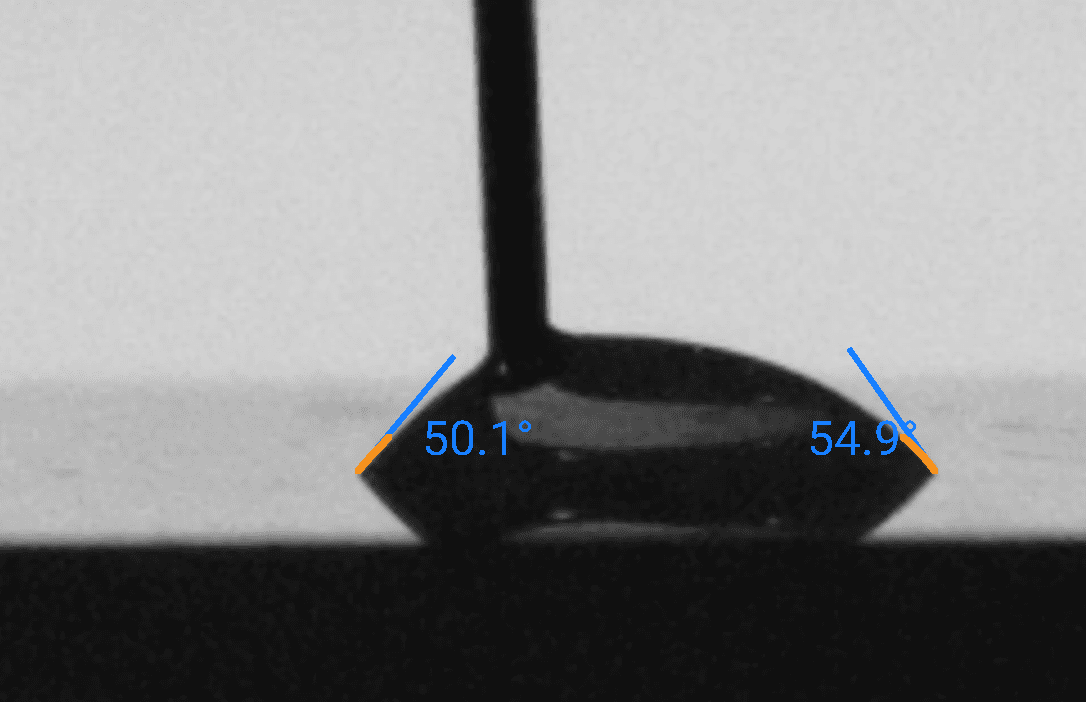
Example window: 28 to 35 mN/m and ink contact angle on the film at or below 30°. Lot A printed well. Lot B was high in surface tension and beaded on the film. Lot C was in range when fresh, but the ink taken from the press after a long run had shifted, pointing to solvent loss. Our article on dynamic surface tension explains why fast processes can still differ.
Example data, not customer data. Water based inkjet ink on treated PE film; pendant drops at 25 °C; median of 5 drops; viscosity from a separate viscometer.
Report a correction
Spotted an issue in this summary? Send a correction request and our team will review it.
Correction Request
We work hard to keep this page accurate and up to date. If you spot an error (wrong revision/year, missing requirement, incorrect interpretation, or broken link), tell us and we'll review it.
Contact us to report a correctionReferences
1.
Scotti, S., Lesch, A. Fully inkjet printed poly(N isopropylacrylamide)/graphene electrodes for electroanalytical sensing with pH switchable selectivity. Electrochimica Acta 576:149649, 2026. See our University of Bologna case study. https://dropletlab.com/validation/case-studies/university-of-bologna-inkjet-ink-surface-tension/
2.
Derby, B. Additive manufacture of ceramics components by inkjet printing. Engineering 1(1):113 to 123, 2015. https://doi.org/10.15302/J-ENG-2015014
3.
Reis, N., Derby, B. Ink jet deposition of ceramic suspensions: modeling and experiments of droplet formation. MRS Proceedings 625:117, 2000. https://doi.org/10.1557/proc-625-117
4.
Jang, D., Kim, D., Moon, J. Influence of fluid physical properties on ink jet printability. Langmuir 25(5):2629 to 2635, 2009. https://doi.org/10.1021/la900059m
5.
Ricoh MH5420/MH5440 industrial inkjet printhead specifications. https://www.ricoh.com/products/industrial-inkjet-printheads/ricoh-mh5420-mh5440
6.
Berry, J. D., Neeson, M. J., Dagastine, R. R., Chan, D. Y. C., Tabor, R. F. Measurement of surface and interfacial tension using pendant drop tensiometry. Journal of Colloid and Interface Science 454:226 to 237, 2015. https://doi.org/10.1016/j.jcis.2015.05.012
7.
Bubat, A., Scholz, W. Silicone additives for paints and coatings. Chimia 56(5):203 to 209, 2002. https://chimia.ch/chimia/article/download/2002_203/2872/13557
8.
Deegan, R. D. et al. Capillary flow as the cause of ring stains from dried liquid drops. Nature 389:827 to 829, 1997. https://doi.org/10.1038/39827
9.
Rentzhog, M., Fogden, A. Rheology and surface tension of water based flexographic inks and implications for wetting of PE coated board. Nordic Pulp and Paper Research Journal 20(4):399 to 409, 2005. https://doi.org/10.3183/npprj-2005-20-04-p399-409
10.
Li, R. et al. Ink penetration of uncoated inkjet paper and impact on printing quality. BioResources 10(4):8135 to 8147, 2015. https://doi.org/10.15376/biores.10.4.8135-8147
11.
Thorman, S., Yang, L., Hagberg, A., Strom, G. The impact of non uniform ink absorption on flexographic print mottle. Journal of Print and Media Technology Research 7(1):7 to 18. https://jpmtr.org/index.php/journal/article/view/77
12.
Rump, M. et al. Selective evaporation at the nozzle exit in piezoacoustic inkjet printing. Physical Review Applied 19(5):054056, 2023. https://doi.org/10.1103/PhysRevApplied.19.054056
13.
Wijshoff, H. The dynamics of the piezo inkjet printhead operation. Physics Reports 491(4 to 5):77 to 177, 2010. https://doi.org/10.1016/j.physrep.2010.03.003
14.
Mitsuyoshi, K., Tsuru, I., Hamada, D. Relationship between jetting performance and surface tension in micro second order on water based inkjet ink. NIP30, IS&T, 2014. https://doi.org/10.2352/ISSN.2169-4451.2014.30.1.art00011_1
15.
ISO 19403-3:2024. Paints and varnishes: wettability, part 3, determination of the surface tension of liquids using the pendant drop method. See our EN ISO 19403-3 page. https://www.iso.org/standard/87263.html
16.
ISO 19403-2:2024. Paints and varnishes: wettability, part 2, determination of the surface free energy of solid surfaces by measuring the contact angle. https://www.iso.org/standard/87262.html
17.
ASTM D3825-09. Standard test method for dynamic surface tension by the fast bubble technique (withdrawn 2016). https://store.astm.org/d3825-09.html
18.
Chen, X. et al. Contact angle measurement with a smartphone. Review of Scientific Instruments 89(3):035117, 2018. https://pubs.aip.org/aip/rsi/article-abstract/89/3/035117/368179/Contact-angle-measurement-with-a-smartphone
19.
Surface tension measurement with a smartphone using a pendant drop. Colloids and Surfaces A: Physicochemical and Engineering Aspects. https://www.sciencedirect.com/science/article/abs/pii/S0927775717307744