Contents
Print Quality and Ink Adhesion

Corona Treatment Monitoring for Print Quality: A Surface Readiness Gate for Ink Adhesion on Plastic Film

Move beyond subjective dyne testing. Turn corona treatment into a measurable, repeatable surface readiness gate, quantify contact angle and surface energy to control print wetting, ink adhesion, and coating performance on plastic film.

Who this is for: Process engineers, QA/QC teams, press operators, and manufacturing leads responsible for corona treatment, print quality, and adhesion performance in film converting, digital printing, and lamination workflows.

Positioning: Dropometer does not replace your final print-quality or adhesion acceptance test. It replaces subjective dyne-pen judgment with quantitative contact angle and surface energy data, so corona treatment level becomes a measured, repeatable gate rather than an operator's visual call.

Last updated
July 10, 2026
Gurdeep-Saini-Photo
Written by
Gurdeep Singh Saini
Holds a BASc in Mechanical Engineering (Ryerson) and an MASc from York University. He focuses on the custom AI behind the instrument.
COO at Droplet Lab
Read More
Droplet-Lab logo
Technical Review by
Droplet Lab Team
Droplet Lab builds precision instruments and software for surface science measurement, specialising in contact angle analysis and surface tension characterisation. Used by researchers across materials science, pharmaceuticals, coatings, and advanced manufacturing, Droplet Lab's Dropometer has contributed to studies published in peer-reviewed journals including Advanced Functional Materials (Impact Factor 19). The team combines instrument engineering with deep domain knowledge in wettability science with a focus on practical accuracy.

Read More
Gurdeep-Saini-Photo
Written By

Gurdeep Singh Saini

COO at Droplet Lab

Holds a BASc in Mechanical Engineering (Ryerson) and an MASc from York University. He focuses on the custom AI behind the instrument.

Droplet-Lab logo
Reviewed By

Droplet Lab Team

Droplet Lab builds precision instruments and software for surface science measurement, specialising in contact angle analysis and surface tension characterisation. Used by researchers across materials science, pharmaceuticals, coatings, and advanced manufacturing, Droplet Lab's Dropometer has contributed to studies published in peer-reviewed journals including Advanced Functional Materials (Impact Factor 19). The team combines instrument engineering with deep domain knowledge in wettability science with a focus on practical accuracy.


The Cost Of Getting It Wrong

15–20%

of annual revenue consumed by Cost of Poor Quality in typical manufacturing operations

Fabrico COPQ Guide, citing American Society for Quality estimates

10×

higher hidden cost vs. visible scrap cost: rework, re-inspection, downtime, and warranty claims are rarely captured

Fabrico COPQ Guide 2026

1 → 10 → 100

the well-documented "1-10-100 Rule": prevention costs roughly 1x, internal rework roughly 10x, and an external failure (warranty, recall, lost business) roughly 100x, for the specific failure modes an upstream screen actually catches

1-10-100 Rule of Quality Costs (Making Strategy Happen; AIGPE)

Sources: Fabrico, "The Cost of Poor Quality (COPQ) in Manufacturing: 2026 Guide" (fabrico.io); Making Strategy Happen and AIGPE on the 1-10-100 Rule. Industry-wide benchmarks, not Droplet Lab claims.

QC-Ready Summary

What this workflow does and what it does not

Quick technical reference for engineers and QA managers evaluating fit before reading further.

Evidence Box (QC-Ready)

Problem this solves

Inconsistent corona treatment leading to unstable surface energy, poor ink wetting, weak adhesion, and downstream print defects such as mottle, bleed, and coating failure, discovered on press rather than caught before printing.

Dropometer role in workflow

Quantifies corona treatment effectiveness by measuring contact angle, spot-to-spot variability, and surface energy, replacing a subjective dyne-pen call with real-time, numeric process monitoring and control.

Primary outputs

Water contact angle across zones on the treated film
Spot-to-spot variability across the web to catch uneven treatment
Surface energy trend using Fowkes or van Oss–Good models
Optional ink surface tension (pendant drop) to check ink-side compatibility

Calibration requirement

10 to 20 representative film samples spanning pass and fail (print quality, adhesion test) outcomes
Minimum 2 operators
Fixed probe liquid, droplet volume, capture time, and replicate count, tracked per film substrate and treater line

Gate requirement

PASS / MONITOR / FAIL thresholds must be set by correlating measured contact angle and surface energy to your actual print-quality and adhesion-test outcomes; substrate- and press-specific, not universal. ASTM D2578 (Wetting Tension of Polyethylene and Polypropylene Films) is the relevant, currently active industry standard for this measurement, dyne value ranges should still be validated against your own line [1].

Known limitations

Contact angle indicates wettability, not guaranteed adhesion. Corona treatment decays over time after application, and over-treatment can create a weak boundary layer of low-molecular-weight oxidized material that reduces adhesion despite good wettability [2].

Who this is for

What are you trying to solve?

The Dropometer serves four roles across a film-converting or printing operation. Each has a different primary risk.

Process Engineer

Investigating batch-to-batch or shift-to-shift variation in print defects with no clear root cause, especially after a treater voltage, gap, or line-speed change.

Unexplained process drift

QA / QC Manager

Needing a numeric, repeatable replacement for dyne-pen judgment calls to reduce print-defect scrap and improve first-pass yield.

Rework and scrap cost

Compliance Officer

Requiring documented, defensible evidence of treatment level for NCR files, CAPA responses, or customer/supplier audits.

Audit non-conformance

Lab Manager

Running a DOE to optimize treater power, gap, and line speed for consistent ink adhesion across film types.

Operator-to-operator variability
workflow fit

Is this the right screen for your process?

This is not a universal solution. Check the conditions below before investing further time.

Good fit if

You currently rely on dyne pens or dyne inks alone and want a numeric, repeatable replacement or cross-check
Your corona-treated film performs inconsistently across the web, across rolls, or across a shift, and you suspect treater drift or decay
You need a documented, numeric pre-print or in-process gate, not a subjective visual or ink-pen call
Your QA or compliance process requires a traceable treatment-verification record
You are running a DOE to optimize treater power, gap, or line speed and need quantitative surface-energy data, not just print outcomes

Less relevant if

Your print defects correlate with ink formulation or press mechanics (registration, tension, viscosity) with stable, verified film surface energy
Your adhesion failures happen despite good wettability readings, that is a weak-boundary-layer or over-treatment signal, not a wetting problem, see Root Causes
You do not corona-treat your film at all and print directly on an inherently high-energy substrate
Your acceptance test is purely a final print-quality visual check with no appetite to add an upstream or in-process gate
Root Cause Context

Why Corona Treatment Needs a Measured Gate, Not a Visual One

Corona treatment is a well-established way to raise the surface energy of plastic film for printing and adhesion. The treatment itself, and the equipment delivering it, both drift, and dyne-pen checks are too coarse to catch it early.

Corona treatment is a widely used process for increasing the surface energy of plastic films such as polyethylene and polypropylene, enabling ink wetting, coating, and adhesion that the untreated film would not support. Untreated polyolefin film typically sits around 29 to 31 dynes/cm, while most inks and coatings need the substrate closer to 38 to 42 dynes/cm to wet and bond reliably [3]. Corona discharge closes that gap by oxidizing the film surface.

The gap does not stay closed on its own. Corona discharge systems drift with voltage variation, treater condition, and web handling, and the treated surface itself loses surface energy over time as additives migrate and the surface relaxes, this is why converting lines apply secondary treatment close to the point of use rather than relying on treatment done earlier in the process [4]. On top of that, more treatment is not automatically better: over-treatment builds up low-molecular-weight oxidized material at the surface, a weak boundary layer that can reduce ink and adhesive adhesion even though the surface still reads as well-wetted [2].

The industry's standard method for verifying wetting tension on these films, ASTM D2578, remains active and current [1]. In practice, most lines still verify treatment with dyne pens or dyne inks, a fast but subjective, operator-dependent check that gives a pass/fail band rather than a number. This workflow replaces that subjective call with quantitative contact angle and surface energy measurement, before printing and continuously during a run, so treater drift, decay, and over-treatment are caught as numbers on a trend line instead of discovered as defects on press.

Recognition

What Does Corona Treatment Failure Actually Look Like?

Corona-treated film does not consistently perform during printing. Despite running a corona treater, variation in surface energy shows up as inconsistent ink wetting, weak adhesion, and coating defects, often with no numeric record of what the treatment level actually was at the time.

Print mottle and uneven ink solids across a run, batch, or roll.
Ink bleed and poor edge definition.
Weak ink adhesion on plastic film that fails tape or scratch checks despite looking fine visually.
Pinholes, crawling, or coating defects tracing back to the film surface rather than the ink or coating itself.
Frequent, ad hoc re-treatment before printing because nobody trusts the last measurement, or there wasn't one.
No numeric baseline to say whether a defect is a treater problem, a decay problem, or an ink problem.
Diagnosis

Root Causes

Why:

  • Insufficient corona discharge energy fails to raise the substrate's surface energy enough for reliable ink wetting.

How to detect:

  • High contact angle, low measured surface energy versus your target band

Corrective action:

  • Adjust treater power, line speed, or electrode gap Re-verify against your dyne or contact-angle target

Why:

  • Uneven voltage distribution across the electrode or web handling issues create inconsistent treatment across the width of the film.

How to detect:

  • High variability across zones at a single point in time

Corrective action:

  • Inspect the treater station, check electrode condition Re-align the web and correct mechanical handling issues

Why:

  • Corona-treated surfaces lose surface energy over time as additives migrate to the surface and the surface relaxes, this is a documented, expected effect, not a malfunction [4].

How to detect:

  • Contact angle increases with elapsed time since treatment Failures correlate with time-to-print rather than the treater setting itself

Corrective action:

  • Define and enforce a validated time-to-print window from your own decay trend Apply secondary treatment close to the point of use if the window can't be met

Why:

  • Oils, dust, slip additives, or antiblock agents on the film surface block treatment from activating the surface evenly.

How to detect:

  • Localized wetting failure that doesn't correlate with treater settings

Corrective action:

  • Improve web cleaning and handling protocols Audit additive packages in the film resin

Why:

  • Excessive corona energy builds up low-molecular-weight oxidized material at the surface, a weak boundary layer that can reduce adhesion even though the surface still wets well [2].

How to detect:

  • Good wettability and surface energy readings, but poor adhesion or print performance

Corrective action:

  • Optimize treater energy to the level your adhesion data actually requires, do not maximize it Run a DOE across power/gap/speed rather than defaulting to "more treatment"

Why:

  • The ink's own surface tension may be too high relative to the treated film's surface energy for reliable bonding, independent of how well the film was treated.

How to detect:

  • Film contact angle and surface energy read stable and in range, but print results are still poor

Corrective action:

  • Check ink surface tension against the treated film's surface energy Work with the ink supplier on formulation if a mismatch is confirmed

Not sure which root cause applies to your process?

A surface science specialist can review your failure history and help you identify whether a surface screen would add a useful upstream gate.

For Compliance Officers and QA Managers

Building a defensible pre-bond inspection record

Surface readiness measurement produces the type of numeric, traceable output that subjective dyne-pen or visual methods cannot. If your quality system requires documented evidence of process control at each stage for NCR responses, CAPA files, incoming inspection records, or supplier audits, contact angle and surface energy measurement provide that evidence in a format your QA documentation already requires. No specific external regulation mandates corona-treatment verification on your line, ASTM D2578 defines the test method, not a compliance obligation, so this is offered as internal QC documentation value, not a compliance-avoidance claim.

Audit trail

Numeric contact-angle and surface-energy values with replicate spread, timestamps, operator records, and film lot identification, replacing subjective dyne-pen notes with defensible numeric logs.

CAPA evidence

When print-quality or adhesion complaints trigger a Corrective and Preventive Action file, contact-angle and surface-energy data provide quantitative before/after evidence of film treatment condition, not anecdotal process descriptions.

NCR documentation

Non-conformance reports that include numeric treatment data let you assign root cause, treater drift, decay, contamination, or ink, with evidence, not inference.

Supplier qualification

Incoming film-lot verification using contact angle and surface energy provides a numeric acceptance criterion for supplier approval, applicable to ISO 9001 and similar quality systems.

Process control records

Contact-angle and surface-energy trend logs demonstrate statistical process control at the treater station, relevant to Six Sigma, SPC, and DMAIC programs targeting print-line COPQ.

Treatment verification

Replaces a subjective dyne-pen pass/fail call with a numeric contact-angle or surface-energy value referenced against ASTM D2578 methodology [1].

What to Measure

Primary screen

Water Contact Angle

Why it matters: A direct measure of wettability and the fastest read on whether corona treatment reached the target level.

How to interpret: Lower angle means better wetting; rising angle versus your baseline signals under-treatment, decay, or contamination.

When it is not enough: Does not fully predict adhesion, over-treatment can read as good wetting while still failing an adhesion test.

Primary screen

Surface Energy

Why it matters: Quantifies the film's bonding potential more directly than a dyne-pen pass/fail band.

How to interpret: Higher surface energy generally improves ink and adhesive adhesion, within the range your ink actually needs.

When it is not enough: Needs calibration to your own print or adhesion outcomes, not a universal number.

Primary screen

Spot-to-spot variability (uniformity)

Why it matters: Detects uneven corona treatment across the web that a single-point reading would miss.

How to interpret: High variation across zones signals an unstable treater or web-handling issue.

When it is not enough: Flags instability but does not identify the mechanical or electrical cause on its own.

Supplementary

Ink Surface Tension (pendant drop)

Why it matters: Confirms the ink is actually compatible with the treated film's surface energy.

How to interpret: Ink surface tension should sit meaningfully below the film's measured surface energy for reliable wetting.

When it is not enough: Does not reflect ink viscosity or cure/dry behavior, both separate variables in print quality.

Validated Measurement Approach

Independent benchmarking and publication-based validation references.

Benchmark Validation

Dropometer contact angle and pendant-drop surface tension methods have been benchmarked against KRÜSS DSA100E reference measurements. The instrument is referenced in peer-reviewed journals including Bioactive Materials (Impact Factor 20) and Advanced Functional Materials (Impact Factor 19).

See peer-reviewed validation

Publication Evidence

Our instruments are referenced in peer-reviewed journals, theses, and conference publications.

Browse citations
QC Protocol

How Dropometer Fits Your Workflow

Dropometer is best used as a pre-print gate, an in-process drift monitor, and a DOE tool for optimizing treater settings.

1

Pre-print surface readiness gate

Measure contact angle and surface energy across zones before printing to confirm the treated surface meets your target band.

2

In-process monitoring

Track treatment performance during the run to catch treater drift before it produces scrap.

3

Optimization loop

Run a DOE across treater power, gap, and line speed to find the setting that maximizes adhesion without over-treating.

4

Troubleshooting

Use the signal pattern (angle, variability, stable-but-failing) to isolate treater, decay, contamination, over-treatment, or ink as the cause.

We completed our gage R&R study on the unit and it performed very well.

Brandon Barbee

Corporate Quality Engineer - Zeus Industries - Polymer Manufacturing

Download the Pre-Bond Surface Screening SOP Template

An editable SOP template your team can adapt for your substrate, adhesive, and preparation route. Includes measurement protocol, gate-setting guidance, and a QC log format ready for your documentation system.

Example Outputs

Sample Corona Treatment Verification Log: Multiple Zones, Same Web

Representative output format. Values are illustrative, not a universal specification. Typical untreated polyolefin film sits around 29 to 31 dynes/cm; most inks need the substrate closer to 38 to 42 dynes/cm to bond reliably [3].

Actual measurement output

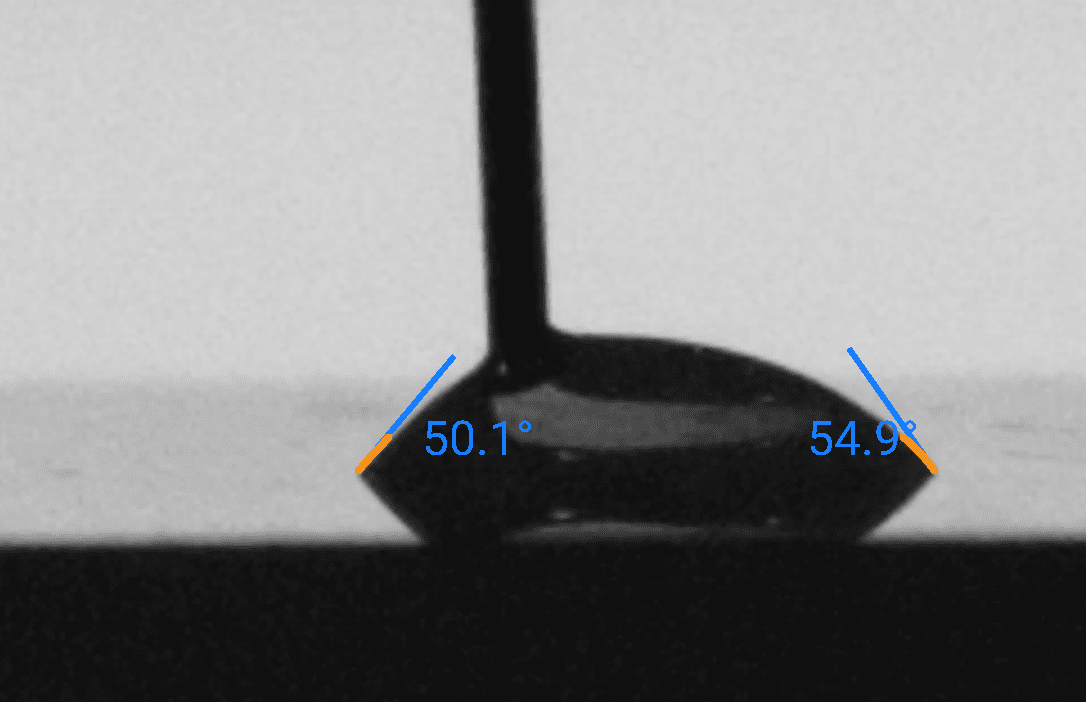
Dropometer contact angle measurement, DI water on nylon film. Left contact angle and right contact angle shown with fitted tangent lines at each contact point and the baseline overlay. Nylon is used here as the closest available film-like substrate from the reference image set; substitute a treated-polyolefin-film image from the image library if available.

Sessile drop contact angle measurement: DI Water on Nylon, left contact angle 50.1°, right 54.9°

Sample Corona Treatment Verification Log: Multiple Zones, Same Web

Zone Contact Angle (°) Est. Surface Energy (dyn/cm) vs. Target Band
Zone A — Web centre 68.4° 41 Within target band
Zone B — Web centre repeat 69.1° 40 Within target band
Zone C — Web edge 78.6° 35 Below target, under-treated edge
Zone D — 4h post-treatment recheck 82.3° 33 Below target, treatment decay
Zone E — High-power test zone 65.2° 43 In range but flagged, adhesion test needed to rule out over-treatment

Zone C shows under-treatment at the web edge, consistent with uneven electrode voltage distribution, flagged for treater inspection. Zone D shows treatment decay four hours after the initial pass, consistent with the expected decline in surface energy over time, flagged against the site's validated time-to-print window. Zone E reads within the target surface-energy band but is flagged rather than auto-passed, because good wettability alone does not rule out a weak boundary layer from over-treatment, an adhesion check is needed before this zone clears.

Troubleshooting

Corona treatment troubleshooting guide

Start condition: print defects or adhesion complaints are increasing. Use the signal pattern to identify the most likely cause.

Signal A

Contact angle is high, surface energy is low versus target

Likely cause: Under-treatment, treater power, gap, or line speed is not delivering enough energy.
Action: Adjust treater settings and re-verify. If readings improve and hold, treater setting was the cause.

Signal B

Median looks acceptable but variability across the web is high

Likely cause: Non-uniform treatment, electrode condition or web handling.
Action: Inspect the treater station and web alignment; test fixed cross-web positions to isolate the pattern.

Signal C

Contact angle rises with elapsed time since treatment

Likely cause: Treatment decay.
Action: Define or tighten your time-to-print window from the decay trend; apply secondary treatment closer to the point of use if needed.

Signal D

Wetting and surface energy both read good, but adhesion or print quality still fails

Likely cause: Over-treatment (weak boundary layer) or an ink-side mismatch, not a film-treatment problem.
Action: Check ink surface tension against the film's surface energy; if the ink is fine, dial treater energy back and re-run your adhesion test, more treatment is not the fix here.

FAQ

Common questions before adoption

No. It is an upstream and in-process screening tool. It measures contact angle, variability, and surface energy on the treated film. Your print-quality inspection and adhesion test remain the acceptance standard for finished rolls. What it replaces is the current reliance on a subjective dyne-pen call as your only treatment check.

There is no universal threshold, though untreated polyolefin film typically sits around 29 to 31 dynes/cm and most inks need roughly 38 to 42 dynes/cm to bond reliably [3]. Establish your own PASS / MONITOR / FAIL gates by correlating measured values to your historical print-quality and adhesion outcomes for your specific film and ink.

Yes. ASTM D2578, Standard Test Method for Wetting Tension of Polyethylene and Polypropylene Films, is the relevant, currently active standard for this exact measurement [1]. Dyne solutions and dyne pens are the traditional way most lines apply that standard; this workflow gives the same underlying measurement a numeric, repeatable form.

No. Over-treatment can build up a weak boundary layer of low-molecular-weight oxidized material that reduces adhesion even though the surface still wets well [2]. A clean wetting reading is a strong signal, not a guarantee, confirm with your adhesion test.

This varies by film, additive package, and storage conditions, there is no single published number. Establish your own time-to-print window from your own contact-angle decay trend rather than relying on a generic figure.

Yes. The Dropometer produces numeric contact-angle and surface-energy logs with replicate data, timestamps, and operator records, usable in NCR documentation, CAPA files, incoming inspection records, and supplier audit packages.

Dyne pens give a fast pass/fail band and are genuinely useful, but they are subjective, operator-dependent, and coarse. Contact angle and surface energy measurement give a numeric, repeatable value, track drift and decay as a trend rather than a snapshot, and produce audit-defensible records dyne pens cannot.

Business Impact

What Changes When You Screen Corona Treatment Readiness

Before and with Dropometer; operational outcomes

Metric Before Dropometer With Dropometer Indicative Benchmark
Failure discovery point On press, after ink, plates, and run time are already committed Pre-print and in-process, before the defect reaches the press "Press-side rework and re-treatment cost more than an upstream catch"
Treatment verification Subjective dyne-pen pass/fail, operator-dependent Numeric contact-angle/surface-energy value referenced to ASTM D2578 "Replaces a pass/fail band with a trackable number"
Treatment decay Unmanaged or assumed from generic guidance Tracked against your own measured decay trend, own time-to-print window "Eliminates reliance on time-since-treatment assumptions"
Root-cause triage Multi-day, opinion-driven, treater/ink/decay all blamed at once Same-shift, data-driven: angle, variability, and stable-but-failing patterns isolate the cause "Structured elimination vs. iterative trial-and-error"
Audit documentation Subjective notes; not defensible under audit Numeric contact-angle/surface-energy logs with timestamps and operator records "Applicable to NCR, CAPA, incoming inspection, and supplier qualification records"
Rework and scrap cost Included in cost standards and often treated as unavoidable Drift- and decay-driven print defects intercepted before or during the run "COPQ from rework typically 15–20% of revenue for manufacturers without upstream gates"

Instant ROI Snapshot

Corona Treatment ROI Snapshot

Estimate avoided reprint and re-treatment cost from corona drift and decay.

Each unit is $5,000; default models 1 unit.
Corona-drift or decay-driven rework/scrap excursions per month, not total print defects.
Cost to re-treat or re-run a drift-affected web segment.
Contact angle/dyne monitoring is the established method for this exact failure mode.
Web/roll scrap specifically attributable to corona drift, not blanket line scrap.
Faster drift troubleshooting and DOE optimization time.

Result

~0
Monthly savings
~0
Payback period
~0
Year-1 net benefit

Monthly savings = preventable rework cost + preventable scrap cost + other monthly savings.

Honest scope

What Contact Angle and Surface Energy Measurement Cannot Tell You

Knowing the limits of any measurement tool is part of using it responsibly.

No universal surface-energy threshold applies to every film, ink, and treater combination. PASS/FAIL gates must be built per line and system.
Wettability does not equal adhesion performance, always correlate to your actual ink-adhesion or print-quality test.
Corona treatment decays over time; a good reading at the treater does not guarantee a good reading at the press if time-to-print is long.
Over-treatment can produce good wettability readings alongside poor adhesion, via a weak boundary layer of oxidized material, more treatment is not always better [2].
Rough, textured, or heavily additive-loaded films may increase replicate scatter.
Surface energy values are model-dependent, do not compare values from different models as absolute indicators.

Use this page to replace subjective dyne-pen judgment with a numeric, trackable gate, not to eliminate the need for a final print-quality and adhesion check. The Dropometer is one layer in a quality system, not a substitute for one.

How this page was created

Editorial and technical transparency notes for this page.

Transparency Details 4 checklist items
01

Drafting assistance

Initial draft created with AI assistance (ChatGPT 5.2 Pro), then rewritten for technical clarity.

02

Technical review

Reviewed and edited for technical accuracy by a surface-science specialist.

03

Verification steps

Identifiers, units, thresholds, and key claims checked against cited sources before publication.

04

Updates

Reviewed every 12 months or when the underlying standard changes.

Report a correction

Spotted an issue in this summary? Send a correction request and our team will review it.

Correction Request

We work hard to keep this standards summary accurate and up to date. If you spot an error (wrong revision/year, missing requirement, incorrect interpretation, or broken link), tell us and we'll review it.

Contact us to report a correction
References

Sources

1.
ASTM International. D2578, Standard Test Method for Wetting Tension of Polyethylene and Polypropylene Films. Confirmed active via a current 2023 edition listing (D2578-23) found in this review; verify the exact current-edition URL on astm.org before publishing, as ASTM's own store URLs change per edition. https://www.astm.org/Standards/D2578.htm
2.
PFFC (Paper, Film and Foil Converter). "Surface Treating: Promoting Adhesion." Documents low-molecular-weight oxidized material buildup from over-treatment as a cause of reduced ink/coating/adhesive adhesion. https://pffc-online.com/surface-prep/corona-flame-plasma/9271-promoting-adhesion-0301
3.
Vetaphone. "Why Do We Need Corona Treatment, and How Does It Work?" Source for representative dyne-level ranges (untreated polyolefin ~29-31 dyn/cm; typical ink requirement ~38-42 dyn/cm) and treatment-decay mechanism. https://www.vetaphone.com/knowledge-hub/why-do-we-need-corona-treatment-and-how-does-it-work/
4.
Vetaphone. "Why Do We Need Corona Treatment, and How Does It Work?" Same source, cited separately for treatment-decay discussion (additive migration, surface relaxation, dyne-level drop over time). https://www.vetaphone.com/knowledge-hub/why-do-we-need-corona-treatment-and-how-does-it-work/
5.
Fabrico. "The Cost of Poor Quality (COPQ) in Manufacturing: 2026 Guide." Source for the 15–20%-of-revenue and 10× hidden-cost figures used in the Post-Hero Highlights. https://www.fabrico.io/blog/cost-of-poor-quality-copq-manufacturing-guide/
6.
Making Strategy Happen, "The Cost of Quality: The 1-10-100 Rule." https://www.makingstrategyhappen.com/the-cost-of-quality-the-1-10-100-rule/