“
On a real surface, the receding angle from a sessile drop and from a tilted plate can disagree wildly: one method is not a substitute for the other. The application decides.

ASTM D2578 is the US dyne test for treated polyethylene and polypropylene film: you swab test solutions of known surface tension onto the film and find the strongest one that stays wet. The Dropometer does not run that swab test, so it gives no dyne reading. It measures wetting of the same film by water contact angle with ±0.35° accuracy, and checks your test solutions by pendant drop (Dropometer datasheet). Contact angle is an alternative method, not the test solution method the standard specifies; if a contract or customer requires an ASTM D2578 result, run a correlation study on your own samples first.
What brings you here?
Quality manager
Your customers specify an ASTM D2578 dyne level, but you want a number you can trend by roll and shift. Read water contact angle on the same strip and keep the swab test for the reported value.
Process engineer
You need to see treatment across the web and how fast it fades in stored rolls. Build a correlation between your swab readings and contact angle, then set limits from your own film.
Converter or printer
Your supplier quotes a dyne level at shipping, but the film sits before it reaches press. Check incoming rolls by contact angle and confirm doubtful ones with your test solutions.
Free one page checklist for working next to ASTM D2578 on PE and PP film: check your test solutions by pendant drop, read water contact angle on the same strip, and track treatment as rolls age.
Talk to an expert
Tell us your resin, treater and the dyne level your customer asks for. We will read contact angle and your test solutions live, and tell you plainly where the Dropometer fits next to your swab test and where it does not.


Droplet Lab builds precision instruments and software for surface science measurement, specialising in contact angle analysis and surface tension characterisation. Used by researchers across materials science, pharmaceuticals, coatings, and advanced manufacturing, Droplet Lab's Dropometer has contributed to studies published in peer-reviewed journals including Advanced Functional Materials (Impact Factor 19). The team combines instrument engineering with deep domain knowledge in wettability science with a focus on practical accuracy.
ASTM D2578-23, Standard Test Method for Wetting Tension of Polyethylene and Polypropylene Films, from ASTM International Subcommittee D20.19. ASTM states it is equivalent to ISO 8296. The method and reagents were developed for polyolefin film; on other polymers the user must show the method applies. See our ISO 8296 page.
Partially compliant. The Dropometer measures wetting of the same PE or PP surface by water contact angle and surface free energy, and checks test solution surface tension by pendant drop. It does not judge whether a swabbed solution holds or breaks, so it gives no ASTM D2578 dyne value. If a contract or customer requires an ASTM D2578 result, run a correlation study on your own samples first.
Contact angle range 10° to 175°, accuracy ±0.35°, display resolution 0.01°. Pendant drop surface tension up to 75 mN/m, accuracy ±0.03 mN/m, resolution 0.01 mN/m. From the Dropometer product specification.
The drop shape method is validated against a KRUSS DSA100E in two peer reviewed papers. See our validation publications.
A labels and office products manufacturer uses the Dropometer to see how inks and adhesives wet film, paper, board and plastic. Read the case study.
ASTM notes that wetting tension on its own is not a complete measure of ink, coating or adhesive adhesion. The same holds for contact angle. Keep your tape or peel test.
What ASTM D2578 measures on polyolefin film, where the 35 dyne note comes from and how the Dropometer fits
ASTM D2578 measures the wetting tension, or dyne level, of polyethylene and polypropylene film: you swab test solutions of known surface tension onto the film and find the strongest one that holds as a continuous film. Film extruders, converters and flexo printers in North America use it to check that corona or flame treatment lets the film retain inks, coatings and adhesives before printing, coating or laminating. ASTM states the method is equivalent to ISO 8296. The Dropometer is partially compliant. It does not run the swab test, but it measures wetting of the same film by water contact angle and surface free energy, and it checks the surface tension of your test solutions by pendant drop. Contact angle is an alternative method, not the test solution method the standard specifies; if a contract or customer requires an ASTM D2578 result, run a correlation study on your own samples first.
A dyne level in dyn/cm is the same number as mN/m. ASTM D2578 notes that 35 dyn/cm or higher has generally meant acceptable treatment for Type 1 polyethylene tubular film for commercial flexo printing, and that no general level has been set for polypropylene (source: ASTM D2578-23 summary). Many jobs ask for more: Enercon lists 38 to 44 dyn/cm for water based flexo and gravure ink on both PE and PP (source: Enercon recommended treatment ranges). In Beyond 38 Dynes: What Surface Energy Really Tells You About Adhesion, Prof Steven Abbott explains why a dyne reading signals a process change but does not on its own explain adhesion.
The Dropometer contact angle and surface energy kit reads water contact angle with ±0.35° accuracy, and surface tension by pendant drop with ±0.03 mN/m accuracy up to 75 mN/m (Dropometer datasheet). It runs on battery at the treater, as in corona treatment monitoring for print quality. For a side by side view of the two checks, see Dropometer vs dyne pens. To see why a film fails at a good dyne level, measure two liquids and work out surface free energy, as the surface energy measurement guide explains. Fowkes, van Oss Chaudhury Good and Equation of State are built into the software; OWRK is not built in, so enter your angles in the free Contact Angle to Surface Energy Calculator. Compare your results with our surface free energy reference values for common polymers.
Further reading: the plastics guide, reproducible surface energy calculation from contact angles and a classroom experiment on contact angle on treated and untreated surfaces.
Checking test solutions and reading water contact angle next to your ASTM D2578 swab test, step by step
These steps describe Dropometer measurements that sit next to the ASTM D2578 swab test. They are not the swab procedure and do not replace it. Buy the current edition and follow it for any dyne level you report.
From the Dropometer product specification. Display resolution is 0.01°.
Pendant drop surface tension accuracy up to 75 mN/m, from the Dropometer product specification.
5 V battery operation, so the unit can sit at the treater or at goods in.
Hang a drop of each test solution from the needle and read its surface tension. Enter the solution density from the supplier's data sheet. Compare each value with the label and the tolerance your supplier states, and replace solutions that have drifted. See the surface tension measurement guide.
Cut strips across the web width and mark the treated side. Handle them by the edges, because skin oils change both the swab result and the angle. Condition them as the standard specifies, and note the treatment date and the test date.
Swab the test solutions on one part of each strip as the standard specifies, using a clean swab for each solution, and record the wetting tension. Suppliers describe about one square inch per swab and a two second hold (source: ACCU DYNE TEST). The Dropometer does not do this step.
Lay the strip flat on the sessile stage, treated side up, on an area the solutions have not touched. Dispense a fixed drop volume of deionised water and read the angle at a fixed time. Automatic edge and baseline detection gives the same reading from the same image.
Repeat with a second liquid such as diiodomethane, then calculate surface free energy with the Fowkes, van Oss Chaudhury Good or Equation of State model in the software. For OWRK, which is not built in, enter your angles in the free Contact Angle to Surface Energy Calculator.
Record wetting tension, mean angle, spread, position, resin grade, treatment date, test date and room conditions. Plot angle against wetting tension and set your accept limit from that data. Report dyne levels from the swab test, not from the angle.
This video shows a complete Dropometer contact angle measurement, from setup to result. It covers the steps above in one run.
Independent benchmarking and publication-based validation references.
Peer reviewed method
The Dropometer drop shape method is validated against a KRUSS DSA100E in two peer reviewed papers, one in Review of Scientific Instruments and one in Colloids and Surfaces A. Contact angle accuracy is ±0.35° (Dropometer product specification).
Customer evidence
We have no published client study run next to ASTM D2578 yet. A labels manufacturer uses the Dropometer in two labs to check how inks, adhesives and coatings wet film and other substrates.
ASTM D2578 · PE and PP film · 35 dyne note
ASTM D2578 tells you how to find the wetting tension. It sets no pass level for every job. Its own note gives one reference point: 35 dyn/cm or higher has generally meant acceptable treatment for Type 1 polyethylene tubular film for commercial flexo printing, and no general level exists yet for polypropylene (source: ASTM D2578-23 summary). Treater makers publish higher ranges for many inks and coatings. Enercon lists 36 to 40 dyn/cm for solvent flexo ink on PE and 38 to 40 on PP (source: Enercon recommended treatment ranges). Your customer, ink or adhesive supplier, or your own trials set the real level. For why a dyne target is a starting point, read Beyond 38 Dynes by Prof Steven Abbott.
No published table converts water contact angle into an ASTM D2578 dyne level for every PE or PP grade. Slip, antiblock and antistatic additives move both readings. To use contact angle against a dyne specification, run a correlation study: read rolls across your treatment range and storage times with your test solutions and with the Dropometer, then set your contact angle limit from that data. Repeat it when you change resin, additive package or treater settings.
Check the solutions too. Read each one by pendant drop, compare it with its labelled value and the tolerance your supplier states, and replace any that have drifted. Enercon advises dating solutions and replacing them after about six months (source: Enercon on dyne solutions and pens).
Example data for illustration only. These are not measured results. Your own film, treatment, solutions and limits decide the numbers.
| Days since treatment | ASTM D2578 wetting tension (dyn/cm) | Mean water contact angle (°) | Std dev (°) | Decision (example limit 81°) |
|---|---|---|---|---|
| 0 | 44 | 70.6 | 0.9 | Accept |
| 3 | 42 | 73.9 | 1.0 | Accept |
| 7 | 40 | 77.2 | 0.8 | Accept |
| 14 | 38 | 80.3 | 1.1 | Accept, close to limit: use soon |
| 28 | 36 | 83.8 | 1.2 | Hold: below the 38 dyn/cm minimum |
| 56 | 34 | 86.9 | 1.3 | Hold: retreat or return |
Each row is one test day on the same example roll. The wetting tension is the operator's ASTM D2578 swab reading. The water contact angle is the mean of five drops on the Dropometer at the same reading time. The example customer minimum is 38 dyn/cm. The example contact angle limit of 81° or lower was set from this correlation, because the 38 dyn/cm reading came at 80.3°.
The same example data as the table: water contact angle on one BOPP roll as it ages, with the example limit set from the ASTM D2578 correlation.
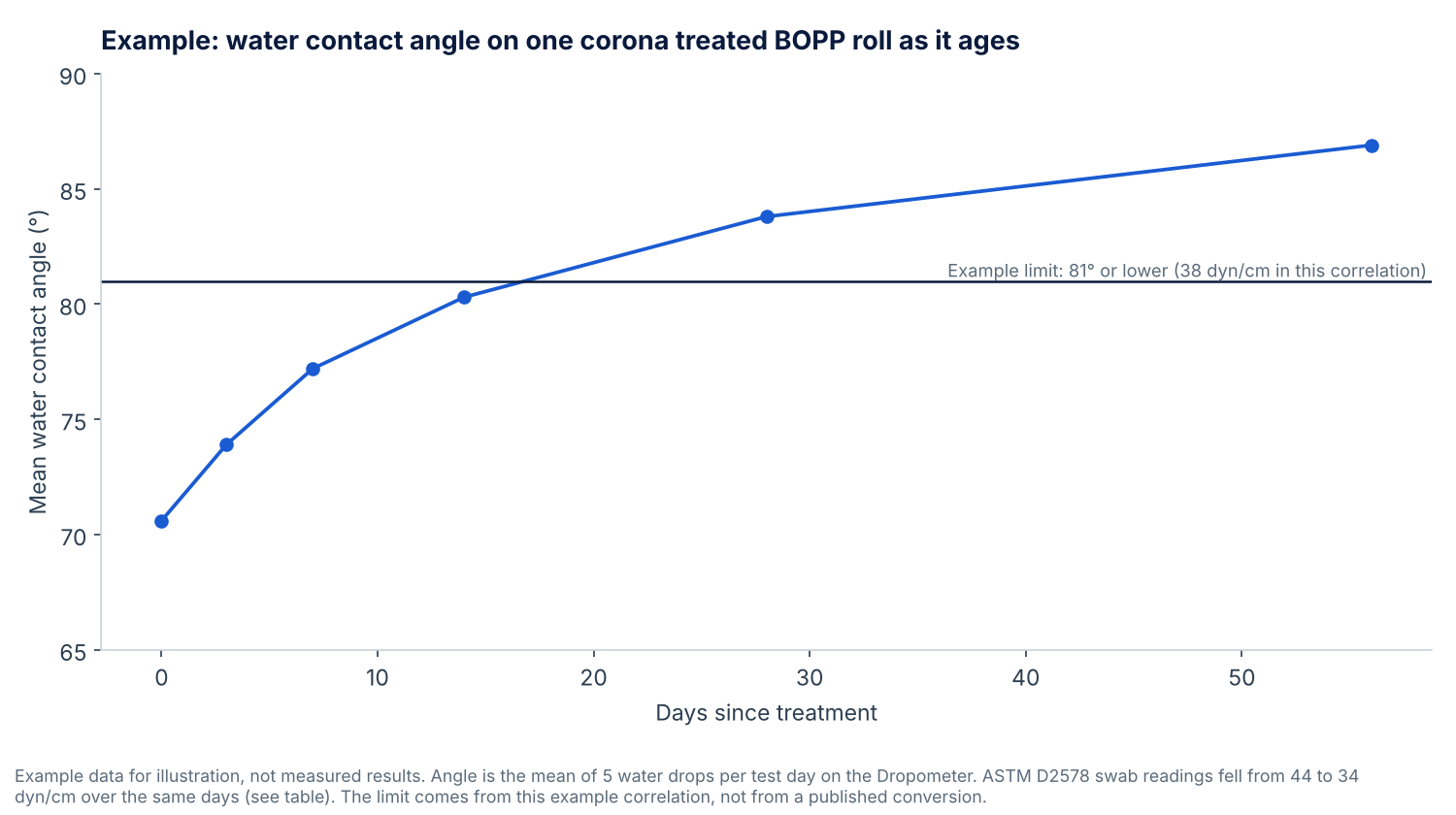
Example data, not measured results.
What changes when a measured angle sits next to your test solutions
| Metric | Before Dropometer | With Dropometer | Results |
|---|---|---|---|
| How the check is read | Swabbed solution judged by eye as holding or breaking | Water contact angle read from the drop image | No published benchmark |
| Result format | The highest solution that holds, in solution steps | An angle per drop, 0.01° display resolution, ±0.35° accuracy | Dropometer product specification |
| Operator spread | About 1.0 dyn/cm between operators, 0.5 dyn/cm for a good inspector | Automatic edge and baseline detection: same reading from the same image | Swab figures: ACCU DYNE TEST. Angle: no published benchmark |
| Test solution check | Replace solutions on a fixed date | Pendant drop reading of each solution, ±0.03 mN/m accuracy up to 75 mN/m | Dropometer product specification |
| Reported ASTM D2578 dyne level | Test solutions | Still test solutions | ASTM D2578 scope |
Bring a fresh roll, an aged roll and your test solutions. We will measure all of them live.
Enter your own numbers. The defaults are examples, not Droplet Lab results.
Quality cost snapshot
Result
Annual exposure combines audit/CAPA cost, customer rejections, and recall probability; avoided exposure applies the risk reduction percentage.
Lock these before you compare contact angle with ASTM D2578 readings between shifts, lines or sites
| Parameter | Recommended Setting | Technical Rationale |
|---|---|---|
| Reported dyne level | From the ASTM D2578 swab test only | Contact angle is an alternative method, not the test solution method the standard specifies. |
| Film type | Polyethylene or polypropylene | The method and reagents were developed for these polyolefins. Other polymers need their own check, or see ISO 8296. |
| Test liquid for the angle | Deionised water | Water contact angle is the usual partner check for treated film, as in ASTM D5946. |
| Drop volume and reading time | Fixed for every drop | Changing either adds spread that is not about treatment. |
| Fit model | Young-Laplace or polynomial, the same for every run | Both models are in the Dropometer software. Do not mix them within one study. |
| Test solution check | Pendant drop, solution density entered, read soon after the drop forms | Solutions drift with age and swab contamination, and solvent can evaporate from the drop. |
| Storage time | Record treatment date and test date for every reading | Treatment fades in stored rolls, so a reading without dates cannot be compared. |
| Environment | Condition as the standard specifies; record room temperature and humidity | The Dropometer has no temperature or humidity control and runs at 10 to 45 °C. |
Pick the method by the question you need answered
Start: What do you need to know about the treated PE or PP film?
Your purchase order or specification asks for a minimum wetting tension on PE or PP film measured to ASTM D2578.
Use ASTM D2578 test solutions. The Dropometer does not run the swab test. It can check your solutions by pendant drop, and contact angle can sit beside the swab result once you have a correlation study on your own film.
Rolls pass at the extruder but print poorly weeks later, and you want a number to trend by storage time.
Trend water contact angle to ASTM D5946 / ISO 15989 by treatment date. The Dropometer is fully compliant with that method.
Your solutions are old, have been swabbed many times, or give readings that disagree between operators.
Read each solution by pendant drop on the Dropometer, up to 75 mN/m with ±0.03 mN/m accuracy, and compare with the label.
You treat PET, PVC, polyamide or another plastic film or sheet.
ASTM D2578 was developed for polyolefins. See ISO 8296, which covers plastic film and sheeting, and check your correlation on that material.
Start from the question you need answered. Blue boxes are measurements the Dropometer runs.
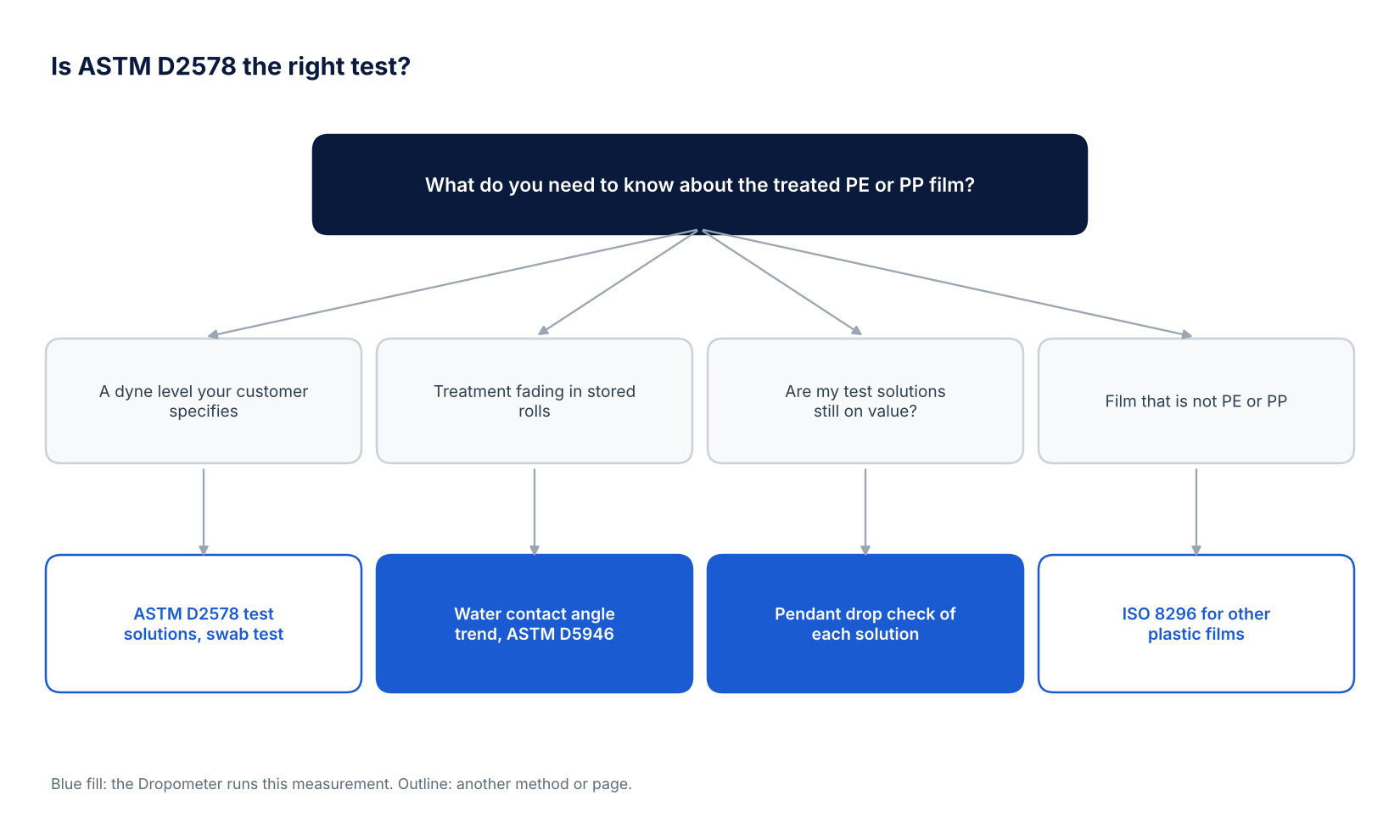
Is ASTM D2578 the right test?
What a wetting tension and a contact angle tell you on polyolefin film, and what they do not
Honest limits of the method and of the Dropometer
It measures the wetting tension, or dyne level, of polyethylene and polypropylene film. You swab a series of test solutions of known surface tension onto the treated surface and find the strongest one that holds as a continuous film rather than pulling into droplets. The method and reagents were developed for polyolefins, so on other polymers you must show it applies.
The standard sets no pass level for every job. A note says 35 dyn/cm or higher has generally meant acceptable treatment for Type 1 polyethylene tubular film for commercial flexo printing, and that no general level exists yet for polypropylene (source: ASTM D2578-23 summary). Many inks need more: Enercon lists 38 to 44 dyn/cm for water based flexo on PE and PP. Set your level from film that printed and laminated well, and read Beyond 38 Dynes by Prof Steven Abbott for why a dyne target is a starting point.
Not the swab test itself, so it is partially compliant. It measures wetting of the same PE or PP film by water contact angle and surface free energy, and it checks your test solutions by pendant drop. Contact angle is an alternative method, not the test solution method the standard specifies; if a contract or customer requires an ASTM D2578 result, run a correlation study on your own samples first.
ASTM states that D2578 is equivalent to ISO 8296. ASTM D2578 is written for polyethylene and polypropylene film, while ISO 8296 covers plastic film and sheeting more broadly. Quote the designation your customer names in the specification. See our ISO 8296 page.
Not with a general table. The link between angle and dyne level depends on your resin, additives, treatment and storage time. Read the same rolls with your test solutions and with the Dropometer, plot one against the other, and set your contact angle limit from that data. Keep reporting the dyne level from the swab test.
Yes. It reads surface tension by pendant drop up to 75 mN/m with ±0.03 mN/m accuracy (Dropometer datasheet), which covers the usual solution range. Enter each solution's density, read it soon after the drop forms, and compare it with the label and the tolerance your supplier states.
The swab test is read by eye, so pressure, swab loading and judgment of the hold time all matter. ACCU DYNE TEST reports that a good inspector repeats within about 0.5 dyn/cm and that results between operators usually agree within about 1.0 dyn/cm (source: ACCU DYNE TEST). Train all testers the same way, and use a measured contact angle to trend between solution steps.



















This page summarises ASTM D2578 in our own words and does not reproduce the standard. Buy the current edition from ASTM before you write a procedure. The Dropometer is partially compliant: it measures wetting of the film by contact angle and checks test solutions by pendant drop, but it does not run the test solution method the standard specifies. Droplet Lab does not certify compliance. Your own method validation does.
Sources, review and tools
ASTM D2578-23 listing; ANSI webstore: ASTM D2578-23; Nimonik: ASTM D2578-23 summary; Enercon: ASTM cotton swab dyne testing, the Dropometer product specification and Droplet Lab validation papers.
Drafted with Claude (Anthropic) from the sources listed, then reviewed by Droplet Lab.
We did not copy text from the standard. Buy the current edition for the full procedure.
October 2026
Spotted an issue in this summary? Send a correction request and our team will review it.
Correction Request
We work hard to keep this page accurate and up to date. If you spot an error (wrong revision/year, missing requirement, incorrect interpretation, or broken link), tell us and we'll review it.
Contact us to report a correction