



Contents
Case Study

A labels and office products manufacturer bought a Dropometer for its US R&D lab. A year later its lab in Mexico asked for the same unit.

Last Updated
October 18, 2026
Industry
Labels and office products manufacturing
Instrument
Manual Dropometer, ordered twice
Location
R&D labs in the United States and Mexico
Customer since
August 2025
Drop shape method validated against a KRÜSS DSA100E in peer review Repeat purchase: a second R&D lab ordered the same unit in 2026 2 peer reviewed validation papers

The company's R&D team needed to see how inks, adhesives, primers and varnishes wet film, paper, corrugated board and plastic. A product evaluation manager found the Dropometer on YouTube, brought both R&D labs into one demo, and bought a manual unit in 2025. In 2026 the second lab ordered the same configuration, and the new order includes surface energy measurement for both labs.

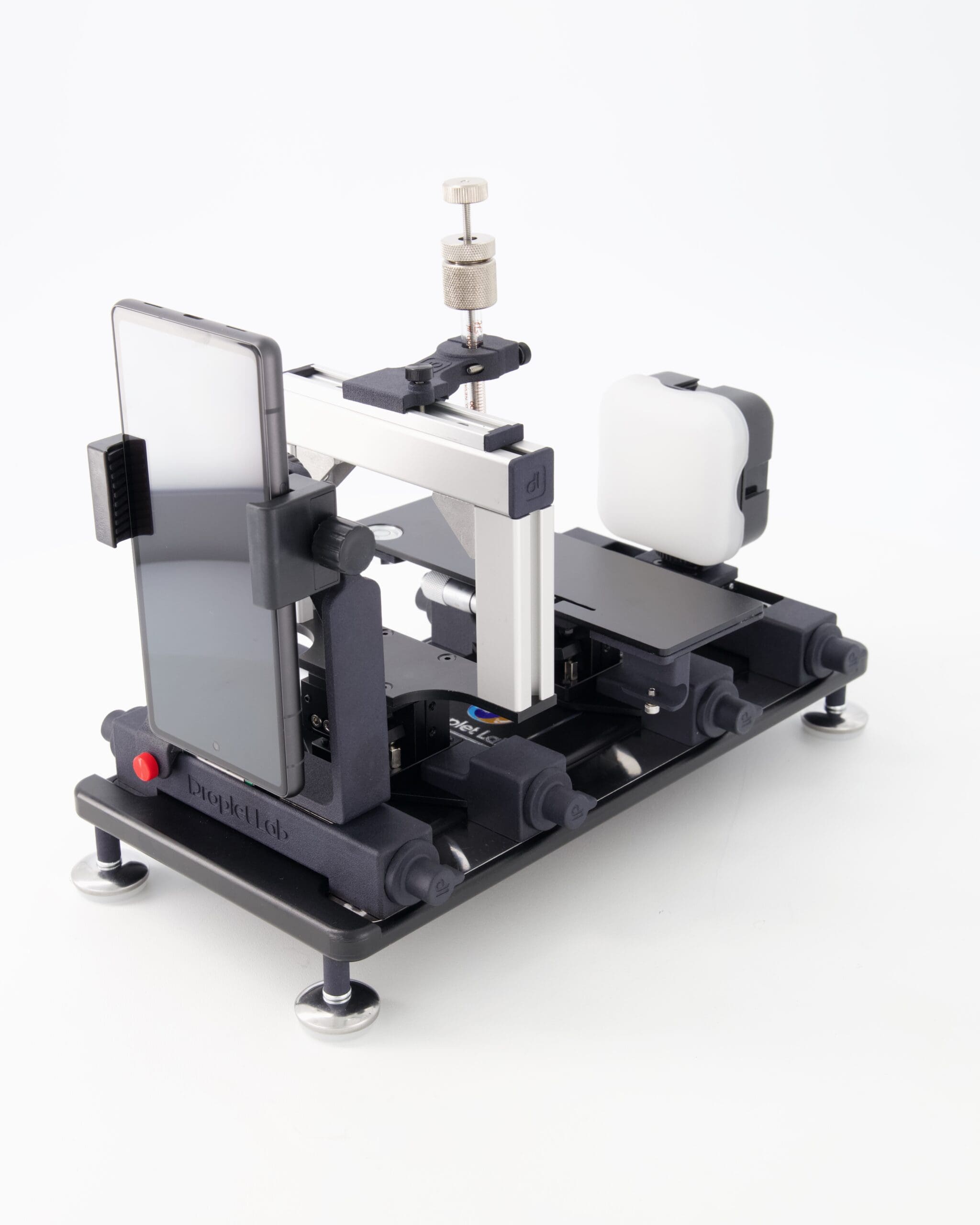
Manual Dropometer contact angle instrument with smartphone camera, sample stage and light source (current model)
Abhimanyu Photo
Written by
Abhimanyu Bhandankar
Holds an MBA from Schulich School of Business and a BE in IT. He joined Droplet Lab in July 2019 and now leads sales and marketing.
CEO at Droplet Lab
Read More
Gurdeep-Saini-Photo
Technical Review by
Gurdeep Singh Saini
Holds a BASc in Mechanical Engineering from Ryerson University (now Toronto Metropolitan University) and an MASc from York University. He develops the automatic edge and baseline detection behind the Dropometer's analysis.
COO at Droplet Lab
Read More
Abhimanyu Photo
Written By

Abhimanyu Bhandankar

CEO at Droplet Lab

Holds an MBA from Schulich School of Business and a BE in IT. He joined Droplet Lab in July 2019 and now leads sales and marketing.

Gurdeep-Saini-Photo
Reviewed By

Gurdeep Singh Saini

COO at Droplet Lab

Holds a BASc in Mechanical Engineering from Ryerson University (now Toronto Metropolitan University) and an MASc from York University. He develops the automatic edge and baseline detection behind the Dropometer's analysis.

Primary outcome: one lab's choice became the standard for a second lab

R&D labs that ordered the Dropometer

Same configuration ordered for a second site, US and Mexico

2025: US R&D lab 1 lab
2026: plus product development lab in Mexico 2 labs

The US R&D lab ordered a manual Dropometer in August 2025. In April 2026 the company's product development lab in Mexico asked for "the same unit", and its purchase order followed in September 2026. The second order includes surface energy measurement for both labs, so both sites can run the same contact angle, surface tension and surface energy tests on inks, adhesives and coatings.

2 R&D labs

A US R&D lab in 2025 and a product development lab in Mexico in 2026 ordered the same configuration.

3 measurements

Contact angle and surface tension, with surface energy included for both labs in the second order.

4 substrate types

Film, paper, corrugated board and plastic, with inks, adhesives, primers and varnishes.

1 demo for both labs

A single remote demo in June 2025 covered the R&D teams of both sites.

Executive Summary

Who

A global labels and office products manufacturer with R&D and product development labs in the United States and Mexico. Its teams evaluate inks, adhesives, primers and varnishes on film, paper, corrugated board and plastic.

Problem

The R&D team wanted to see how inks and adhesives flow and wet out on its substrates, including dynamic contact angle within about two minutes. It also needed to test real formulation liquids, not just water, and wanted the same method available to its lab in Mexico.

Solution

A manual Dropometer for contact angle and surface tension, ordered in August 2025 for the US lab, with a two hour remote training session in October 2025. In September 2026 the Mexico lab ordered the same unit, and that order includes surface energy measurement for both labs.

Time to Value

24 April 2025: quote requests from the website. 20 June 2025: remote demo for both R&D labs. 6 August 2025: purchase order for the US lab. 30 October 2025: two hour training. 14 April 2026: the Mexico lab asks for the same unit. 3 September 2026: second purchase order approved.

Results

Two R&D labs have now ordered the same instrument, so both can use one method for ink, adhesive and coating wetting. The evaluation manager wrote that the unit can measure inks, raw adhesives and primer or varnish using disposable syringes with different needle sizes, alongside distilled water.

Highlights

2

R&D labs ordering the same unit

3

Measurements in the second order

4

Substrate types tested

Real liquids

Inks, adhesives, primers, varnishes

Quote teaser

We are very pleased with the Droplet unit that is capable to conduct diff. types of testing (Surface Angle, Surface Tension, and Surface Energy).

The company, at a glance

Research focus

Product evaluation and development for labels and office products.

Products / applications

Printed and coated products where inks, adhesives, primers and varnishes must wet and hold on their substrates: comparing how inks and adhesives flow on corrugated board from different suppliers, the surface tension of laser printable top coats, and the surface energy of films before adhesives, coatings or primers go on.

Measurement stage

R&D and product development, before products move to production.

Users

R&D lab staff in the US and product development staff in Mexico.

Materials and surfaces tested

Film, paper, corrugated board and plastic, with water, inks, raw adhesives, primers and varnishes.

Key constraints

Viscous, coloured and fast changing liquids; porous and coated substrates; two sites that need the same method.

The challenge: seeing how inks and adhesives wet real substrates

Every product depends on a liquid wetting the right surface, the right way.

What the R&D team needed

The team wanted to see "how the inks/adhesives flow and wet out on the substrates (film/paper/corrugated board/plastic)", in the evaluation manager's words. That meant contact angle and surface tension on the liquids the company actually uses, the core checks in our packaging and containers guide and our guide to contact angle measurement.

Why these liquids are hard to measure

Inks, adhesives and varnishes are viscous and often coloured, and their contact angle changes over time as they spread or soak in. How strongly a liquid holds together, its work of cohesion, competes with how strongly the surface pulls it out, and ink viscosity changes the picture again (see ink beading, viscosity and thickness troubleshooting). The team measures dynamic contact angle within about two minutes, with drops from 2 µL to 20 µL. Before the demo, the evaluation manager noted that the lab had not yet tested surface tension.

The insight: test the real liquids, not just water, with one method across sites

What Was Deployed

First lab (purchase order August 2025): a manual Dropometer contact angle and surface tension kit, with drops placed by a threaded plunger syringe. Training: a two hour remote session with Droplet Lab's engineer in October 2025. Second lab (purchase order September 2026): the same configuration. The second order includes surface energy measurement for both labs. Surface energy is calculated from the contact angles of two or more liquids; the surface free energy calculator and our reference values for common polymers and substrates show how. Use described by the team: water as the standard drop, plus inks, raw adhesives and primer or varnish from disposable syringes with different needle sizes.
The Origin

Found on YouTube, then a demo for two labs

The company's product evaluation manager found Droplet Lab through its YouTube videos on contact angle and surface tension. On 24 April 2025 she sent two quote requests through the website, asking about both manual and automatic dispensing.

She then wrote a budget proposal for upper management and asked for a demo for her lab team and her senior director. On 20 June 2025 Droplet Lab ran a remote demo for the R&D teams of both the US lab and the product development lab in Mexico. Afterwards she listed what the team needed: static and dynamic contact angle, drops from 2 µL to 20 µL, real inks and top coats, and surface tension. The US lab chose a manual unit, and the purchase order followed on 6 August 2025.

The Mexico lab waited for budget. In April 2026 it pointed to the US lab's purchase the year before and asked for "the same unit for our lab". Its purchase order was approved on 3 September 2026.

Decision Rationale

Manual first, then the same unit again

Two configurations were quoted in April 2025.

Option A

Automatic dispensing

Quoted in April 2025.

Not chosen. Can be added later.
Option B

Manual system, same unit at both labs

Contact angle and surface tension, with surface energy added for both labs in 2026.

Chosen

The US lab chose the manual system, which handles water and real formulation liquids through syringes with different needles. When the Mexico lab was ready, it did not reopen the evaluation. It asked for the same unit, so both labs share one method and can compare results. Automatic dispensing remains an option for later.

Next Step

Checking how inks, adhesives or coatings wet your substrates?

The Dropometer measures contact angle, surface tension and surface energy with your real liquids, not just water. Labs at more than one site can run the same method on the same instrument. The drop shape method is validated against a KRÜSS DSA100E in peer review, and setup takes about 2 minutes. Book a 15 minute demo and bring your inks and substrates.

Before vs After

Metric Before After
R&D labs that ordered a Dropometer None Two: the US lab in 2025 and the Mexico lab in 2026
Surface tension in the lab Not tested in the lab; contact angle only Surface tension and dynamic contact angle on the Dropometer
Order, first lab vs second lab August 2025, US September 2026, Mexico
Configuration, first lab vs second lab Manual, contact angle and surface tension The same unit, by request
Surface energy measurement Not in the first order Included for both labs in the second order
Liquids the unit can take Distilled water as the standard drop Plus inks, raw adhesives and primer or varnish, by disposable syringe

Rollout timeline

Timeline (high level)

April 2025: Discovery

  • Evaluation manager finds Droplet Lab on YouTube
  • Two quote requests through the website on 24 April

June 2025: Demo for both labs

  • Budget proposal to upper management
  • Remote demo for the US and Mexico R&D teams on 20 June

August to October 2025: First lab

  • Purchase order on 6 August
  • Delivered around the start of October; two hour remote training on 30 October

December 2025: Team feedback

Evaluation manager notes the unit can measure inks, raw adhesives and primer or varnish with disposable syringes

April to September 2026: Second lab

  • Mexico lab asks for the same unit on 14 April
  • Purchase order approved on 3 September

September to October 2026: Second unit built

  • Built and ready to ship to the Mexico lab
  • Delivery runs through the company's customs broker

Proof and validation: what is measured, and what is not published

Test method

Sessile drop contact angle, including dynamic contact angle over about two minutes, and pendant drop surface tension. Drop sizes of interest from 2 µL to 20 µL. Liquids: distilled water, inks, raw adhesives, primers and varnishes. Substrates: film, paper, corrugated board and plastic.

Sample size and operators

R&D and product development staff at two labs. Sample sizes and test plans are internal to the company.

Repeatability / reproducibility

Not published. The company's results are internal.

Notes / assumptions

This page describes the purchase, the use case and the team's own words. It does not report the company's test results, which are confidential. The measurement method itself is validated against a KRÜSS DSA100E in peer review.

Outcomes to date

Measured Outcomes

2 labs

Same unit, two countries

The US R&D lab bought first; the Mexico product development lab asked for the same unit a year later.

3 tests

Contact angle, surface tension, surface energy

The second order includes surface energy measurement for both labs, which completes the set of wetting tests.

Real liquids

Inks, raw adhesives, primer or varnish

The unit takes inks, raw adhesives and primer or varnish through disposable syringes with different needle sizes, alongside distilled water as the standard drop.

Operational Outcomes

One method, two sites

Both labs ordered the same configuration, so wetting results can be compared between the US and Mexico once the second unit is running.

Repeat purchase without re-evaluation

The second lab referred to the first lab's quote and asked for the same unit.

Team adoption

The evaluation manager described the training as very informative, with different test methods learned from Droplet Lab's engineer.

Financial Context

Two purchase orders, one standard method

This page does not show prices. Both labs bought through the company's standard procurement process.

Purchase · two purchase orders

August 2025 for the US lab and September 2026 for the Mexico lab.

Coverage · 3 measurements

Contact angle, surface tension and surface energy across both labs.

Trust · repeat order

The second lab chose the same unit after the first lab's purchase.

Instrument pricing is available on request.

What the team said

We are very pleased with the Droplet unit that is capable to conduct diff. types of testing (Surface Angle, Surface Tension, and Surface Energy).
Product Evaluation Manager - R&D

What's next

Delivered

Manual Dropometer and remote training for the US R&D lab (2025)
Purchase order for the Mexico product development lab (September 2026)

In Pilot

Second unit built and awaiting cross border delivery to the Mexico lab

Planned

Onboarding and training for the Mexico lab team
Surface energy measurement on both units, included in the second order

Frequently asked questions

Can the Dropometer measure inks and adhesives, not just water?

Yes. The team measures inks, raw adhesives and primer or varnish from disposable syringes with different needle sizes, alongside distilled water. It measures dynamic contact angle within about two minutes, with drops from 2 µL to 20 µL.

Why did a second lab order the same unit?

The company's lab in Mexico asked for the same unit the US lab bought in 2025, so both labs can run one method and compare results. Its purchase order was approved on 3 September 2026, and it adds surface energy measurement for both labs.

Did the team choose manual or automatic dispensing?

Both were quoted in April 2025. The US lab chose the manual system, which handles water and real formulation liquids through syringes with different needles. Automatic dispensing can be added later.

Next Step

Checking how inks, adhesives or coatings wet your substrates?

The Dropometer measures contact angle, surface tension and surface energy with your real liquids, not just water. Labs at more than one site can run the same method on the same instrument. The drop shape method is validated against a KRÜSS DSA100E in peer review, and setup takes about 2 minutes. Book a 15 minute demo and bring your inks and substrates.