
Expert contribution
Beyond 38 Dynes: What Surface Energy Really Tells You About Adhesion
Why dyne readings are valuable process signals—but do not directly explain adhesion—and which contact angle matters when coatings begin to dewet.


Droplet Lab Team
Droplet Lab builds precision instruments and software for surface science measurement, specialising in contact angle analysis and surface tension characterisation. Used by researchers across materials science, pharmaceuticals, coatings, and advanced manufacturing, Droplet Lab's Dropometer has contributed to studies published in peer-reviewed journals including Advanced Functional Materials (Impact Factor 19). The team combines instrument engineering with deep domain knowledge in wettability science with a focus on practical accuracy.
Disclosure: An unpaid, independent contribution; Prof Abbott has no commercial affiliation with Droplet Lab.
Dynes and adhesion
Take some polyethylene with surface energy 32 dynes and try to stick to it and you have problems. Corona/plasma/flame treat it to 38 dynes and adhesion isn’t so hard. Having a reliable way to distinguish between 32 and 38 dynes is handy for routine production. If a sample comes out at 36 dynes you know that something has changed, and in production “change” is seldom an improvement.But if you rely on surface energy and shift to PET you’re in for a surprise. PET has a surface energy of 43 dynes so adhesion should be easy – yet nothing sticks to untreated PET. There are two ways to deal with this problem. The first is to corona/plasma/flame treat to increase the surface energy (but not too much, the surface starts to fall apart). The second, less well-known, and first demonstrated by 3M, is to hit the surface with an excimer laser or xenon flash. The chemistry and surface energy remain unchanged, but adhesion increases strongly.
To untangle all this, we need to do a quick check. If adhesion came from surface energy, then at most it would be something like 50 mN/m, a respectably high value. Yet those who require good adhesion require at least 500 N/m peel strength. Good adhesion is 10000x larger than surface energy! Another check is with our 38 dynes. If we’ve gone from 32 to 38 that’s an increase of ~ 20%. Yet typically adhesion goes from “nothing” to “strong”. So the increase can’t be due to surface energy.
The first simple rule of adhesion is that it comes from “entanglement” across the interface, which might be physical tangles of polymer chains or entanglements via chemical bonds. Corona treatment of PE/PP and of PET does two things. First, it opens up the semi-crystalline surface to allow polymer entanglements. Second it adds chemical functionality to allow opportunities for bonding. For PET the excimer/xenon trick transforms the crystalline surface, immune to entanglement, into an amorphous one which is easy to stick to.
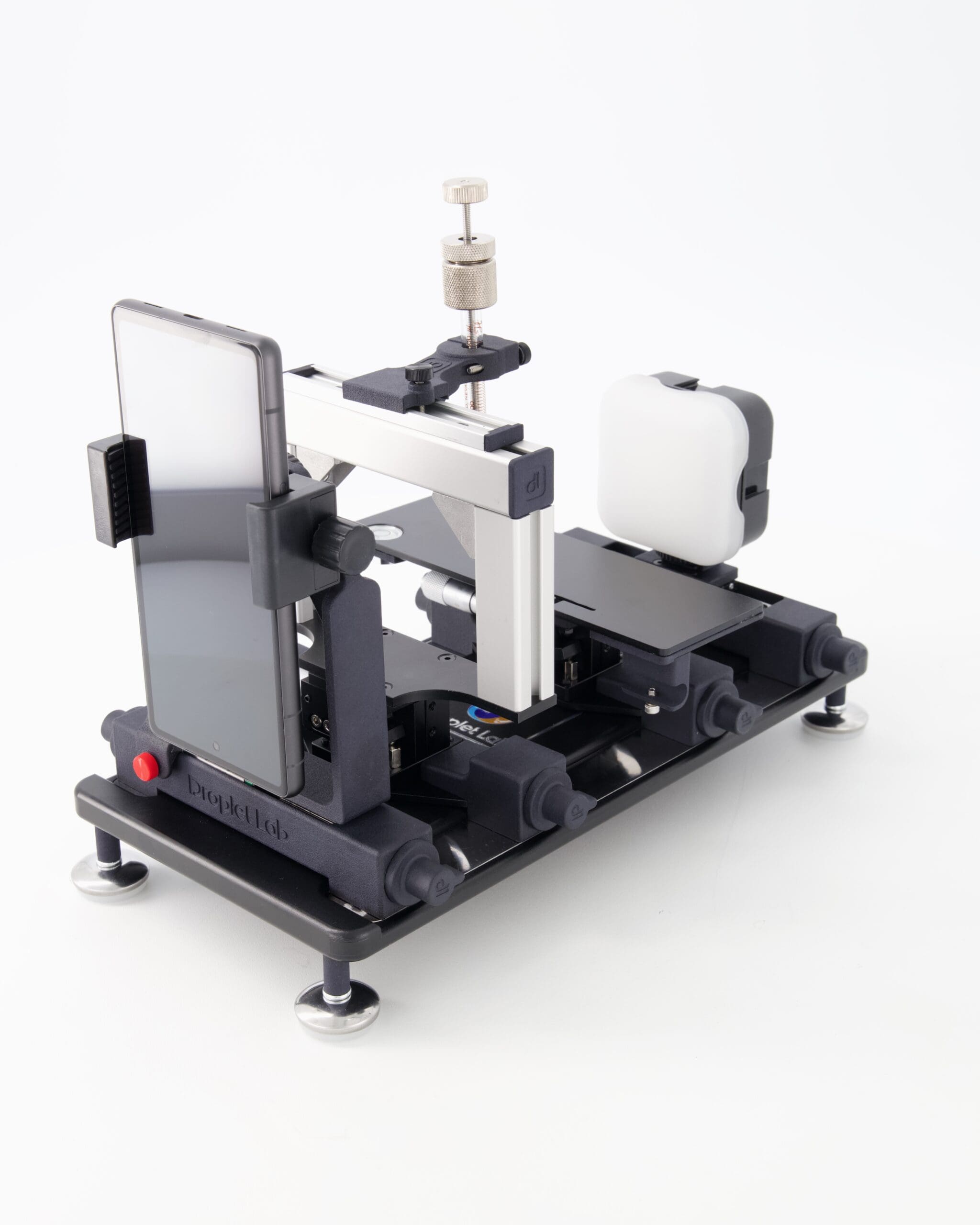
The second rule is even simpler – remove junk from the surface before trying to adhere to it. In some circumstances, corona/plasma/flame can remove a nanolayer of contaminants such as oils or plasticizer, allowing the now-clean surface to stick. Or maybe a good wipe with IPA will do the trick. Your Droplet Lab contact angle device can readily pick up the differences between a clean and contaminated surface.
So use your dynes information not because “higher dynes adhere” (the small increases aren’t significant) but because “I’ve found a surface treatment and/or cleaning process that gives me great adhesion and if the dynes change, that’s telling me that something is different, probably worse.” For those who would like a “popular science” introduction to adhesion, my book Sticking Together: the Science of Adhesion is available from all on-line bookstores at an attractive price.
Dynes and wetting
A drop of water on a low surface energy surface has a high contact angle and it doesn’t wet it. If you’re inkjet printing or spray coating this might be a problem. But surprisingly it is irrelevant for most coating applications. That’s because offset, screen, flexo printing, and typical roll and slot coating techniques fully wet the surface via forces that overwhelm weak surface energy effects. The problem isn’t “wetting” but, rather “dewetting”.
One of my apps shows there is a simple rule for dewetting. If a pinhole of diameter d appears (e.g. from an air bubble) and the coating thickness h and contact angle θ are related as h/d < 2(1 − cos θ) then the pinhole will open.
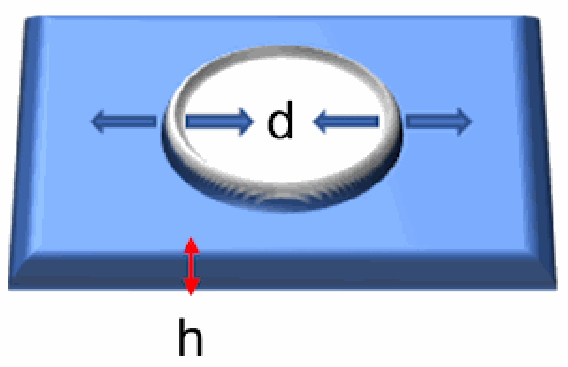
So a large θ means that it’s easier for a pinhole to open. But there’s a catch. Because you have wetted the entire surface, the surface is “contaminated”, so the contact angle you measured via a single drop as “advancing” or “equilibrium” contact angle is not the relevant value. If just one component of the coating goes to the surface to reduce θ as the contact line recedes, then the pinhole won’t grow. To see if your coating will de-wet, you need to measure the receding contact angle.
In an ideal world, advancing, equilibrium and receding contact angles would all be measured to understand the relevant wetting behavior. For inkjet and spray coating, the advancing angle is relevant. For other techniques, the receding angle is the important one.
Unfortunately, receding angles are much trickier to obtain. If your system is dominated by dewetting, talk to your Droplet Lab representative about the best way to measure the receding angle.
If you want to explore more about the practicalities of printing/coating, my free eBook, Printing Science: Principles and Practice, can be downloaded as a free pdf here.
Which contact angle should you measure?
Advancing angle: inkjet printing and spray coating.
Equilibrium angle: useful for general characterization.
Receding angle: coating processes where dewetting and pinhole growth are the practical risks.
Need help measuring treatment, cleanliness or receding contact angle?
Talk to Droplet Lab about the measurement setup that matches your coating or adhesion process.
Frequently Asked Questions
Not directly. A shift from 32 to 38 dynes is only around a 20% change in surface energy, but real adhesion improvement is closer to 10,000 times larger than surface energy alone could explain. Adhesion comes from entanglement between coating and substrate, not from the dyne number itself. The reading is useful mainly as a signal that something in your process has changed.
Surface energy predicts wetting, not adhesion. PET’s higher surface energy means liquids wet it easily, but its crystalline surface does not allow the polymer entanglement that adhesion depends on. Corona, plasma, flame, excimer laser or xenon flash treatment changes the surface structure, not just its energy.
A pinhole opens when the ratio of coating thickness to pinhole diameter falls below a threshold set by the contact angle. Because the surface becomes “contaminated” once fully wetted, the relevant angle for predicting dewetting is the receding angle, not the advancing or equilibrium angle typically measured from a single drop.
It depends on your process. Advancing angle is relevant for inkjet printing and spray coating. Receding angle matters for other coating techniques, particularly where dewetting risk is the concern, and it is the harder of the two to measure reliably.