Polymer 3D Print Adhesion Diagnostics for FDM, SLA, and DLP
Catch first-layer bed adhesion problems and SLA resin release instability before a print starts, by measuring the surface wetting behavior that actually predicts them.
Who this is for: Process engineers, QA/QC teams, and R&D specialists running polymer 3D printing, including FDM (fused deposition modeling), SLA (stereolithography), and DLP (digital light processing).
Positioning: Dropometer does not replace mechanical testing of printed parts or process-parameter tuning (temperature, exposure, peel force). It adds a fast, quantitative wetting and surface energy screen before a build, so build-plate contamination or resin drift is caught before it consumes machine time and material.
Droplet Lab Team
Droplet Lab builds precision instruments and software for surface science measurement, specialising in contact angle analysis and surface tension characterisation. Used by researchers across materials science, pharmaceuticals, coatings, and advanced manufacturing, Droplet Lab's Dropometer has contributed to studies published in peer-reviewed journals including Advanced Functional Materials (Impact Factor 19). The team combines instrument engineering with deep domain knowledge in wettability science with a focus on practical accuracy.

The Cost Of Getting It Wrong
10×
higher hidden cost vs. visible scrap cost: rework, re-inspection, downtime, and warranty claims are rarely captured
Lean Six Sigma research consensus
$1 → $10
upstream prevention typically saves $10 in internal rework and up to $100 in external warranty and recall costs, for the specific failure modes an upstream screen actually catches
COPQ prevention-to-failure ratio
Sources: ASQ, Learn Lean Sigma, Fabrico COPQ Guide 2026. Figures are industry-wide benchmarks, not Droplet Lab claims. On this page specifically, this instrument screens first-layer bed adhesion and SLA resin release behavior well; it does not measure layer-to-layer (interlayer) bond strength within a finished print, which the peer-reviewed literature attributes primarily to thermal history and melt/crystallization behavior during printing, not surface wetting. If your defect is interlayer delamination rather than first-layer lift-off or resin release failure, this screen is the wrong diagnostic tool.
What this workflow does and what it does not
Quick technical reference for process engineers and QA managers evaluating fit before reading further.
Evidence Box (QC-Ready)
Unpredictable first-layer detachment, filament bed-adhesion failure, and SLA resin release or peel failures caused by uncontrolled build-plate or resin wetting behavior, without a quantitative pre-print way to catch it.
A fast pre-print release-decision and troubleshooting tool for build-plate and resin surface readiness. Not a replacement for mechanical testing of the printed part or process-parameter tuning (temperature, exposure, peel force).
Contact angle for build-plate or printed-surface wetting
Surface energy trend data for build-plate condition or coating drift
Pendant drop surface tension for SLA/DLP resin
Spot variability and zone mapping for non-uniform contamination
Correlate wetting and surface energy readings against your own print outcomes (first-layer success rate, resin release consistency, scrap rate) per material and build-plate combination, not a generic published value.
DI water for build-plate surface testing
Fixed droplet volume, down to the instrument's automatic dosing floor
Fixed capture time
Minimum 5 replicates per zone
Wettability indicates bed-adhesion or resin-release risk, it does not measure interlayer bond strength or mechanical properties of the finished part directly. Rough polymer surfaces also increase measurement scatter relative to a smooth reference sample.
What are you trying to solve?
The Dropometer serves four roles across a polymer 3D printing QC program. Each has a different primary risk.
Process Engineer (Build-Plate Reliability)
Fighting first-layer lift-off, warping, or inconsistent print starts, and needing to know whether the build plate itself, not the print settings, is the cause.
SLA/DLP Process Engineer (Resin Release)
Troubleshooting resin peel or release failures, and needing to know whether resin aging or contamination is driving the instability rather than exposure settings.
QA / QC Manager
Needing a numeric pre-print release gate to catch build-plate or resin drift before it consumes machine time and material.
Compliance Officer
Requiring documented, defensible evidence of build-plate and resin batch qualification for NCR responses, CAPA files, or supplier audits.
Is this the right screen for your process?
This is not a universal solution. Check the conditions below before investing further time.
Good fit if
Less relevant if
Most Adhesion Problems in 3D Printing Are Diagnosed After the Failure. This Moves the Check Earlier.
A pre-print wetting diagnostic catches build-plate and resin drift before it costs you a build, not after.
In polymer additive manufacturing, most first-layer and resin-release problems are diagnosed only after a failed print, wasting time, material, and machine availability. A pre-print wetting check moves that diagnosis earlier: contact angle on the build plate predicts first-layer wetting and adhesion risk, and pendant-drop surface tension on SLA or DLP resin predicts release and peel behavior, both measurable before committing a build.
It's worth being precise about what this actually screens. Build-plate surface contamination, surface energy drift from plate wear or coating degradation, and resin aging or contamination are all wetting-driven and screen well with this instrument. Layer-to-layer (interlayer) bond strength within a finished FDM or SLA part is a different mechanism: the peer-reviewed literature on interlayer bonding centers on thermal history, contact pressure, and crystalline morphology during printing, not surface wetting. If your defect is interlayer delamination rather than a first-layer or resin-release failure, this screen narrows the wrong list of suspects.
Used correctly, on the failure modes it does cover, this workflow shifts a team from reactive troubleshooting after a failed build to proactive, upstream control.
What Does a Print Adhesion Problem Actually Look Like?
Prints fail to stick to the build plate, resin doesn't release cleanly from the vat film, or results vary between identical print jobs, without a quantitative way to tell whether the build plate, the resin, or the print settings are responsible.
Root Causes
Why:
- Oils, dust, and handling residue on the build plate disrupt wetting and reduce first-layer adhesion.
How to detect:
- High contact angle plus high variability across measurement zones relative to a clean baseline
Corrective action:
- Standardize build-plate cleaning and handling protocols between prints
Why:
- Wear or inconsistent reapplication of a build-plate coating or surface treatment changes surface energy over time, independent of contamination.
How to detect:
- Surface energy trend deviation on the build plate relative to a known-good baseline
Corrective action:
- Reapply or replace the build-plate coating or treatment on a measured schedule, not a fixed calendar guess
Why:
- Some polymer materials inherently resist wetting on a given build-plate surface, independent of contamination or wear.
How to detect:
- Persistently high contact angle on an otherwise clean, well-treated build plate
Corrective action:
- Modify build-plate surface chemistry, coating, or adhesive layer for that specific polymer
Why:
- Resin aging or contamination alters surface tension, which changes release and peel behavior from the vat film.
How to detect:
- Pendant-drop surface tension variation on the resin relative to a fresh-batch baseline
Corrective action:
- Control resin storage conditions and handling; replace or filter aged resin batches
Why:
- If build-plate and resin wetting measure within baseline but delamination or weak interlayer bonding still occurs, the cause is more likely thermal history, layer contact pressure, or crystalline morphology during printing than anything a wetting screen measures.
How to detect:
- Contact angle and surface tension are within baseline while interlayer failures continue
Corrective action:
- Route the investigation to print temperature profile, layer time, and process-parameter tuning rather than continuing to iterate on surface measurement alone
Not sure which root cause applies to your process?
A surface science specialist can review your print failure history and help you identify whether a wetting screen would add a useful upstream gate.
Building a defensible print-readiness record
Surface readiness measurement produces the type of numeric, traceable output that a subjective visual check of the build plate or resin cannot. If your quality system requires documented evidence of process control for NCR responses, CAPA files, incoming inspection records, or supplier audits, contact angle and surface tension data provide that evidence in a format your QA documentation already requires.
Audit trail
Numeric contact angle, surface energy, and resin surface tension values with replicate spread, timestamps, and build-plate/resin lot identification; replacing subjective "the plate looked clean" notes with defensible numeric logs.
CAPA evidence
When a first-layer or resin-release failure triggers a Corrective and Preventive Action file, wetting data from before and after a plate-cleaning or resin-handling change provide quantitative evidence of the mechanism involved, not anecdotal description.
NCR documentation
Non-conformance reports that include numeric wetting data allow you to assign root cause to build-plate contamination, coating drift, polymer mismatch, or resin aging with evidence, not inference.
Supplier qualification
Incoming build-plate coating or resin lot inspection using contact angle and surface tension provides a numeric acceptance criterion for supplier qualification, independent of the supplier's own published values.
Process control records
Build-plate and resin surface trend logs demonstrate statistical process control at the pre-print step; relevant to Six Sigma, SPC, and DMAIC programs targeting print-yield-driven COPQ.
Print qualification record
A pre-print wetting check on a new build-plate coating, resin batch, or polymer material gives QA a numeric basis for release, instead of finding out about a bad plate or resin batch only after a failed build.
What to Measure
Contact angle (build-plate wettability)
Why it matters: Indicates whether the build plate surface is ready for first-layer adhesion.
How to interpret: Higher contact angle generally indicates poorer wetting and higher first-layer failure risk, correlated against your own print outcomes.
When it is not enough: Doesn't directly measure interlayer or mechanical bond strength.
Spot Variability (Surface Uniformity)
Why it matters: Detects localized contamination or coating defects across the build plate.
How to interpret: High variability across zones indicates inconsistent adhesion risk, not a uniformly clean plate.
When it is not enough: Flags where a problem exists without confirming which specific root cause is responsible; use zone mapping alongside root-cause review.
Surface Energy (Polymer Interaction)
Why it matters: Predicts how the plate will interact with filament or resin as a trend measure over time.
How to interpret: Compare against a known-good baseline trend rather than a single absolute number.
When it is not enough: Not a chemical identification of what's causing a drift, only that one exists.
Resin surface tension (SLA/DLP, pendant drop)
Why it matters: Impacts resin release and peel force from the vat film during printing.
How to interpret: A drift from your fresh-batch baseline indicates aging or contamination worth investigating.
When it is not enough: Sensitive to handling; standardize sampling technique for comparable readings.
Validated Measurement Approach
Independent benchmarking and publication-based validation references.
Benchmark Validation
Dropometer contact angle and pendant-drop surface tension methods have been benchmarked against KRÜSS DSA100E reference measurements. The instrument is referenced in peer-reviewed journals including Bioactive Materials (Impact Factor 20) and Advanced Functional Materials (Impact Factor 19).
See peer-reviewed validationPublication Evidence
Our instruments are referenced in peer-reviewed journals, theses, and conference publications.
Browse citationsHow Dropometer Fits Your Workflow
Dropometer is best used as a pre-print release gate on build plates and resin batches, with a rule-out workflow for isolating build-plate, resin, or process-parameter causes when a print fails.
Identify the failure mode
Determine whether the problem is first-layer bed adhesion, SLA/DLP resin release, or something else entirely: This determines which of the two measurement paths (build-plate contact angle or resin surface tension) applies
Establish a baseline
Measure a known-good build plate or fresh resin batch: This baseline is what every future plate, coating, or resin batch gets compared to
Apply the pre-print wetting test
Run contact angle on the build plate, or pendant-drop surface tension on the resin, before committing a build: Fixed droplet volume, fixed capture time, minimum 5 replicates per zone
Use rule-out logic
If wetting measures within baseline but the failure persists, treat it as a process-parameter or interlayer-bonding issue, not a surface issue: This keeps you from tuning the wrong variable when the wetting screen already cleared
Establish QC gates
Set PASS / MONITOR / FAIL thresholds correlated to your own print success rate and scrap data: PASS: within baseline band → release for print MONITOR: borderline result → re-clean plate or re-test resin FAIL: out of band → hold and troubleshoot using the Root Causes signal pattern
We completed our gage R&R study on the unit and it performed very well.
Brandon Barbee
Corporate Quality Engineer - Zeus Industries - Polymer Manufacturing
Download the Pre-Print Surface Screening SOP Template
An editable SOP template your team can adapt for your build-plate material, resin system, and process. Includes measurement protocol, gate-setting guidance, and a QC log format ready for your documentation system.
Sample Pre-Print Screening: Build-Plate and Resin Release Readiness
Representative output format. Values are illustrative, not a universal specification.
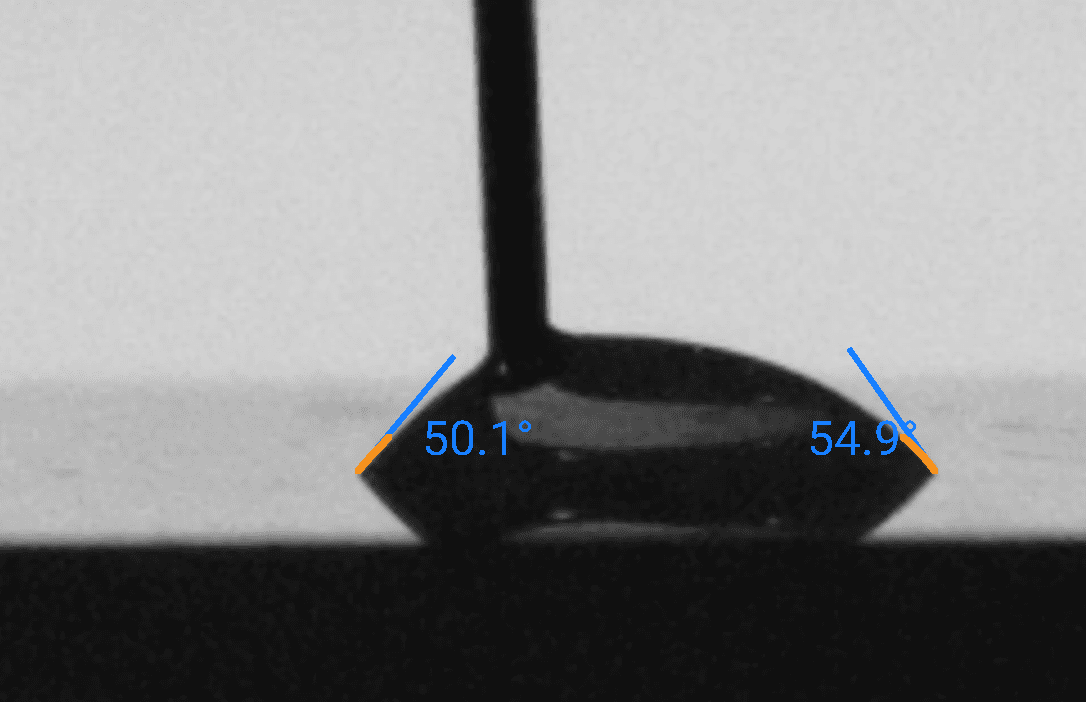
Dropometer contact angle measurement with DI water on Nylon. This is the type of output used to decide whether a build proceeds or the plate/resin gets attention first.
Sample Pre-Print Screening: Build-Plate and Resin Release Readiness
| Sample | Contact Angle (°) or Surface Tension (mN/m) | Variability (Zone-to-Zone) | Release Decision |
|---|---|---|---|
| Build plate, freshly cleaned (baseline) | 62° | Low | PASS |
| Build plate, after 40 prints, no recoat | 89° | Moderate | MONITOR — recoat or reclean before next build |
| Build plate, visible handling residue | 104° | High | FAIL — reclean before print |
| SLA resin, fresh batch (baseline) | 34.2 mN/m | Low | PASS |
| SLA resin, 6 weeks open storage | 38.7 mN/m | Moderate | MONITOR — confirm release behavior before full build |
The freshly cleaned build plate and fresh resin batch both establish the PASS baseline. The 40-print plate without a recoat shows a real contact-angle shift and moderate zone variability, worth a MONITOR flag before assuming the next print will behave like the baseline. The plate with visible handling residue shows both a high contact angle and high zone variability together, the combination this workflow is built to catch before it becomes a failed print. The aged resin batch shows a real surface tension drift; it doesn't guarantee a release failure, it flags that release behavior should be confirmed before committing a full build to that batch. This output would be included in the print-readiness record used to decide whether a build proceeds.
Print adhesion troubleshooting guide
Start condition: first layers aren't sticking, resin isn't releasing consistently, or print results vary between identical jobs. Use the signal pattern to identify the most likely cause.
High contact angle plus high zone variability on the build plate
Likely cause: Build-plate surface contamination from oils, dust, or handling residue.
Action: Standardize build-plate cleaning and handling protocols between prints.
Surface energy trend deviation on an otherwise clean plate
Likely cause: Build-plate coating or surface treatment wear, independent of contamination.
Action: Reapply or replace the coating on a measured schedule.
Persistently high contact angle on a clean, well-treated plateLikely cause: Polymer-to-surface mismatch for this specific material. Action: Modify build-plate surface chemistry or coating for that polymer.
Likely cause: Polymer-to-surface mismatch for this specific material.
Action: Modify build-plate surface chemistry or coating for that polymer.
Resin surface tension drift from a fresh-batch baseline
Wetting measures within baseline but the failure persists
Likely cause: Interlayer bonding or process-parameter issue (temperature, exposure, peel force), not a surface issue this screen measures. Action: Route the investigation to print process parameters and interlayer bonding factors instead.
Common questions before adoption
No. It measures build-plate wetting and resin surface tension, which predict first-layer bed adhesion and resin release behavior. Interlayer bond strength is primarily a thermal and rheological property of the print itself, not something this instrument measures directly.
No. It's a pre-print upstream screen. Confirm final mechanical suitability with your established tensile, peel, or bond-strength acceptance tests.
The build plate is a solid surface, measured by sessile-drop contact angle and surface energy. SLA/DLP resin is a liquid, measured by pendant-drop surface tension. They use different physical setups and predict different failure modes.
Yes, though some polymers inherently resist wetting on a given build-plate surface regardless of cleaning. That's a polymer-to-surface mismatch, not a contamination problem, and the corrective action is different.
It's worth checking. Run zone mapping across the build plate; high variability across zones on an otherwise-passing average reading is a common signature of intermittent contamination.
On a measured schedule based on your own coating wear data, not a fixed calendar guess. Track the trend and set a MONITOR threshold before it reaches FAIL.
Yes. The Dropometer produces numeric contact angle, surface energy, and surface tension data with replicate records, timestamps, and plate/resin lot identification, usable in NCR responses, CAPA files, and supplier audit packages.
What Changes When You Screen Wetting Before a Build, Not After a Failed One
Before and with Dropometer; operational outcomes
| Metric | Before Dropometer | With Dropometer | Indicative Benchmark |
|---|---|---|---|
| Failure discovery point | A failed print, after committing machine time and material | Contact angle or resin surface tension screening before the build starts | "COPQ from late-discovered defects typically 15–20% of revenue for manufacturers without upstream gates" |
| Build-plate maintenance | Fixed recoat/reclean schedule regardless of actual condition | Measured surface energy trend triggers recoat or reclean when it's actually needed | "Reduces both premature maintenance and missed-drift failures" |
| Resin batch handling | Resin used until a release failure occurs | Surface tension checked against a fresh-batch baseline before a full build | "Catches drift before it reaches a committed build" |
| Failure diagnosis | Trial-and-error across print settings, plate, and resin | Rule-out logic isolates whether the cause is surface-related before touching process parameters | "Structured diagnosis vs. guess-and-check troubleshooting" |
| Audit documentation | Subjective visual plate/resin check; not defensible under audit | Numeric wetting logs with timestamps and lot ID | "Applicable to NCR, CAPA, incoming inspection, and supplier qualification records" |
Instant ROI Snapshot
3D Print Adhesion ROI Snapshot
Estimate avoided scrap and reprint cost from build-plate and resin release failures.
Result
Monthly savings = preventable rework cost + preventable scrap cost + other monthly savings.
What Wetting Measurement Cannot Tell You About a 3D Print
Knowing the limits of any measurement tool is part of using it responsibly.
Use this page to improve pre-print troubleshooting and build-plate/resin qualification, not to replace mechanical testing of the finished part. The Dropometer is one layer in a quality system, not a substitute for one.
Similar surface readiness workflows
Binder Jet Additive Manufacturing
A related additive manufacturing pre-print screening workflow, sharing the same production-scrap ROI shape rather than a lab formulation story.
Powder Bed Fusion Additive Manufacturing
A related additive manufacturing QC workflow, relevant to surface and build-condition drift affecting build success rate.
Surface Cleanliness Verification
The general contamination-screening methodology this page's build-plate contamination root cause depends on.
How this page was created
Editorial and technical transparency notes for this page.
Drafting assistance
Initial draft created with AI assistance (Claude 4.8 Opus Pro), then rewritten for technical clarity by Droplet Lab Staff
Transparency Note
Technical review and editing by a surface-science specialist for accuracy
Transparency Note
Identifiers, units, thresholds, and key claims checked against cited sources before publication
Transparency Note
Reviewed every 12 months or when underlying standards or instrument specifications change
Report a correction
Spotted an issue in this summary? Send a correction request and our team will review it.
Correction Request
We work hard to keep this standards summary accurate and up to date. If you spot an error (wrong revision/year, missing requirement, incorrect interpretation, or broken link), tell us and we'll review it.
Contact us to report a correction