



Contents
Case Study

Cleaning a failing implant should not change the implant. A University of Manchester group measured which brushes do, one 3 µl water drop at a time.

Last Updated
October 18, 2026
Industry
Dental biomaterials research
Location
Manchester, United Kingdom
Customer since
April 2023
Published with the Dropometer
Dental Materials, 2025
Image
Alabbad, Silikas and Thomas 2025, Fig. 6, CC BY 4.0
Named in a 2025 Dental Materials paper Drop shape method validated against a KRÜSS DSA100E in peer review 2 peer reviewed validation papers

Prof. Nikolaos Silikas's group in the Division of Dentistry bought a Dropometer with the automatic dropper through Droplet Lab's UK reseller in 2023. The group measured water contact angle on SLA titanium discs, untreated and after four rotary cleaning brushes, with 25 measurements per group. Three brushes made the surface significantly more wettable; the Labrida BioClean brush did not. The study was published in Dental Materials in 2025.

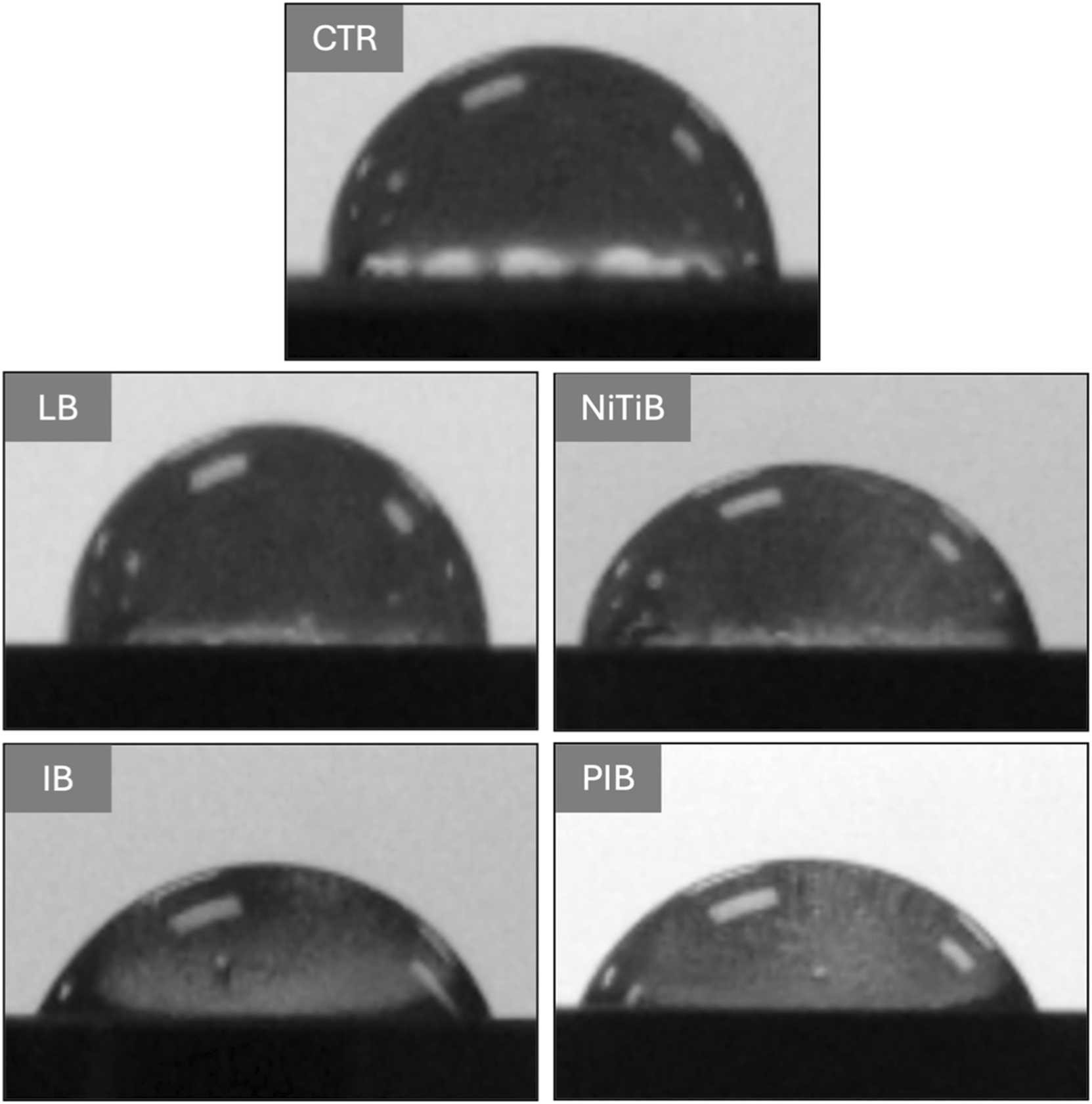
Representative water drops on SLA titanium discs, untreated control and after four rotary brushes, imaged with the Dropometer (Alabbad, Silikas and Thomas 2025, Fig. 6, CC BY 4.0)
Abhimanyu Photo
Written by
Abhimanyu Bhandankar
Holds an MBA from Schulich School of Business and a BE in IT. He joined Droplet Lab in July 2019 and now leads sales and marketing.
CEO at Droplet Lab
Read More
Gurdeep-Saini-Photo
Technical Review by
Gurdeep Singh Saini
Holds a BASc in Mechanical Engineering from Ryerson University (now Toronto Metropolitan University) and an MASc from York University. He develops the automatic edge and baseline detection behind the Dropometer's analysis.
COO at Droplet Lab
Read More
Abhimanyu Photo
Written By

Abhimanyu Bhandankar

CEO at Droplet Lab

Holds an MBA from Schulich School of Business and a BE in IT. He joined Droplet Lab in July 2019 and now leads sales and marketing.

Gurdeep-Saini-Photo
Reviewed By

Gurdeep Singh Saini

COO at Droplet Lab

Holds a BASc in Mechanical Engineering from Ryerson University (now Toronto Metropolitan University) and an MASc from York University. He develops the automatic edge and baseline detection behind the Dropometer's analysis.

Primary outcome: a clear ranking of which brushes change the surface

Water contact angle on SLA titanium discs after 60 s of brushing

Median of 25 measurements per group, 3 µl water at 23 °C, image at 5 s, as reported in Alabbad, Silikas and Thomas, Dental Materials 41 (2025) 383 to 390

Untreated SLA control 84.8°
Labrida BioClean brush 85.9°, not different from control
NiTiBrush Nano 81.0°
i-Brush1 67.45°
Peri-implantitis Brush 65.3°

Values are medians of 25 measurements per group, as reported in Table 2 of the paper. The untreated SLA surface read 84.8°. After the Peri-implantitis Brush it read 65.3°, after the i-Brush1 67.45° and after the NiTiBrush Nano 81.0°, all significantly more wettable at p below 0.05. The Labrida BioClean brush read 85.9°, not different from the control. The three metal brushes also lowered Sa roughness, and the authors note that the clinical effect of the wettability change is not yet clear.

125 measurements

Five discs per group, five drops per disc, across five groups.

3 µl

Water drop volume placed by the automatic dispenser on every disc.

3 of 4 brushes

Brushes that made the SLA surface significantly more wettable than the untreated control.

1 of 4 brushes

Only the Labrida BioClean brush left contact angle and Sa roughness not different from the control.

Executive Summary

Who

Prof. Nikolaos Silikas's dental biomaterials group in the Division of Dentistry at the University of Manchester, UK. Postgraduate researchers in the group study dental and implant materials, including titanium, composites and primers.

Problem

Dentists clean infected implant surfaces with rotary brushes, but the brushes can change the very surface they clean. The group needed to measure whether each brush altered wettability, a property linked to how bone and tissue interact with an implant.

Solution

A fully automatic Dropometer with the automatic dropper, automatic sliding stage and all four measurement apps, ordered through Mi-Net Technology, Droplet Lab's UK reseller, in April 2023 and set up with the lab on a remote onboarding call in July 2023.

Time to Value

23 March 2023: interest reported by the UK reseller. 4 April 2023: remote demo. 27 April 2023: order placed. June 2023: shipped to the UK. 5 July 2023: remote onboarding with the lab, first water drop measured on the call. September 2024: contact angle app update for the group's phone. 27 October 2024: paper submitted. 9 January 2025: published online in Dental Materials.

Results

Across 125 measurements on 25 SLA titanium discs, three of four brushes made the surface significantly more wettable. Median water contact angle fell from 84.8° untreated to 65.3° at the lowest. The Labrida BioClean brush left it unchanged at 85.9°. The results, alongside SEM, EDX and profilometry, were published in Dental Materials in 2025.

Highlights

84.8° to 65.3°

Median water contact angle, control to lowest

125

Contact angle measurements

3 µl

Automated drop volume

2023

Customer since

University of Manchester, at a glance

Research focus

Dental biomaterials: implant surfaces, restorative composites, primers and adhesion.

Products / applications

Titanium dental implants and the tools used to clean them during peri-implantitis treatment.

Measurement stage

Laboratory study comparing treated and untreated surfaces alongside SEM, EDX and profilometry.

Users

Postgraduate researchers in the Division of Dentistry.

Materials and surfaces tested

Grade 5 Ti-6Al-4V discs, 14.5 mm across, with a sandblasted and acid etched (SLA) surface, tested with ultrapure water.

Key constraints

Rough SLA surfaces; five discs per group and five drops per disc; drop volume, temperature and timing kept the same across groups.

The challenge: proving that a cleaning tool leaves the implant surface as it was

Peri-implantitis treatment depends on cleaning, and cleaning can change the surface that bone needs.

Why implants need cleaning

Peri-implantitis is an inflammation of the soft tissue and bone around a dental implant. Treatment starts with removing the biofilm from the implant surface, often with rotary brushes made of titanium, stainless steel, nickel titanium or polymer. Checking what a cleaning step does to the surface is the core of dental and orthopedic implant surface QC.

Why cleaning can do harm

Modern implants have engineered surfaces. An SLA surface is sandblasted and acid etched to create a rough micro texture that helps bone attach. A brush that removes biofilm may also flatten or scratch that texture and leave metal behind.

Why wettability is part of the answer

How easily water spreads on an implant, its wettability, affects how proteins and cells meet the surface. The group wanted to know whether each brush changed wettability, and to read that result alongside the changes in roughness and composition. Our medical device surface guide explains why wetting matters for implants and other devices.

What success would require

The same drop volume, temperature and timing on every disc: five discs per group, five drops per disc, 125 measurements in all. Then any difference in contact angle comes from the brush, not from the method. Our contact angle measurement guide explains the sessile drop method, and our guide to reproducible contact angle measurement covers what keeps readings comparable.

The insight: hold the drop constant, so the surface is the only thing that changes

What Was Deployed

Delivered configuration (ordered April 2023): the Dropometer contact angle and surface tension kit with the automatic dropper, the automatic sliding stage and all four applications: contact angle, surface tension, surface energy and sliding angle, on the supplied phone. In the published study, the automated dispenser placed a 3 µl drop of ultrapure water on each disc at 23 °C. The image was captured 5 s after deposition, and the software fitted a polynomial to find the left and right contact angles. Five discs per group were measured five times each. See our analysis of the Dental Materials paper for the full method and results.
The Origin

From a reseller's first lead to a lab full of postgraduates on a call

In early 2023 Droplet Lab appointed Mi-Net Technology, based in Nottingham, as its reseller for the UK and Ireland. On 23 March 2023 Mi-Net reported interest from its customer at the University of Manchester, Prof. Nikolaos Silikas's group in the Division of Dentistry. Droplet Lab ran a remote demo for the group on 4 April 2023 and sent its two peer reviewed validation papers through Mi-Net afterwards. The group chose the top specification, with the automatic dropper, the automatic sliding stage and all four measurement apps, and the order was placed on 27 April. Our guide to contact angle goniometers for advanced research explains what to look for in a research instrument. The instrument shipped to the UK in June. On 5 July 2023 Droplet Lab's team took a room of the group's postgraduate researchers through assembly and their first measurements over a video call. The first water drop was analysed with both of the app's fitting methods, and both read 93°.

Before vs After

Metric Before After
Water contact angle, Labrida BioClean brush 84.8° (21.0) 85.9° (17.0), not different from control
Water contact angle, NiTiBrush Nano 84.8° (21.0) 81.0° (18.3)
Water contact angle, i-Brush1 84.8° (21.0) 67.45° (12.50)
Water contact angle, Peri-implantitis Brush 84.8° (21.0) 65.3° (25.7)
Roughness Sa, Labrida BioClean brush 1.53 µm (0.12) 1.49 µm (0.21), not different from control
Roughness Sa, NiTiBrush Nano 1.53 µm (0.12) 1.41 µm (0.28)
Roughness Sa, i-Brush1 1.53 µm (0.12) 0.88 µm (0.57)
Roughness Sa, Peri-implantitis Brush 1.53 µm (0.12) 1.28 µm (0.23)

Rollout timeline

Timeline (high level)

March to April 2023: Demo and order

  • Interest reported by Mi-Net, the UK reseller, on 23 March
  • Remote demo on 4 April; top specification ordered on 27 April

June 2023: Shipped to the UK

Instrument shipped from Canada to the reseller in June 2023

5 July 2023: Onboarding

  • Video call with the group's postgraduate researchers
  • Assembly guide for the automatic parts sent during the call
  • First water drop measured live; both fitting methods read 93°

September 2024: Contact angle app update

  • Update for the group's phone model
  • The lab confirmed the contact angle app connected and measured on 6 September 2024

October 2024 to January 2025: Published

  • Paper submitted 27 October 2024 and accepted 22 December 2024
  • Published online in Dental Materials on 9 January 2025, with contact angle measured on the Dropometer

Proof and validation: what the paper shows, and what it does not

Test method

Static water contact angle on Grade 5 Ti-6Al-4V discs with an SLA surface, untreated or brushed for 60 s with one of four rotary brushes. 3 µl ultrapure water from the automatic dispenser, 23 °C, image at 5 s, polynomial fit, measured on the Dropometer (Droplet Lab, Canada).

Sample size and operators

Five discs per group, five repeat measurements per disc: 25 measurements per group and 125 in all. The study prepared 75 discs, 15 per group, for all of its tests.

Repeatability / reproducibility

Reported as median and range per group; ranges ran from 12.50° to 25.7°. Kruskal-Wallis test p below 0.001, with Dunn-Bonferroni post hoc comparisons. The methods text mentions a mean, but Table 2 reports medians.

Notes / assumptions

Source: M. Alabbad, N. Silikas, A. Thomas, "Effect of mechanical instrumentation on titanium implant surface properties", Dental Materials 41 (2025) 383 to 390, doi:10.1016/j.dental.2024.12.014, CC BY 4.0. Contact angle was one of four methods, with SEM, EDX and optical profilometry. Water was the only test liquid. The study used discs, not implants, and SLA surfaces only. The authors note that the effect of the wettability change on re-osseointegration is not yet clear.

Outcomes to date

Measured Outcomes

65.3°

After the Peri-implantitis Brush

Down from 84.8° on the untreated surface, the largest change of the four brushes (Alabbad, Silikas and Thomas, Dental Materials 41 (2025) 383 to 390).

67.45°

After the i-Brush1

Also significantly more wettable, together with the largest drop in roughness, from Sa 1.53 to 0.88 µm.

85.9°

After the Labrida BioClean brush

Not different from the control, matching its unchanged Sa roughness and its near control appearance under SEM.

Operational Outcomes

Consistent drops

The automated dispenser was set to a 3 µl drop for all 125 measurements.

Published output

Contact angle formed one of four methods in a 2025 Dental Materials paper.

Local channel

Ordered and supported through the UK reseller, with remote training from Droplet Lab.

What's next

Delivered

Rotary brush effects on titanium implant surfaces (Dental Materials, 2025)
Remote onboarding for the group's postgraduate researchers (July 2023)
Contact angle app update for the group's phone model (September 2024)

Frequently asked questions

Do implant cleaning brushes change the titanium surface?

Three of four brushes did. On SLA titanium discs, median water contact angle fell from 84.8° untreated to as low as 65.3°. The Labrida BioClean brush left it unchanged at 85.9°. The study was published in Dental Materials in 2025.

How was the measurement kept consistent?

The automated dispenser placed a 3 µl drop of ultrapure water on each disc at 23 °C, and the image was captured 5 s after deposition. Five discs per group were measured five times each, 125 measurements in all.

Can UK labs buy and get support locally?

Yes. The University of Manchester ordered through Mi-Net Technology, Droplet Lab's reseller for the UK and Ireland. Droplet Lab ran the remote demo and onboarding, and the first water drop was measured live on the onboarding call.

Next Step

Testing whether a cleaning or surface treatment changes wetting?

The Dropometer places a set drop volume with its automatic dropper, so the surface is the only thing that changes between groups. Its drop shape method is validated against a KRÜSS DSA100E in peer review. Book a 15 minute demo and bring a treated and an untreated sample.