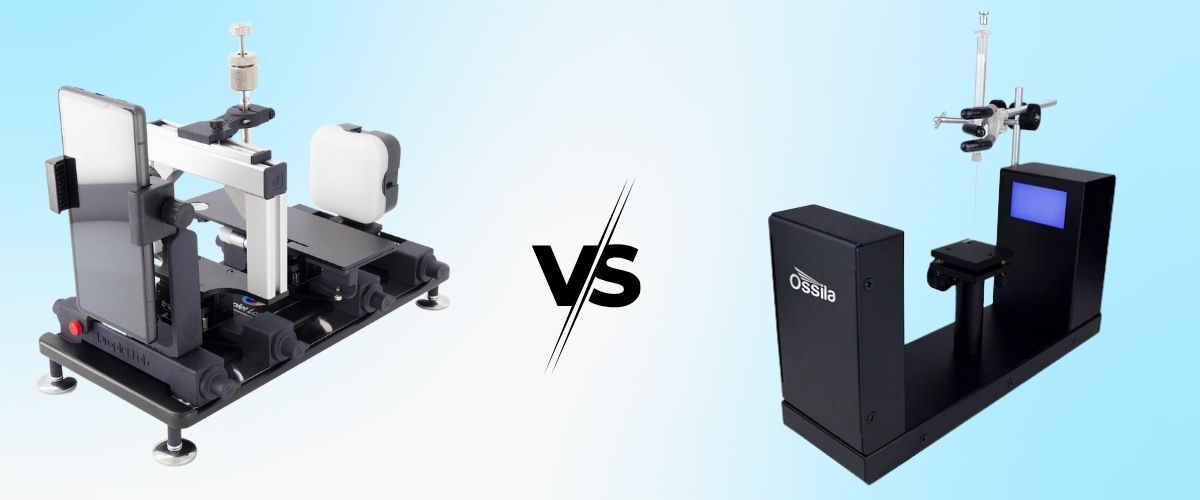
Disclosure: Our company develops and manufactures Dropometer. Our product evaluation uses the purchasing guidelines from The Ultimate Guide to Buying Goniometers for Contact Angle Measurement. Our objective is to assist you in selecting the appropriate tool for your application without declaring a single best choice.
Executive summary : Ossila Contact Angle Goniometer vs. Dropometer
The Ossila contact angle goniometer and Dropometer perform measurements of contact angles and surface tension through pendant drop. The Ossila contact angle system offers an affordable solution for static contact angles and basic surface tension measurements in a fixed station. The Dropometer enables you to analyze advancing and receding angles, sliding angles , surface energy and pendant drop surface tension through AI-based analysis while providing portable and offline operation capability along with audit-friendly documentation. Ossila goniometer provides cost-effective solutions for customers interested in basic measurements while Dropometer offers advanced features for organizations focusing on analysis depth and future scalability.
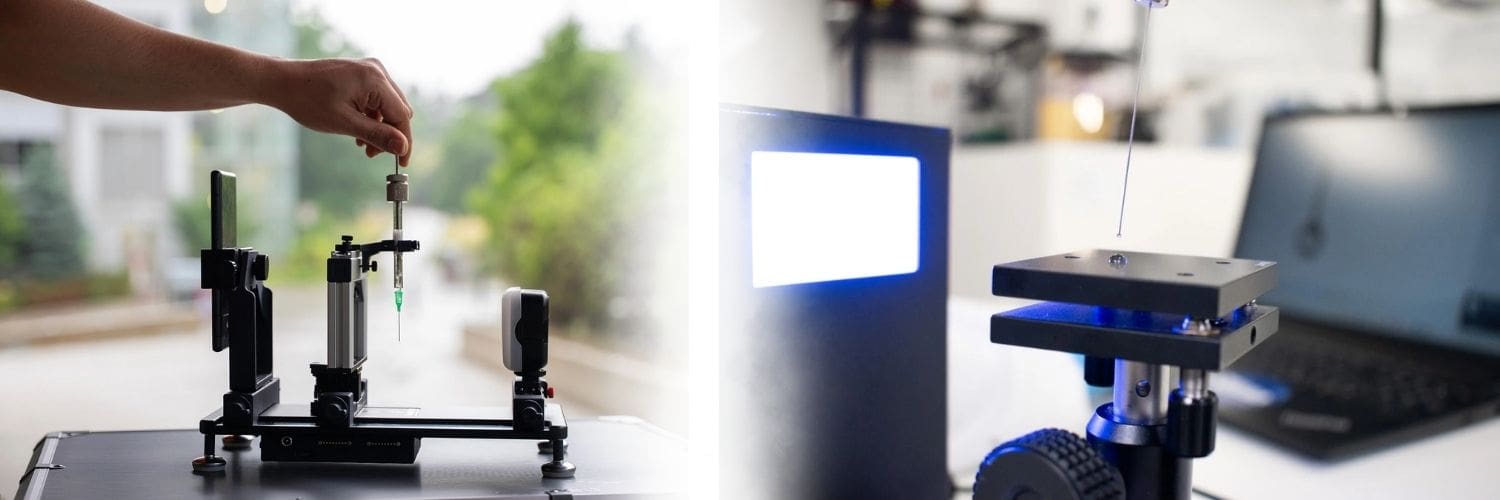
Compact benchtop; mains power + PC. Typical setup uses PC software via USB; Ossila provides downloadable software and drivers for data capture and contact angle analysis.
Portable, battery/offline, field + lab ready. The app runs offline for field work and can export data to a PC over USB or cloud-sync when connectivity is available.
Environmental control
Not integrated
Optional enclosures / add-ons; clear upgrade path
Stated accuracy
Manufacturer-stated accuracy: ±1°
Tight-tolerance design with peer-reviewed method parity; resolution of 0.01 degrees makes it suitable for sub-degree decisions
Price (typical)
~US$3,000
From US$4,990; academic discounts & lease-to-own available
Where they’re similar
Both systems provide identical static contact angle measurement on a liquid droplet over a solid surface along with pendant-drop surface tension evaluation.
Both systems allow users to acquire images and videos for documentation and export data to support surface wetting studies across materials.
Where they differ (and why it matters)
1) Measurement scope
Ossila: The system performs well in measuring static contact angles and pendant-drop surface tension. The manual handling of dynamic angles through tilt operations is approximated since automated operations remain under operator supervision.
Dropometer: The system extends its capabilities to include advancing and receding angles , sliding angle while providing Surface Energy and pendant-drop Surface Tension measurements. The broad wetting toolkit for R&D and QA work becomes accessible through the instrument.
Why it matters: The dynamic angle and sliding angle measurements in combination provide essential information regarding hysteresis and roll-off which is crucial for self-cleaning systems, adhesion preparation and microfluidic applications. These outputs relate to intermolecular forces at the three-phase line, often summarized by a force diagram of a droplet on a surface.
2) Optics & analysis engine
Ossila: The device features 1080p imaging with polynomial and circle fitting capabilities and allows users to adjust baseline and region of interest settings.
Dropometer: The system utilizes AI-based edge detection and model fitting which decreases operator bias and enables quick analysis of repeatable results in different laboratory settings.
3) Automation & throughput
Ossila: The system functions mostly through manual operation which works well for low-to-moderate measurement quantities when personnel operate the equipment.
Dropometer: The system uses semi-automated analysis while offering tilt and auto-dropper modules which speed up operations without requiring the purchase of $20k-$100k high-end benchtop instruments.
4) Calibration, traceability & data handling
Ossila: The instrument uses a calibration sphere for measurement and provides exportable visual data that can be used for lab documentation purposes.
Dropometer: The application provides timestamped method metadata and generates audit-friendly reports which facilitate offline operation in secure environments and enhance reproducibility.
5) Portability & deployment
Ossila: The system provides benchtop capabilities to support work in a single laboratory space. PC connectivity is via USB, and labs typically install vendor-provided software and drivers for measurement and CSV export.
Dropometer: The system operates within the portable class of less than 2.5 kilograms and requires no power source for field or classroom deployment along with fast setup features for multi-site QA and secure laboratory use. Data can be transferred to PCs by USB or shared through standard lab data flows when connectivity is permitted.
Deeper look at key criteria
Measurement scope & real-world capability
You should select Ossila contact angle goniometer when you require static contact angle analysis and pendant-drop Surface Tension measurement only at a fixed laboratory setup.
Select Dropometer when you need additional analysis capabilities including advancing and receding angles alongside sliding and surface free energy for testing hysteresis and roll-off and adhesion differences across various materials and treatments.
Accuracy, Repeatability & what it means for your lab
The Ossila contact angle goniometer provides steady results in both static contact angle (CA) and pendant-drop surface tension (ST) measurements. Static CA measurements executed through manual procedures on Ossila goniometer demonstrate practical reproducibility of ±1–2°. The system delivers optimal results when your quality assurance standards need wide bands of ±1° or more and you have tight budget restrictions.
This Dropometer maintains minimal user-to-user variances through AI edge detection and standardized app use. The system remains the better choice when decisions depend on hysteresis and sliding measurements or sub-degree changes and when you require uniform audit logs for different operators and locations.
Modularity & Upgradability
Ossila: Fixed feature set with no real upgrade path beyond basic accessories. That keeps entry price low but can box you in if you later need dynamic angles, automation, or environmental control—often forcing a full platform change.
Dropometer: Modular by design (optional tilt, auto-dropper, specialized sample holders; environmental add-ons). You can expand capability over time instead of replacing the system.
Cost & total ownership
Ossila: The lowest upfront spend for a purpose-built bench unit handling static CA and pendant-drop ST.
Dropometer: Starts at US$4,990 but helps lower upfront cost with academic discounts and lease-to-own options—and carries no recurring software license fees. Over a multi-year horizon (especially if you’ll grow into dynamic angles, sliding, or SFE), total cost of ownership can be highly competitive.
If you expect to add tilt, auto-dosing, environmental control, or specialized fixtures later, Dropometer’s upgrade path keeps you from re-buying an entirely new platform.
Bottom line
Pick Ossila contact angle goniometer when your top priorities are price, simplicity, and accurate static CA + pendant-drop ST at a bench.
Pick Dropometer when your top priorities are measurement scope (dynamic, sliding, SFE), portability/offline operation, multi-user consistency, and a clear upgrade path with academic discounts and lease-to-own to ease the upfront spend.
Yes. It runs offline on phone included with the instrument and exports when needed. You can later move data via USB or standard lab data systems without changing the measurement workflow.
The ossila contact angle goniometer connects by USB and uses PC software; you’ll install the provided software and drivers for capture and analysis. This supports videos, images, and CSV export for contact angle analysis.
For classroom demos of wetting, a portable unit like Droplet Lab Dropometer simplifies setup and shows real-time changes in contact angle. A force diagram of the droplet helps explain the role of surface tension and surface energy.