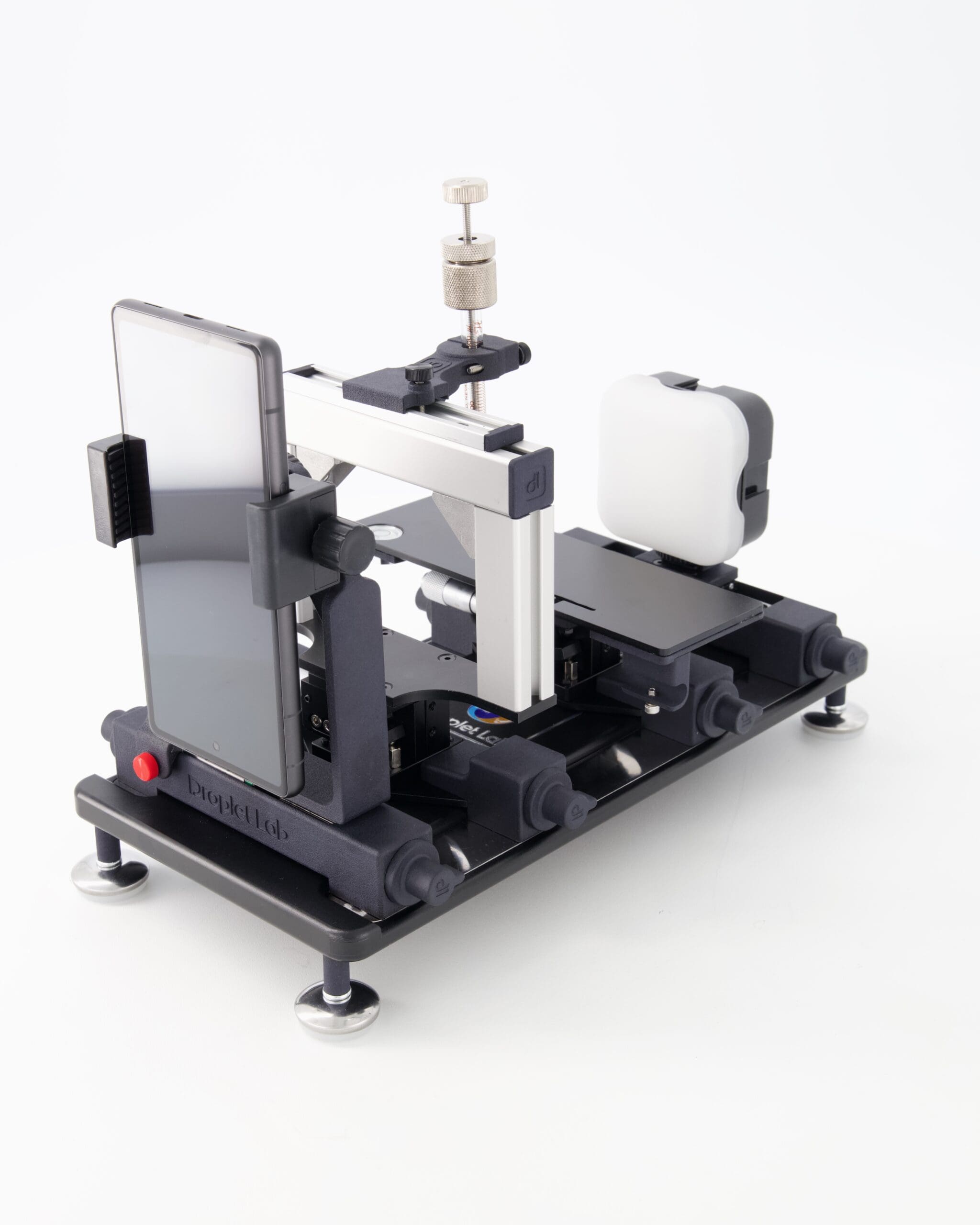
Dropometer
From US $4,990

Instrument comparison
Both are budget-friendly optical drop-shape systems that cover static contact angle and pendant-drop surface tension. The real split is bench-fixed simplicity versus dynamic angles, roll-off, surface energy and portable, offline-capable measurement.
From US $4,990
~US $3,000 (base)


Droplet Lab builds precision instruments and software for surface science measurement, specialising in contact angle analysis and surface tension characterisation. Used by researchers across materials science, pharmaceuticals, coatings, and advanced manufacturing, Droplet Lab's Dropometer has contributed to studies published in peer-reviewed journals including Advanced Functional Materials (Impact Factor 19). The team combines instrument engineering with deep domain knowledge in wettability science with a focus on practical accuracy.
Ossila is a legitimately capable low-cost bench goniometer, it undercuts us on price. Choose it if static contact angle plus surface tension on a flat, clean sample is genuinely all you need. The Dropometer earns its higher price only when you need dynamic/sliding angles, in-software surface energy, portability or offline operation — not before.
Both are affordable optical systems built around drop-shape imaging, and both cover static water contact angle and pendant-drop surface tension. For those two measurements on a flat, clean sample, either will serve.
The decision is method breadth and deployment. Ossila is a mains-powered bench unit tethered to a Windows 11 PC. The Dropometer adds advancing/receding (dynamic) angles, a motorised sliding-angle tilt stage, multi-model surface energy, and battery/offline operation; at a higher price.
Both capture a real drop image and fit it optically, so you get a defensible contact-angle number rather than a subjective read.
Both do pendant-drop surface tension. Ossila fits drop-shape models to a needle-suspended drop; the Dropometer uses Young–Laplace.
Both automate edge detection and fitting in software neither is a manual protractor read.
Both are credible for academic and small-QA budgets and avoid the recurring software fees common on premium benchtops.
Ossila covers static contact angle and pendant-drop surface tension with stage levelling only. The Dropometer adds advancing/receding (dynamic) angles, a motorised sliding-angle tilt stage (0–60°) and in-software surface energy. If you only ever need static CA and surface tension, that breadth is wasted spend; if you touch hysteresis, roll-off or surface energy, it is decisive.
Ossila is a benchtop that needs mains power and a Windows 11 PC over USB. The Dropometer runs on battery for up to ~8 hours and fully offline on the included smartphone, so it works on a line, at a supplier site, or in a smartphone-restricted secure lab where a tethered PC is a non-starter.
Both instruments automate the fit. The difference is handling: Ossila dispenses from a manual glass syringe with no motorised stage, so drop volume and placement are operator-controlled. The Dropometer offers automated dosing (0.05 µL minimum) and a motorised tilt stage, removing the manual steps that most often drive operator-to-operator spread; the failure mode that sinks a Gage R&R study.
Ossila's expandability is limited. The Dropometer is modular: add a single-syringe or Hamilton multi-syringe automated dropper, tilt stage, and specialised holders for fabrics or curved parts, so the platform grows instead of being replaced.
This is the real reason to pay more. Ossila's contact-angle routine fits a polynomial to a static drop and reads the tangent at the baseline. That is useful for screening, but a placed-and-read drop returns an apparent angle sitting somewhere between advancing and receding; it hides roughness, heterogeneity and any chemistry happening at the interface. The Dropometer's advancing/receding workflow, run slowly with controlled dosing, measures the hysteresis those static reads conceal. If your samples are real-world (rough, coated, reacting), that gap is the measurement.
On a static-CA-only bench, repeatability is limited by how consistently the operator dispenses and places each drop. Ossila's manual syringe and fixed stage leave that to the user. The Dropometer's automated dosing and tilt reduce those variables; the same factor that decides whether several people running the same sample pass a Gage R&R study.
Ossila is not strictly a subset of the Dropometer. Its contact-angle range is wider (5°–180° vs 10°–175°), so it edges out superhydrophobic (>175°) and near-complete-wetting (<10°) samples the Dropometer can't reach. Its camera also captures at 30 fps vs 10 fps. The Dropometer answers on accuracy (±0.35° vs ±1°), method breadth, and deployment; not on raw range or frame rate.
The hidden cost in an Ossila purchase isn't the sticker; it's what happens when scope grows. Adding dynamic angles, roll-off, or field capability means a second instrument. The Dropometer's modular path lets one platform grow, which usually wins on total spend over a multi-year program.
| Criterion | Dropometer | Ossila Contact Angle Goniometer |
|---|---|---|
| Contact angle (sessile, static) | Yes | Yes |
| Contact-angle accuracy | ±0.35° | ±1° |
| Contact-angle range | 10°–175° | 5°–180° |
| Advancing / receding (dynamic CA) | Yes (automated protocol) | Manual video only — no automated protocol¹ |
| Surface tension (pendant) | Yes (Young–Laplace) | Yes (optical / drop-shape) |
| Surface free energy | Yes (Equation of State, Fowkes, Oss & Good) | Not in software — compute externally |
| Sliding / tilt (roll-off) angle | Optional | No |
| Automated dosing | Yes (0.05 µL min, motorised option) | Manual syringe only |
| Capture rate | 10 fps | 30 fps |
| Camera resolution | 1920 × 1080 | 1920 × 1080 |
| Deployment | Smartphone, battery (~8 h), fully offline | Benchtop, mains power + Windows 11 PC |
| Portable / handheld | Yes | Bench only |
| Warranty | 5 years (with free software updates) | 2 years |
| Starting price | US $4,990 | ~US $3,000 |
| Large / in-situ parts | Yes, can be modified | Sample must fit stage |
Competitor specifications are drawn from Ossila's publicly available product page and manual and may change; verify current figures with the vendor before purchase.
This comparison is based on the Ossila Contact Angle Goniometer's publicly available product page and manual, alongside the Dropometer's own published datasheet. We have not run a side-by-side lab test between the two instruments on the same samples. Where a spec isn't published by the vendor; for example an Ossila surface-tension range or accuracy figure, which Ossila does not state, we say so rather than estimate it. Where Ossila outperforms the Dropometer (angle range, frame rate) we say that too.
Ossila returns a static contact angle; the single number a place-and-read bench goniometer is built to give. That is exactly the value the two observations below warn about: a reading captured once, by hand, can't separate a true surface property from how the drop happened to settle. The Dropometer's automated advancing/receding and tilt workflows are built to measure what that single static number hides.
"Repeatable numbers don't come from dropping a droplet and reading it. They come from advancing and receding slowly enough that you are measuring thermodynamics, not fluid dynamics."
"The gap between the advancing and receding angle — the hysteresis — is where a surface reveals its roughness, its heterogeneity, and whether something is reacting."
The implication for this comparison: the capability that actually protects your data; dynamic, hysteresis-aware measurement is native to the Dropometer and sits outside what a static-only bench goniometer like Ossila is designed to do.
Ossila at ~$3,000 is the rational pick; don't pay for capability you'll never use. It does both measurements, natively.
The Dropometer's dynamic/sliding angles and in-software surface energy are the reason to step up; Ossila does not offer them.
The Dropometer's portable, offline operation has no Ossila equivalent.
Start on the Dropometer's modular platform to avoid buying a second instrument when scope expands.
Ossila is a legitimately good low-cost bench goniometer that undercuts the Dropometer and does static contact angle and pendant surface tension natively. Choose it when a fixed station doing those two measurements is genuinely all you need. The Dropometer earns its higher price when you need advancing/receding or sliding angles, in-software surface energy, portability, offline operation or a tighter accuracy and longer warranty, not before.
For static water contact angle on flat samples, yes. It is a credible budget bench instrument. The limitation is scope: it does not do dynamic advancing/receding angles, sliding angle, in-software surface energy, or in-situ measurement.
For most QC and many research workflows, yes. It adds portability and offline AI fitting. For ultra-high-magnification microdrop work you may still want a large-optics benchtop system.
See how the Dropometer stacks up against other goniometers, tensiometers and screening tools.
Independent benchmarking and publication-based validation references.
Dropometer contact angle and pendant-drop surface tension methods have been benchmarked against KRÜSS DSA100E reference measurements.
Our instruments are referenced in peer-reviewed journals, theses, and conference publications.