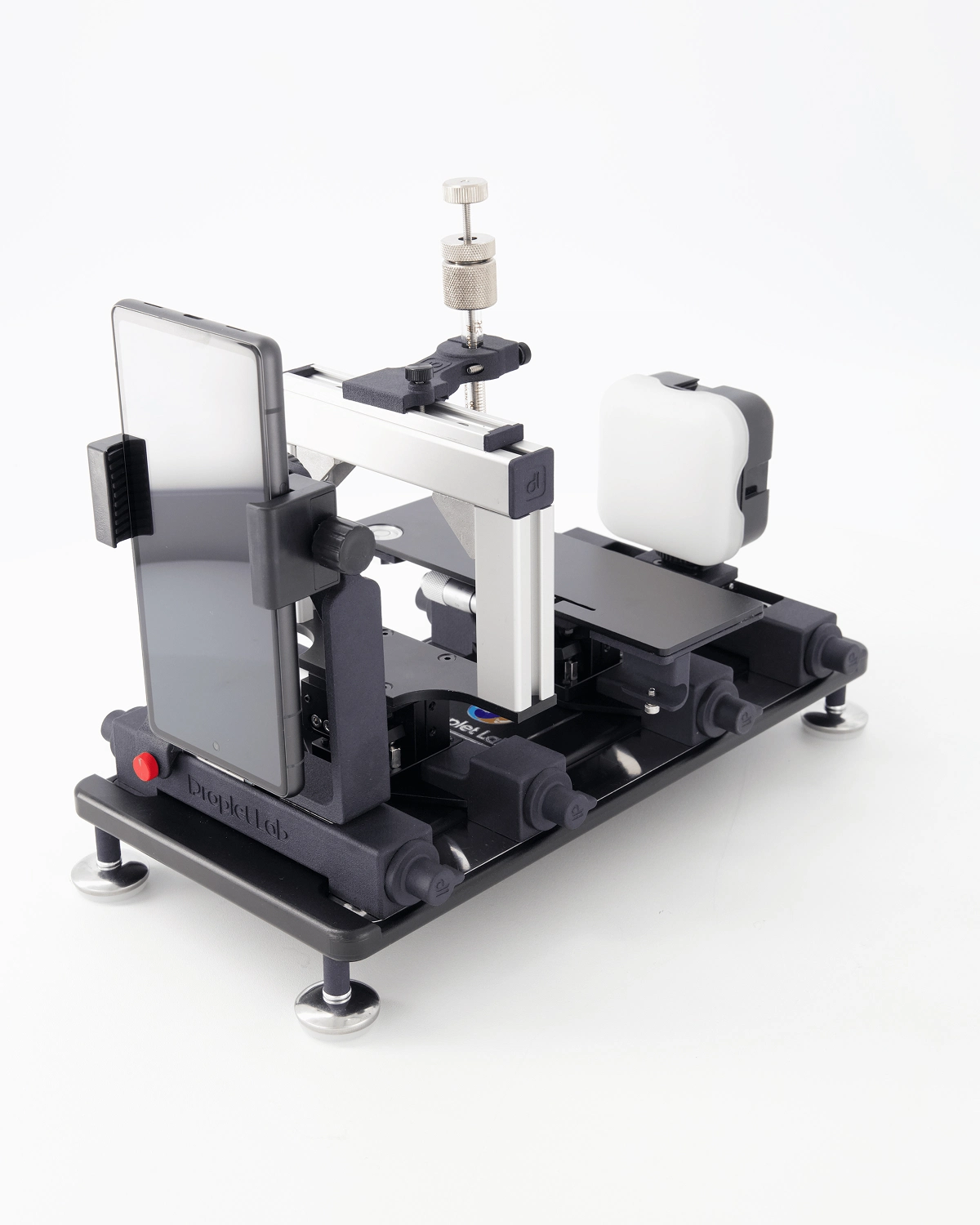
Dropometer
US$4,990 base kit, checked 23 October 2026

Surface energy analyzer comparison
Brighton Science's Surface Analyst measures water contact angle on production parts in under two seconds, using its patented Ballistic Deposition method, and gives a pass or fail result for surface cleanliness and readiness to bond. The Dropometer is a portable drop shape analyzer for contact angle, surface free energy and surface tension. This page explains which suits which job.
US$4,990 base kit, checked 23 October 2026
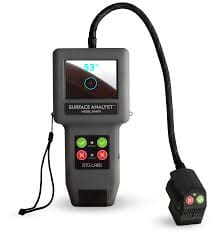
Quote only; Brighton does not publish prices. Checked 23 October 2026


Choose the Brighton Science Surface Analyst for fast, repeatable water contact angle checks on large parts on a production line, with pass or fail limits and MES data. Choose the Dropometer (US$4,990) when you need surface free energy from several liquids, advancing and receding angles or surface tension, in the lab or on site.
These tools answer different questions. The Surface Analyst is a surface inspection device: it fires a small water droplet at the part and reports the water contact angle as a measure of surface cleanliness and readiness, built for manufacturing environments such as aerospace, automotive and medical device production. The Dropometer is a measurement instrument: it places drops of one or more liquids, measures static and dynamic contact angles, and calculates surface free energy and surface tension. Some plants use an inspection tool on the line and a measurement instrument to set its limits.
Both measure water contact angle as a check on surface cleanliness and treatment.
Both are portable and run on battery: the Surface Analyst 5001 for about 4 hours, the Dropometer for up to 8.
Both help prevent adhesion failures before bonding, coating, sealing or printing. See preventing adhesive failure before bonding.
The Surface Analyst gives a fast water contact angle for go or no go decisions. The Dropometer gives contact angles of several liquids, surface energy and surface tension for setting and explaining those limits.
The Surface Analyst deposits the drop on the part itself. The Dropometer measures a sample placed on its stage.
The Surface Analyst uses HPLC certified water from a cartridge. The Dropometer uses any test liquid, which is what surface free energy calculations need.
The Surface Analyst stores images and sends results to MES or BConnect for trend analysis. The Dropometer exports TIFF images and CSV results.
A single water contact angle is a sensitive check of surface cleanliness and treatment, and the Surface Analyst can also display it in dyne terms. Surface free energy, with its dispersive and polar parts, needs the contact angles of two or more liquids. That is the Dropometer's job, and it is what explains why an ink or adhesive wets one surface and not another. See our surface energy measurement guide and work of adhesion.
ASTM D8597 covers contact angle measurement with portable goniometers. Brighton Science says it has been involved in its development since 2019 and that its devices are designed to meet the requirements of ASTM D8597-24. If your quality system calls for D8597, read the standard and ask each vendor how their device and procedure meet it.
A common pattern in manufacturing is to set limits in the lab and enforce them on the line. The Dropometer measures surface energy and contact angles on treated and untreated samples to find where adhesion fails. A fast inspection tool then checks every part against that limit. Our industrial QA buying guide covers line inspection options.
| Criterion | Dropometer | Surface Analyst 5001 (handheld) | Surface Analyst 7001 (automated) |
|---|---|---|---|
| Price (checked 23 October 2026) | US$4,990 base kit (phone and lifetime licence included) | Quote only | Quote only |
| Main job | Measure contact angle, surface free energy and surface tension | Inspect surface cleanliness and readiness on parts | Automated inspection on a production line |
| Test liquids | Any; several for surface free energy | HPLC certified water cartridge | Water cartridge |
| Contact angle | 10° to 175°; 0.35° accuracy vs a KRÜSS DSA100E (peer reviewed); 0.01° resolution | Water contact angle; numeric accuracy not published | Water contact angle; numeric accuracy not published |
| Drop placement | Syringe onto a sample on the stage | Ballistic Deposition, top down and non destructive, on the part | Ballistic Deposition, automated |
| Time per reading | Seconds to minutes, depending on method | Under 2 seconds | Over 5,000 inspections an hour |
| Advancing and receding angles | Advancing and receding in the app | No | No |
| Surface free energy | Equation of State, Fowkes, van Oss Chaudhury Good in the app; OWRK in our free calculator | Dyne value derived from water angle | Dyne value derived from water angle |
| Liquid surface tension | Pendant drop, up to 75 mN/m; 0.01 mN/m resolution | No | No |
| Data | TIFF images, CSV results; no audit trail or electronic signatures | Pass or fail; RS232 or Ethernet to MES; BConnect | MES integration; BConnect |
| Weight and power | 5 V, battery up to 8 h; 1 kg; sets up in about 2 minutes | Weight not published; battery about 4 h | Fixed installation |
| Warranty | 5 years (phone and syringe excluded as consumables), plus 5 years of software updates | Not published | Not published |
Checked 23 October 2026. Surface Analyst figures come from Brighton Science's product and FAQ pages and a distributor flyer (battery, data output and water cartridge). Brighton does not publish a price or a numeric repeatability figure. Dropometer figures come from the Dropometer specification.
We compared Brighton Science's published product information with the Dropometer's specification and its peer reviewed validation against a KRÜSS DSA100E. We have not measured with a Surface Analyst. Brighton Science says it has been involved in developing ASTM D8597, the standard for contact angle measurement with portable goniometers, and we point to it as the reference for that method.
Disclosure: Droplet Lab makes the Dropometer, so read this page knowing that. Every competitor figure links to the maker's own page or datasheet, and where a figure is not published we say so. If your need is in line inspection of large parts with pass or fail limits, the Surface Analyst is the better tool and the verdict flips.
The Surface Analyst and the Dropometer both rest on the same physics: water wets a clean, treated surface differently from a contaminated one. Dr. Alidad Amirfazli explains why so little contamination matters.
"Because only the top few ångström decide wetting, an invisible contaminant film, even a monolayer picked up from the air, is enough to change how a liquid behaves on the surface."
What this means here: any water contact angle check, on the line or in the lab, is a sensitive contamination test. Set its limits from measured surface energy and adhesion results.
Pick: Brighton Science Surface Analyst 5001 or 7001. See the industrial QA guide.
Pick: Dropometer, for surface energy and contact angles of several liquids. See the bonding use case.
Pick: Dropometer, for surface energy, dynamic angles and liquid surface tension. See the advanced research guide.
Pick: either; the Surface Analyst for quick water checks, the Dropometer for full measurements. See the field and on site guide.
The Surface Analyst is built for production: fast, non destructive water contact angle checks on real parts, with pass or fail limits and data to MES. The Dropometer is built for measurement: surface free energy, advancing and receding angles and surface tension, at US$4,990. If you are setting up surface quality control, the two can work together. Book a 15 minute demo to see the measurement side.
It measures water contact angle and can display a dyne value derived from it. Surface free energy with its dispersive and polar parts needs contact angles of at least two liquids, which the Dropometer measures.
Brighton states an on screen pass or fail result in under two seconds for the handheld 5001, and over 5,000 inspections an hour for the automated 7001.
Brighton Science sells by quote and does not publish prices. BConnect, its cloud platform, is a subscription.
Not in the same way. The Dropometer measures samples placed on its stage, or coupons cut from a part. For in place checks on large or vertical surfaces the Surface Analyst is the better tool.
ASTM D8597, Standard Test Method for Surface Wettability of Coatings, Substrates, and Pigments by Contact Angle Measurement Using Portable Goniometers. Brighton Science says it has been involved in its development since 2019.
How the Dropometer compares with other surface energy tools and contact angle goniometers.
Where the Dropometer's accuracy figure comes from.
Dropometer contact angle and pendant drop surface tension were compared with a KRÜSS DSA100E in two peer reviewed papers: Review of Scientific Instruments (2018) and Colloids and Surfaces A (2017).
Customers have cited the Dropometer in 52 peer reviewed papers, theses and conference papers, listed with links.