



Contents

Contact Angle Buyer’s Guide

Best Contact Angle Goniometer for Industrial QA

Our pick for line-side pass/fail decisions where speed, operator independence, and repeatability across shifts matter more than measurement depth. Every score below is calculated from published weights and criterion scores that you can check or replace with your own.

Scored 1–5 against 11 weighted criteria; full calculation shown on this page. Specifications and pricing last reviewed May 2026.

Abhimanyu Photo
Written by
Abhimanyu Bhandankar
Holds an MBA from Schulich School of Business and a BE in IT. He joined Droplet Lab in July 2019 and now leads sales and marketing.
CEO at Droplet Lab
Read More
Gurdeep-Saini-Photo
Technical Review by
Gurdeep Singh Saini
Holds a BASc in Mechanical Engineering (Ryerson) and an MASc from York University. He focuses on the custom AI behind the instrument.
COO at Droplet Lab
Read More
Abhimanyu Photo
Written By

Abhimanyu Bhandankar

CEO at Droplet Lab

Holds an MBA from Schulich School of Business and a BE in IT. He joined Droplet Lab in July 2019 and now leads sales and marketing.

Gurdeep-Saini-Photo
Reviewed By

Gurdeep Singh Saini

COO at Droplet Lab

Holds a BASc in Mechanical Engineering (Ryerson) and an MASc from York University. He focuses on the custom AI behind the instrument.

The short answer

For line-side pass/fail decisions where speed, operator independence, and repeatability across shifts matter more than measurement depth, the ranking below uses a weighting tuned to industrial QA. The criteria that matter most here are up-weighted while the remaining criteria still contribute to the final score.

The ranking

Three practical options ranked for industrial QA, from the fastest line-side check to broader traceable measurement and low-cost threshold screening.

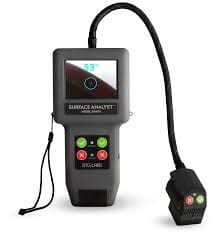
Brighton Science Surface Analyst 5001 handheld

Top pick

Brighton Science Surface Analyst 5001

Handheld industrial

4.4/ 5

On a production line, the Surface Analyst 5001 wins because it is built for this decision: a roughly two-second, one-button water-contact-angle check that operators can run consistently across shifts. It takes first place on the two criteria this use case weights most heavily, accuracy and repeatability at 18 percent and automation and throughput at 16 percent, and it leads the Dropometer by only 0.2 overall.

Where it wins

Roughly two-second one-button test; operator-independent workflow; rugged handheld format; on-device storage for approximately 40,000 tests.

Where it loses ground

Static water contact angle only; no dynamic or sliding angle, surface tension, or surface energy; proprietary consumables.
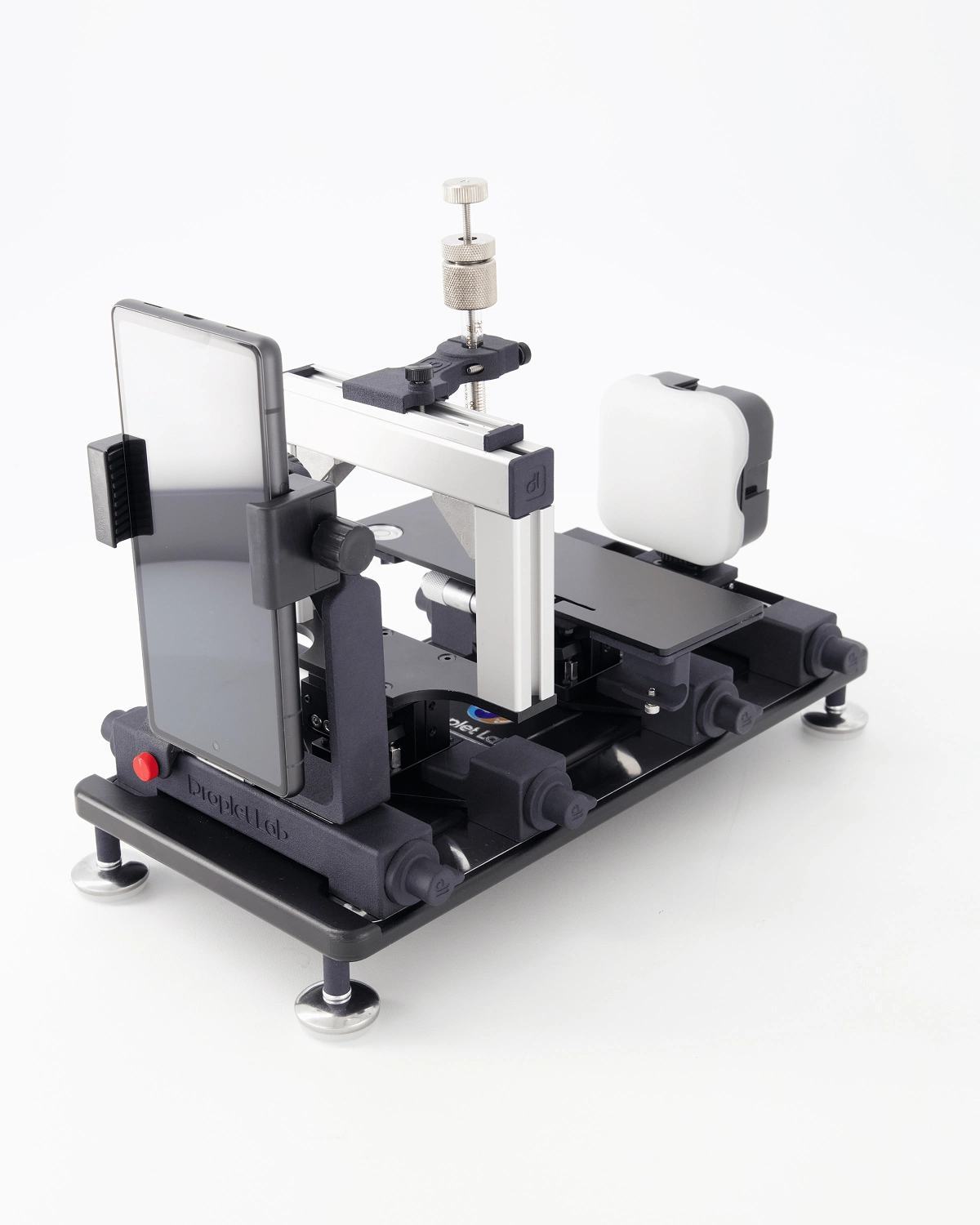
Droplet Lab Dropometer contact angle goniometer

Runner-up

Dropometer

Droplet Lab

4.2/ 5

The Dropometer is the strong alternative when QA needs traceable, reportable data rather than a bare pass/fail result. Image-based measurements and exportable datasets help with audits, supplier discussions, and failure analysis.

Where it wins

Traceable image-based results; exportable data; broader measurement scope when failures need diagnosis.

Where it loses ground

A full imaging workflow is slower per test than a one-button handheld at a high-cadence production line.

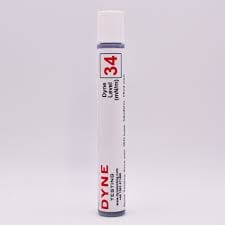
Dyne test pens for surface energy screening

Third

Dyne test pens

Threshold pens

2.9/ 5

Dyne pens are the fastest and lowest-cost surface-energy threshold check and remain common in packaging and plastics. They score below 3 here, which on our scale means they do not meet what industrial QA requires: the result is qualitative, operator-dependent, and leaves no numeric record to trend or defend. They are a useful pre-screen, not a QA instrument.

Where it wins

Instant, pocketable, inexpensive, and aligned with ISO 8296 threshold checks.

Where it loses ground

Qualitative and operator-dependent; uses hazardous fluids; limited shelf life; no digital logging.

How we arrived at these scores

Every instrument is scored from 1 to 5 against the same 11 criteria, where 3 meets typical requirements and 5 is best in class. This use-case ranking is weighted because industrial QA values different outcomes than advanced research or teaching.

Measurement scope

Static, dynamic and sliding contact angle, surface tension, and surface energy.

Optics and software

Fitting models, automation, and batch workflows.

Accuracy and repeatability *

Instrument specification and operator-to-operator Gage R&R.

Calibration and traceability

Logs, references, and standards alignment.

Automation and throughput *

Dosing, tilt, unattended runs, and cycle time.

Environmental control

Temperature and humidity options.

Data handling and security

Offline operation, exports, multi-user access, and audit trails.

Modularity and upgrades

Ability to add capability without replacing the platform.

Build quality and support *

Durability, warranty, service, and update commitment.

Total cost of ownership

Licenses, accessories, calibration, and service.

Portability and power *

Weight, battery, offline use, and setup time.

Side-by-side specification comparison

Compare the three leading options across the specifications most relevant to industrial quality assurance.

SpecificationBrighton Surface Analyst 5001DropometerDyne test pens
Measurement scopeStatic water contact angle onlyStatic, dynamic and sliding contact angle; surface tension; surface energySurface-energy threshold only
Result typeNumeric and pass/failNumeric plus image and exportable dataQualitative pass/fail
Typical test speedAbout 2 secondsSeconds to about 1 minuteInstant
AutomationOne-button, operator-independentAutomated image analysis with DropletAIFully manual
TraceabilityOn-device log of about 40,000 testsExportable logs and imagesNone
PortabilityHandheld, about 0.5 kgPortable, about 1 kg, battery poweredPocket-sized
Starting pricePrice on requestUS $4,990About US $20–$50 per pen

Specifications are drawn from publicly available manufacturer documentation and the Droplet Lab buying guide. Verify current figures, accessories, and pricing with each vendor before purchase.

Expert perspective

Production QA should optimize the entire decision workflow, not only the fastest individual test. A useful system must give operators a consistent result and preserve enough evidence to investigate failures.

Droplet Lab Editorial TeamBuyer’s guide methodology note

Frequently Asked Questions

Choose the Dropometer when audits, supplier discussions, failure analysis, or process development require traceable images and exportable numeric data rather than a simple pass/fail decision.

Dyne pens can support a simple threshold check, but they do not create numeric digital records and the interpretation remains operator-dependent. Confirm whether that evidence level satisfies your quality system.

Consistent sample positioning, operator independence, speed, traceable records, and an escalation path for failed checks are the core requirements.

No. Speed helps high-cadence screening, but measurement depth and traceability matter when a failure must be diagnosed, reported, or defended in an audit.

References

1.
Brighton Science — Surface Analyst 5001 product pageManufacturer specifications for scope, speed, and on-device data logging.
2.
Ossila — Contact Angle Goniometer product pageReference point for benchtop instrument scope.
3.
ISO 8296 — Plastics film and sheeting: determination of wetting tensionStandard underlying dyne test threshold methods.
4.
Zeus polymer extrusion manufacturing — Droplet Lab case studyProduction-floor Gage R&R deployment referenced above.
5.
Droplet Lab — Scientific ValidationPeer-reviewed benchmarking of Dropometer methods.

Not sure this is your use case?

Configure a Dropometer for your workflow and see a live price, or compare the full range side by side.