Plasma Treatment Verification for Adhesion: Check Each Plasma Surface Treatment Before Coating or Bonding
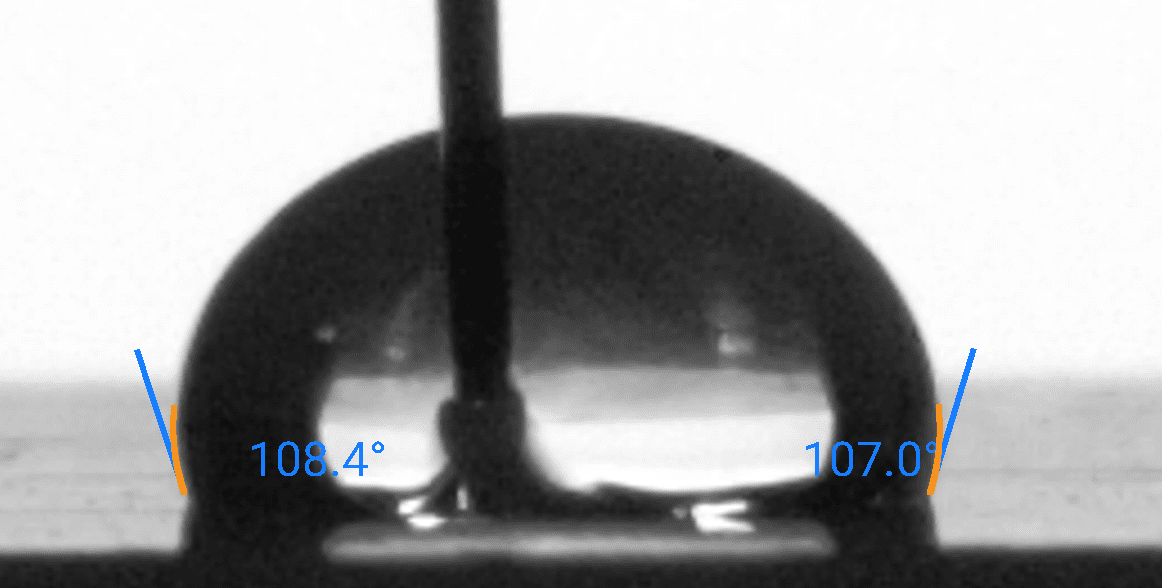
Atmospheric plasma and vacuum plasma treatment change the surface you cannot see, and the effect varies with settings, part geometry and time. Measure water contact angle on the treated substrate before coating, printing or bonding, so a weak or faded treatment is caught while the part can still be treated again.
Who this is for: Process, quality and R&D engineers running plasma treatment systems in electronics, medical device, automotive and plastics manufacturing.
Where it fits: Right after plasma treatment and before any bonding or coating step, including ink; also when you set up or change treatment settings.
What it does not do: It does not measure adhesion strength or replace your adhesion tests. It shows whether the treatment changed the surface as intended.
Droplet Lab Team
Droplet Lab builds precision instruments and software for surface science measurement, specialising in contact angle analysis and surface tension characterisation. Used by researchers across materials science, pharmaceuticals, coatings, and advanced manufacturing, Droplet Lab's Dropometer has contributed to studies published in peer-reviewed journals including Advanced Functional Materials (Impact Factor 19). The team combines instrument engineering with deep domain knowledge in wettability science with a focus on practical accuracy.

What plasma treatment does to the water contact angle and adhesion
97.1° to 14°
water contact angle on neutral polypropylene before and after 180 s of 50 W oxygen plasma.
Mandolfino et al., Polymers 11(2):202 (2019)
Up to +386.6%
lap shear strength of epoxy joints on plasma treated polypropylene compared with untreated, depending on treatment settings.
Mandolfino et al., Polymers 11(2):202 (2019)
Sources: K. Ho, T. Shiba, C.-Y. Chen, D. M. Kim, Biomimetics 10:571, 2025 (a customer publication that used the Dropometer); C. Mandolfino, E. Lertora, C. Gambaro, M. Pizzorni, Polymers 11(2):202, 2019. Figures come from these studies, not from Droplet Lab measurements.
What this plasma treatment check does and what it does not
A quick reference for engineers and quality managers checking fit before reading further.
Evidence Box
Coatings, inks and adhesives that fail because a plasma treatment was weak, uneven or had faded before the next step.
The Dropometer drop shape method was validated against a KRUSS DSA100E in two peer reviewed papers, in Review of Scientific Instruments and Colloids and Surfaces A.
Harvard School of Dental Medicine researchers used the Dropometer to measure contact angle before and after vacuum plasma treatment of titanium (Ho et al., Biomimetics, 2025).
Harvard's Center for Nanoscale Systems added a Dropometer for its users; five labs used it in seven publications in under three years.
ASTM F22 (water break) and ASTM F21 (atomizer) screen for hydrophobic films. Contact angle supplements these tests; it does not replace them.
Contact angle shows that the treatment changed the surface. Your adhesion tests still decide whether the coating or bond is good.
What plasma treatment problem are you trying to solve?
Pick the card closest to your role. Each one points to the part of this page that answers it.
Process engineer
You run an in-line atmospheric plasma or a vacuum plasma chamber and need to know that every part was treated, not just that the machine ran. A water contact angle check after treatment shows the result on the part.
Quality manager
Dyne inks give a pass or fail at set levels and depend on the operator's eye. A contact angle reading gives a number you can trend and file with the batch.
R&D engineer
You are setting up a new plasma surface treatment and need to compare gases, power, speed and distance. Contact angle and surface free energy show which settings improve wettability most, and how each surface modification lasts.
Is a contact angle check right for your plasma treatment process?
It helps when you need to confirm what the plasma did to the surface. It helps less when the coating, ink or adhesive itself is the problem.
Good fit if
Less relevant if
How to verify plasma treatment before coating or bonding
The answer in under a minute.
When a coating or bond fails after plasma, the root cause often lies at the surface. The treatment increases the surface energy so coatings, inks and adhesives can wet it for better adhesion, but the effect depends on settings, geometry and time. Measure water contact angle on each treated substrate right after treatment and compare it with a baseline from parts that passed your adhesion tests. If the angle drifts, treat again before the next step.
Your adhesion tests still decide what good looks like. This check tells you, on every part or batch, whether the plasma treatment achieved that surface. The Dropometer contact angle and surface energy kit runs it next to the line. Harvard researchers used it to measure vacuum plasma treated titanium; read our analysis of that paper and the Harvard shared facility case study. For the wider picture, read why contact angle matters for coatings and adhesives QC.
Expert perspective on reading a treated surface
Droplet adhesion is three-dimensional. Two side-view angles give an estimate; the whole story is how the angle and the contact line vary all the way around the drop.
Adhesion challenges plasma treatment solves, and the ones it creates
Many materials like polypropylene, polyethylene and PTFE have a low surface energy, so coatings, inks and adhesives bead up instead of wetting them. Metals, glass and composites carry thin organic films that do the same. Plasma treatment uses gas that has been made to ionize into ions and electrons and other charged particles. It removes organic contaminants and adds polar functional groups to the top few molecular layers, which modifies the surface properties and raises the surface energy without changing the bulk material. That is why plasma treatment is mainly used to improve adhesion before bonding, coating and printing. The catch is that the treatment is microscopic and invisible. Gas, power, speed, distance and part geometry change how much each area receives, over treatment can create weak boundary layers, and the effect fades with time and storage conditions. The machine log shows that the plasma ran; it does not show what the surface of the material looks like when the coating goes on.
Root causes of poor adhesion after plasma treatment
Why:
- Too little power, too short a time, the wrong gas or too great a distance leaves too few polar groups on the surface, so wettability and adhesion stay low.
How to detect:
Water contact angle stays close to the untreated value. The treated vs untreated surfaces experiment shows the size of change to expect.Corrective action:
- Raise power or time, or reduce speed or distance, then confirm on the part with a contact angle check.
Why:
- Atmospheric plasma nozzles treat what they pass over at the set distance. Edges, recesses and curved areas often see less. Moroni et al. (2020) found PP surface free energy and joint strength changed with plasma distance and speed.
How to detect:
- Spot to spot spread rises, with high angles at edges, corners or recesses.
Corrective action:
- Map the part, then adjust the path, distance, speed or passes until every bond or coating area meets the gate.
Why:
- The effect of plasma treatment on the surface fades as the surface reorganises and picks up airborne contaminants. Heat, humidity and long storage speed this up.
How to detect:
- Contact angle rises with time after treatment. Measure at fixed times to find how long parts stay ready.
Corrective action:
- Set a maximum time from treatment to coating or bonding, control storage conditions, and treat parts again if they go past it.
Why:
- Heavy oils, silicone or mold release can be more than the plasma removes, and handling after treatment puts contamination back on.
How to detect:
A high angle with a wide spread, or values that drift from lot to lot. Our guide to sample prep and contamination control covers how to keep samples clean.Corrective action:
- As part of surface preparation, clean heavy contamination with a solvent first, handle treated parts with gloves, and keep them covered until the next step.
Why:
- Too much energy can break polymer chains into a weak boundary layer that wets well but tears off under load.
How to detect:
Contact angle is very low, but adhesion tests fail with a thin layer of substrate on the coating. Compare with reference surface free energy values for common polymers as a sense check.Corrective action:
- Reduce power or time to the lowest setting that meets the gate, and confirm with adhesion and aging tests.
Why:
- Cure, mix, film thickness and flash off all affect adhesion performance after a good treatment.
How to detect:
- Treated surfaces match their baseline, but the coating or adhesive fails cohesively.
Corrective action:
- Check the coating or adhesive process against its specification. A surface check will not find this cause.
Not sure whether the plasma reached the surface?
Bring an untreated part, a treated part that passed and one that failed to a call, and we will compare them on screen.
What a plasma treatment record contains
Each check produces a record you can file with the batch. These records can feed into your existing quality records under ISO 9001, ISO 13485, IATF 16949 or your sector's quality system.
Part identity
Part number, material, supplier lot and the area measured.
Treatment settings
Atmospheric or vacuum plasma, gas, power, speed or time, distance and operator.
Method settings
Probe liquid, drop volume and the reading time after each drop lands.
Readings
Contact angle at each spot, the median and the spread, plus surface free energy where measured.
Decision
Release, treat again or hold, with the time from treatment to the next step.
Drop images
Automatic edge and baseline detection gives the same reading from the same image, so a reviewer can recheck any result.
What to measure after plasma surface treatment
Water contact angle on the treated substrate
Why it matters: It shows whether the treatment raised surface energy enough for wetting and adhesion.
How to interpret: Compare with an untreated reference and a treated baseline from parts that passed adhesion tests. There is no universal pass value; set gates per material and process from your own correlation study.
When it is not enough: It cannot tell you the coating or adhesive is right or fully cured.
Spot to spot spread across the treated area
Why it matters: Uneven treatment from geometry or path shows up as spread before the median moves.
How to interpret: A median inside the gate with a wide spread still means part of the area was missed.
When it is not enough: It cannot replace mapping complex parts at the areas that matter.
Surface free energy from water and diiodomethane
Why it matters: Plasma mainly raises the polar part, which relates to how adhesives and coatings wet the surface.
How to interpret: Use it to compare gases and settings, and to see what changed when the water angle drifts.
When it is not enough: Values depend on the model and liquids used; compare within one method.
Contact angle versus time after treatment
Why it matters: It shows how long treated parts stay ready in your storage conditions.
How to interpret: Set the maximum time from treatment to the next step where the angle starts to drift.
When it is not enough: Heat, humidity and packaging change the window, so check it again when they change.
Validated measurement approach for plasma treated surfaces
How the Dropometer itself has been validated, and where customers have published with it.
Peer reviewed method
The Dropometer drop shape method is published in Review of Scientific Instruments and Colloids and Surfaces A. Contact angle was validated against a KRUSS DSA100E, with a published accuracy of 0.35°.
See the validation papersCustomer publication on plasma treatment
Harvard School of Dental Medicine researchers used the Dropometer to measure saline contact angle on titanium before and after vacuum plasma treatment. Angles fell from 83.1° to 24.1° on machined discs and from 77.3° to 15.7° on rough discs (Ho et al., Biomimetics, 2025).
Read our analysis of the paperHow to implement plasma treatment verification in the manufacturing process
The steps below assume one material, one treatment system and one coating or adhesive. Repeat steps 1 to 3 for each new combination.
Lock the method
Fix the probe liquid, drop volume, reading time after the drop lands, lighting and spots. Our contact angle measurement guide covers the basics.
Baseline untreated and treated
Measure an untreated part and a treated part that passed your adhesion tests, at five or more spots each.
Set the gates
Treat parts at lower and higher settings, coat or bond them, and run adhesion tests. Set release, treat again and hold bands where adhesion changes. Keep your ASTM F22 water break or ASTM F21 atomizer screen if your process uses one.
Check after treatment
Check each part or batch after treatment and before coating, printing or bonding, within the time window you set for the production process.
Release, treat again or hold
Release parts inside the gates. Treat again outside them, and hold parts that fail twice.
Record and watch the trend
Store readings with the part, lot and treatment settings, and check the baseline again after any change to gas, nozzle or treatment system.
We completed our gage R&R study on the unit and it performed very well.
Brandon Barbee
Corporate Quality Engineer - Zeus Industries - Polymer Manufacturing
Download the plasma treatment verification SOP
A two page SOP you can adapt for your material, plasma system and coating or adhesive, with the method lock, gate setting steps and a record sheet.
Contact angle and surface energy measurement with the Dropometer
What a plasma treatment verification record looks like
Example data only. Your gates and values will differ and must come from your own adhesion tests.
Example gate: within 8° of the treated baseline with spread up to 4°. The grey row is an untreated reference. Green rows are released, amber rows are treated again, red rows are held.
Example plasma treatment log
| Part | Treatment | Area | Time since treatment | Median (°) | Spread SD (°) | Versus baseline | Result |
|---|---|---|---|---|---|---|---|
| Untreated reference | None | Face | n/a | 94.2 | 1.6 | Untreated | Reference only |
| Batch 41 coupons | Atmospheric air plasma | Face | 5 min | 48.7 | 2.0 | Baseline | Release |
| Housing 5120 | Atmospheric air plasma | Face | 20 min | 50.9 | 2.4 | +2.2 | Release |
| Housing 5121 | Atmospheric air plasma | Inner corner | 20 min | 63.5 | 5.1 | +14.8 | Treat again |
| Housing 5122 | Atmospheric air plasma | Face | 4 days | 76.0 | 3.3 | +27.3 | Hold: treat again and retest |
Example data, not customer data. Water contact angles on a molded polymer housing, read at a fixed time after deposition.
The order to check signals after plasma treatment
Check these in order. Each one rules out a cause before you look at the next.
Contact angle versus treated baseline
Shows whether the treatment achieved the surface you qualified.
Distance from untreated
An angle close to the untreated reference means the treatment was missed or has faded.
Spot to spot spread
Shows whether geometry or path left areas under treated.
Time since treatment
Links a drift to storage time and conditions.
Surface free energy
A two liquid reading shows what changed. The surface free energy calculator turns contact angles into a value.
Common questions about plasma treatment verification
Questions teams ask about plasma treatment, dyne testing and contact angle.
How do you verify plasma treatment?
Measure water contact angle on the treated part soon after treatment and compare it with an untreated reference and a baseline from parts that passed adhesion tests. A drop that spreads more means higher surface energy. Check several spots to see uniformity, and repeat after storage to see how long the treatment lasts. Dyne inks and water break tests give quick screens alongside it.
Is contact angle better than dyne ink testing?
They answer different needs. A dyne test evaluates wetting tension with inks at set levels and gives a fast pass or fail, and the result depends on the operator's reading of the ink. Contact angle measurement gives a number for each spot that you can trend, compare between lines and file with the batch. Many teams keep dyne inks for quick checks and use contact angle to set and review the gates.
What is the difference between atmospheric plasma and vacuum plasma?
Atmospheric plasma runs in open air, often in-line, with a nozzle that treats what it passes over. Vacuum plasma treats whole parts inside a chamber at low pressure, which suits complex geometry and batches. Both raise surface energy; the settings, gas and part shape decide how evenly. Corona treatment is a related treatment technology used mostly on films. The verification check is the same for both types of plasma.
How long does plasma treatment last?
It varies depending on the type of material, gas, settings and storage conditions. Some surfaces stay ready for hours, others for days, and heat and humidity shorten the window. Moroni et al. (2020) saw only small changes in PP joint failure load when bonding was delayed up to 24 hours at their settings. Measure contact angle at fixed times on your own parts to set the window.
Can plasma treatment be too strong?
Yes. Too much power or time can break polymer chains into a weak boundary layer that wets very well but tears away under load. A very low contact angle with failed adhesion tests is the sign. Set gates from adhesion results, not from the lowest angle you can reach.
Which materials benefit from plasma treatment?
Low surface energy polymers such as polypropylene, polyethylene and PTFE benefit most, along with silicones, textiles and composites. Metals and glass also benefit when plasma cleaning technology removes thin organic films. Wettability determines how easily a liquid spreads on a surface; our glossary entry on wettability explains it, and the medical device guide covers plasma before coating and bonding of device parts.
What should we look for in an instrument for this check?
It should measure contact angle and surface free energy on parts next to the line, use a published method and give repeatable results across operators. Check how it handles small and curved areas. Our guide to the best contact angle goniometer for industrial QA compares options.
What changes when you verify plasma treatment on the part
Typical changes in how teams work. Benchmarks are given only where a published source exists.
Before and with plasma treatment verification
| Metric | Before Dropometer | With Dropometer | Indicative Benchmark |
|---|---|---|---|
| Proof the treatment worked | Machine log shows the plasma ran | Contact angle on the part | Vacuum plasma cut titanium contact angle from 83.1° to 24.1° (Ho et al., 2025) |
| Effect of treatment on adhesion | Assumed from settings | Gates set from adhesion tests | Plasma raised epoxy lap shear on PP by up to 386.6% (Mandolfino et al., 2019) |
| Uniformity on complex parts | Unknown until a coating fails | Mapped spot by spot | No published benchmark; track on your own parts |
| Time from treatment to next step | Set by habit | Set from measured drift | No published benchmark; track on your own parts |
| Failure investigation | Plasma, coating and cure all suspected | Record shows whether the surface matched baseline | No published benchmark; track on your own parts |
See the check on your own treated parts
Bring an untreated part, a treated part that passed and one that failed. We will show the difference on a call.
Estimate the cost of failures from weak or faded plasma treatment
Enter your own numbers. The result is an estimate, not a Droplet Lab claim.
Plasma Treatment Verification ROI Snapshot
Estimate avoided rework from weak, uneven or faded plasma treatment.
Result
Monthly savings = preventable rework cost + preventable scrap cost + other monthly savings.
What a plasma treatment check cannot tell you
Honest limits, so you know when to reach for another test.
The check confirms that the treatment changed the surface as intended. Adhesion strength, cure, durability and surface chemistry still need adhesion tests, aging tests or surface analysis.
Standards, evidence and related surface treatment workflows
These pages cover the standards, the customer evidence and the other surface problems behind this check.
Standard
ASTM F22
Water break test for hydrophobic surface films.
Standard
ASTM F21
Atomizer test for hydrophobic surface films.
Case study
Harvard shared facility
How one Dropometer served five labs and seven publications.
Published paper
Ho et al. (2025): our analysis
Vacuum plasma treatment of titanium, measured with the Dropometer.
Instrument
Dropometer
Contact angle and surface free energy on treated parts next to the line.
Related use case
Bonding and adhesion reliability
All bonding and adhesion use cases in one place.
Related use case
Silicone and invisible residue detection
Find silicone and other films that block adhesion.
Related use case
PCB surface prep
Solder mask, conformal coating and cleanliness checks.
Guide
Medical device guide
Where wetting checks fit in device coating and bonding.
How this page was created
Editorial and technical transparency notes for this page.
Drafting assistance
Drafted with Claude Opus 5.5 (Anthropic) using web search for sources, then edited by the Droplet Lab team.
Technical review
Reviewed and edited for technical accuracy by the Droplet Lab Team.
Verification steps
Standard identifiers, units, thresholds and key procedural claims are checked against cited sources before publication.
Updates
Reviewed every 12 months or when the underlying method changes.
Report a correction
Spotted an issue in this summary? Send a correction request and our team will review it.
Correction Request
We work hard to keep this page accurate and up to date. If you spot an error (wrong revision/year, missing requirement, incorrect interpretation, or broken link), tell us and we'll review it.
Contact us to report a correction