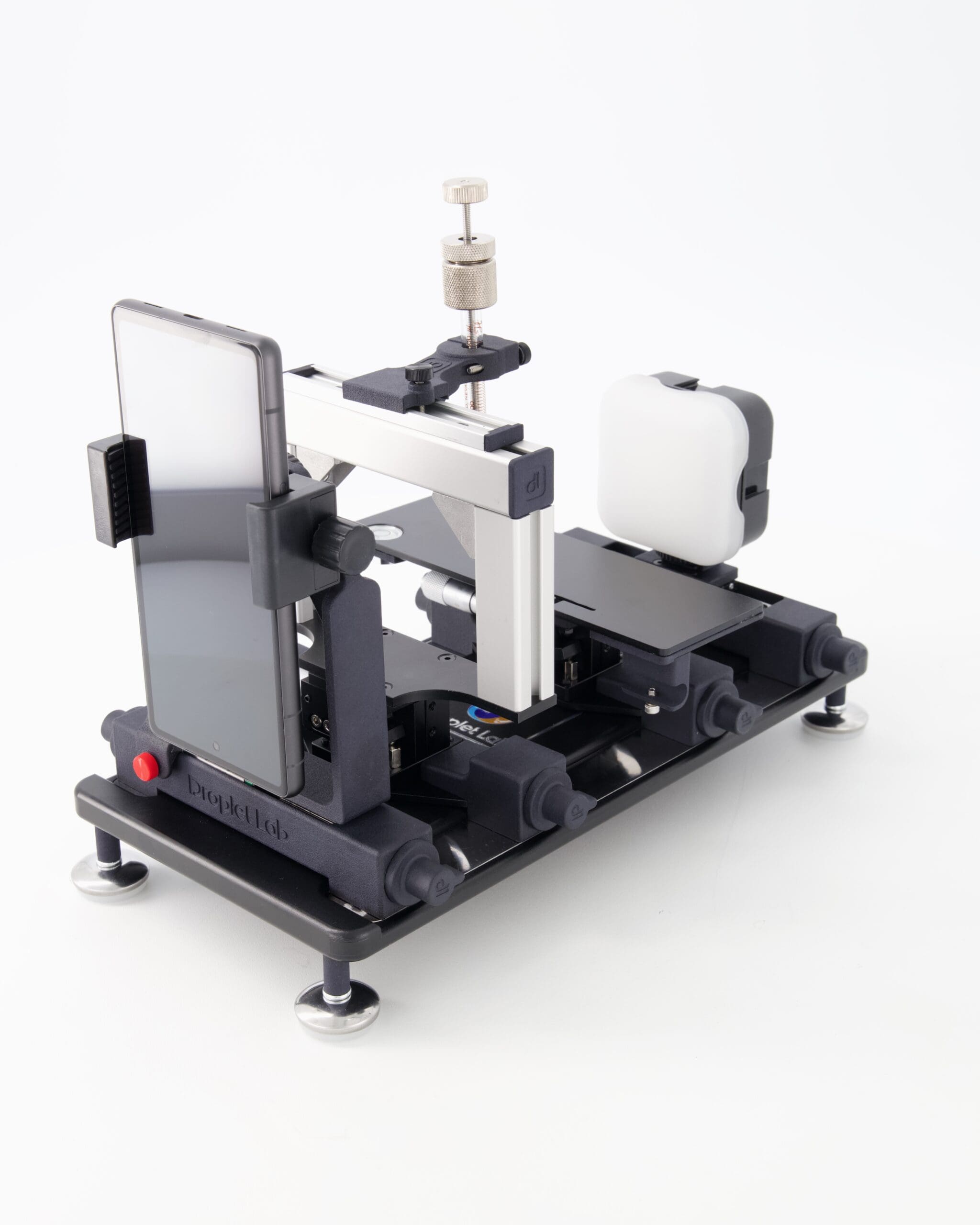
Dropometer
From US $4,990

Product comparison
Both tell you something about surface energy but at very different resolutions. Dyne test pens are a fast, cheap, pass/fail check: draw the pen across a film and see whether the ink holds or beads to bracket the surface energy to within a couple of units. The Dropometer measures the actual contact angle and computes full surface free energy including the polar and dispersive parts non-destructively, with a traceable record. Dyne pens became the default fast screen only because real measurement used to be slow and manual. Now that AI automates the measurement, the Dropometer can do the screening job too and hand you the number, and the reason, that a pen only gestures at.
From US $4,990
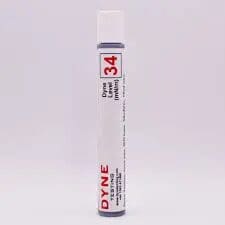
~$7–11 per pen; ~$109 per 16-level set


Droplet Lab builds precision instruments and software for surface science measurement, specialising in contact angle analysis and surface tension characterisation. Used by researchers across materials science, pharmaceuticals, coatings, and advanced manufacturing, Droplet Lab's Dropometer has contributed to studies published in peer-reviewed journals including Advanced Functional Materials (Impact Factor 19). The team combines instrument engineering with deep domain knowledge in wettability science with a focus on practical accuracy.
Dyne pens earned their place as the default screening tool for one reason: until now, a real surface measurement was slow, manual and benchtop, so a cheap pen that answered in seconds won by default. Automated, AI-based measurement removes that premise. The Dropometer gives you the same "has something changed?" signal the pens are actually used for but quantitatively, non-destructively, and logged; and it adds what a pen fundamentally can't: whether a surface is clean or contaminated, how it behaves dynamically, and the receding angle that predicts dewetting. Dyne pens aren't junk; they're a coarse change-signal with real blind spots. If your only need is a high-frequency threshold check and you can live with a subjective, drifting, destructive read, they still work. But if you want the screen and the real measurement in one tool, the Dropometer is built to replace the pen, not sit beside it.
Dyne pens and the Dropometer sit at opposite ends of the surface-energy toolkit. A dyne pen is a consumable that brackets a solid's surface energy by whether a calibrated fluid wets it. The Dropometer is an instrument that measures the contact angle a liquid makes with a surface and computes surface free energy from it. One screens; the other quantifies.
Both address solid surface energy the property that governs wetting, adhesion, printing and coating.
Both are used in the same industries: packaging, converting, automotive, aerospace and medical-device manufacturing often on the same corona/plasma/flame-treated surfaces.
A pen returns a pass/fail against one dyne level (~2 mN/m bands); the Dropometer returns a quantitative angle (0.01° resolution) and a surface-energy value.
Dyne pens give a single total surface energy; the Dropometer resolves the polar and dispersive components, which is what actually diagnoses an adhesion or ink problem.
The pen deposits a dyed, hazardous fluid on the part and relies on a by-eye call; the Dropometer uses a small, often-evaporating drop and logs a traceable result; non-destructive and auditable.
Dyne fluids age (6-month shelf life) and contaminate through use, so their calibration wanders; the Dropometer has no consumable to expire.
A dyne pen answers a binary question: is the surface above this level, yes or no and it answers it fast and cheaply. That is genuinely useful on a production line where the spec is a threshold. What it can't do is tell you how far above or below, why, or whether the number you got yesterday is comparable to today's. The Dropometer answers those: it turns a threshold check into a measurement you can trend, compare between operators and sites, and defend in an audit. Different questions but no longer different tools by necessity: automated AI fitting makes a real measurement fast enough to serve as the screen, so one instrument can do the quick check and the quantitative work the pen can't.
Prof. Steven Abbott puts the limitation bluntly: surface energy predicts wetting, not adhesion. Going from 32 to 38 dynes is about a 20% change in surface energy, yet adhesion typically jumps from nothing to strong; an improvement thousands of times larger than surface energy alone can explain, because real adhesion comes from molecular entanglement across the interface, not the dyne number. So a dyne reading is genuinely useful as a change-signal — "if the dynes change, something in my process is different, probably worse" — but it does not tell you whether a part will actually bond. Reading a pen as if it predicted adhesion is the most common way it misleads.
Two surfaces can read "38 dyne" on a pen and behave completely differently in a coating or print process, because total surface energy hides the balance between its polar and dispersive parts and that balance is what determines whether a specific ink or adhesive will bond. Dyne pens can't see it; measuring contact angle with more than one test liquid and applying a model (e.g., Fowkes, Oss & Good) resolves it. When adhesion fails intermittently despite a passing dyne check, this is usually why.
Two of the failures that actually bite in production are invisible to a dyne pen. The first is contamination: a nanolayer of oil or plasticizer can wreck adhesion on a surface that still "passes" its dyne check and, as Dr Abbott notes, a contact-angle device can readily pick up the difference between a clean and a contaminated surface. The second is dewetting: whether a coating forms pinholes is governed by the receding contact angle, not the single advancing or equilibrium value a pen (or a one-shot drop) reflects. Measuring the receding angle is exactly the kind of thing a pen cannot do and an automated instrument can.
Where a dyne pen is still the pragmatic choice, we'll say so. For a rapid, low-cost threshold check with no device on hand, a pen is hard to beat; no capital, no power, no training, an answer in seconds. If your spec is simply "≥38 dyne before printing" and you run that check hundreds of times a shift, pens remain defensible today. But that niche is narrowing: once the measurement itself is automated, the instrument that also detects contamination, measures the receding angle and leaves a record starts to win even the quick-check job.
A single pen answers one threshold; bracketing a surface needs a range, so the real entry cost is a set at about $109, not a few dollars. Pens look almost free, but they're a recurring consumable with a 6-month shelf life that degrades as the fluid contaminates through use, so results drift and pens are re-purchased continually. The fluids are classified as hazardous; requiring ventilation, skin/eye protection, and a warning against use by pregnant staff which carries its own handling and compliance overhead. The Dropometer is a one-time purchase that uses ordinary test liquids (often just water) and doesn't expire.
| Criterion | Dyne Pens / Dyne Test | Dropometer |
|---|---|---|
| Type | Consumable screening pens | Integrated instrument |
| What it measures | Solid surface energy — total only | Contact angle → surface free energy (polar + dispersive), surface tension |
| Output | Pass/fail vs a dyne level | Quantitative angle & surface-energy value |
| Range | 30–72 mN/m (dyne levels) | CA 10°–175°; SFE via models; tension up to 75 mN/m |
| Resolution | ~2 mN/m band (typical pen steps) | 0.01° / 0.01 mN/m |
| Polar / dispersive components | Total only | Via multi-liquid models |
| Predicts adhesion / dewetting risk | Dyne ≠ adhesion (change-signal only) | Receding angle + contamination detection |
| Method | Subjective visual (film ≥3 s vs bead ≤1 s) | Optical drop-shape, AI-guided fitting |
| Non-destructive | Deposits dyed fluid on the surface | Small test-liquid drop (often water) |
| Dynamic / sliding angle | No | Yes |
| Liquid surface tension | No | Pendant drop |
| Materials | Mainly polymers / films | Any solid surface |
| Consumable / drift | Yes — 6-month shelf life; contaminates with use | No consumable fluids |
| Traceability / audit logs | Manual, subjective | Built-in calibration & logs |
| Safety | Hazardous fluids; ventilation; pregnancy warning | No hazardous reagents required |
| Speed | Seconds per check | ~1 min per measurement |
| Cost | ~$7–11 per pen; ~$109 per 16-level set | ~$4,990 base (one-time) |
| Portability | Pocket-portable | 1 kg, battery up to 8 h |
| Standards / basis | ISO 8296 (test fluid) | Young-Laplace, Fowkes, Oss & Good etc.; peer-reviewed validation |
Dyne-pen specifications are drawn from the Dyne Testing product data sheet and ISO 8296 product page and may change; per-pen pricing and dyne-level increments are published by ACCU DYNE TEST and used here.
This comparison draws the dyne-pen details from Dyne Testing's published product data sheet and its ISO 8296 product page, and the Dropometer's capabilities from its own datasheet and peer-reviewed validation (including Review of Scientific Instruments, with Dropometer data contributing to studies in journals such as Advanced Functional Materials, Impact Factor 19). The adhesion and dewetting context is drawn from Prof. Steven Abbott's independent article Beyond 38 dynes (an unpaid contribution with no commercial affiliation to Droplet Lab). We haven't overstated the case: where a dyne pen is still the cheaper, faster tool for a bare threshold check, we say so plainly. Dyne pens' resolution (~2 mN/m), shelf life (6 months) and hazard classification are as stated by the vendor.
The most important thing a dyne pen can't tell you is whether your part will actually stick because the dyne number and adhesion aren't the same story. And on what to measure instead; the clean-vs-contaminated check and the receding angle that governs dewetting, neither of which a pen can do:
"Adhesion comes from entanglement between coating and substrate, not from the dyne number itself — the reading is useful mainly as a signal that something in your process has changed."
"Surface energy predicts wetting, not adhesion."
"Your Droplet Lab contact angle device can readily pick up the differences between a clean and contaminated surface."
"To see if your coating will de-wet, you need to measure the receding contact angle."
The implication for this comparison: keep using the dyne reading as a change-signal if you like, but the questions that decide whether a coating bonds or dewets: contamination, receding angle, the polar/dispersive balance; need an actual measurement, and that measurement is now fast enough to be your screen.
Dyne pens. Cheapest, fastest tool for a threshold check, and an instrument would only slow the line down.
Dropometer. You need the polar/dispersive split and a quantitative number to find the cause.
Dropometer. Logged, calibrated, non-subjective results replace a by-eye judgement.
Dropometer. Dynamic/sliding angles, surface tension and full surface energy well beyond a pen's scope.
Because AI automates the measurement, the Dropometer can serve as the fast screen and give you the number, the contamination check and the dewetting insight a pen can't; consolidating a drifting consumable and a separate instrument into one auditable workflow.
Dyne pens have been the default fast screen because, until now, real measurement was too slow to use that way. That's changed. The Dropometer screens as fast as the decision needs while also giving you what a pen can't — the actual number, the polar/dispersive breakdown that explains adhesion, contamination detection, the receding angle behind dewetting, plus liquid surface tension and materials beyond polymer film; all non-destructively and on a traceable record, with no hazardous consumable to expire. Pens aren't junk, and for a bare high-frequency threshold check they're still cheap and quick; but for a screen that actually tells you what's happening on the surface, the Dropometer is built to take their place.
For a threshold pass/fail on a clean, freshly treated polymer surface, they're often quite accurate when new. Their weaknesses are resolution (~2 mN/m bands), subjectivity (a by-eye film-vs-bead call), and drift; the fluids age within ~6 months and contaminate through use, so accuracy degrades over a pen's life.
Increasingly, yes. Now that AI automates the measurement, the Dropometer is fast enough to serve as the routine screen while also delivering the number, contamination check and dewetting insight a pen can't — on a traceable record, with no hazardous consumable. The one job where a pen still wins on marginal speed and cost is a bare, high-frequency threshold check with no device on hand; even there, remember the dyne reading is only a change-signal, not an adhesion measure.
Because total surface energy hides the polar/dispersive balance that actually determines whether a given ink or adhesive will bond. Two surfaces with the same dyne reading can behave very differently; contact angle with multiple liquids reveals the difference.
Not directly. As surface scientist Prof. Steven Abbott points out, going from 32 to 38 dynes is only about a 20% change in surface energy, while real adhesion can improve thousands-fold — because adhesion comes from molecular entanglement, not the dyne number. The reading is best used as a signal that something in your process has changed; contact-angle measurement, including the receding angle and contamination detection, is what actually explains bonding and dewetting.
See how the Dropometer stacks up against other goniometers, tensiometers and screening tools.
Independent benchmarking and publication-based validation references.
Dropometer contact angle and pendant-drop surface tension methods have been benchmarked against KRÜSS DSA100E reference measurements.
Our instruments are referenced in peer-reviewed journals, theses, and conference publications.