



Contents

Contact Angle Buyer's Guide

Best Contact Angle Goniometer for Advanced Research

Our pick for research groups that need the full static, dynamic, sliding, surface energy and surface tension toolkit with reporting that will survive peer review. Every score below is calculated from published weights and criterion scores that you can check or replace with your own.

Abhimanyu Photo
Written by
Abhimanyu Bhandankar
Holds an MBA from Schulich School of Business and a BE in IT. He joined Droplet Lab in July 2019 and now leads sales and marketing.
CEO at Droplet Lab
Read More
Gurdeep-Saini-Photo
Technical Review by
Gurdeep Singh Saini
Holds a BASc in Mechanical Engineering (Ryerson) and an MASc from York University. He focuses on the custom AI behind the instrument.
COO at Droplet Lab
Read More
Abhimanyu Photo
Written By

Abhimanyu Bhandankar

CEO at Droplet Lab

Holds an MBA from Schulich School of Business and a BE in IT. He joined Droplet Lab in July 2019 and now leads sales and marketing.

Gurdeep-Saini-Photo
Reviewed By

Gurdeep Singh Saini

COO at Droplet Lab

Holds a BASc in Mechanical Engineering (Ryerson) and an MASc from York University. He focuses on the custom AI behind the instrument.

The short answer

For peer-reviewed and regulated research, where measurement scope, optical fidelity and demonstrated accuracy matter more than portability or purchase price, the ranking below uses a weighting tuned to advanced research. Measurement scope, optics and software, and accuracy and repeatability carry 15 percent each; total cost of ownership and portability together carry 5 percent.

The ranking

Three options ranked for advanced research, from the fully automated benchtop platform to a portable research-grade alternative and an affordable static-angle bench unit.

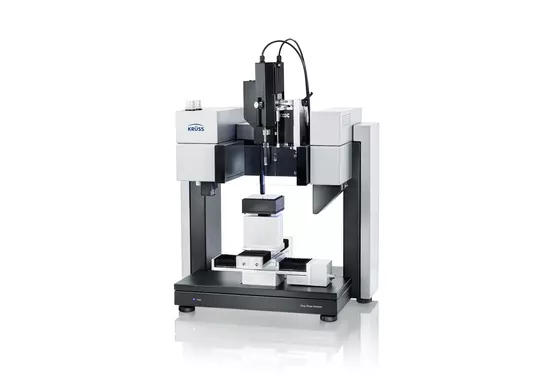
Premium benchtop systems (KRÜSS DSA100, Biolin Theta Flex, DataPhysics OCA, ramé-hart)

Top pick

Premium benchtop systems (KRÜSS DSA100, Biolin Theta Flex, DataPhysics OCA, ramé-hart)

Premium benchtop

4.9/ 5

Premium benchtops take first place because they deliver the complete audit-ready toolkit on one platform: static, advancing and receding angles, sliding angle via motorized tilt, surface energy, and pendant-drop surface tension, with advanced optics, programmable automation, environmental modules and traceable reporting. They score 5 out of 5 on ten of the eleven criteria, which is why the total sits at 4.9 despite the worst cost profile in the category.

Where it wins

Full measurement scope on a single instrument; motorized XYZ, programmable multi-syringe dosing and automated tilt; high-speed optics to 3450 fps with real-time fitting; built-in calibration routines, certified standards and full audit trails; modular climate and liquid-handling upgrades.

Where it loses ground

$20,000 to $100,000 or more before training, installation, service and modules; roughly 24 kg and not portable; requires a dedicated lab install, stable power and trained personnel. It scores 2 out of 5 on total cost of ownership, but that criterion carries only 3 percent here.
Dropometer

Runner-up

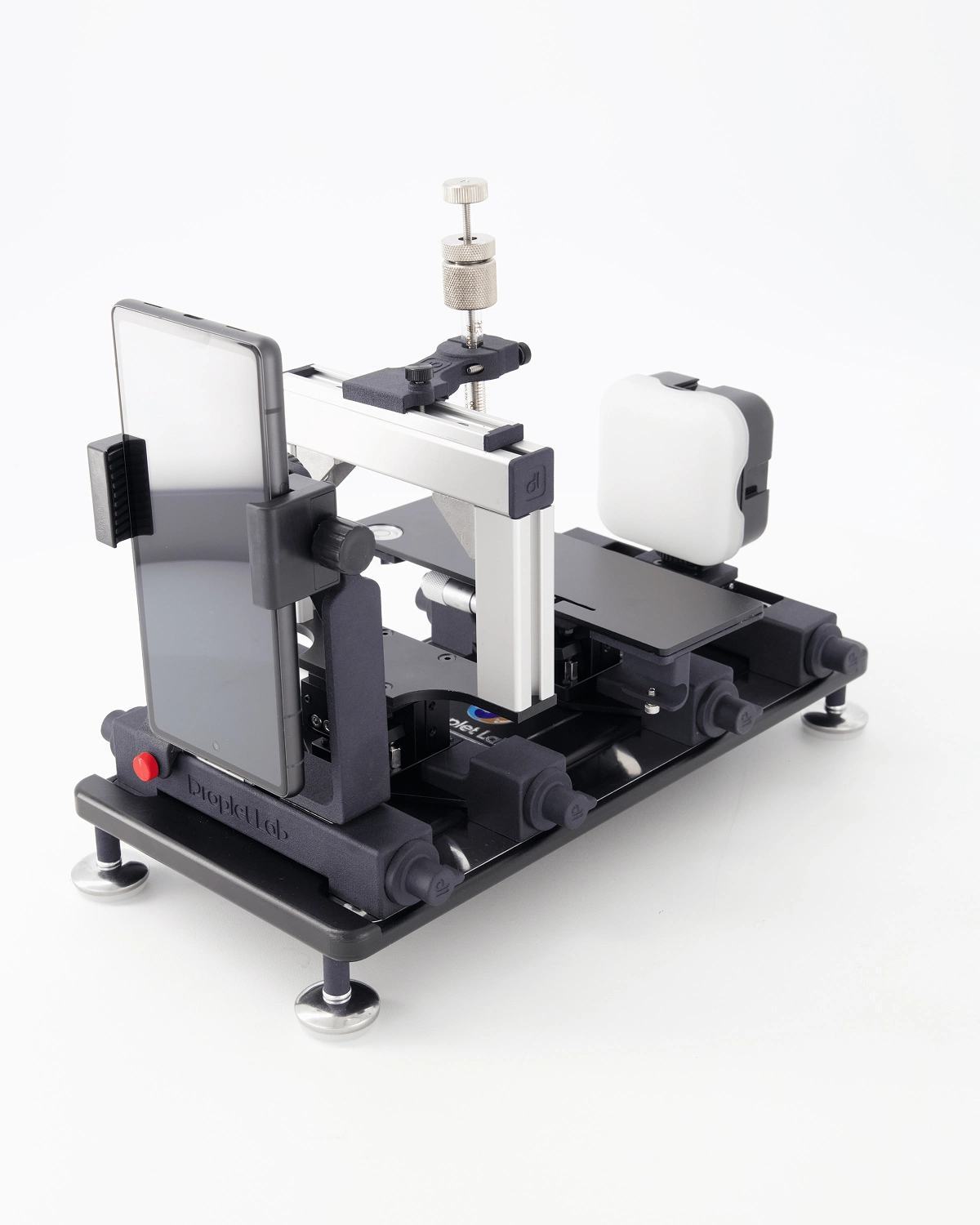
Dropometer

Droplet Lab

4.1/ 5

The Dropometer ranks second because it matches the premium benchtops on measurement scope and comes close on optics and accuracy, with peer-reviewed fitting algorithms benchmarked against a KRÜSS DSA100E at 0.01° stated resolution. The 0.8 gap is almost entirely automation and environmental control, where it scores 3 and 2.5 against a benchtop's 5.

Where it wins

Peer-reviewed algorithm validation; 0.01° resolution with 0.35° datasheet instrument accuracy; full contact angle, surface tension and surface energy scope; automatic dropper and tilt stage available; portable, battery powered and fully offline.

Where it loses ground

No robotic automation depth, no integrated environmental chamber, and no vendor-validated regulated software stack; manual sample preparation and drop placement still drive part of the variability.

Ossila Contact Angle Goniometer

Third

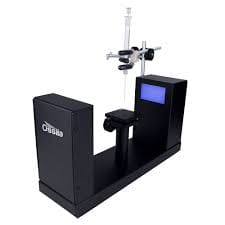
Ossila Contact Angle Goniometer

Entry benchtop

2.9/ 5

Ossila scores below 3 here, which on our scale means it does not meet what advanced research requires. It is a capable, accurate bench unit and it scores 5 out of 5 for cost, but this use case weights scope, optics and accuracy at 15 percent each, and a manual static-angle instrument without dynamic measurement, traceable logs or an upgrade path cannot reach the bar. That is a statement about fit, not about build quality.

Where it wins

About $3,000 with a two-year warranty; ±1° stated accuracy; static contact angle plus pendant-drop surface tension; Young–Laplace and polynomial fitting; compact and semi-portable.

Where it loses ground

No dynamic or sliding angle, which removes hysteresis work entirely; manual sample handling with no dosing or tilt automation; mains power and a Windows laptop required; no environmental control, calibration logs or upgrade path.

How we arrived at these scores

Side-by-side specification comparison

Compare the three leading options across the specifications most relevant to advanced research.

SpecificationPremium benchtop systemsDropometerOssila
Measurement scopeStatic, advancing, receding and sliding contact angle; surface energy; pendant-drop surface tensionStatic, dynamic and sliding contact angle; surface tension; surface energyStatic contact angle; pendant-drop surface tension
Stated resolution and accuracy0.01° and 0.01 mN/m resolution; 0.1° instrument accuracy (KRÜSS DSA100E)0.01° and 0.01 mN/m resolution; 0.35° contact angle and 0.03 mN/m surface tension datasheet accuracy±1° stated
Optics and fittingHigh-resolution, high-speed optics to 3450 fps; real-time fittingSmartphone camera; DropletAI contact-point detection; peer-reviewed Young–Laplace and polynomial fitting1080p camera; polynomial and pendant-drop fitting
AutomationMotorized XYZ, multi-syringe dosing, automated tilt, batch processingAutomated analysis; optional dosing and tilt modulesManual, software assisted
Environmental controlOptional temperature and humidity modulesOptional enclosures and upgrade pathNone
TraceabilityFull logs, certified standards, validated softwareBuilt-in calibration prompts and exportable logsBasic calibration sphere
PortabilityBenchtop only, about 24 kgAbout 1 kg, battery powered, fully offlineBenchtop, mains powered, laptop required
Starting price$20,000 to $100,000+US $4,990About US $3,000

Expert perspective

A research instrument should be chosen on the measurement scope the group will actually publish, not the widest scope on the datasheet. The useful question is which parameters will appear in a paper or a regulatory file, and whether the instrument and the fitting model behind each number can be defended when a reviewer asks.

Droplet Lab Editorial TeamBuyer's guide methodology note

Resolution is not accuracy, and surface-energy values depend on the model used. Equation-of-state and acid–base approaches can return materially different results from the same contact-angle data, so report the model alongside every value.

Frequently Asked Questions

When the protocol genuinely requires unattended robotic dosing, integrated climate control, vendor-validated regulated software, or hysteresis studies at high frame rates. If none of those appear in your method, you are paying for capability that will sit unused.

Because a score here measures fit against what advanced research requires, not absolute quality. Ossila scores 5 out of 5 on cost and 3.5 on accuracy, but this use case weights measurement scope at 15 percent and Ossila covers static angles only. On a page with different requirements it scores considerably higher.

Yes, provided the measurement method is validated and reported. The Dropometer's fitting algorithms have been benchmarked against a KRÜSS DSA100E in two peer-reviewed studies. Report the fitting model and the surface-energy model used with every value.

No. Resolution is the smallest increment an instrument can display. Accuracy is how close the displayed value sits to the true value and depends on optics, fitting algorithm and droplet quality. Verify any accuracy claim against a calibration sphere or a certified liquid.

References

1.
KRÜSS DSA100 technical specificationsManufacturer specifications for scope, automation and instrument accuracy.
2.
Ossila — Contact Angle Goniometer product pageManufacturer specifications for the entry benchtop unit.
3.
Contact angle measurement with a smartphone — Review of Scientific Instruments (2018)Peer-reviewed validation of the contact-angle fitting algorithm.
4.
Surface tension measurement with a smartphone using a pendant drop — Colloids and Surfaces A (2017)Peer-reviewed validation of the pendant-drop surface tension method.
5.
Droplet Lab — Scientific ValidationBenchmarking against the KRÜSS DSA100E reference instrument.

Not sure this is your use case?

Configure a Dropometer for your workflow and see a live price, or compare the full range side by side.