



Contents
Case Study

Its European lab feared a standard part would not survive its harsher chemistries. Droplet Lab made PTFE slide mounts, and the US lab ordered the same setup.

Last Updated
October 18, 2026
Industry
Specialty plating and surface finishing chemicals
Sites
European and US R&D labs
Configuration
Automatic dropper, four measurement apps, PTFE slide mounts
Customer since
May 2023
Image
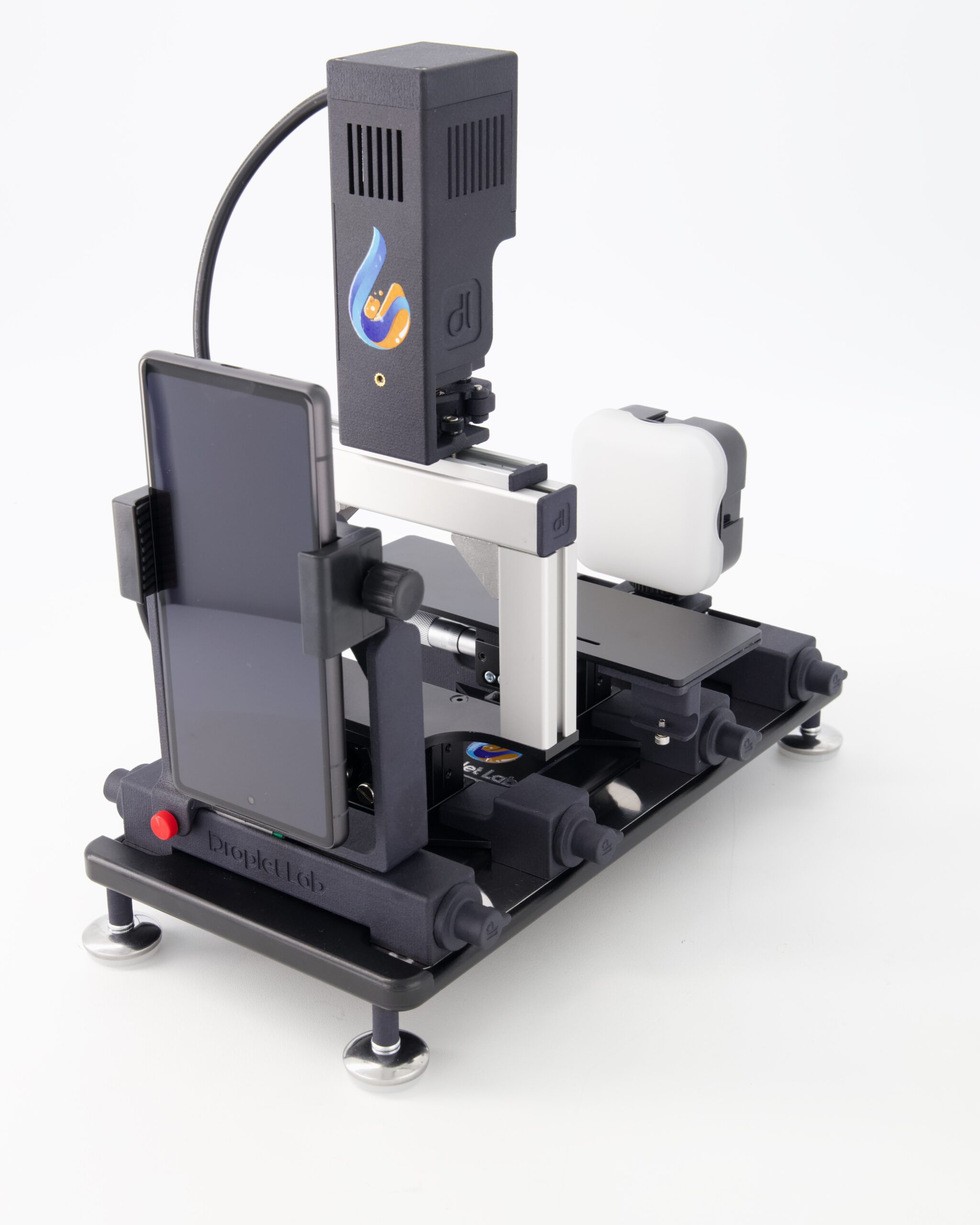
Standard model shown; the client's units add PTFE slide mounts
Second site ordered on the first site's referral Drop shape method validated against a KRÜSS DSA100E in peer review Published contact angle accuracy of 0.35°

A global maker of plating and surface finishing chemistries needed contact angle and surface tension on its own process solutions, some of them caustic. Its European wet chemistry group asked whether the standard Nylon 12 parts could be made in PTFE. Droplet Lab designed PTFE slide mounts for the tilting stages, and the group ordered a Dropometer with the automatic dropper in May 2023. In 2024 its US R&D lab asked to match that setup and ordered the same configuration.

Standard Dropometer with the automatic dropper. Product photo only; the client's units add custom PTFE slide mounts on the tilting stages.
Abhimanyu Photo
Written by
Abhimanyu Bhandankar
Holds an MBA from Schulich School of Business and a BE in IT. He joined Droplet Lab in July 2019 and now leads sales and marketing.
CEO at Droplet Lab
Read More
Gurdeep-Saini-Photo
Technical Review by
Gurdeep Singh Saini
Holds a BASc in Mechanical Engineering from Ryerson University (now Toronto Metropolitan University) and an MASc from York University. He develops the automatic edge and baseline detection behind the Dropometer's analysis.
COO at Droplet Lab
Read More
Abhimanyu Photo
Written By

Abhimanyu Bhandankar

CEO at Droplet Lab

Holds an MBA from Schulich School of Business and a BE in IT. He joined Droplet Lab in July 2019 and now leads sales and marketing.

Gurdeep-Saini-Photo
Reviewed By

Gurdeep Singh Saini

COO at Droplet Lab

Holds a BASc in Mechanical Engineering from Ryerson University (now Toronto Metropolitan University) and an MASc from York University. He develops the automatic edge and baseline detection behind the Dropometer's analysis.

Primary outcome: one proven setup, repeated at a second site

Two R&D labs, one configuration with PTFE slide mounts

Automatic dropper, four measurement apps and custom PTFE slide mounts on the tilting stages

European wet chemistry lab Automatic dropper and PTFE slide mounts, onboarded 14 September 2023
US R&D lab Same configuration, delivered 25 October 2024, onboarded 25 November 2024

The European wet chemistry group asked whether the standard Nylon 12 parts could be made in PTFE, because of the harsher chemistries it studies. Droplet Lab designed PTFE slide mounts for the manual and automatic tilting stages, approved by the group on 13 June 2023. When the US lab ordered in 2024, the supplier offered UHMW polyethylene instead. The lab chose to wait for PTFE, to match what the European lab already used.

2 R&D sites

European and US labs running the same configuration.

4 measurements

Contact angle, surface tension, surface energy and sliding angle on one base.

PTFE slide mounts

Custom mounts for the manual and automatic tilting stages, specified for caustic liquids.

1 referral

The US lab came to Droplet Lab on the European lab's recommendation.

Executive Summary

Who

A global maker of plating and surface finishing chemistries, mainly for electronics manufacturing. The users are R&D scientists in its European wet chemistry group, which works on stripping, etching and cleaning, and in its US R&D lab.

Problem

The European group studies harsh plating chemistries and was concerned that the standard Nylon 12 parts would not stand up to them. The US lab wanted to match the European lab's capabilities, starting with water contact angle on different substrates and the surface tension of its own solutions.

Solution

A Dropometer with the automatic dropper and the contact angle, surface tension, surface energy and sliding angle apps, plus custom PTFE slide mounts for the manual and automatic tilting stages. The first unit was ordered in May 2023 through a US distribution partner, the second directly in September 2024.

Time to Value

22 February 2023: first questions, including PTFE parts. 27 March 2023: updated quote with a PTFE slide holder, after demos. 23 May 2023: first order. 13 June 2023: PTFE tilting stage designs approved. 14 September 2023: European lab onboarded. 29 July 2024: US lab referral. 7 August 2024: demo. 30 September 2024: second order. 25 October 2024: delivered. 25 November 2024: US lab onboarded. 11 February 2025: PTFE parts shipped to the US lab.

Results

Both labs were supplied the same configuration with PTFE slide mounts. The US lab came to Droplet Lab on the European lab's referral, asked to match its capabilities, and chose to wait for PTFE over a faster alternative. Both sites were onboarded by video call, and the US lab also received a recorded assembly session and a written guide.

Highlights

2

R&D sites equipped

PTFE

Slide mount material

4

Measurement types

2023

Customer since

Quote teaser

...it gave us a much clearer view on the equipment itself and its functionalities, as well as how suitable it would be for our research needs.

The client, at a glance

Research focus

Plating and surface finishing chemistries, including stripping, etching and cleaning processes.

Products / applications

Specialty chemicals for electronics manufacturing and metal finishing.

Measurement stage

R&D: how water and process solutions wet different substrates, and the surface tension of the solutions themselves.

Users

R&D scientists in a European wet chemistry group and a US R&D lab.

Materials and surfaces tested

Water and process solutions, some acidic or caustic, on a range of substrates.

Key constraints

Liquids that can attack instrument parts, possible fume hood use, and matching the setup between two sites.

The challenge: measuring wetting with liquids that can attack instrument parts

Plating, stripping, etching and cleaning chemistries are made to react with surfaces, and a stray drop can reach the instrument.

Liquids made to react with surfaces

The European group studies stripping, etching and cleaning chemistries. Before buying, it asked whether the standard Nylon 12 parts would stand up to the harsher ones, and whether they could be made in PTFE. The concern was a drop running off a sample onto the instrument. Our page on contact angle and surface tension of corrosive liquids such as acids covers this kind of work.

Two measurements the labs needed

The US lab planned to start with water contact angle on different substrates, then the surface tension of its own solutions. It measured surface tension with a bubble tensiometer, and had analysed contact angle by uploading photos to desktop software. Our contact angle measurement guide explains the method, and our wettability glossary entry covers the basics.

Two sites, one setup

When the US lab got in touch in July 2024, it was hoping to match capabilities with the European lab. Starting from the same configuration is the simplest route to reproducible contact angle measurement across sites. The two labs have not reported comparing results.

What success would require

PTFE wherever a running drop could reach the tilting stage, automatic drop control, and the same configuration and training at both sites. The client's chemistries mainly serve electronics manufacturing, covered in our Electrical and Electronics guide and our page on the IPC TM-650 test methods.

The insight: make the parts a running drop can reach out of PTFE, then copy the setup

What Was Deployed

Delivered configuration at both sites: the Dropometer contact angle and surface tension kit with the automatic dropper, the contact angle, surface tension, surface energy and sliding angle apps, Hamilton syringes and the supplied phone. On the manual and automatic tilting stages, the standard slide mount is replaced by a custom PTFE mount for caustic liquids, designed by Droplet Lab. The sessile stage is anodised aluminium. The syringe is borosilicate glass with a PTFE tip, and the disposable Luer lock needles also come in an all stainless steel version.
The Origin

"Would it be possible to easily change this surface with say PTFE?"

In February 2023 the client's European wet chemistry group sent Droplet Lab a list of questions through a US distribution partner. One shaped the order: "I'm afraid the Nylon-12 material won't stand some of the harsher chemistries we are studying, would it be possible to easily change this surface with say PTFE?" After live demos, and after reviewing other possible suppliers, the group asked on 24 March 2023 for an updated quote on both the manual and automatic versions with PTFE. The quote added a PTFE slide holder to keep the liquid off the stage and base. The group ordered the automatic configuration in May, and approved Droplet Lab's designs for manual and automatic PTFE tilting stages on 13 June. The instrument reached Europe by 4 September, and the lab was onboarded by video call on 14 September 2023. On 29 July 2024 a senior materials scientist at the company's US R&D lab contacted Droplet Lab on the European lab's referral, hoping to match its capabilities. After a demo on 7 August, the US lab ordered the same configuration on 30 September 2024.

Decision Rationale

Material first, then automation

The labs weighed the stage material and the level of automation before ordering.

Option A

Standard Nylon 12 parts

The standard 3D printed parts on the tilting stage.

Not chosen: the group was concerned Nylon 12 would not stand up to its harsher chemistries.
Option B

Manual dropper with PTFE

Manual Hamilton syringe with the PTFE slide holder, quoted in March 2023 alongside the automatic version.

Quoted, not chosen.
Option C

Fully automatic with PTFE parts

Automatic dropper, four measurement apps, and PTFE slide mounts on the manual and automatic tilting stages.

Chosen by both labs.
Option D

UHMW polyethylene for the US custom parts

Offered on 22 October 2024, when the supplier of the PTFE parts was delayed.

Not chosen: the lab has a few solutions that are not compatible with it.
The European group chose full automation with custom PTFE parts, which meant a longer build than a standard unit. The US lab could have had its custom parts sooner in UHMW polyethylene. It chose to wait for PTFE, so both sites would have the setup the European lab already used. The cost was time: the instrument arrived on 25 October 2024, and the PTFE parts shipped on 11 February 2025. Teams weighing similar choices can compare options in our guide to the best contact angle goniometer for industrial QA.

Next Step

Working with liquids that attack standard instruments?

The Dropometer is modular, so parts in a running drop's path can be made for your chemistry, as with the PTFE slide mounts here. It measures contact angle, surface tension, surface energy and sliding angle, and its drop shape method is validated against a KRÜSS DSA100E in peer review. Book a 15 minute demo and tell us what your solutions contain.

Before vs After

Metric Before After
Stage parts in a running drop's path Standard 3D printed Nylon 12 parts Custom PTFE slide mounts on the manual and automatic tilting stages
Drop dispensing Manual and automatic versions both quoted Automatic dropper with set drop volume and flow rate at both sites
Contact angle analysis at the US lab Photos uploaded to desktop software Drop images captured and analysed on the supplied phone
Surface tension at the US lab Bubble tensiometer Bubble tensiometer, plus pendant drop on the Dropometer
Setup across the two labs European lab only, from September 2023 Same configuration at both sites from late 2024
Assembly guidance at the US lab Assembly videos Recorded assembly session and a written guide with photos

Rollout timeline

Timeline (high level)

22 February to 27 March 2023: Questions and demos

  • Questions on PTFE parts through a US distribution partner
  • Live demos, then an updated quote with a PTFE slide holder on 27 March

23 May to 13 June 2023: First order

  • Automatic configuration ordered through the partner on 23 May
  • Manual and automatic PTFE tilting stage designs approved on 13 June

4 August to 14 September 2023: European lab set up

  • Shipped on 4 August and received in Europe by 4 September
  • Onboarding by video call on 14 September, with a second session on the automatic system requested

29 July to 30 September 2024: Second site

  • US lab contacts Droplet Lab on the European lab's referral on 29 July
  • Demo on 7 August, order on 30 September

25 October to 25 November 2024: US lab set up

  • Delivered on 25 October, assembly call on 28 October, recorded
  • Written assembly guide with photos sent on 30 October
  • Onboarding by video call on 25 November

27 January to 11 February 2025: Questions and PTFE parts

  • Operating questions on saving images, focus and needle calibration, answered on 9 February
  • Custom PTFE slide mounts shipped to the US lab on 11 February

Proof and validation: what this case shows, and what it does not

Test method

The client has not published or shared measurement results. This case study covers the configuration, the material choice and the repeat order. Planned use: water contact angle on different substrates, and surface tension of the client's own solutions, many of them acidic.

Sample size and operators

Not reported. R&D scientists at two sites, one in Europe and one in the US.

Repeatability / reproducibility

Not reported by the client.

Notes / assumptions

The client is not named on this page. The hero image shows the standard Dropometer with the automatic dropper, not the client's units with PTFE slide mounts. The client has not reported tests of the PTFE parts against its chemistries. Sliding angle is part of the configuration but is not the US lab's main use.

Outcomes to date

Measured Outcomes

2

R&D sites on the same setup

A European wet chemistry lab from September 2023 and a US materials lab from November 2024.

PTFE

Slide mount material

Custom PTFE slide mounts for the manual and automatic tilting stages, approved by the European group on 13 June 2023 and shipped to the US lab on 11 February 2025.

4

Measurement types available

Contact angle and surface tension first, with surface energy and sliding angle on the same base.

Operational Outcomes

Repeat order

The second site ordered on the first site's referral.

Matched methods

Both labs have the same configuration, which was the US lab's stated aim when it got in touch.

Written and video training

The US lab received a recorded assembly session and a written guide.

Financial Context

Two purchases, two routes, one configuration

This page does not show the instrument price. The first unit was bought through a US distribution partner and the second directly from Droplet Lab, both with PTFE stage parts.

First unit · via partner

European lab, ordered May 2023 through a US distribution partner.

Second unit · direct

US lab, ordered September 2024.

Custom parts · PTFE

PTFE slide mounts for the tilting stages at both labs.

Prices are not disclosed on this page. Pricing, including custom PTFE parts, is available on request.

What the client said

I would prefer we stick to what they have already used and proven out.
Senior Materials Scientist - US R&D lab

What's next

Delivered

European wet chemistry lab: Dropometer with automatic dropper and PTFE slide mounts (2023)
US R&D lab: the same configuration (2024)
PTFE slide mounts shipped to the US lab (February 2025)

Frequently asked questions

Can the Dropometer handle caustic plating solutions?

This client asked for parts a running drop could reach to be made in PTFE. Droplet Lab designed PTFE slide mounts for the manual and automatic tilting stages. The syringe is borosilicate glass with a PTFE tip, and the sessile stage is anodised aluminium.

Why did a second site order the same setup?

The company's US R&D lab came to Droplet Lab on the European lab's referral and asked to match its capabilities. It ordered the same configuration on 30 September 2024, and chose to wait for PTFE parts rather than take UHMW polyethylene sooner.

Which measurements does the configuration include?

The automatic dropper with the contact angle, surface tension, surface energy and sliding angle apps, at both sites. Both labs were onboarded by video call.

Next Step

Working with liquids that attack standard instruments?

The Dropometer is modular, so parts in a running drop's path can be made for your chemistry, as with the PTFE slide mounts here. It measures contact angle, surface tension, surface energy and sliding angle, and its drop shape method is validated against a KRÜSS DSA100E in peer review. Book a 15 minute demo and tell us what your solutions contain.