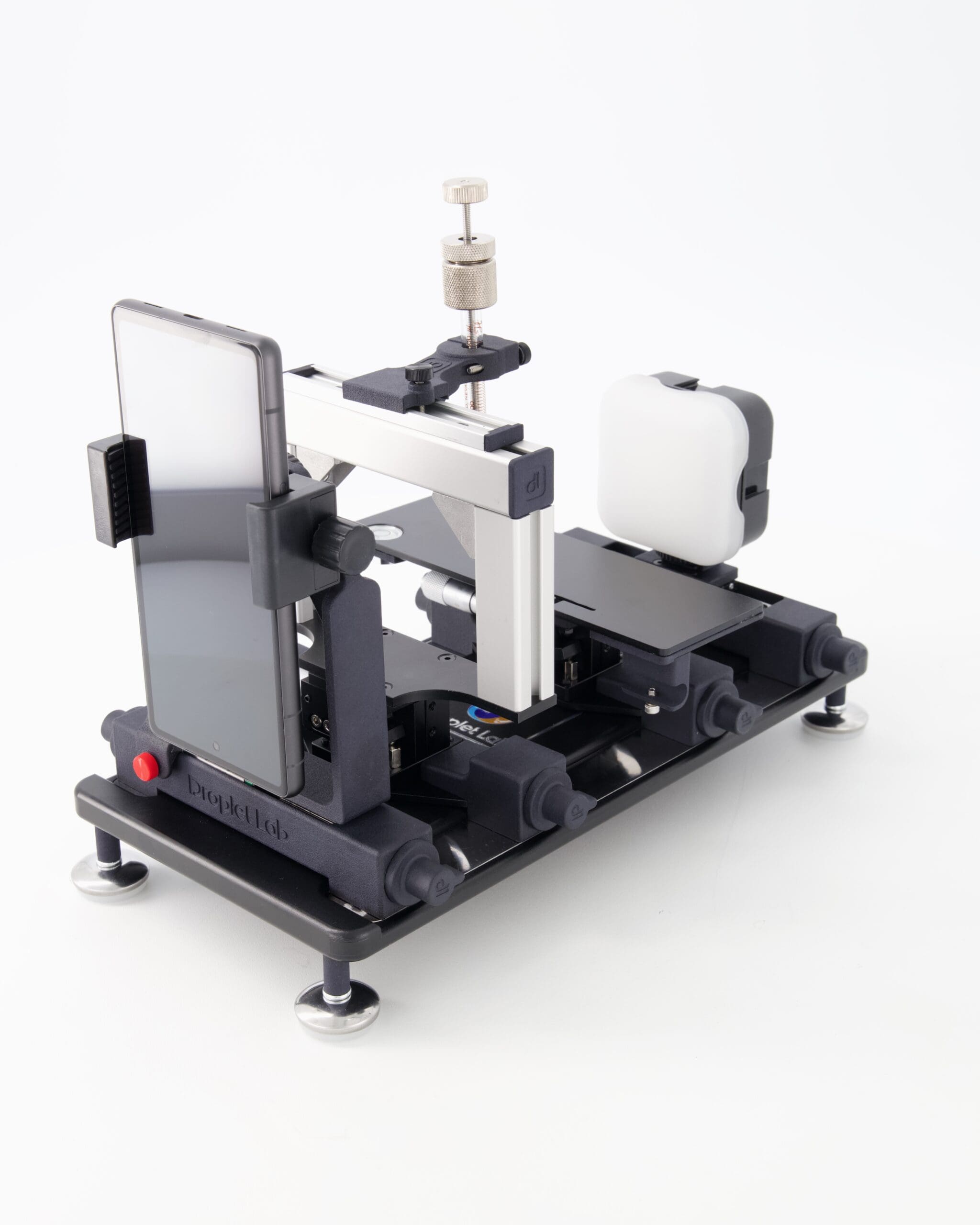
Dropometer
From US $4,990

Product comparison
Both measure contact angle, surface free energy and surface tension from drop shape. The real split is class of instrument: the DSA100 is a fully-featured, lab-grade benchtop platform with automated dosing, environmental control and high-speed optics; the Dropometer delivers the measurements most labs actually run; static and dynamic contact angle, captive bubble, sliding angle, surface energy and pendant-drop surface tension in a 1 kg, battery-powered, smartphone-based package at roughly a sixth of the price.
From US $4,990
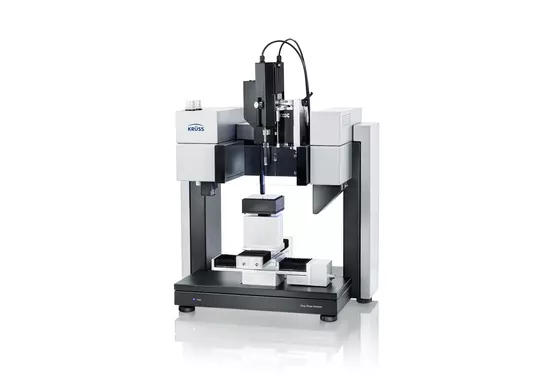
From US $30,000 (quote only; E is priced above S)


Droplet Lab builds precision instruments and software for surface science measurement, specialising in contact angle analysis and surface tension characterisation. Used by researchers across materials science, pharmaceuticals, coatings, and advanced manufacturing, Droplet Lab's Dropometer has contributed to studies published in peer-reviewed journals including Advanced Functional Materials (Impact Factor 19). The team combines instrument engineering with deep domain knowledge in wettability science with a focus on practical accuracy.
The DSA100 is the more capable instrument. It is a lab-grade benchtop platform, and if you need its automation, environmental control, high-speed optics or 2000 mN/m tension range, buy it and don't look back. What the Dropometer disputes is the assumption that you need all of that to get trustworthy contact-angle, sliding-angle and surface-energy numbers. For the large majority of QC and research workflows, you don't and the Dropometer delivers those at roughly one-sixth the price, on battery, anywhere. Choose the DSA100 when the application genuinely demands its automation or extremes; choose the Dropometer when it doesn't and you'd rather spend the other $25,000 on science.
The Dropometer and the KRÜSS DSA100 solve the same core problem; quantifying wetting from drop shape but for different buyers. The DSA100 is built for a central lab that wants one highly automated, environmentally controlled instrument to do everything. The Dropometer is built for teams that want capable measurement to be cheap, portable and available at more than one location.
Optical drop-shape analysis for contact angle (sessile, advancing, receding, static).
Surface free energy from multi-liquid contact angles using standard models.
Surface / interfacial tension by the pendant-drop method with Young-Laplace fitting.
The DSA100 is a $30,000+ benchtop platform; the Dropometer is a $4,990 portable. Everything below follows from that gap.
The DSA100E adds software-controlled XYZ staging and multi-liquid dosing for unattended, repeatable series. The Dropometer automates dosing and tilt but positions samples manually excellent for single-sample and field work, not for hands-off 100-position QC runs.
KRÜSS wins decisively on frame rate (thousands of fps), optical resolution, and temperature/humidity control. The Dropometer's 10 fps camera and ambient operation cover routine work but not high-speed dynamics or hot/cold-stage studies.
The DSA100 is a 24 kg, mains-powered bench fixture. The Dropometer is a 1 kg, battery-powered, phone-based tool you can carry to the sample. For many labs that single difference decides it.
The DSA100's spec sheet is genuinely deeper than the Dropometer's. The honest question is how much of that depth maps to your actual measurements. If you run static and dynamic contact angle, sliding angle, and surface energy on flat samples at room temperature; the bread and butter of coatings, cleaning-validation and materials QC, the Dropometer covers it. The DSA100's extra reach (2000 mN/m tension, 400 °C stages, 3450 fps, fiber Meniscus CA) is real value if your program needs those specific extremes, and dead weight if it doesn't.
A repeatable contact angle comes from advancing and receding a drop slowly enough to measure thermodynamics rather than fluid dynamics not from placing a drop and reading a single number. Both instruments support that dynamic workflow. The DSA100E further reduces operator variance through automated positioning and dosing; the Dropometer reduces it through guided AI drop-fitting and a fixed, repeatable capture geometry. Different routes to the same goal: take the human guesswork out of the measurement.
Where the DSA100 outperforms the Dropometer, we say so. Instrument-based contact-angle accuracy is tighter (0.1° vs the Dropometer's ±0.35°). Frame rate, optical resolution, surface-tension range and environmental control are all in a higher class. Automated series measurement on the DSA100E has no equivalent on the Dropometer. If those capabilities are on your requirements list, the price gap is justified.
Because the Dropometer is $4,990, standing up a second or third measurement point; a production line, a satellite lab, a field team is an incremental decision, not a capital project. A single DSA100 concentrates a lot of capability at one bench; several Dropometers spread adequate capability across many. Which economics fit depends on whether your bottleneck is measurement depth at one place or measurement access across several.
| Criterion | Dropometer | KRÜSS DSA100S | KRÜSS DSA100E |
|---|---|---|---|
| Class | Portable, smartphone-based | Benchtop, standard config | Benchtop, expert config |
| Indicative price | $4,990 US | $30,000+ US | $30,000+ US (above S) |
| Contact angle range | 10° to 175° | 0° to 180° | 0° to 180° |
| CA resolution (software) | 0.01° | 0.01° | 0.01° |
| CA accuracy | ±0.35° | 0.1° (instrument-based) | 0.1° (instrument-based) |
| CA models | Young-Laplace, polynomial | Conic section, polynomial, circle, Young-Laplace, height-width | Conic section, polynomial, circle, Young-Laplace, height-width |
| Dynamic CA (advancing/receding) | Automated protocol | Yes | Yes |
| Sliding / tilt angle | 0–60° tilt (manual; automatic stage add-on); 0.01° | Optional (internal tilting, 0.01°) | Optional (external tilting, 0.1°) |
| Surface free energy | Equation of State, Fowkes, Oss & Good | Recommended; 8+ models¹ | Recommended; 8+ models¹ |
| Surface / interfacial tension | Pendant, up to 75 mN/m | Pendant/rising, 0.01–2000 mN/m | Pendant/rising, 0.01–2000 mN/m |
| Surface-tension resolution | 0.01 mN/m | 0.01 mN/m | 0.01 mN/m |
| Dosing | Manual + automatic; min 0.05 µL | 1× software-controlled syringe; 20 nL | 2× software-controlled syringes + Liquid Needle; 20 nL |
| Multi-liquid dosing | - | Optional, up to 8 liquids | Optional, up to 8 liquids |
| Sample positioning | Manual | Manual X/Y + manual Z | Software-controlled XYZ (10 µm) |
| Camera frame rate | 10 fps | up to 2300 fps (CF04) / 3450 fps (CF10) | up to 2300 / 3450 fps |
| Zoom / optics | 4× zoom, manual focus | 7× zoom; 3.1–21.7 µm resolution | 7× zoom; 3.1–21.7 µm resolution |
| Temperature control | Ambient (10–45 °C) | Optional −30 to 400 °C | Optional −30 to 400 °C |
| Specialty methods | Sessile, tilted, pendant | + Constrained Sessile Drop, Stood-up Drop, Meniscus fiber CA (opt.) | Same as S |
| Footprint / weight | 30×15×45 cm · 1 kg | 555×375 mm, 490 mm H · 24 kg | 555×375 mm, 490 mm H · 24 kg |
| Power | 5 V, battery (up to 8 h) | 88–264 V AC mains | 88–264 V AC mains |
| Platform / interfaces | Android & iOS; Bluetooth, Wi-Fi, USB, cellular; cloud sharing | PC (USB 3.0); ADVANCE software | PC (USB 3.0); ADVANCE software |
| Warranty | 5 years + 5 yr free software | Not stated on datasheet | Not stated on datasheet |
Competitor specifications are drawn from publicly available manufacturer documentation and may change; verify current figures with the vendor before purchase.
Unlike a paper-only comparison, this one rests on measured data. Droplet Lab has run side-by-side tests of the Dropometer against Kruss DSA100E using standard, challenging test cases, and the results have been published in peer-reviewed journals including validation of the smartphone-based measurement method in Review of Scientific Instruments and Colloids and Surfaces A. KRÜSS DSA100 specifications are taken from its publicly available datasheet and brochure. Where KRÜSS leads the Dropometer; frame rate, optical resolution, surface-tension range, environmental control, instrument-based accuracy, automated series measurement, we say so plainly. KRÜSS does not publish list pricing; the $30,000+ figure is an order-of-magnitude indication, not a quote.
The test that matters for an affordable instrument isn't whether it works in principle — it's whether it returns the same values as the expensive benchtop systems on standard, challenging samples. That is the bar the Dropometer was engineered and validated to clear, and it's why a $4,990 tool belongs in the same conversation as a $30,000+ bench.
"We're in the 21st century. 3D printing, excellent digital microscopes, fast control software and mobile computing make it possible to combine precision with affordability. It's great that Droplet Labs have transformed this important technique into an affordable package. But the team at Droplet Labs haven't compromised on accuracy. Producing an OK prototype was one thing. The real challenge was to create a package that delivered reliable values, using standard, challenging test cases to compare results to those from well-known high-price devices. Only when components, engineering, assembly and software gave the required precision, accuracy and reliability were they happy to put the device on the market."
That is the whole case for the Dropometer against a system like the DSA100: not that it out-specs a lab-grade bench, but that it was benchmarked to them before it shipped and priced at a fraction of the cost.
DSA100E. Software-controlled XYZ positioning and multi-liquid dosing are the point of the expert configuration, and the Dropometer does not automate sample positioning.
DSA100 (S or E, with the relevant options). These are genuine capability gaps the Dropometer does not close.
Dropometer. It covers the core methods at ~$5,000, on battery, anywhere — and you can deploy several for the price of one DSA100.
Take the E if positioning and multi-liquid dosing should be automated; take the S if an operator is present and manual positioning with single-syringe software dosing is enough.
The KRÜSS DSA100 is the more capable instrument and, in its E configuration, the more automated one — the right buy when your application demands lab-grade automation, environmental control, high-speed optics, or surface tension far beyond aqueous. The Dropometer is the right buy when it doesn't: it delivers static and dynamic contact angle, sliding angle, surface energy and pendant-drop surface tension in a portable, battery-powered, $4,990 package, with a 5-year warranty and free software upgrades. Match the instrument to the measurements you actually run — and to whether your constraint is depth at one bench or access across many.
On instrument-based contact-angle accuracy, yes — KRÜSS states 0.1° against the Dropometer's ±0.35°, and it leads on optics, frame rate and tension range. Whether that margin matters depends on your application; for most coatings, cleaning-validation and materials QC work, the Dropometer's accuracy is well within what the measurement requires.
For most QC and many research workflows, yes — it adds portability and offline AI fitting at a fraction of the price. For automated high-throughput series, environmental-stage work, high-speed dynamics, fiber CA, or surface tension beyond ~75 mN/m, the DSA100 remains the right tool.
The S positions samples manually with one software-controlled syringe; the E adds software-controlled XYZ staging and a second syringe plus Liquid Needle dosing for hands-off, automated series measurement.
See how the Dropometer stacks up against other goniometers, tensiometers and screening tools.
Independent benchmarking and publication-based validation references.
Dropometer contact angle and pendant-drop surface tension methods have been benchmarked against KRÜSS DSA100E reference measurements.
Our instruments are referenced in peer-reviewed journals, theses, and conference publications.