



Contents
Case Study

Some battery electrolytes can attack a steel needle. This R&D team set up its Dropometer with disposable plastic needles instead.

Last Updated
October 18, 2026
Industry
Battery materials R&D
Location
North America
Customer since
2025
Liquids
Electrolytes that can attack metal
Disposable plastic needles on the automatic dropper Contact angle and pendant drop methods validated against a KRÜSS DSA100E in peer review Published contact angle accuracy of 0.35°

A North American battery R&D team needed contact angle and surface tension measurements for its electrolyte work. Some of its electrolytes can attack metal, so steel needles were ruled out, and each liquid had to stay free of cross contamination. After an in person demo, Droplet Lab fitted the automatic dropper with long disposable plastic needles. Contact angle, surface tension and surface energy now sit on one instrument.

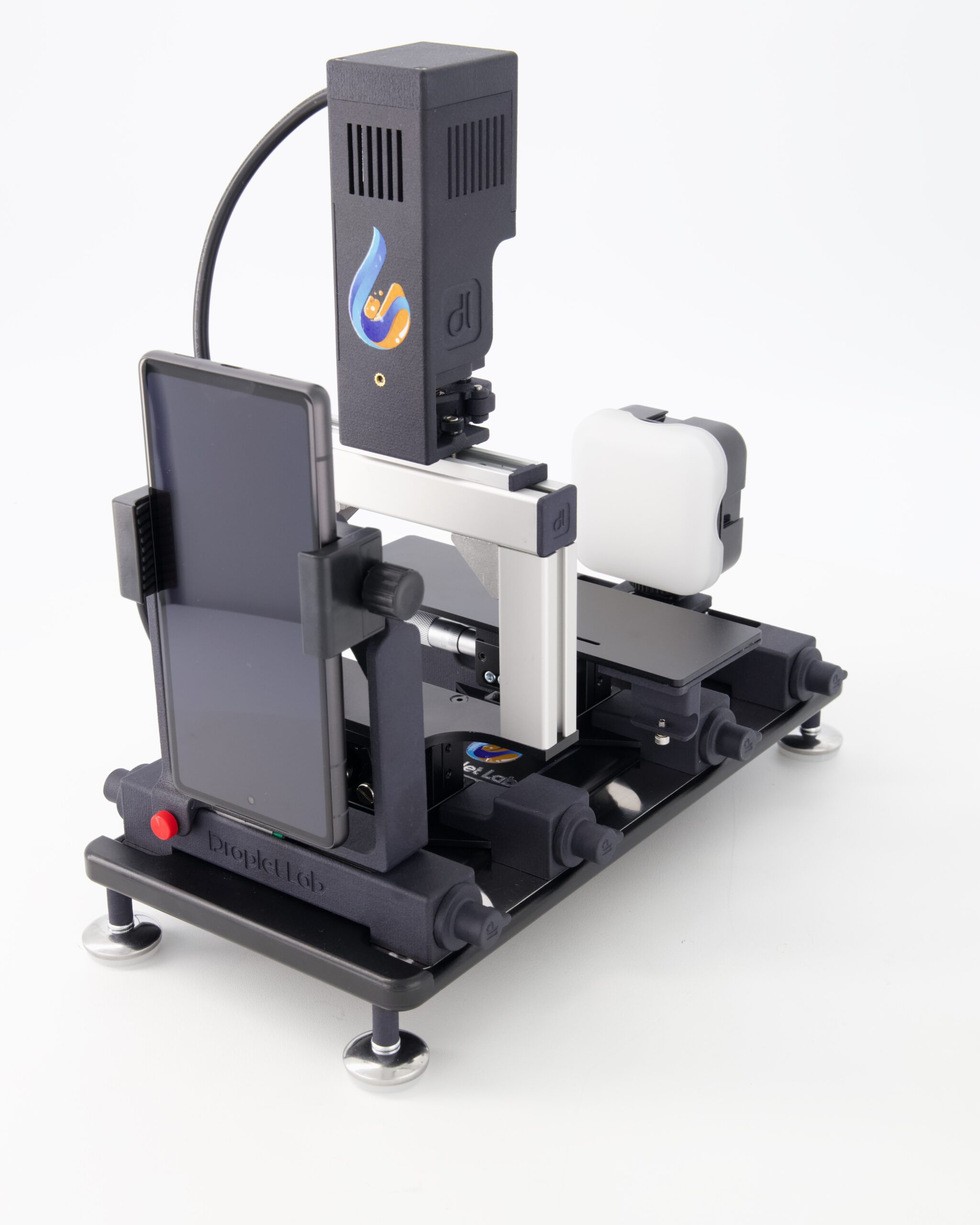
Standard Dropometer with automatic dropper (product photo; not the client's lab or needle setup)
Abhimanyu Photo
Written by
Abhimanyu Bhandankar
Holds an MBA from Schulich School of Business and a BE in IT. He joined Droplet Lab in July 2019 and now leads sales and marketing.
CEO at Droplet Lab
Read More
Gurdeep-Saini-Photo
Technical Review by
Gurdeep Singh Saini
Holds a BASc in Mechanical Engineering from Ryerson University (now Toronto Metropolitan University) and an MASc from York University. He develops the automatic edge and baseline detection behind the Dropometer's analysis.
COO at Droplet Lab
Read More
Abhimanyu Photo
Written By

Abhimanyu Bhandankar

CEO at Droplet Lab

Holds an MBA from Schulich School of Business and a BE in IT. He joined Droplet Lab in July 2019 and now leads sales and marketing.

Gurdeep-Saini-Photo
Reviewed By

Gurdeep Singh Saini

COO at Droplet Lab

Holds a BASc in Mechanical Engineering from Ryerson University (now Toronto Metropolitan University) and an MASc from York University. He develops the automatic edge and baseline detection behind the Dropometer's analysis.

Executive Summary

Who

A North American battery R&D team, led by a team lead scientist and supported by a laboratory specialist. The team works with several electrolytes, some of which can attack metal. In 2025 it was compiling a list of new lab equipment and added a contact angle instrument to that list.

Problem

The team needed contact angle and surface tension for its electrolyte work. Some of its electrolytes can attack metal, so stainless steel needles were not suitable and a polymeric tip was essential. Each electrolyte also had to be handled separately, with the liquid kept in the needle rather than the syringe, so one liquid could not contaminate the next.

Solution

A Dropometer with the contact angle, surface tension and surface energy apps and the automatic dropper, fitted with long disposable plastic needles that are changed between liquids. Droplet Lab confirmed before the order that the plastic needles fit both its manual and automatic droppers. The team bought directly from Droplet Lab after an in person demo.

Time to Value

13 Aug 2025: discovery call and quotes. 4 Sep 2025: in person demo. 17 Sep 2025: plastic needle solution proposed. 21 Oct 2025: order placed. November 2025: delivered. 4 Feb 2026: remote onboarding. 8 Jul 2026: the team lead confirmed everything was working well.

Results

The team shortlisted the Dropometer, saw it in person, and approved it once the plastic needle question was solved. It chose the automatic dropper version. After onboarding and follow up support, the team lead confirmed on 8 July 2026 that everything was working well. The team has not shared measurement data, so this page reports the setup, not results.

Highlights

3

Measurements on one instrument

2 inch

Plastic needles recommended for the dropper

Oct 2025

Order placed after an in person demo

2025

Customer since

The battery R&D team, at a glance

Research focus

Battery R&D work with several electrolytes, some of which can attack metal.

Products / applications

Battery components in development; materials and results are confidential.

Measurement stage

Laboratory R&D, with the instrument bought in a 2025 round of new lab equipment.

Users

Battery R&D scientists and a laboratory specialist.

Materials and surfaces tested

Not disclosed. The team's electrolytes and materials are confidential.

Key constraints

Electrolytes that can attack metal; disposable polymeric needles only; each liquid handled separately.

The challenge: wetting tests with liquids that attack the hardware

In battery R&D, how an electrolyte wets a surface matters, and some electrolytes are hard on the hardware that delivers the drop.

Why these liquids are difficult

The team works with several electrolytes, and some of them can attack metal. A standard stainless steel needle was therefore not suitable, because it could corrode and contaminate the drop it delivers. The team asked for disposable polymeric needles instead, and for the automatic dropper to work with them.

Why cross contamination matters

Each electrolyte had to be handled separately. The team wanted the liquid to stay inside the needle rather than the syringe, so a needle could be changed between liquids. Carry over from one liquid to the next would work against reproducible contact angle measurement from the first drop.

What success would require

Contact angle, surface tension and surface energy on one instrument, an automatic dropper, and a liquid path with no metal in contact with the electrolyte. The team also wanted to see the instrument in person before its finance review, and a quote that covered the needle solution.

The insight: keep metal out of the liquid path

What Was Deployed

Delivered configuration (November 2025): the Dropometer contact angle and surface tension kit with the contact angle, surface tension and surface energy apps, the manual and automatic droppers, and a pack of long disposable plastic needles, on the supplied smartphone. Before the order, Droplet Lab confirmed that the plastic needles fit both droppers and recommended 2 inch needles so the liquid stays in the needle. Drops are imaged and analysed with the sessile drop and pendant drop methods described in our contact angle measurement guide.
The Origin

From a LinkedIn conversation to a needle problem solved before the order

Droplet Lab first connected with the team's lead scientist on LinkedIn in April 2025. A discovery call followed on 13 August 2025, and the same day Droplet Lab sent quotes for contact angle, surface tension and surface energy, with and without the automatic dropper. The team was compiling a list of new lab equipment, and by late August the Dropometer was on its shortlist. Droplet Lab ran an in person demo on 4 September 2025. The team then raised one concern: some of its electrolytes can attack metal, so it needed disposable polymeric needles and no cross contamination between liquids. Droplet Lab proposed long plastic needles that fit both droppers. On 24 September the team confirmed it would go ahead with the automatic dropper, and the order followed on 21 October 2025. Teams weighing a research grade instrument can compare options in our guide to the best contact angle goniometer for advanced research.

Before vs After

Metric Before After
Liquid path Stainless steel needles not suitable for the team's electrolytes Disposable plastic needles on the automatic dropper
Cross contamination Each liquid had to stay in the needle, not the syringe Long plastic needle per liquid, changed between liquids
Drop delivery Manual and automatic dropper both quoted Automatic dropper chosen on 24 Sep 2025
Measurements Contact angle and surface tension needed for electrolyte work Contact angle, surface tension and surface energy on one portable kit
Evaluation On a shortlist while the team compiled new lab equipment In person demo on 4 Sep 2025, order on 21 Oct 2025

Rollout timeline

Timeline (high level)

13 Aug 2025: Discovery call

  • Liquids and measurements discussed
  • Quotes sent with and without the automatic dropper

4 to 24 Sep 2025: Demo and needle solution

  • In person demo by Droplet Lab on 4 September
  • Disposable plastic needles proposed on 17 September
  • Team approved the automatic dropper version on 24 September

21 Oct to 28 Nov 2025: Order and delivery

  • Order placed on 21 October
  • Shipped on 18 November and confirmed received complete on 28 November

Feb to May 2026: Onboarding and service

  • Remote onboarding call on 4 February
  • Unit returned to Droplet Lab for repair of stage and baseplate parts, then re shipped
  • Call on 27 May to check the automatic dropper and setup

Jun to Jul 2026: Replacement parts and sign off

  • Replacement phone holder and syringe shipped on 8 June
  • Team lead confirmed everything working well on 8 July

Proof and validation: what this case shows, and what it does not

Test method

Not yet reported. The instrument is configured for sessile drop contact angle, pendant drop surface tension and surface energy, with drops delivered by the automatic dropper through disposable plastic needles.

Sample size and operators

Not yet reported. Users are the team's battery R&D scientists, trained on a remote onboarding call and a follow up call with Droplet Lab.

Repeatability / reproducibility

The team has not shared measurement data. The Dropometer's contact angle and pendant drop methods are validated against a KRUSS DSA100E in peer review.

Notes / assumptions

This page describes how the setup was configured for electrolytes that can attack metal. It does not report the team's materials, electrolytes or results, which are confidential.

Outcomes to date

Measured Outcomes

3

Measurements on one instrument

Contact angle, surface tension and surface energy apps run on the same Dropometer, so the team does not need a separate instrument for each test.

2 inch

Plastic needle length

Droplet Lab recommended 2 inch disposable plastic needles so each electrolyte stays in its own needle, and confirmed before the order that they fit both the manual and automatic droppers.

8 Jul 2026

Setup confirmed working

After onboarding and follow up support, the team lead confirmed in writing that everything was working well. The team has not shared measurement results.

Operational Outcomes

Chosen after a demo

Shortlisted during a 2025 equipment round, shown in person on 4 September 2025, and approved on 24 September once the needle question was solved.

Automatic dropper

The team chose the automatic dropper version. In May 2026 the team lead reported the automatic dropper working well, and in July 2026 the whole setup.

Room to grow

The surface energy app is included, so the team can add surface energy work on the same instrument.

Financial Context

Three measurements and automation for a new lab

This page does not show the price. The team bought directly from Droplet Lab by purchase order after an in person demo, and asked for a pack of plastic needles to be added to the quote.

Purchase · direct

Bought directly from Droplet Lab in 2025.

Scope · 3 measurements

Contact angle, surface tension and surface energy.

Add on · plastic needles

Added to the quote at the team's request in September 2025.

Instrument pricing is available on request.

In the client's words

Everything is now working well.
Team Lead - Battery materials R&D

What's next

Delivered

Dropometer with contact angle, surface tension and surface energy apps and automatic dropper
Disposable plastic needles for aggressive electrolytes
Remote onboarding, follow up support and replacement parts

Planned

Droplet Lab is working on an Ansys integration, and the team has said it is interested.

Frequently asked questions

Can the Dropometer measure electrolytes that attack metal?

Yes. For this team, Droplet Lab fitted the automatic dropper with long disposable plastic needles, so no metal touches the electrolyte. Droplet Lab confirmed before the order that the plastic needles fit both the manual and automatic droppers.

How do you avoid cross contamination between liquids?

Each liquid stays in its own needle rather than the syringe, and the needle is changed between liquids. Droplet Lab recommended 2 inch needles so the liquid stays in the needle.

Which measurements does the team run?

Contact angle, surface tension and surface energy on one instrument, with the automatic dropper. The team has not shared measurement data, so the case study reports the setup, not results.

Next Step

Testing liquids that are hard on your instrument?

The Dropometer's manual and automatic droppers accept disposable plastic needles, so liquids that attack metal or must not mix can each have their own needle. Contact angle, surface tension and surface energy run on one portable kit. Book a 15 minute demo and tell us which liquids you need to test.