



Contents
Case Study

A University of Maryland dental group used water contact angle on the Dropometer to find which antibacterial coating formulations changed the crown surface.

Last Updated
October 18, 2026
Industry
Dental biomaterials research
Location
Baltimore, Maryland, USA
Customer since
2020
Published with the Dropometer
Coatings, 2024
Image
Ba-Armah et al. 2024, Fig. 2a, cropped, CC BY
Named in a 2024 Coatings paper Drop shape method validated against a KRÜSS DSA100E 2 peer reviewed validation papers

A dental biomaterials group at the University of Maryland School of Dentistry in Baltimore bought a Dropometer in 2020 to use contact angle as a screening tool before other analysis such as XPS. In a 2024 Coatings study of an antibacterial resin coating for provisional crowns, the group measured water contact angle on six groups, n = 15 per group. Adding 5% or more DMADDM lowered it from about 70° to between 50.7° and 54.7°.

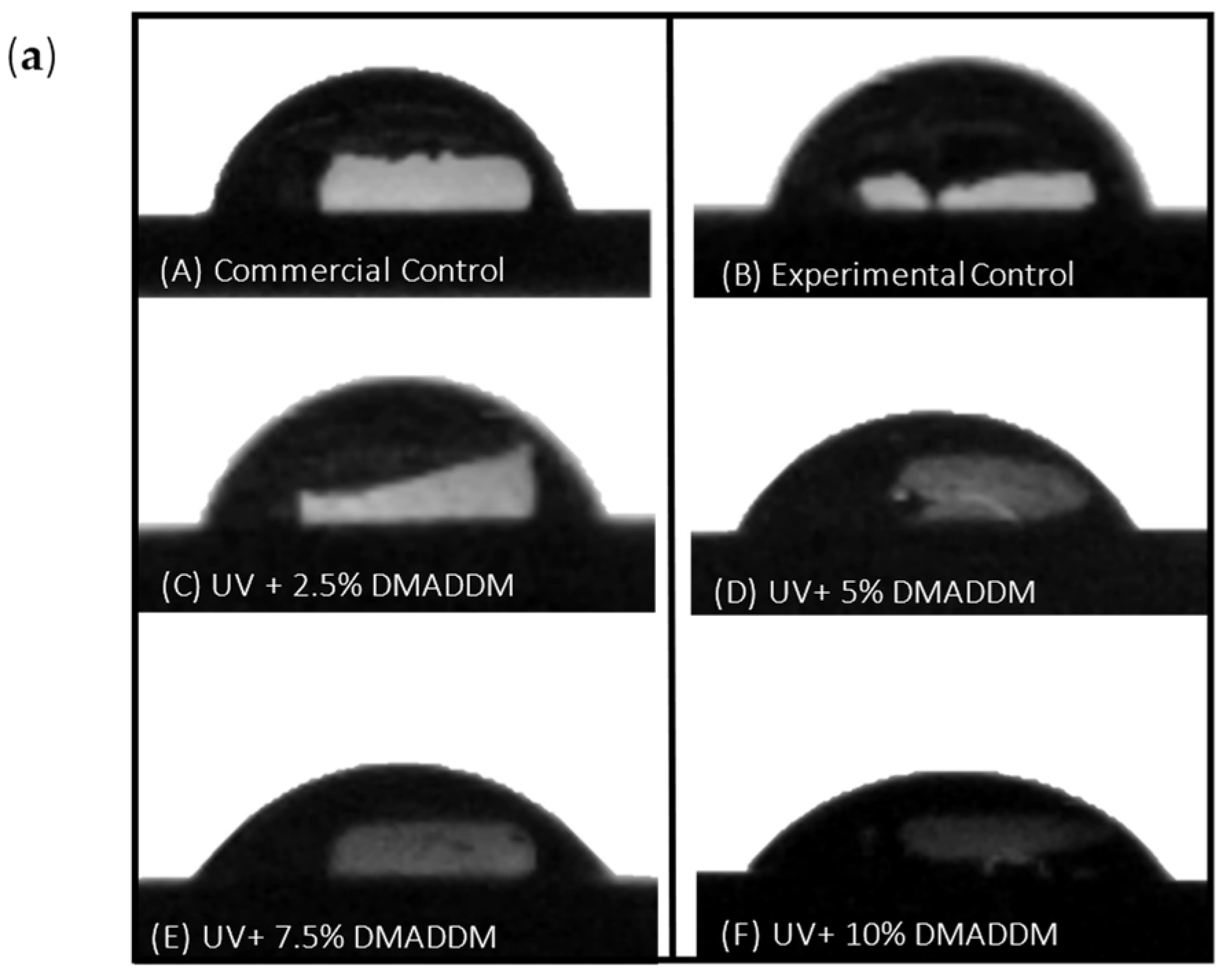
Representative water drops on six provisional crown resin groups, imaged with the Dropometer (Ba-Armah et al. 2024, Fig. 2a, cropped, CC BY)
Abhimanyu Photo
Written by
Abhimanyu Bhandankar
Holds an MBA from Schulich School of Business and a BE in IT. He joined Droplet Lab in July 2019 and now leads sales and marketing.
CEO at Droplet Lab
Read More
Gurdeep-Saini-Photo
Technical Review by
Gurdeep Singh Saini
Holds a BASc in Mechanical Engineering from Ryerson University (now Toronto Metropolitan University) and an MASc from York University. He develops the automatic edge and baseline detection behind the Dropometer's analysis.
COO at Droplet Lab
Read More
Abhimanyu Photo
Written By

Abhimanyu Bhandankar

CEO at Droplet Lab

Holds an MBA from Schulich School of Business and a BE in IT. He joined Droplet Lab in July 2019 and now leads sales and marketing.

Gurdeep-Saini-Photo
Reviewed By

Gurdeep Singh Saini

COO at Droplet Lab

Holds a BASc in Mechanical Engineering from Ryerson University (now Toronto Metropolitan University) and an MASc from York University. He develops the automatic edge and baseline detection behind the Dropometer's analysis.

Primary outcome: a clear threshold where the coating surface changes

Water contact angle on cured resin coatings with rising DMADDM content

Mean ± SD, n = 15 per group, 5 µL deionised water drops in air, evaluated during a 10 s timeframe, as reported in Ba-Armah et al., Coatings 14 (2024) 1370, Fig. 2

Commercial control 70.5°
Experimental control 70°
2.5% DMADDM 69.1°, not different from controls
5% DMADDM 54.7°
7.5% DMADDM 51.7°
10% DMADDM 50.7°

The commercial and experimental controls read 70.5° and 70°. At 2.5% DMADDM the coating read 69.1°, no different from the controls. From 5% DMADDM upward the coating read 54.7°, 51.7° and 50.7°, all significantly more hydrophilic than the controls (p < 0.01). Contact angle was one supporting measurement in a study whose main results were antibacterial; this page does not claim that the change in wettability causes the antibacterial effect.

15 per group

Water contact angle measurements reported for each cured coating group (Fig. 2).

5 µL

Deionised water drop volume, evaluated during a 10 s timeframe.

19.8° drop

Largest change from the commercial control, at 10% DMADDM (70.5° to 50.7°).

5% threshold

The lowest DMADDM content that changed the surface significantly.

Executive Summary

Who

A dental biomaterials group in the Department of Biomaterials and Regenerative Dental Medicine at the University of Maryland School of Dentistry in Baltimore, Maryland, USA. The group develops antibacterial resins and coatings for restorative dentistry, including a coating for provisional crowns.

Problem

Provisional crowns collect biofilm, which can lead to secondary caries at the crown margin. The group was developing an antibacterial resin coating and needed to know how each concentration of the antibacterial monomer changed the coating surface, alongside roughness and biofilm tests.

Solution

A Dropometer with contact angle, surface tension and surface energy apps, bought directly from Droplet Lab in 2020. The group wanted contact angle as a screening tool to evaluate surface treatments before moving on to other analysis techniques such as XPS.

Time to Value

22 July 2020: quote requested through the Droplet Lab website. 29 September 2020: university purchase order issued. 16 November 2020: instrument received by the lab. 10 May 2022: video call with Droplet Lab to improve image quality and data consistency. 28 October 2024: paper published in Coatings.

Results

Water contact angle stayed near 70° for both controls and the 2.5% formulation, with n = 15 per group. From 5% DMADDM upward it fell to between 50.7° and 54.7°, a significant change (p below 0.01). A separate test of liquid resin drops on the crown material read 26.5° to 28.0° with no differences. The paper reports these alongside roughness, biofilm and lactic acid tests.

Highlights

70.5° to 50.7°

Water contact angle, control to 10% DMADDM

15 per group

Water contact angle measurements (n)

5 µL

Water drop volume

2020

Customer since

University of Maryland School of Dentistry, at a glance

Research focus

Dental biomaterials: antibacterial resins and coatings for restorative dentistry.

Products / applications

Resin coatings for provisional crowns, designed to suppress biofilm and secondary caries.

Measurement stage

Laboratory formulation screening alongside roughness, biofilm, metabolic activity and lactic acid tests.

Users

PhD researchers and faculty in the school's biomaterials department, according to the paper's author list.

Materials and surfaces tested

Cured UV resin coatings with 0% to 10% DMADDM and an uncoated commercial crown material, tested with water; uncured resin drops on the crown material.

Key constraints

Many formulations to compare; a screening step needed before other analysis techniques such as XPS.

The challenge: adding an antibacterial agent without losing track of the surface

Every new ingredient in a coating can change how saliva, proteins and bacteria meet the surface.

Why provisional crowns need protection

Provisional crowns stay in the mouth while a permanent crown is made, and their margins collect plaque. Acid from bacteria such as S. mutans can start secondary caries in the tooth underneath. Coatings like this face the same surface questions as the materials in our medical device surface testing guide.

Why an antibacterial coating

Coating the crown with a resin that contains a quaternary ammonium monomer, DMADDM, can kill bacteria on contact. The question is how much monomer to add before the coating surface itself changes.

Why wettability is part of the answer

Hydrophilicity can influence biofilm formation, so the paper reports wetting alongside roughness and biofilm results. The group needed to see at which DMADDM content the coating surface changed. The same question comes up in dental and orthopedic implant surface QC.

What success would require

Every cured sample got the same 5 µL water drop and the same 10 s timeframe, with n = 15 per group, so differences came from the formulation rather than the method. Our guide to reproducible contact angle measurement covers the same controls. All drops were sessile drops in air; the captive bubble method, which measures under liquid, was not used.

The insight: a quick wetting screen shows which formulations changed the surface before other tests

What Was Deployed

Delivered configuration (ordered September 2020): the Dropometer contact angle and surface tension kit with the contact angle, surface tension and surface energy applications. In the published study, 5 µL deionised water drops were placed on cured coating disks in air and the contact angle was evaluated during a 10 s timeframe, with n = 15 per group. Separately, 3 µL drops of each uncured liquid resin were placed on the commercial crown material and imaged after 10 s; the paper reports that Droplet Lab's Sessile software (version 1.0.5.1) used Young Laplace fitting. Our citation analysis of the Coatings paper sets out both configurations, and our contact angle measurement guide explains the method.
The Origin

From a website quote request to a screening step in a coatings paper

In July 2020 a researcher in the University of Maryland School of Dentistry's biomaterials group requested a quote through the Droplet Lab website, after finding the Dropometer while researching contact angle equipment. The lab was developing dental materials with different surface hydrophilicity. It wanted contact angle as a screening tool to evaluate surface treatments before moving on to other analysis techniques, such as XPS. Labs comparing options can see how the Dropometer fits research work in our guide to the best contact angle goniometer for advanced research. The university issued its purchase order in September 2020 and the lab received the instrument in November 2020. In May 2022 Droplet Lab held a video call with the lab to improve image quality and get more consistent data. In October 2024 the group published a study of a new antibacterial resin coating for provisional crowns in Coatings, with water contact angle measured on the Dropometer alongside roughness, biofilm, metabolic activity and lactic acid tests.

Before vs After

Metric Before After
Water contact angle, experimental control (0% DMADDM) 70.5° ± 4.6 (commercial control) 70° ± 6.8, no difference
Water contact angle, 2.5% DMADDM 70.5° ± 4.6 (commercial control) 69.1° ± 7.6, no difference
Water contact angle, 5% DMADDM 70.5° ± 4.6 (commercial control) 54.7° ± 5.9, lower (p < 0.01)
Water contact angle, 7.5% DMADDM 70.5° ± 4.6 (commercial control) 51.7° ± 7.6, lower (p < 0.01)
Water contact angle, 10% DMADDM 70.5° ± 4.6 (commercial control) 50.7° ± 8, lower (p < 0.01)

Rollout timeline

Timeline (high level)

July to September 2020: Quote and order

  • Quote requested through the Droplet Lab website on 22 July
  • University purchase order issued on 29 September

October to November 2020: Delivered

  • Instrument shipped from Canada in October
  • Received by the lab on 16 November, with measurement guides sent the same day

May 2022: Technique review

  • Video call with Droplet Lab on 10 May 2022 to improve image quality and data consistency
  • Replacement parts and a new activation card sent after the call

October 2024: Published

Antibacterial provisional crown coating study published in Coatings on 28 October 2024, with contact angle measured on the Dropometer

Proof and validation: what the paper shows, and what it does not

Test method

Static water contact angle on cured resin coating disks for provisional crowns with 0% to 10% DMADDM, plus an uncoated commercial control: 5 µL deionised water drops, sessile drop in air, evaluated during a 10 s timeframe, measured on the Dropometer (Droplet Lab, Canada). Separately, 3 µL drops of each uncured resin on the commercial crown material, imaged after 10 s.

Sample size and operators

n = 15 per group in Fig. 2 and Fig. 3 (six cured groups, five uncured groups). The methods state 15 measurements without saying how many disks they were spread across. Measurements by researchers in the School of Dentistry's biomaterials group.

Repeatability / reproducibility

Reported as mean ± SD, from 4.6° to 8° across the cured groups and 1.5° to 3.8° for the uncured resins. The 5%, 7.5% and 10% groups differed from the controls at p below 0.01; the uncured groups did not differ.

Notes / assumptions

Source: I. Ba-Armah, M. Alenizy, N. Almutairi, H. Alqarni, A. Alhussein, R. Masri, G. D. Hack, T. W. Oates, J. Sun, M. D. Weir, H. H. K. Xu, "Novel Antibacterial Resin Coating for Dental Provisional Crowns to Suppress Biofilms and Inhibit Secondary Caries", Coatings 14 (2024) 1370, doi:10.3390/coatings14111370, CC BY. Contact angle was a supporting measurement; the study's main results were antibacterial, including about a 4 log reduction in S. mutans biofilm CFU at 5% DMADDM compared with the commercial control. Water was the probe liquid on cured samples; the uncured test used the resin itself as the drop. The study does not show that lower contact angle causes the antibacterial effect.

Outcomes to date

Measured Outcomes

54.7°

At 5% DMADDM

Down from 70.5° on the commercial control, the lowest concentration with a significant change (Ba-Armah et al., Coatings 14 (2024) 1370).

50.7°

At 10% DMADDM

The most hydrophilic coating in the study, about 20° below the controls.

69.1°

At 2.5% DMADDM

Not different from the controls, so low concentrations left the surface wetting unchanged.

Operational Outcomes

Fast screen

Each water contact angle was evaluated during a 10 s timeframe after placing the drop.

Published output

Contact angle formed one of several surface and antibacterial tests in a 2024 Coatings paper.

Uncured check

Drops of each liquid resin on the crown material read 26.5° to 28.0°, with no differences between groups.

What's next

Delivered

Antibacterial resin coating for provisional crowns (Coatings, 2024)
Remote technique review with the lab (May 2022)

Frequently asked questions

Can contact angle screen coating formulations before XPS?

That is how this dental biomaterials group uses it. A quick water contact angle reading shows which formulations changed the surface, before moving on to other analysis techniques such as XPS.

What did the antibacterial coating study find?

Water contact angle stayed near 70° for both controls and the 2.5% DMADDM formulation. From 5% DMADDM upward it fell to between 50.7° and 54.7°, a significant change (p below 0.01), with n = 15 per group. The study was published in Coatings in 2024.

What drop and timing did the group use?

5 µL deionised water drops on cured coating disks, evaluated within a 10 s timeframe. Separately, 3 µL drops of each uncured resin were imaged after 10 s on the crown material.

Next Step

Formulating a coating and need to know when the surface changes?

The Dropometer reads a water contact angle in seconds, so you can screen every formulation before sending the interesting ones to other surface analysis. Its drop shape method is validated against a KRÜSS DSA100E in two peer reviewed papers. Book a 15 minute demo and bring a coated and an uncoated sample.