Primary surface measurement reported
The study reports water contact angle measurements on resin disk specimens and contact angle measurements of uncured UV resin-based coating droplets to evaluate hydrophilicity/wettability.

Client Citation Analysis
The study reports water contact angle measurements on resin disk specimens and contact angle measurements of uncured UV resin-based coating droplets to evaluate hydrophilicity/wettability.
"Using the contact angle measurement apparatus (Dropometer, Droplet Lab, Markham, ON, Canada), the water contact angle was measured via the sessile-drop technique in air." / "The Droplet Lab's Sessile software (version 1.0.5.1) yielded the contact angle data by the utilization of the Young–Laplace equation." — Section 2.3, Contact Angle Assays.
Water contact angle results are used for wettability assessment across the Commercial Control, Experimental Control, and UV resin-coated groups with different DMADDM concentrations (Figure 2). Contact angle results for uncured UV resin-based samples are used to compare the hydrophilicity of uncured coating droplets across the experimental UV resin groups (Figure 3).
The paper states "A total of 15 measurements were taken." for the water contact angle assay, and reports n = 15 for the uncured coating measurements. It does not state how many specimens those 15 measurements were spread across, and gives no measurement temperature or relative humidity for either assay. Values are reported as mean ± sd.
The Dropometer measured water contact angle on cured coated disks (Figure 2) and the contact angle of uncured resin droplets on a TEMPSMART substrate (Figure 3) — 2 of the paper's 9 figures. It was not the primary measurement instrument. The study's principal outcomes were measured by other equipment: colony-forming-unit plate counts, a SpectraMax M5 microplate reader (metabolic activity, lactic acid, fibroblast viability), a BioTek Cytation 5 fluorescence microscope (live/dead staining), an FEI Quanta 200 SEM (biofilm morphology and coating thickness) and a Mitutoyo Surftest SJ-310 profilometer (surface roughness). No correlation between contact angle and any biofilm outcome is computed anywhere in the paper.
Contact angle (degrees) was measured to assess hydrophilicity in two different configurations: (1) water contact angle — 5 µL deionised water on cured resin disk specimens, the configuration comparable to the water contact angle literature; and (2) resin-on-resin contact angle — a 3 µL droplet of the uncured UV coating itself placed on a TEMPSMART resin disk. The probe liquid in (2) is the coating, not water, so the Figure 3 values are a wetting test of the applied coating and are not comparable to water contact angles or to the Figure 2 values.
These were the study's supporting measurements only in the sense that they came after the surface characterisation — they carry the paper's conclusions. They comprise surface roughness (Ra) by stylus profilometry, SEM assessment of coating thickness, S. mutans biofilm colony-forming-unit counts, MTT metabolic activity, lactic acid production, live/dead fluorescence staining, SEM biofilm imaging, and human gingival fibroblast cytotoxicity by CCK-8 absorbance. Seven of the paper's nine figures report these.
contact angle measurement apparatus (Dropometer, Droplet Lab, Markham, ON, Canada); Droplet Lab’s Sessile software (version 1.0.5.1)
surface roughness analyzer (Surftest SJ-310; Mitutoyo America, Aurora, IL, USA)
Labolight DUO (GC America, Alsip, IL, USA)
scanning electron microscope (Quanta 200, FEI Company, Hillsboro, OR, USA)
spectrophotometer (Genesys 10S, ThermoScientific, Waltham, MA, USA)
microplate reader (SpectraMax M5, Molecular Devices, Sunnyvale, CA, USA)
Fluorescent microscope (BioTek Cytation 5, Agilent Technologies, Santa Clara, CA, USA)
scanning electron microscope (Quanta 200, FEI Company, Hillsboro, OR, USA)
The Dropometer is used as a contact angle measurement apparatus to quantify surface hydrophilicity via sessile-drop testing in air. Water contact angle measurements were made by applying 5 µL deionized (DI) water droplets onto resin disks and evaluating the contact angle during a 10 s timeframe (15 measurements). For uncured UV resin-based coatings, a standard 3 µL droplet of each experimental UV resin group was applied onto the surface of the TEMPSMART resin disk and imaged after 10 s; contact angle values were obtained using Droplet Lab’s Sessile software (version 1.0.5.1) via the Young–Laplace equation.
In the study, the contact angle outputs are used to compare wettability/hydrophilicity between control and DMADDM-modified coating groups (cured disks) and to compare wetting behavior across uncured UV resin formulations.
What the contact-angle data were not used for is equally clear in the paper. No statistical relationship between contact angle and any biofilm outcome is tested or reported: the paper computes no correlation between wettability and CFU count, metabolic activity or lactic acid production. Where the Discussion touches the question, it points the other way — the authors write that "the antibacterial properties of DMADDM seem to outweigh any potential increase in bacterial adhesion due to hydrophilicity", and conclude that the biofilm reduction "can be confidently attributed to the intrinsic antibacterial properties of DMADDM, rather than to any variations in surface roughness". The contact-angle result functioned as a check that the new coating did not make the surface worse, not as an explanation of why it worked.
For wettability assessment (Figure 2; mean ± sd; n = 15), Commercial Control (70.5 ± 4.6°), Experimental Control (70 ± 6.8°), and UV+ 2.5% DMADDM (69.1 ± 7.6°) showed no significant differences among these three groups (p > 0.01). UV+ 5% DMADDM (54.7 ± 5.9°), UV+ 7.5% DMADDM (51.7 ± 7.6°), and UV+ 10% DMADDM (50.7 ± 8°) showed no significant differences among these three groups (p > 0.01), and there was a significant difference between the lower-concentration set and the higher-concentration set (p < 0.01).
In Figure 3 (mean ± sd; n = 15) the probe liquid is the uncured coating itself — a 3 µL droplet of each UV resin formulation placed on a TEMPSMART resin disk — so these values describe how the coating wets its substrate during application, not the wettability of a finished surface, and they are not comparable to the water contact angles above. The uncured resin droplets gave 26.84 ± 3.8° (Experimental Control), 26.48 ± 1.9° (UV+ 2.5% DMADDM), 26.70 ± 2.1° (UV+ 5% DMADDM), 27.95 ± 2.1° (UV+ 7.5% DMADDM) and 27.84 ± 1.5° (UV+ 10% DMADDM), with no significant difference between all groups (p > 0.01) — DMADDM loading does not change how the coating flows onto the crown.
Water contact angles are described as a qualitative measure of surface hydrophobicity, with an angle below 65° demonstrating a surface that is more hydrophilic.
The discussion states that while there was a significant difference in hydrophilicity between lower and higher concentrations of DMADDM, the overall hydrophilicity did not adversely impact the coating's performance, and the antibacterial properties of DMADDM "seem to outweigh" potential increases in bacterial adhesion due to hydrophilicity — that is, the authors treat the increased hydrophilicity as a potential liability that the chemistry overcame, not as a contributor to the antibacterial effect. They state the effect "can be confidently attributed to the intrinsic antibacterial properties of DMADDM, rather than to any variations in surface roughness". For uncured UV resin-based coatings, the paper states all coatings showed "excellent hydrophilicity," and that increased wetting ability allows for "faster and easier application" — a handling benefit during placement, which is the one performance claim the contact-angle data do support.
The three coatings with the lowest water contact angles — UV+ 5% (54.7 ± 5.9°), UV+ 7.5% (51.7 ± 7.6°) and UV+ 10% (50.7 ± 8°) — are exactly the three that suppressed biofilm most. On the common assumption that more hydrophobic surfaces resist adhesion, the direction here runs backwards, and the paper does not attempt to reconcile it statistically: no correlation between contact angle and CFU, MTT or lactic acid appears anywhere in it. The Discussion notes the prior literature is unresolved — some studies found bacteria favoured more hydrophilic surfaces, others found no reduced adhesion on more hydrophobic surfaces, and others "did not find any significant correlation between bacterial adhesion and the hydrophobicity of a material". The single sentence bridging to this study's own data is hedged and cited to prior work: S. mutans "was observed to have a high level of hydrophobicity, which may account for the reduced adhesion seen in the present study to the slightly hydrophilic resin-based coatings."
No significant difference in Ra was found between the commercial control and any DMADDM coating (p > 0.05), and the paper reports that "all specimens evaluated in this study had an average surface roughness (Ra) of 0.19 μm or less" — below the 0.2 μm literature threshold "beyond which biofilm adherence is much decreased and the surface is considered smooth". The coated groups reached that with fewer polishing steps than the commercial control. Roughness was measured by a Mitutoyo Surftest SJ-310 stylus profilometer, not by the Dropometer.
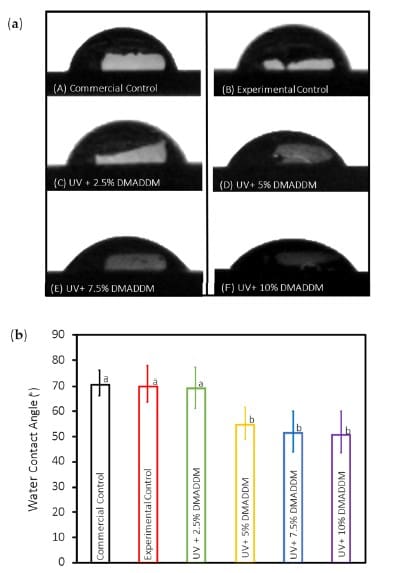
Shows representative water droplet images on samples and statistical comparisons of water contact angle (mean ± sd; n = 15) across Commercial Control, Experimental Control, and DMADDM-containing coating groups.
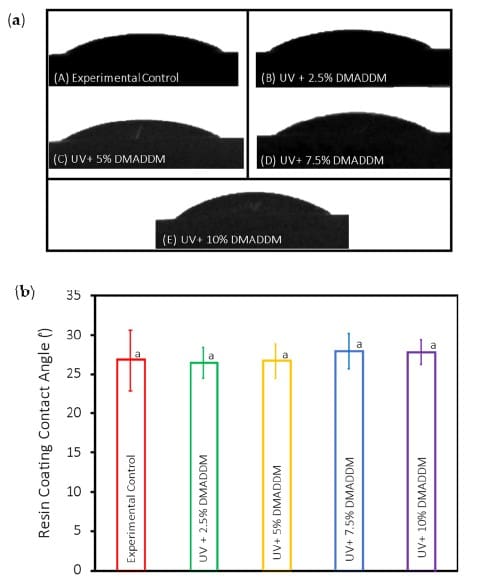
Shows representative images (panel a) and statistical analysis (panel b; mean ± sd; n = 15) of uncured resin coating droplet contact angles across the experimental UV resin groups. The droplet imaged here is the uncured UV coating, placed on a TEMPSMART resin disk — not a water droplet.
The paper treats surface hydrophilicity — measured via water contact angle — as one of two surface properties that had to be ruled out before its antibacterial result could be attributed to chemistry. Roughness was shown to be constant across groups and hydrophilicity was shown not to have harmed performance, which is what allowed the authors to write that the biofilm reduction "can be confidently attributed to the intrinsic antibacterial properties of DMADDM, rather than to any variations in surface roughness". The contact-angle measurement earns its place in the paper as a control, not as the explanation.
Within that context, the Dropometer-generated contact angle data support the paper’s interpretation of how DMADDM concentration changes wettability of cured coated disks, and how uncured coating droplets wet the TEMPSMART resin disk surface in a way the authors describe as favorable for application.
The paper is explicit about what its surface data cannot yet tell a clinician. Only a single bacterial species was examined, and the contact angles are day-zero values on freshly prepared disks. The authors write: "It is yet to be established how easily the coating can be dislodged from the provisional crown material through ordinary toothbrushing and whether the hydrophilicity of the coating impacts hydrolytic degradation and leaching of the antimicrobial agent over time." They name wear resistance and long-term stability as the open questions, and call for multi-species biofilms and in vivo work. For a coating intended to sit on a provisional crown for up to two years, the wettability measured here is a baseline, not a service-life property.
Water contact angles were measured via the sessile-drop technique in air using 5 µL DI water droplets evaluated over a 10 s timeframe, with 15 measurements taken.
The paper reports higher-DMADDM coating groups with lower water contact angles (UV+ 5%, 7.5%, and 10% DMADDM) compared with Commercial Control / Experimental Control / UV+ 2.5% DMADDM, with a significant difference between these sets (p < 0.01).
Uncured UV resin droplet contact angles were obtained from droplet images captured after 10 s. The paper's wording is: "The Droplet Lab's Sessile software (version 1.0.5.1) yielded the contact angle data by the utilization of the Young–Laplace equation."
The uncured UV resin droplet contact angles across Experimental Control and DMADDM-containing UV resin groups showed no significant difference between all groups (p > 0.01).
The paper notes that a water contact angle below 65° demonstrates a surface that is more hydrophilic, providing a criterion for qualitative interpretation of wettability. Two constraints travel with it: the criterion is defined for water and cannot be applied to the Figure 3 uncured-resin droplet values, and the paper itself calls contact angle "a qualitative measure of surface hydrophobicity" — a classification boundary, not a quantitative property.
Every contact angle in this study was taken on a freshly prepared, freshly polished specimen with no thermocycling, water storage or brush abrasion. The authors flag that gap themselves and identify wear resistance and long-term stability as the unanswered questions for clinical use. A lab replicating this protocol should measure contact angle at baseline and again after ageing, and should note the polishing asymmetry in the original design — the commercial control was polished through six grits to 2000, the coated groups through two grits to 1200.