



Contents
Case Study

The undergraduate chemistry teaching labs at USF put 33 contact angle teaching kits into student hands, designed with Droplet Lab.

Last Updated
October 18, 2026
Sector
Undergraduate Chemistry Education
Deployment
33 units, Tampa, FL
Built for undergraduate teaching labs 33 kits in two teaching lab buildings In student lab sessions since 2024

The undergraduate teaching labs of the chemistry department at USF wanted students to measure contact angle themselves, not only read about it. The department found no device like it on the market, so Droplet Lab designed a teaching kit with them over three prototype rounds in 2023. Thirty three kits reached the ISA and NES teaching labs in March 2024, and students used them in lab sessions through the July 2026 summer term.

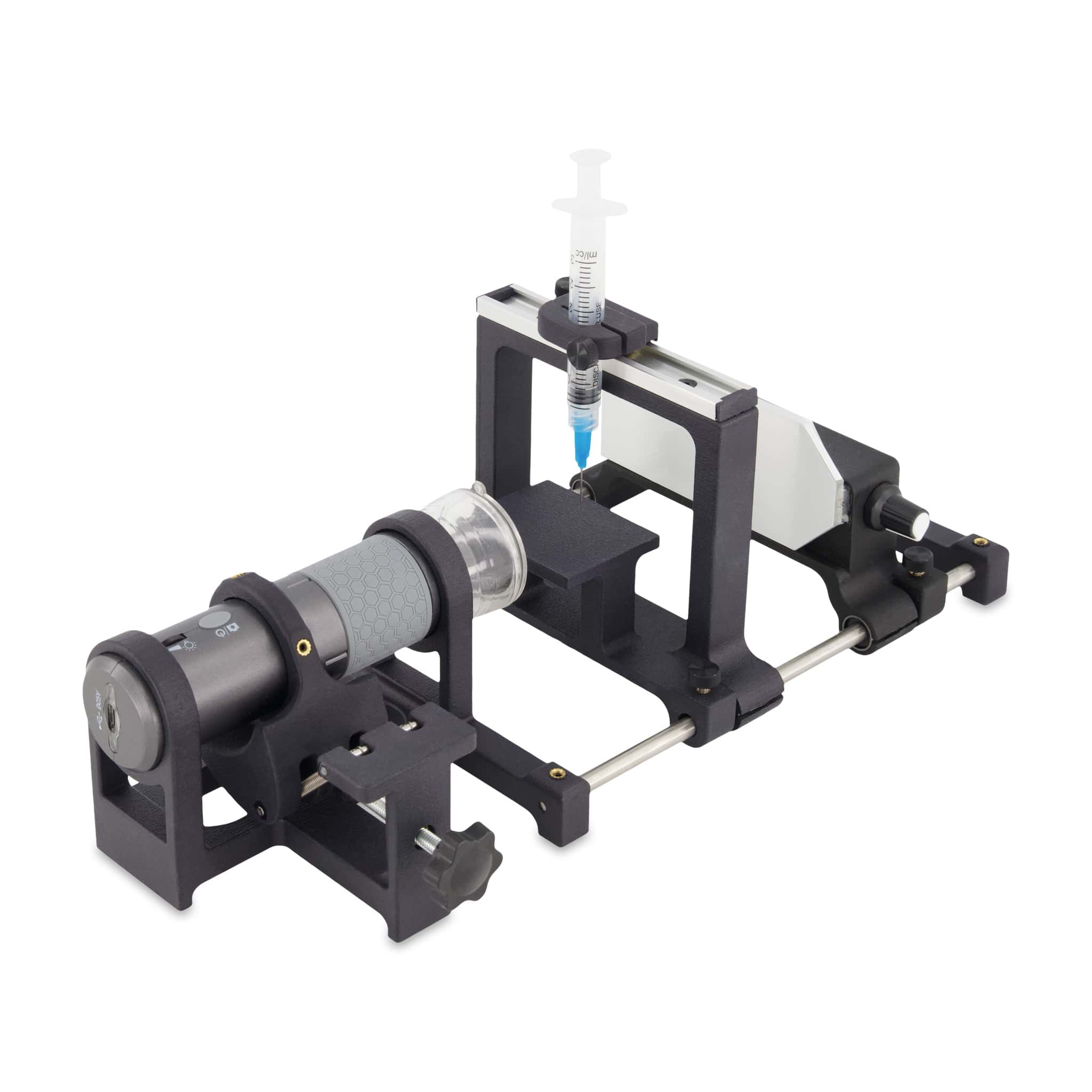
Side view of the Droplet Lab teaching kit with its camera, syringe holder and sample stage
Abhimanyu Photo
Written by
Abhimanyu Bhandankar
Holds an MBA from Schulich School of Business and a BE in IT. He joined Droplet Lab in July 2019 and now leads sales and marketing.
CEO at Droplet Lab
Read More
Gurdeep-Saini-Photo
Technical Review by
Gurdeep Singh Saini
Holds a BASc in Mechanical Engineering from Ryerson University (now Toronto Metropolitan University) and an MASc from York University. He develops the automatic edge and baseline detection behind the Dropometer's analysis.
COO at Droplet Lab
Read More
Abhimanyu Photo
Written By

Abhimanyu Bhandankar

CEO at Droplet Lab

Holds an MBA from Schulich School of Business and a BE in IT. He joined Droplet Lab in July 2019 and now leads sales and marketing.

Gurdeep-Saini-Photo
Reviewed By

Gurdeep Singh Saini

COO at Droplet Lab

Holds a BASc in Mechanical Engineering from Ryerson University (now Toronto Metropolitan University) and an MASc from York University. He develops the automatic edge and baseline detection behind the Dropometer's analysis.

Primary outcome: students run the measurement themselves

Student access to contact angle measurement

Teaching kits in the ISA and NES teaching labs, 2024 to 2026

Before No student contact angle experiment
After 33 kits in student lab sessions

In September 2023 the department asked Droplet Lab for a teaching kit it could buy as a class set. Droplet Lab moved image capture to a separate camera with desktop software, and the department reviewed three prototype rounds between October and December 2023. 33 kits shipped in February 2024 and reached the labs in March. Students used them in lab sessions from summer 2024 through the July 2026 summer term.

33 units

Custom kits delivered to the ISA and NES undergraduate teaching labs.

3 prototype rounds

The department reviewed each prototype between October and December 2023 before ordering.

2 lab buildings

USF IT installed the software across the ISA and NES teaching labs.

2 years of lab sessions

Students used the kits from summer 2024 through the July 2026 summer term.

Executive Summary

Who

The undergraduate teaching labs of the chemistry department at the University of South Florida in Tampa. Dr Jhon J. Figueroa, Assistant Director of Teaching Laboratories, led the project with the teaching assistants and lab specialists who run student sessions.

Problem

The department wanted undergraduates to measure contact angle themselves. A research instrument costs too much to buy as a class set, and the department found no device built for this use. It needed many kits on one teaching budget, simple for students and sturdy enough for repeated handling.

Solution

Droplet Lab designed a teaching kit with the department instead of discounting its research instrument. Image capture moved to a separate camera, with analysis in desktop software on the lab computers. Three prototype rounds in late 2023 covered the battery holder, cable covers, camera position and overall length. The order covered 33 kits with software licences.

Time to Value

April 2020: first contact. May 2020: call with Dr Alidad Amirfazli, Co-founder and Scientific Advisor. 6 September 2023: quote and call. October to December 2023: three prototype rounds and an online demo. 25 January 2024: purchase order. 26 February 2024: kits shipped. 13 March 2024: kits received. July 2024: students using the updated software in lab sessions.

Results

Students used the 33 kits in lab sessions from summer 2024 through the July 2026 summer term. In April 2025 Dr Figueroa reported positive informal feedback and said students drew their own conclusions about material wettability. Teaching assistant feedback led to a manual angle tool in 2024 and surface tension in 2026. Formal student outcome data has not been collected yet.

Highlights

33

Teaching kits in the ISA and NES labs

3

Prototype rounds reviewed by the department

2 years

Student lab sessions, summer 2024 to July 2026

Quote teaser

"You are a single source purchase since there is no device like that in the market."

The teaching labs, at a glance

Department

Undergraduate teaching labs, Department of Chemistry, University of South Florida, Tampa

Course context

Undergraduate chemistry laboratory curriculum combining classroom instruction with hands-on lab work

Teaching stage

Experiential lab module on surface wettability and contact angle

Users

Undergraduate students in lab sessions, supported by teaching assistants and teaching laboratory specialists, in two buildings (ISA and NES)

Deployment

33 teaching kits with software licences

Key constraints

A class set on one teaching budget, durability under student handling, replaceable parts, and software installed through central university IT

Nothing on the market was built for a room full of undergraduates

A price problem, a durability problem, and a product that did not exist.

Surface science taught without an instrument

The department wanted undergraduates to learn contact angle measurement with their own hands. A lecture can define wettability, but students build intuition when they place a drop, capture it and read the angle themselves. That meant enough kits for students to work on them directly, not one shared research unit.

The access problem is a price problem

Research instruments are priced for research budgets, so a teaching lab can rarely buy enough of them for a whole class. The department needed many kits on one teaching budget, not a discount on a single research unit. Our guide to the best contact angle goniometer for teaching and academic labs covers the options teaching labs usually compare.

The product did not exist

In November 2023 Dr Figueroa told us the purchase would be single source, in his words because "there is no device like that in the market". That was the department's own view, recorded before the order was placed.

What success would require

  • A kit students can handle without damaging it, with a removable battery holder and covered LED cables
  • A camera centred on the drop and a total length of 22 cm, as the department specified
  • Software that installs on managed university computers through central IT
  • 33 kits with software licences on one teaching budget

Designed to the price, not discounted to it

What Was Deployed

The undergraduate teaching labs received 33 teaching kits with software licences. Each kit holds a syringe, an LED light and a separate camera, and drop images are analysed in Droplet Lab's desktop software on the lab computers. The kit follows the drop shape approach of the Dropometer contact angle and surface tension kit used in research labs, but it is a separate product built for classroom learning. Before ordering, the department asked for a removable battery holder, covered LED cables, a centred camera and a 22 cm total length. The teaching instrument now lists at US$999 per unit for education.
The Origin

A teaching idea from 2020, picked up again in 2023

Dr Figueroa first contacted Droplet Lab in April 2020 about contact angle and surface tension software for students in the teaching labs. Abhi Bhandankar connected him with Dr Alidad Amirfazli, Co-founder and Scientific Advisor, and the two met by video call in May 2020. Droplet Lab hired an intern that year to draft lab manuals, but the project paused later in 2020.

Dr Figueroa came back on 6 September 2023 and asked for a quote. A call the same day set the direction: a kit built for teaching, at a price the labs could buy as a class set. Within a week Droplet Lab had shortlisted three cameras for the kit. On 21 September it shared a design with the camera, syringe holder and LED light on rails, and Dr Figueroa replied the same day that it looked great.

The first prototype shipped in October 2023 with a desktop app in beta. After two more prototype rounds and an online demo in early December, the purchase request went in on 14 December.

Decision Rationale

Why build rather than buy

The department weighed a research kit, no change, and a new teaching kit.

Option 1
US$4,990 list

Buy research kits

Droplet Lab first quoted its research kit in September 2023, with all software licences and parts included.

Too few kits for a class set on a teaching budget.
Option 2
No capital cost

Keep teaching it from the lecture slide

Keep covering wettability in lectures, without a student experiment.

No cost, and no change to what students do in the lab.
Chosen
US$999 list today

Design a teaching kit with Droplet Lab

Build a new kit around a separate camera and desktop software, with the department reviewing each prototype round.

A class set of 33 kits, shipped in February 2024.
Building a new kit gave the department a class set, but it also took on the risks of a new product. Delivery waited on parts and an import charge, and the first lab sessions showed how much image quality and calibration mattered. Teaching assistants learned to adjust lighting and focus, and Droplet Lab added contrast controls and a manual angle tool in 2024. Labs that want to try angle analysis on their own drop images can start with our free contact angle tool.

Next Step

Teaching surface science without an instrument?

If your teaching labs need a class set rather than one shared research instrument, tell us how many student groups you run. The USF kit was designed with the department over three prototype rounds. The teaching instrument now lists at US$999 per unit for education. Book a 15 minute demo to see the kit and the desktop software.

What changed in the teaching lab

Metric Before After
Student access No class set of contact angle instruments for undergraduates 33 teaching kits across the ISA and NES teaching labs
How the topic was taught Students did not measure contact angle themselves Students capture drop images, run the analysis and interpret wettability results
Instrument handling No instrument for students to handle Students handle the kit themselves, which Dr Figueroa links to a deeper understanding
Image capture Not applicable Separate camera with analysis software on the lab desktop computers
Software Not applicable Desktop app installed by USF IT on managed lab computers, updated in 2024 and 2026
Angle analysis Not applicable Automatic drop profile fit, plus a manual angle tool added in September 2024 after teaching assistant feedback

Rollout timeline

Timeline (high level)

Sep to Dec 2023: Joint development

  • Quote and call, 6 September 2023
  • Design with camera, syringe holder and LED light on rails shared 21 September
  • First prototype shipped in October, desktop app beta shared 19 October
  • Department asked for a removable battery holder, covered cables, a centred camera and a 22 cm length
  • Second prototype in November, third ordered, online demo in early December

Dec 2023 to Jan 2024: Purchase

  • Purchase request submitted 14 December 2023
  • Supplier registration completed in the USF system in January
  • Purchase order received 25 January 2024

Feb to Apr 2024: Delivery and setup

  • Installer and licence key sent 4 February 2024
  • Kits shipped 26 February, after parts delays over Chinese New Year
  • Import charge at delivery paid by Droplet Lab, kits received 13 March
  • Missing fasteners and replacement light knobs shipped in April
  • USF IT installed the software across the ISA and NES teaching labs

May to Sep 2024: First teaching cycle

  • Two students ran the experiment in May ahead of the summer class
  • Drop profile errors and wrong angles traced to lighting, focus and calibration
  • Students used the updated software with new contrast controls from July 2024
  • Manual angle tool added in September 2024 at the department's request

Nov 2024 to Aug 2026: Software updates

  • Teaching laboratory specialist installed version 1.2.2 in November 2024
  • Surface tension update requested after the July 2026 summer term
  • USF IT deployed version 1.3.6a with surface tension to all teaching labs on 11 August 2026

What has been shown so far, and what is still to be measured

Test method

Sessile drop contact angle on solid samples in student lab sessions. Students capture drop images with the kit camera and run the analysis in the desktop software. Surface tension became available in the labs in August 2026.

Sample size and operators

Undergraduate students and teaching assistants in the ISA and NES teaching labs, using 33 kits since summer 2024. Student numbers per term have not been reported to us.

Repeatability / reproducibility

Not yet reported. Dr Figueroa agreed in July 2026 to take part in a planned multi site contact angle study for the Journal of Chemical Education, which would collect student measurement data across institutions.

Notes / assumptions

Student outcome statements on this page are instructor observations from Dr Figueroa's April 2025 email, not formal assessment. The teaching kit is sold for classroom learning, not as a research instrument.

Outcomes to date

Measured Outcomes

33

Teaching kits in use

Thirty three kits in the ISA and NES teaching labs, used by students in lab sessions from summer 2024 through the July 2026 summer term.

2 years

Durability in a teaching environment

The kits stayed in student lab sessions for two years, with spare parts shipped in April 2024 and software updated in 2024 and 2026.

2

Measurements in the software

Contact angle from the start, and surface tension deployed to all teaching labs by USF IT in August 2026.

Operational Outcomes

Student learning

In April 2025 Dr Figueroa reported positive informal feedback, with students analysing their own findings and drawing their own conclusions about material wettability. He linked the freedom to handle the kit without fear of breakage to a deeper understanding.

Teaching approach

Dr Figueroa expects more student led exploration in the labs, with activities that ask students to solve problems and interpret their own data. This is his April 2025 view, not a measured change.

Product changes from feedback

Teaching assistant and instructor feedback led to contrast controls, a manual angle tool and the surface tension update in the desktop software.

What the department said

"The informal feedback has been positive. Students achieved good results, indicating the instruments are functioning effectively and providing accurate data. More importantly, they were able to independently analyze their findings and draw their own conclusions about material wettability. Allowing them the freedom to manipulate the instrument without fear of breakage fostered a deeper understanding of its operation and likely increased their confidence in experimental techniques." In the September 2023 design review, before the kits were built: "The design is perfect. ... I don't see any issues whatsoever." In a feedback call in March 2025, after running the experiment in General Chemistry II: "I am very pleased with the experiment. ... We got good data." And: "This is a good, good instrument for, for education."
Dr Jhon J. Figueroa - Assistant Director of Teaching Laboratories, Department of Chemistry University of South Florida

A partnership still in progress

Delivered

33 custom teaching goniometers deployed across two undergraduate teaching lab buildings
Desktop software installed by USF IT, with contact angle and surface tension measurement (version 1.3.6a, August 2026)
Manual angle tool and contrast controls added after teaching assistant feedback in 2024

In Pilot

Surface tension measurement in student lab sessions since the August 2026 update
Teaching assistant feedback from the current semester feeding the next round of fixes

Planned

A planned multi site contact angle study for the Journal of Chemical Education, which Dr Figueroa agreed in July 2026 to join
Assessed deployment cycle to generate formal student outcome data

Frequently asked questions

Is there a contact angle kit built for undergraduate teaching labs?

Yes. Droplet Lab designed a teaching kit with USF's chemistry teaching labs over three prototype rounds in 2023, because the department found no such device on the market. Each kit holds a syringe, an LED light and a separate camera, with analysis in desktop software on the lab computers.

How many kits did USF buy, and how have they been used?

33 teaching kits with software licences, received in March 2024 for the ISA and NES teaching labs. Students used them in lab sessions from summer 2024 through the July 2026 summer term.

What does the teaching kit cost?

The teaching instrument now lists at US$999 per unit for education. The camera is an off the shelf model, so a damaged camera can be replaced without a service visit, and small parts can be swapped in the lab.

Next Step

Teaching surface science without an instrument?

If your teaching labs need a class set rather than one shared research instrument, tell us how many student groups you run. The USF kit was designed with the department over three prototype rounds. The teaching instrument now lists at US$999 per unit for education. Book a 15 minute demo to see the kit and the desktop software.