



Contents

Contact Angle Buyer's Guide

Best Contact Angle Goniometer for Teaching & Academic Labs

Our pick for teaching labs, where setup time, durability under student handling, and the range of experiments a class can actually run matter more than automation or throughput. Every score below is calculated from published weights and criterion scores that you can check or replace with your own.

Scored 1–5 against 11 weighted criteria; full calculation shown on this page. Specifications and pricing last reviewed May 2026.

Abhimanyu Photo
Written by
Abhimanyu Bhandankar
Holds an MBA from Schulich School of Business and a BE in IT. He joined Droplet Lab in July 2019 and now leads sales and marketing.
CEO at Droplet Lab
Read More
Gurdeep-Saini-Photo
Technical Review by
Gurdeep Singh Saini
Holds a BASc in Mechanical Engineering (Ryerson) and an MASc from York University. He focuses on the custom AI behind the instrument.
COO at Droplet Lab
Read More
Abhimanyu Photo
Written By

Abhimanyu Bhandankar

CEO at Droplet Lab

Holds an MBA from Schulich School of Business and a BE in IT. He joined Droplet Lab in July 2019 and now leads sales and marketing.

Gurdeep-Saini-Photo
Reviewed By

Gurdeep Singh Saini

COO at Droplet Lab

Holds a BASc in Mechanical Engineering (Ryerson) and an MASc from York University. He focuses on the custom AI behind the instrument.

The short answer

A teaching instrument is judged on how many students can get a defensible result out of it in a single lab session. The ranking below weights total cost of ownership at 20 percent, portability and power at 16 percent, and optics and software usability and build quality at 14 percent each. Note the exclusion stated above the ranking before comparing prices.

The ranking

This ranking covers research-capable instruments: units a department can use for teaching now and for project, thesis or research work later. Droplet Lab EDU is deliberately excluded from it. At $999 it is a purpose-built classroom goniometer for contact angle and surface tension, and for a teaching-only lab it is the better buy than anything ranked below, including our own Dropometer. It is not scored here because it is not built for research and would be judged against requirements it was never designed to meet. If your requirement is teaching only, start with the EDU.

Dropometer

Top pick

Dropometer

Droplet Lab

4.3/ 5

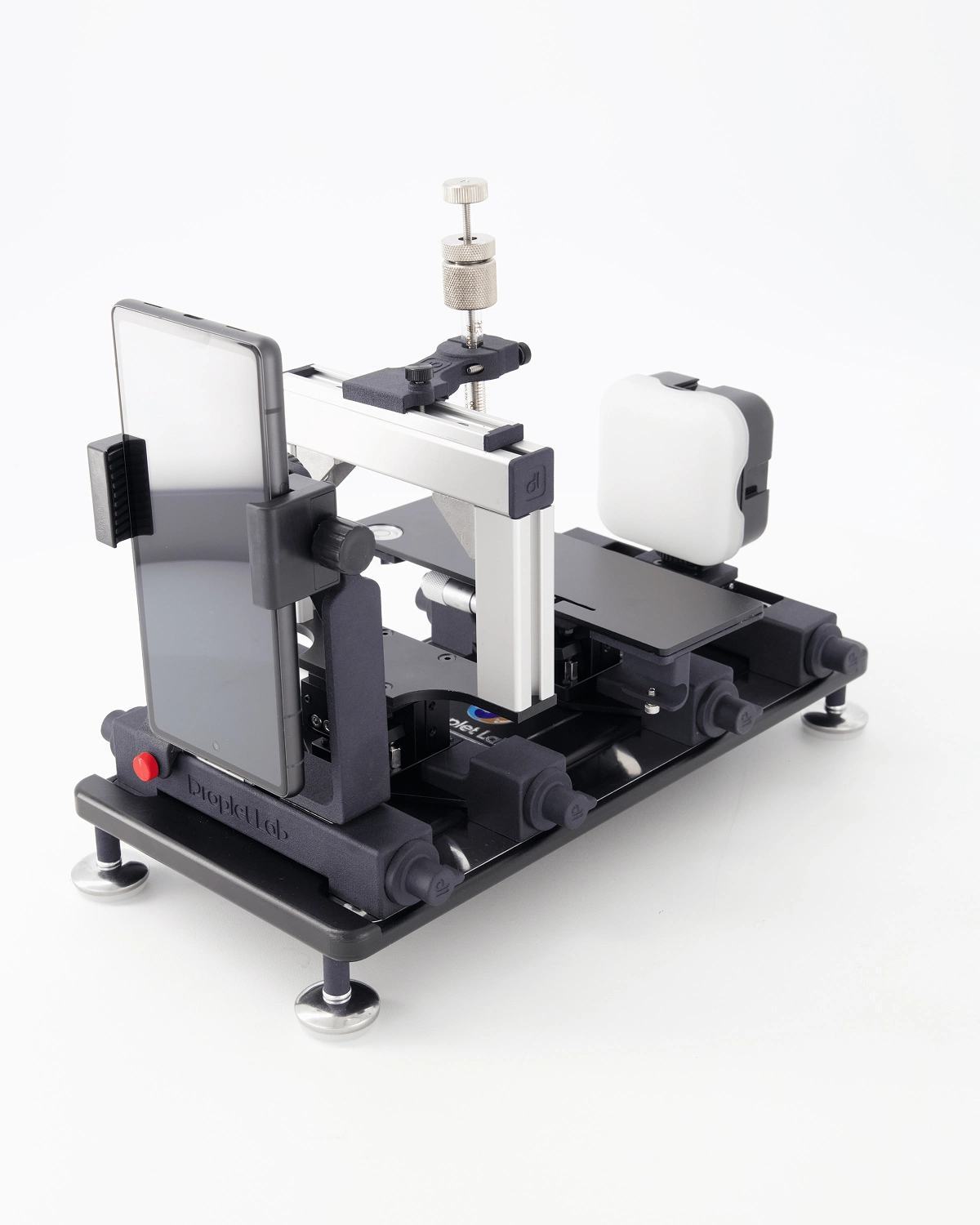
Among research-capable instruments the Dropometer ranks first for teaching because it sets up quickly, runs on battery so it can move between rooms, and covers contact angle, surface energy, surface tension and sliding-angle experiments on one platform. It scores 5 out of 5 on portability, which carries 16 percent here, and it is the only entry to score below 4 on cost, which carries 20 percent.

Where it wins

Fast setup and battery operation for multi-room teaching; static, dynamic and sliding contact angle plus surface energy and surface tension in one platform; automated analysis removes the manual baseline step students most often get wrong; anodized aluminium frame and a 10-year software-update commitment.

Where it loses ground

At $4,990 it is a significant line item for a teaching-only budget and scores 3.5 out of 5 on cost, the lowest of the three. Much of its research-grade capability goes unused in an undergraduate course, and it requires a smartphone, which some institutions restrict.
Ossila Contact Angle Goniometer

Runner-up

Ossila Contact Angle Goniometer

Entry benchtop

3.5/ 5

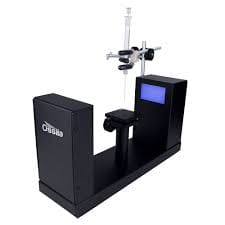
Ossila clears the bar comfortably for teaching. Its fixed bench form factor, integrated software and predictable static contact-angle workflow give students a reliable, structured introduction to drop-shape analysis, and it matches the Dropometer on build quality at 4.5 out of 5. The 0.8 gap comes almost entirely from portability, where it scores 2 against 5, on a criterion weighted at 16 percent.

Where it wins

About $3,000 with a two-year warranty and a 4.5 out of 5 cost score; consistent, repeatable workflow that is easy to write a lab script around; durable academic-grade build; integrated software with pendant-drop and polynomial fitting.

Where it loses ground

Mains-power dependency and limited portability make it hard to share between classrooms; no dynamic or sliding-angle support, which removes hysteresis and roll-off experiments from the syllabus; no upgrade path.

DIY (camera + ImageJ / LB-ADSA)

Third

DIY (camera + ImageJ / LB-ADSA)

Self-assembled

2.8/ 5

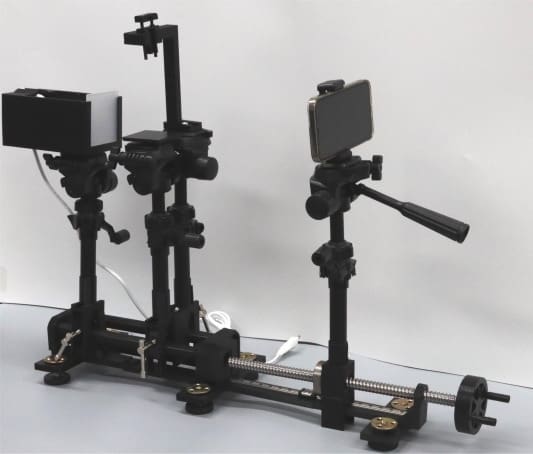
A DIY rig scores 2.8, just below the 3 that marks meeting typical requirements, and it is the closest call on any of these pages. It takes the maximum 5 out of 5 on cost and 4 on portability, and its variability is genuinely useful teaching material. It falls short because a teaching lab also needs results consistent enough to mark, and scores of 2 on optics and build quality reflect how much of a session gets lost to rebuilding rigs.

Where it wins

Effectively no capital cost, so every student group can have one; makes the sources of measurement error visible rather than hiding them; ±1° achievable with careful technique.

Where it loses ground

Slow manual workflow limits how much a class can complete in a session; static angle only; results vary widely between student groups, which makes marking harder; nothing is durable between semesters.

How we arrived at these scores

Side-by-side specification comparison

Compare the three options across the specifications that decide whether an instrument works in a classroom.

SpecificationDropometerOssilaDIY (camera + ImageJ)
Starting priceUS $4,990About US $3,000US $0 to $100
Measurement scopeStatic, dynamic and sliding contact angle; surface tension; surface energyStatic contact angle; pendant-drop surface tensionStatic contact angle only
Experiments supportedWetting, hysteresis, roll-off, surface energy, pendant-drop tensionWetting and pendant-drop tensionWetting only
Setup timeMinutes, battery poweredBench install, mains power and laptopVaries by rig
Moves between classroomsYes, about 1 kgDifficultYes
Result consistency between student groupsHigh, automated analysisModerate, manual dosingLow, fully operator dependent
DurabilityAnodized aluminium frameDurable academic-grade, two-year warrantyAd-hoc
Recurring costNo software feesNone statedNone

Expert perspective

A teaching instrument is bought per seat, not per unit. One expensive instrument shared across six lab groups often teaches less than six cheap ones, because the thing students learn from is running the measurement themselves and seeing their own error.

Droplet Lab Editorial TeamBuyer's guide methodology note

Droplet Lab EDU is $999 per unit, dropping to about $869 at ten or more. It assembles in about a minute, uses reprintable MJF-printed parts that survive student handling, and ships with POGIL-aligned experiments. It is in teaching use at the University of South Florida. It is excluded from the ranking above because it is a teaching instrument rather than a research one, not because it scores badly for classrooms. For a teaching-only lab it is the better spend than our own Dropometer.

Frequently Asked Questions

Because the ranking covers research-capable instruments, and the EDU is not one. It is built for classroom teaching of contact angle and surface tension. For a teaching-only lab it is the better buy than anything ranked here, including our own Dropometer, which is why it is named at the top of the ranking rather than hidden below it.

For most undergraduate courses, several. Students learn the measurement by running it themselves, and one shared instrument turns a lab session into a queue. Reserve a single high-capability instrument for project and thesis work.

Not for an introductory wetting module, where static contact angle and surface tension cover the syllabus. They become useful for project work on hysteresis, roll-off, anti-icing or self-cleaning surfaces.

Yes, and its variability is part of the value: students see how lighting, drop volume and baseline choice move the number. It scores 2.8 here because a teaching lab also needs results consistent enough to mark and equipment that survives the semester.

References

1.
Droplet Lab EDU — educational goniometerSpecifications and pricing for the classroom instrument.
2.
Ossila — Contact Angle Goniometer product pageManufacturer specifications and warranty terms.
4.
Droplet Lab — Client CitationsInstitutions using Droplet Lab instruments in teaching and research.

Not sure this is your use case?

Configure a Dropometer for your workflow and see a live price, or compare the full range side by side.