Contents

Client Citation Analysis

Development of Portable and Easy-to-Use Chemo/Biosensors

This Concordia University PhD thesis set out to make paper based sensors cheaper to build and more reliable to read. Two chapters used a Dropometer to measure water contact angle: once to confirm laser cutting left the Parafilm backing hydrophobic, and once to show that printed carbon ink made the paper under the electrodes repel water. Water treatment right after printing kept the paper wicking, and the electrochemical signal rose more than 75 fold.

At-a-Glance Summary

Primary surface measurement reported

Water contact angle in degrees, reported as mean ± SD: 108 ± 5° and 109 ± 5° on Parafilm (n = 3), 108 ± 2° on the untreated electrode backside, and 112 ± 6° versus 110 ± 5° on the front electrode surface.

Research question

Can low cost fabrication routes (Parafilm heating with laser cutting, and do it yourself screen printing) give paper sensors that wick properly and read precisely, and what stops liquid reaching printed electrodes?

Headline finding

Laser cutting did not change Parafilm wettability. Printed carbon ink turned the paper under the electrodes hydrophobic, and rinsing with water while the ink was still wet kept the paper hydrophilic, which lifted the oxidation peak current from 4 ± 2 µA to 305 ± 18 µA.

Paper Details

Authors
Seyed Hamid Safiabadi Tali (PhD candidate); thesis supervisor Dr. Sana Jahanshahi-Anbuhi
Affiliation
Department of Chemical and Materials Engineering, Gina Cody School of Engineering and Computer Science, Concordia University, Montréal, Québec, Canada
Journal
Not a journal article: Doctor of Philosophy (Chemical and Materials Engineering) thesis, Concordia University
Year
2025 (title page: Fall 2025; committee approval 3 December 2025)
Volume
Not applicable (thesis)
Issue / Article
Not applicable (thesis). Chapter 3 published in Sensors and Actuators B: Chemical 380 (2023) 133324; Chapter 4 published in Electrochimica Acta (2025) 147931
DOI
No DOI (thesis)
Licence
© Seyed Hamid Safiabadi Tali, 2025. No Creative Commons statement in the text; Chapters 3 and 4 were also published as journal articles
Static water contact angle on two sample sets
Measurement scope
Dropometer measurements
  • Chapter 3: Parafilm M sheet, pristine and after laser ablation of the laminated paper
  • Chapter 4: screen printed carbon electrode region on paper, front and back, untreated and water treated
Parafilm M on Whatman grade 1 filter paper; Ercon E3449 carbon/graphite ink on Whatman grade 1 filter paper
Samples tested
Substrates
  • Parafilm test area: 2.5 × 2.5 cm of paper fully ablated before measuring
  • ePADs rinsed twice with water while ink was wet versus untreated
Water (grade not stated for the contact angle tests)
Liquids
Probe liquid
  • Drop volume not stated in the thesis
  • Replicates: n = 3 for Parafilm; not stated for ePADs

Classification

A doctoral thesis on low cost paper sensors where water contact angle checked two fabrication steps.

What Was Measured

Primary surface / interfacial measurement

Water contact angle measured with a Dropometer on Parafilm before and after laser ablation, and on printed electrode regions of paper electrochemical devices (ePADs) before and after water treatment.

Supporting measurements

A micrometer measured laminate thickness; an optical microscope and ImageJ measured channel and barrier widths; a scanner and ImageJ quantified color uniformity. A PalmSens4 potentiostat ran cyclic voltammetry; the thesis does not name the instrument used for chronoamperometry and impedance. SEM (Phenom ProX G5) and FTIR (Nicolet iS20) checked structure and chemistry.

Instruments Mentioned

Dropometer (Droplet Lab, Canada)

Water contact angle on Parafilm and on printed electrode regions of ePADs

Mitutoyo micrometer (293-832-30)

Thickness of Parafilm laminated paper

Universal Laser Systems VLS 2.30DT CO2 laser cutter

Ablation of paper channels and cutting of vinyl screen printing masks

Westover Scientific optical microscope

Cross section of laminated channels

PalmSens4 potentiostat (PalmSens)

Cyclic voltammetry on ePADs (chronoamperometry and impedance also run; instrument not named for those)

Phenom ProX G5 SEM (Thermo Fisher Scientific)

Fiber and graphite flake morphology of untreated and water treated ePADs

Nicolet iS20 FTIR (Thermo Scientific)

Chemical groups on the electrode backside before and after drying

Role of the Droplet Lab instrument

In Chapter 3 the team used a Dropometer to check one risk of their Parafilm heating and laser cutting method: that the laser might damage the hydrophobic Parafilm backing. They ablated a 2.5 × 2.5 cm patch of paper and measured water contact angle on the exposed Parafilm.

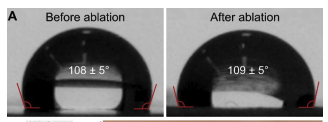
The angle stayed the same within error: 108 ± 5° on pristine Parafilm and 109 ± 5° after ablation (n = 3). The authors read this as the laser settings cutting the paper with minimal impact on the Parafilm.

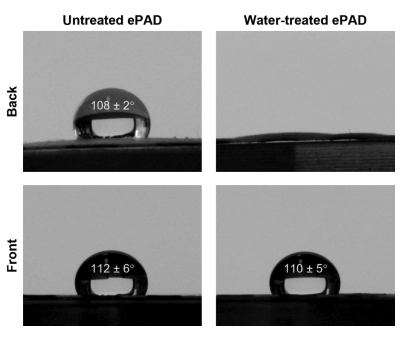
In Chapter 4 the Dropometer measured the electrode region of screen printed paper devices. On the untreated backside the droplet sometimes sat on the paper at 108 ± 2° instead of soaking in. Water treated devices stayed hydrophilic and kept wicking.

On the front electrode surface the angle barely moved: 112 ± 6° untreated and 110 ± 5° water treated. So the treatment changed the paper under the ink, not the ink surface itself. SEM, FTIR and electrochemistry supplied the rest of the explanation.

The contact angles supported the authors' explanation for the weak signal of untreated electrodes: in some devices water could not pass through hydrophobic paper to reach them. Together with SEM, FTIR and impedance data, this helped the authors attribute the 75 fold gain to restored wicking rather than a change in the ink.

Bring This Measurement Into Your Lab

Checking whether a printing, coating or laser step has changed how water wets your substrate? Measure it before and after with the Dropometer.

Method Snapshot

Droplet Lab measurement protocol

Parameter Value as reported
Instrument Dropometer (Droplet Lab) in Chapter 3; Dropometer instrument (Droplet Lab Inc., Canada) in Chapter 4
Measurement Water contact angle
Chapter 3 samples Pristine Parafilm M sheet; Parafilm layer after laser ablation of a 2.5 × 2.5 cm paper area
Chapter 4 samples Electrode region of screen printed ePADs, front and back, untreated and water treated
Liquid Water; grade not stated for contact angle
Drop volume Not stated
Fit / model Not stated
Temperature / humidity Not stated for contact angle (22 °C and about 35% RH were recorded only for flow speed tests)
Replicates n = 3 for Parafilm; not stated for ePADs
Reporting Mean ± SD in degrees

Key Findings

Laser cutting left Parafilm unchanged

Parafilm read 108 ± 5° before and 109 ± 5° after laser ablation of the paper (n = 3), so the backing kept its hydrophobic barrier role.

Printed ink made the paper repel water

On untreated devices the backside electrode region reached 108 ± 2°, and in some cases the droplet never entered the paper.

Treatment fixed the paper, not the ink

The front electrode surface read 112 ± 6° untreated and 110 ± 5° water treated, while the treated backside stayed hydrophilic and wicked.

Signal rose more than 75 fold

From other instruments: twice washed devices gave 305 ± 18 µA oxidation peaks versus 4 ± 2 µA untreated, and charge transfer resistance fell from over 40 kΩ to 0.14 kΩ.

Fabrication outcomes

From other tools: Parafilm laminated channels held liquid with barriers as narrow as 172 ± 15 µm, and printed electrodes reached 286 ± 31 µm resolution.

Measured Values by Sample

Water contact angles measured with the Dropometer, as reported in the thesis text and figure captions.

Water contact angle by sample

Sample Value
Pristine Parafilm M sheet (Ch. 3) 108 ± 5° (n = 3)
Parafilm after laser ablation of paper (Ch. 3) 109 ± 5° (n = 3)
Untreated ePAD, backside electrode region (Ch. 4) 108 ± 2°
Water treated ePAD, backside (Ch. 4) Hydrophilic, droplet wicked in; no angle reported
Untreated ePAD, front electrode surface (Ch. 4) 112 ± 6°
Water treated ePAD, front electrode surface (Ch. 4) 110 ± 5°

Figures & Visuals

Two figures in the thesis contain Dropometer images or values. The thesis has no Creative Commons licence, so we link to the published versions instead of reproducing them.

Figure 3.3: Parafilm wettability after laser cutting

Panel A shows water drops on Parafilm before and after laser ablation, with Dropometer values of 108 ± 5° and 109 ± 5°. Thesis © S. H. Safiabadi Tali 2025; published version in Sensors and Actuators B: Chemical (licence not stated in the thesis). Figure number in the journal article may differ.

Figure 4.S3: Electrode wettability before and after water treatment

Supporting figure on water contact angle measurements of untreated and water treated ePADs, made with the Dropometer. Thesis © S. H. Safiabadi Tali 2025; published version in Electrochimica Acta (licence not stated in the thesis). Likely in the article's supplementary file.

Why It Matters

Paper sensors only work if liquid reaches the right place. Contact angle is a quick way to test whether a fabrication step has changed that.

Inks can block wicking

Carbon inks carry hydrophobic components that can seal the paper under an electrode. A contact angle check on the backside shows this before any electrochemistry is run.

Process checks for barriers

Laser steps can change surface roughness and chemistry. Measuring the barrier material before and after confirms the step left it intact.

Ties a weak sensor signal to a wetting cause

Separates paper wettability from electrode surface wettability

Verifies a laser step left the hydrophobic barrier intact

Expert Perspective

Expert Perspective

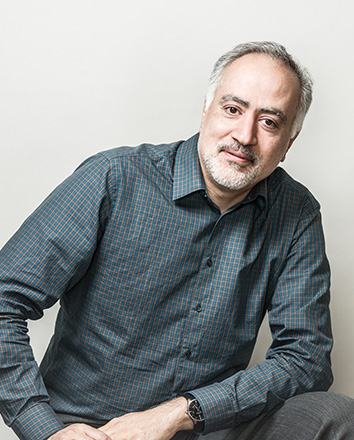
What a liquid responds to is only the outermost few ångström of a surface — the skin, not the bulk. Change that skin and you change the wetting, even if the material underneath is identical.

Dr Alidad Amirfazli

Professor, Department of Mechanical Engineering, York University, Co-founder and Scientific Advisor, Droplet Lab

Practical Takeaways

Measure both faces

The front electrode surface and the paper behind it behaved differently. Measuring only one side would have hidden the cause.

Pair angles with other evidence

The authors combined contact angle with SEM, FTIR and impedance before drawing a conclusion about mechanism.

FAQ

Frequently Asked Questions

What did the Dropometer measure in this thesis?

It measured water contact angle on Parafilm before and after laser cutting, and on the electrode region of screen printed paper devices. Every sensor performance number in the thesis came from other instruments.

Did laser cutting change the Parafilm?

No measurable change was found. Pristine Parafilm read 108 ± 5° and laser exposed Parafilm read 109 ± 5°, with three replicates each.

Why did water treatment improve the electrodes?

Untreated devices had hydrophobic paper under the ink, so the sample could not reach the electrodes. Water treatment kept the paper wicking, while SEM, FTIR and the front surface angles showed the ink itself was largely unchanged.

Were these results also published as journal papers?

Yes. Chapter 3 appeared in Sensors and Actuators B: Chemical in 2023, and Chapter 4 in Electrochimica Acta in 2025.

Citation

Use the formal reference below when citing the original thesis.

Formal Reference

Safiabadi Tali, S. H. (2025). Development of portable and easy-to-use chemo/biosensors [Doctoral thesis, Concordia University]. No DOI or repository link stated in the thesis.

Short Cite + DOI

Safiabadi Tali, PhD thesis, Concordia University, 2025. No DOI (thesis)