
Contents
Material Wettability, Wicking and Microfluidics

Laser Induced Graphene (LIG) Electrode QC: Contact Angle Checks for Batch to Batch Consistency in Flexible Sensors

The same laser and polyimide film can make LIG that is superhydrophilic or superhydrophobic, depending on atmosphere, laser dose and storage. A contact angle on each batch's working area, with a fit built for rough surfaces, catches process drift before you build and test sensors.
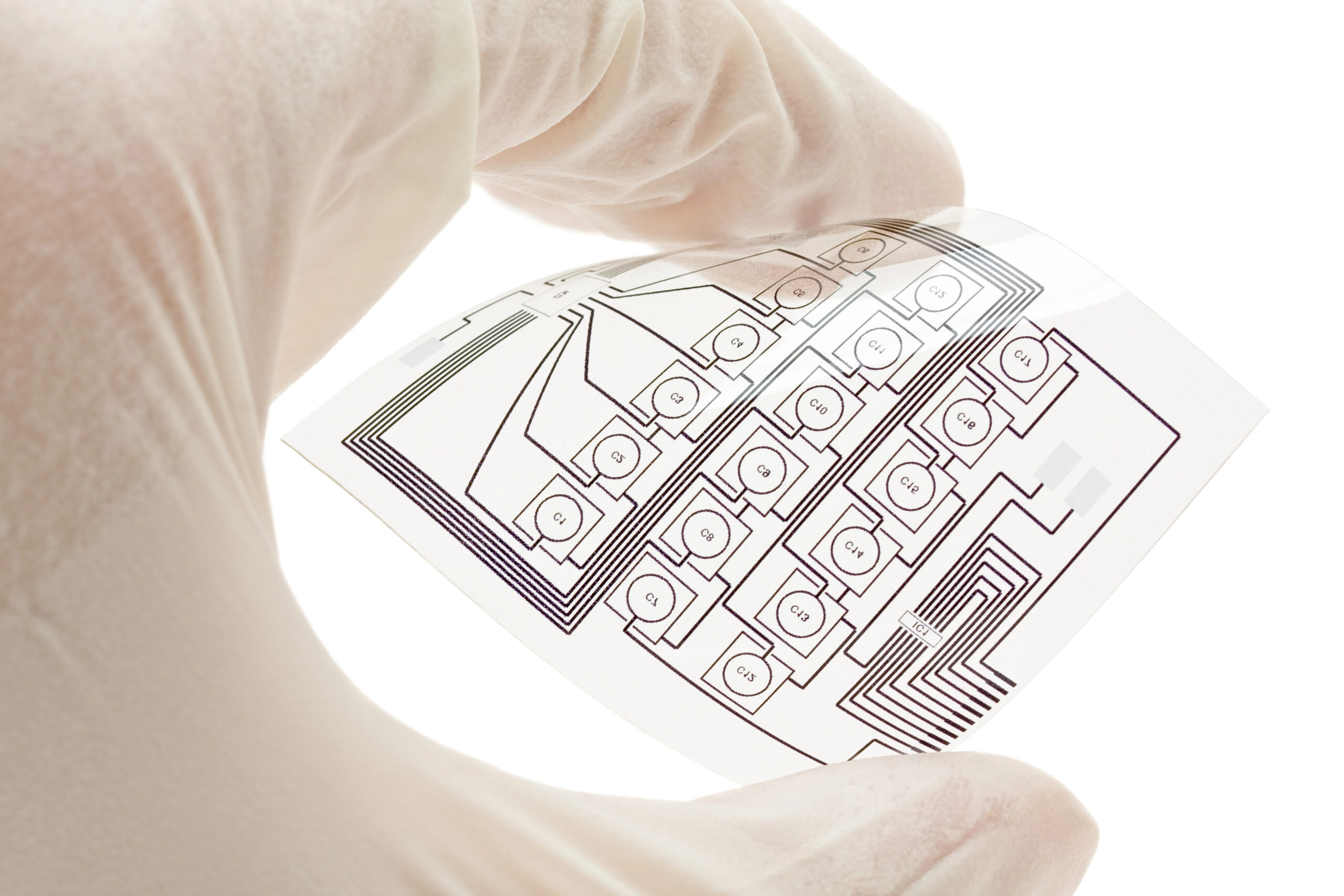
Who this is for: Electrochemical sensor, biosensor and flexible electronics labs that make laser induced graphene electrodes on polyimide or other polymers.

Where it fits: Laser process setup, batch release before sensor assembly, coating and plating checks, and storage studies.

What it does not do: It does not measure sheet resistance, electroactive area or sensor response. Electrochemistry still decides.

Method
Sessile drop contact angle with a polynomial (non axisymmetric) fit on small drops on the working area
Standard
No graphene standard we read includes contact angle; ISO/TS 21356 and IEC TS 62607 cover structure and electrical properties
Setup
About 2 minutes
Why it matters

Why LIG electrodes need a fast surface check

Over 30% vs under 5%

contact angle variation when 36 LIG electrodes were made in one day, versus batches made with 30 minutes of laser rest between them, measured on the Dropometer.

Tang et al., Micromachines 15(7):874, 2024 (customer publication)

13° to 157°

range of water contact angle on LIG from the same laser and polyimide film as the oxygen in the purge gas changed, driven by surface oxygen rather than roughness.

Dallinger et al., ACS Applied Nano Materials, 2023

55% in 7 days

of initial capacitance lost by LIG electrodes stored in a plastic box, while bench stored electrodes stayed hydrophilic, so storage conditions change the surface.

Behrent, Borggraefe and Baeumner, Anal. Bioanal. Chem. 416:2097, 2024

Sources: Tang Y. et al., Batch to batch variation in laser inscribed graphene (LIG) electrodes for electrochemical sensing, Micromachines, 2024; Dallinger A. et al., Different roles of surface chemistry and roughness of laser induced graphene: implications for tunable wettability, ACS Applied Nano Materials, 2023; Behrent A., Borggraefe C., Baeumner A. J., Analytical and Bioanalytical Chemistry, 2024. Figures come from these sources, not from Droplet Lab measurements.

Quick reference

What this LIG electrode check does and what it does not

A quick reference for LIG sensor labs checking fit before reading further.

Evidence Box

Problem this solves

LIG electrodes that vary from batch to batch or change in storage, found only after sensors are built and tested.

Standards

No graphene standard we read includes contact angle. ISO/TS 21356 covers structural characterization and IEC TS 62607 parts cover properties such as sheet resistance.

Peer reviewed method

The Dropometer drop shape method was validated against a KRUSS DSA100E in two peer reviewed papers, in Review of Scientific Instruments and Colloids and Surfaces A.

Customer case study

The McLamore lab at Clemson University measured LIG electrodes on the Dropometer with 2 µL drops and a polynomial fit, and used it to expose a laser throughput effect.

Customer publications

Two peer reviewed papers and an MS thesis from the Clemson lab report Dropometer contact angle on bare, plated and coated LIG.

Honest limit

In the same study contact angle stayed stable while plated electrodes varied 30 to 40% electrochemically, so contact angle screens the surface but does not replace CV.

Who this is for

What LIG question are you trying to answer?

Pick the card closest to your role. Each one points to the part of this page that answers it.

Sensor researcher

You make LIG electrodes for electrochemical sensors or biosensors. A contact angle on each batch shows whether the surface matches the last good batch before you spend time on functionalization and testing.

Use the polynomial fit; symmetric fits fail on rough LIG.

Process engineer

You tune laser power, speed, pulse density, focus and atmosphere. Contact angle shows how each change shifts the surface, and whether long runs drift as the laser heats.

Log laser settings and rest time with every batch.

Flexible electronics developer

You coat, plate or encapsulate LIG for wearables and printed devices. Contact angle before and after each step shows the coating reached the surface and stays there in storage.

Set separate gates for bare and coated electrodes.
Fit check

Is this the right check for your LIG process?

It measures wetting on the electrode surface. It does not measure electrical or electrochemical performance.

Good fit if

You laser scribe polyimide or other polymers into LIG.
You need a quick check on every batch before sensor assembly.
You change laser settings, atmosphere or film supplier.
You plate, coat or functionalize LIG surfaces.
You store electrodes before use and need to track change.

Less relevant if

You need sheet resistance; use a four point probe.
You need electroactive area; use cyclic voltammetry.
Your working area is smaller than a drop.
Your LIG is so hydrophilic that drops vanish into it at once.
Summary

How contact angle supports LIG electrode QC

The answer in under a minute.

Place a small drop on the working area of each LIG electrode and fit it with a polynomial method made for rough, uneven surfaces. Compare the batch median and spread with your last good batch. A shift points to laser drift, atmosphere, film or storage changes; confirm with cyclic voltammetry before you build sensors.

The Dropometer contact angle kit runs the check. The Clemson University case study shows a lab that found a laser throughput effect this way, described in the batch to batch variation analysis. Our contact angle measurement guide and wettability glossary entry explain more.

Expert Quote

Expert perspective on liquid and solid

A contact angle is a thermodynamic property: fix the liquid and the solid and the same angle appears whether the drop sits on a plate or climbs a capillary.

Dr. Alidad Amirfazli

Professor, Department of Mechanical Engineering, York University; Co-founder, Scientific Advisor, Droplet Lab

The problem

Why LIG electrodes vary from batch to batch

Laser induced graphene is made by scribing a polymer film, usually polyimide, with a laser, which converts the surface into porous, conductive graphene. The original work used a CO2 laser on Kapton and found a conversion threshold of 2.4 W, with sheet resistance falling below 15 ohm per square at higher power. The process is simple, but the surface it makes is not fixed. Scribing in oxygen or air gives superhydrophilic LIG, while argon or hydrogen gives superhydrophobic LIG. On one laser and film, water contact angle ran from 13° to 157° as purge gas oxygen changed, because surface oxygen changed. Laser dose, pulse density and focus move it too, and one study warns its settings are likely not transferable to other lasers. Storage matters: electrodes kept in a plastic box lost 55% of their capacitance in a week. Reviews name batch to batch variation as a main weakness of LIG sensors. At Clemson University, 36 electrodes made in one day varied by more than 30% in contact angle, and the source of that drift still needs study. Without a quick surface check, these changes are found only after sensors are built, functionalized and tested.

Sensors from one batch respond differently from the last.
Electrodes made late in a long run behave differently.
Coatings or plating spread unevenly on some electrodes.
Electrodes change after a few days in storage.
Settings copied from a paper give different results on your laser.
Troubleshooting

Why LIG surfaces change and what to check

Why:

  • Long runs without rest changed LIG in one study, and maintenance and operating frequency were named as control factors.

How to detect:

  • Spread in contact angle grows through the day.

Corrective action:

  • Split production into smaller batches with laser rest, and clean the lens on a schedule.

Why:

  • Oxygen in the purge gas or room air changes surface oxygen and wetting.

How to detect:

  • The angle shifts when gas flow, enclosure or humidity changes.

Corrective action:

  • Control and log the atmosphere during scribing.

Why:

  • Power, speed, pulse density and focus interact differently on each laser.

How to detect:

  • Published settings give a different angle on your machine.

Corrective action:

  • Build your own map of settings against contact angle and sheet resistance.

Why:

  • LIG surfaces oxidize in air and light and adsorb material from packaging.

How to detect:

  • The angle changes between fabrication day and use.

Corrective action:

  • Fix storage conditions and measure at a set time after scribing.

Why:

  • Nanoplatinum plating raised the angle by nearly 20% in one study.

How to detect:

  • Coated electrodes read differently from bare ones.

Corrective action:

Set separate gates for bare and coated electrodes. Our page on corrosive liquids covers plating solutions.

Why:

Symmetric fits gave errors up to 60% on rough LIG, and buffers act like mild surfactants. Our guide to reproducible contact angle measurement covers fair comparisons.

How to detect:

  • Repeat readings on one electrode disagree, or buffers read lower than water.

Corrective action:

Use the polynomial fit and compare each liquid only with itself. Check a flat control against our contact angle reference values.

Not sure why your LIG batches differ?

Send electrodes from good and bad batches, and we will compare them on a call.

Lab records

What an LIG batch record contains

Each check produces a record you can file with the batch, beside sheet resistance and CV results.

Batch

Film type and lot, laser model and settings, atmosphere, batch size and laser rest time.

Timing

Time since scribing and storage conditions.

Method settings

Liquid, drop volume, fit method, read time and operator.

Readings

Contact angle per electrode, batch median and spread.

Linked results

Sheet resistance, CV or sensor response for the same batch.

Drop images

Automatic edge and baseline detection gives the same reading from the same image, so a reviewer can recheck any result.

Measurements

What to measure on LIG electrodes

Batch

Contact angle on the working area

Why it matters: It shows whether this batch's surface matches the last good batch.

How to interpret: Compare batch median and spread with your reference. One published bare LIG process read 58.6 ± 1.4° in DI water; your process sets its own range.

When it is not enough: It does not show electroactive area or sheet resistance.

Spread

Variation within and between batches

Why it matters: Rising spread shows laser or process drift.

How to interpret: Track percent variation per batch; one lab saw over 30% in a long single day run and under 5% with laser rest.

When it is not enough: Stable contact angle does not guarantee stable electrochemistry.

Coating

Angle before and after plating or coating

Why it matters: It shows the coating reached the surface.

How to interpret: Use a separate range for each coating; plating raised the angle to 78° in one study.

When it is not enough: It does not show coating thickness or activity.

Storage

Angle over storage time

Why it matters: LIG surfaces change in air, light and packaging.

How to interpret: Measure the same batch at fixed times after scribing.

When it is not enough: It does not show the capacitance or current change on its own.

Validation

Validated measurement approach for LIG electrodes

How the Dropometer itself has been validated, and how a customer used it on LIG.

Peer reviewed method

The Dropometer drop shape method is published in Review of Scientific Instruments and Colloids and Surfaces A. Contact angle was validated against a KRUSS DSA100E, with a published accuracy of 0.35°.

See the validation papers

Customer evidence on LIG electrodes

Tang and colleagues at Clemson University measured LIG electrodes on a Dropometer-M with 2 µL drops, the polynomial fit in Droplet Lab software 1.4.0.10, one operator and archived images (Micromachines, 2024). Contact angle exposed a laser throughput effect and showed nanoplatinum plating raised the angle by nearly 20%.

Read the citation analysis
QC Protocol

How to check LIG batches by contact angle

Six steps per batch. Run them before functionalization and electrochemical tests.

1

Lock the method

Fix drop volume (2 µL in published work), liquid, read time and the polynomial fit.

2

Mount electrodes

Hold each electrode flat on a sample mount and place the drop on the working area only.

3

Measure each batch

Measure every electrode or a fixed sample per batch, by one operator. Our aptasensor thesis analysis shows the same workflow with buffers.

4

Archive images

Save every drop image with batch, laser settings and time since scribing.

5

Compare with the gate

Compare the batch median and spread with your reference before functionalization.

We completed our gage R&R study on the unit and it performed very well.

Brandon Barbee

Corporate Quality Engineer, Zeus Industries, Polymer Manufacturing

Download the LIG electrode QC SOP

A two page SOP you can adapt for your LIG process, with the method lock, how to set a gate against your electrochemistry, a troubleshooting table and a record sheet.

Contact angle measurement with the Dropometer

Contact angle measurement with the Dropometer

Example output

Example LIG batch log

Example data only. Your values and gates will differ and must come from your own electrochemical results.

How to read this log

Example gate: batch median 55 to 62° with spread under 5%. Batches 1 and 2 passed. Batch 3 was the end of a long run without laser rest, and spread rose past the gate. Plated electrodes have their own range. Our electrical and electronics guide covers related materials.

Example LIG batch log

Batch Laser rest before batch Median angle (°) Spread in batch Coating Decision
1 30 min 58.4 3.1% None Release
2 30 min 59.0 3.8% None Release
3 None, end of long run 51.2 18.5% None Hold; check laser
4 30 min 77.6 4.2% Nanoplatinum Release (plated range)

Example data, not customer data. CO2 laser LIG on polyimide; 2 µL DI water drops; polynomial fit; nine electrodes per batch.

Signal order

The order to check signals on LIG batches

Check these in order. Each one rules out a cause before you look at the next.

1

Fit and liquid

Rules out symmetric fit errors and liquid effects.

2

Batch median

Shows whether the surface matches the reference.

3

Spread in batch

Shows laser drift within a run.

4

Time since scribing

Shows storage and ageing effects.

5

Electrochemistry

Confirms sensor performance. Our page on hydrogel wettability covers soft coatings for sensors.

FAQ

Common questions about LIG electrode wettability

Questions LIG sensor labs ask about contact angle and batch QC.

Either, depending on how it is made. Scribing in oxygen or air gives superhydrophilic LIG near 0°, while argon or hydrogen gives superhydrophobic LIG above 150°. On one laser and polyimide film, the angle ran from 13° to 157° with purge gas oxygen, because surface oxygen changed. Laser dose and pulse density shift it too.

It is fast and responds to the surface chemistry that changes with laser drift, atmosphere and storage. At Clemson University it revealed that electrodes made in one long run varied by more than 30%, while batches with laser rest stayed under 5%. The case study describes the method.

LIG is rough and porous, so drops are not perfectly symmetric. The Clemson lab found Young Laplace fitting gave errors of up to 60% on repeat tests of one sample, and switched to a polynomial, non axisymmetric fit with 2 µL drops for every measurement.

No. In the same study, contact angle did not vary across batches while plated electrodes varied 15 to 20% within batches and 30 to 40% across batches electrochemically. Use contact angle to screen surfaces quickly, and confirm with cyclic voltammetry or your sensor test.

DI water for a baseline, plus the buffers your sensors meet. Common buffers such as HEPES, MES and Tris can act like mild surfactants and read differently from water, and the type of liquid had a significant effect on mean contact angle in published work. Compare each liquid only with itself.

LIG surfaces oxidize in air and light and can pick up material from packaging. In one study, electrodes stored in a plastic box lost 55% of their capacitance within 7 days, while bench stored electrodes stayed hydrophilic for two weeks. Measure at a fixed time after scribing and fix your storage.

We found none. ISO/TS 21356 covers structural characterization of graphene and IEC TS 62607 parts cover properties such as sheet resistance, without contact angle. Reviews name batch to batch variation and hard standardization as main weaknesses of LIG sensors, so record your own method fully.

One that places small drops, offers a non axisymmetric fit for rough surfaces and archives every image. The Dropometer does this at the bench, and the Clemson lab has used it in two peer reviewed papers and an MS thesis. Our biotechnology guide covers biosensor labs.

Business impact

What changes when you check LIG batches

Typical changes in how labs work. Benchmarks are given only where a published source exists.

Before and with LIG batch checks

Metric Before Dropometer With Dropometer Indicative Benchmark
Batch release Found during sensor testing Contact angle on each batch first Over 30% vs under 5% variation with laser rest (Tang et al., 2024, Dropometer)
Laser settings Copied from papers Mapped against your own contact angle 13° to 157° on one laser and film (Dallinger et al., 2023)
Storage Assumed stable Measured at fixed times after scribing 55% capacitance lost in 7 days in a plastic box (Behrent et al., 2024)
Coating checks Judged by eye Angle before and after plating Nearly 20% rise after nanoplatinum (Tang et al., 2024)

See the measurement on your own electrodes

Send electrodes from good and bad batches. We will show the comparison on a call.

Estimate saved testing on LIG electrode batches

Enter your own numbers. The result is an estimate, not a Droplet Lab claim.

LIG batch screening estimate

Estimate saved testing on LIG electrode batches.

Each Dropometer unit is US$5,000; the default models one unit.
Your own cost to functionalize and test one batch.
Mounting, contact angle measurement and analysis per batch.
No published benchmark. Use your own estimate and start low if unsure.

Result

~0
Candidates saved per month
~0
Monthly savings
~0
Payback period
~0
First year net benefit

Monthly savings = materials saved + technician time saved from reduced iterations.

Limits

What contact angle cannot tell you about LIG

Honest limits, so you know when to reach for another test.

It does not measure electrochemical performance.
Symmetric fits fail on rough LIG; use the polynomial fit.
Superhydrophilic LIG can absorb drops at once.
Buffers read differently from water.
Readings change with time since scribing.
Gates from one laser do not transfer to another.

Contact angle shows whether an LIG surface matches your reference batch. Sheet resistance, electroactive area, Raman quality and sensor response need their own tests.

How this page was created

Editorial and technical transparency notes for this page.

Transparency Details 4 checklist items
01

Drafting assistance

Drafted with Claude Opus 5.5 (Anthropic) using web search for sources, then edited by the Droplet Lab team.

02

Technical review

Reviewed and edited for technical accuracy by the Droplet Lab Team.

03

Verification steps

Standard identifiers, units, thresholds and key procedural claims are checked against cited sources before publication.

04

Updates

Reviewed every 12 months or when the underlying method changes.

Report a correction

Spotted an issue in this summary? Send a correction request and our team will review it.

Correction Request

We work hard to keep this page accurate and up to date. If you spot an error (wrong revision/year, missing requirement, incorrect interpretation, or broken link), tell us and we'll review it.

Contact us to report a correction
Sources

References

1.
Tang, Y., Moreira, G. A., Vanegas, D., Datta, S. P. A., McLamore, E. S. Batch to batch variation in laser inscribed graphene (LIG) electrodes for electrochemical sensing. Micromachines 15(7):874, 2024. See our citation analysis. https://dropletlab.com/validation/citations/analysis/batch-to-batch-variation-in-laser-inscribed-graphene-lig-electrodes-for-electrochemical-sensing/
2.
Laser inscribed graphene aptasensor for detection of apple stem pitting virus. MS thesis, Clemson University, 2023. See our citation analysis. https://dropletlab.com/validation/citations/analysis/laser-inscribed-graphene-aptasensor-for-detection-of-apple-stem-pitting-virus/
3.
Lin, J. et al. Laser induced porous graphene films from commercial polymers. Nature Communications 5:5714, 2014. https://doi.org/10.1038/ncomms6714
4.
Li, Y. et al. Laser induced graphene in controlled atmospheres: from superhydrophilic to superhydrophobic surfaces. Advanced Materials 29(27):1700496, 2017. https://doi.org/10.1002/adma.201700496
5.
Dallinger, A., Steinwender, F., Gritzner, M., Greco, F. Different roles of surface chemistry and roughness of laser induced graphene: implications for tunable wettability. ACS Applied Nano Materials, 2023. https://doi.org/10.1021/acsanm.3c02066
6.
Behrent, A., Griesche, C., Sippel, P., Baeumner, A. J. Process property correlations in laser induced graphene electrodes for electrochemical sensing. Microchimica Acta 188:159, 2021. https://doi.org/10.1007/s00604-021-04792-3
7.
Behrent, A., Borggraefe, C., Baeumner, A. J. Analytical and Bioanalytical Chemistry 416(9):2097 to 2106, 2024. https://doi.org/10.1007/s00216-023-05082-y
8.
Hjort, R. G. et al. Hydrophobic laser induced graphene potentiometric ion selective electrodes for nitrate sensing, 2022. https://doi.org/10.1007/s00604-022-05233-5
9.
Crapnell et al. Analytical Methods (review of LIG electrochemical sensors). https://e-space.mmu.ac.uk/637535/1/D4AY01793E.pdf
10.
Chen, X. et al. Contact angle measurement with a smartphone. Review of Scientific Instruments 89(3):035117, 2018. https://pubs.aip.org/aip/rsi/article-abstract/89/3/035117/368179/Contact-angle-measurement-with-a-smartphone
11.
Surface tension measurement with a smartphone using a pendant drop. Colloids and Surfaces A: Physicochemical and Engineering Aspects. https://www.sciencedirect.com/science/article/abs/pii/S0927775717307744