Primary surface measurement reported
Sessile-drop contact angle (hydrophobicity) measurements on LIG and nPt-LIG electrode surfaces.

Client Citation Analysis
Sessile-drop contact angle (hydrophobicity) measurements on LIG and nPt-LIG electrode surfaces.
"Hydrophobicity was analyzed using a Droplet lab DROPOMETER-M (Markham, ON, Canada)." / "Contact angle calculations were based on the polynomial method (non-axisymmetric drop)." / "The instrument camera was used to capture a static picture in sessile droplet mode." — Section 2.4, Goniometry.
Contact-angle outputs were used to quantify batch-to-batch variation in LIG hydrophobicity immediately after graphitization, compare wettability across multiple testing solutions (including common biological buffers), and evaluate wettability changes after nanoplatinum metallization.
Four unique batches (nine electrodes each) were prepared on individual days, by the same operator." (Section 2.4). Figure 1 reports n = 24 for each violin-plot group and n = 6 electrodes in each batch for batch-average plots — a replicate count the paper states inconsistently (see the Method Snapshot notes).
Hydrophobicity reported as contact angle (degrees) measured by goniometry using sessile droplets on LIG and nanoplatinum-metallized LIG (nPt-LIG) electrodes.
The study also reports LIG characterization using stereomicroscopy, open circuit potential (OCP), and cyclic voltammetry (CV) as part of the batch-variation assessment and electrochemical sensing context, including calculation of oxidation peak current and area between anodic/cathodic curves from CV traces.
Droplet lab DROPOMETER-M (Markham, ON, Canada)
Droplet lab software (version 1.4.0.10)
Universal CO2 laser system (version VLS3.60, Scottsdale, AZ, USA)
DC power supply (Tektronix, Beaverton, OR, USA)
SDG2042X Arbitrary Waveform Function-Generators (Siglent, OH, USA)
Thermo Orion A211 Benchtop pH Meter and calibration standards (Waltham, MA, USA)
MultiPalmSens4 potentiostat (PalmSens BV, GA, Houten, The Netherlands)
BASi electrochemical glass cells
Rstudio (version 1.1.463)
CorelDraw (Corel Corporation, Ottawa, ON, Canada)
Hydrophobicity (contact angle) was measured using a Droplet lab DROPOMETER-M by placing a 2 µL aliquot on the working area of the LIG electrode, capturing a static image in sessile droplet mode, and calculating contact angle using a polynomial (non-axisymmetric drop) method. In the software workflow, key image features (e.g., droplet edges/profile of interest) were identified following manufacturer recommendations, and images from each test were archived.
In this study’s batch-variation workflow, the resulting contact-angle data were used to compare hydrophobicity across fabrication batches, across testing solutions (including common buffers), and before/after nanoplatinum metallization.
Under the study's four-batch protocol, contact angle varied by less than 5% across batches for both bare LIG and platinum-metallized LIG. The authors conclude: "Contact angle did not vary across batches, but the type of liquid tested did have a significant effect on mean contact angle." The >30% variation reported below occurred only when 36 electrodes were laser-written in a single day without downtime; an intra-day throughput effect, not batch-to-batch variation, and one the authors could not explain: "Additional studies are required to identify the source of the variation during the LIG manufacturing process."
The average contact angle for LIG in DI was reported as 58.6 ± 1.4°, and the authors interpret this as indicating a hydrophilic surface under their test conditions.
The mean contact angle in 2× isotonic buffer was reported as 59.3 ± 2.6°, and described as not significantly different than DI; within fabrication batches, contact angle variation for non-modified LIG in DI and isotonic bicarbonate was reported as less than 5%.
Contact angles for non-modified LIG in HEPES, MES, and Tris were reported as significantly lower than DI, and the authors interpret this as each buffer behaving as a mild surfactant impacting surface tension; within-group variation for these buffer conditions was reported as 6% to 8%.
When 36 electrodes were fabricated in a single day, reported contact-angle variation was more than 30%. Fabricating and analyzing 36 electrodes as four batches of nine with a 30 min laser downtime between batches was associated with reduced variation (reported as a reduction from 30% to less than 5%), and the authors identify laser maintenance, operational frequency, and batch size as control factors for future protocols.
After metallization with nPt, the contact angle in DI and isotonic carbonate buffer was reported as 78 ± 4°, described as an increase by nearly 20% with a more hydrophobic surface. The authors report the HEPES/MES/Tris contact angles for nPt-LIG as similar (63 ± 2°) and higher than all LIG experiments, with within-batch variation described as 5%.
Using oxidative peak current, single LIG electrodes varied by less than 2% across batches; the LIG sensor chip by 8%. Peak separation was 205 ± 50 mV for single electrodes and 519 ± 20 mV for the chip.
Nanoplatinum deposition raised peak current by 150–250 µA, increased capacitance sevenfold, and cut peak separation to 143 ± 3 mV. But batch variation rose to 15–20% within batches and 30–40% across batches. The paper's headline conclusion: "metallization of LIG with nPt improves performance but comes at the expense of increased batch variability."

Shows representative goniometry images for four electrode batches (LIG sample with a 2 µL DI droplet) with calculated contact angles overlaid.
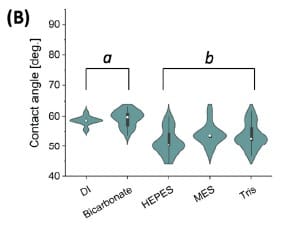
Violin plots compare contact-angle distributions across testing liquids for non-modified LIG (n = 24 per group), with group subsetting indicated by LSD lettering.
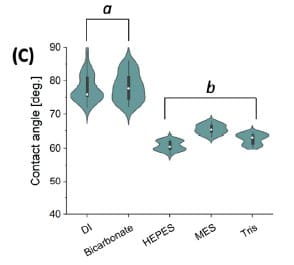
Violin plots show how contact-angle distributions shift after nanoplatinum metallization across the same set of testing liquids (n = 24 per group).
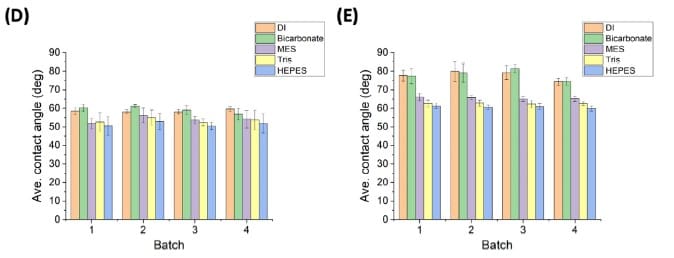
Batch-average contact angles (with standard deviation error bars) are shown for non-modified LIG (D) and nPt-LIG (E), with n = 6 electrodes per batch.
The paper frames laser-inscribed graphene as an emerging platform for electrochemical sensing and positions batch-to-batch variability as a practical challenge for scalable device manufacturing. The DROPOMETER-M measured how LIG wettability responds to the liquid in contact with it, and served as a screening check on fabrication consistency. Its result was a negative one, and a useful one: the authors conclude that "contact angle did not vary across batches, but the type of liquid tested did have a significant effect on mean contact angle." Wettability stayed flat while the electrochemical response varied by 30–40% across batches after platinum metallization — so contact angle is not the parameter that explains batch-to-batch variation in these electrodes. Knowing which measurement does not track a failure mode saves the next lab from chasing it.
The authors also use contact-angle comparisons across testing buffers (including zwitterionic buffer components) and after nanoplatinum metallization to discuss interfacial behavior in different solutions. Wettability stayed flat across batches while the electrochemical response varied by 30–40% across batches after platinum metallization — so contact angle is not the parameter that explains batch-to-batch variation in these electrodes, and the paper computes no correlation between wettability and any electrochemical parameter. Knowing which measurement does not track a failure mode saves the next lab from chasing it.
The authors report that preliminary Young–Laplace (axisymmetric) fitting showed significant errors (up to 60% for the same sample tested multiple times sequentially), and therefore used the polynomial (non-axisymmetric drop) approach throughout for contact-angle calculations.
LIG is a rough, porous carbon film whose "surface chemistry and feature size are highly variable," and polyimide "undergoes deformation during the graphitization process." Axisymmetric fitting assumes a symmetric drop; on this surface the drop pins asymmetrically, which is why the polynomial (non-axisymmetric) method was used for every reported value. The angles reported are apparent contact angles on a rough heterogeneous surface, not intrinsic Young angles. No roughness correction, hysteresis, or advancing/receding measurement was performed.
The study reports markedly different contact-angle variation for 36 electrodes fabricated in a single day versus splitting fabrication into multiple batches with laser downtime, and highlights maintenance and operational factors (e.g., lens cleaning, operational frequency, batch size) as protocol controls.
HEPES, MES, and Tris produced significantly lower contact angles on non-modified LIG than DI, and the authors interpret these shifts in the context of surfactant-like behavior and interfacial effects.
Nanoplatinum metallization increased reported contact angles (78 ± 4° in DI and isotonic carbonate buffer) and shifted contact angles in HEPES/MES/Tris relative to non-modified LIG.
The authors characterize LIG using goniometry together with electrochemical tests (OCP and CV) as part of the overall analysis of batch-to-batch variation for electrochemical sensing applications.