Contents

Client Citation Analysis

Fullerene-like amorphous carbon nitride film surface properties and evaluating the initial adsorption kinetics of albumin and fibrinogen

This study prepares fullerene-like amorphous carbon nitride (FL‑CNx) films on gold substrates using different N₂/Ar plasma discharge gas ratios and reports sessile water contact angles as a surface-wettability metric alongside protein adsorption kinetics measurements.

At-a-Glance Summary

How the paper credits the instrument

The paper's only mention, in Materials and methods → Contact angle measurements: "The unit was verified by measuring the contact angle of PTFE film (Goodfellow, 0.05 mm thickness) which was 107.3 ± 2.2°. This was within the measured range (108.7 ± 2.5°) of a commercially available contact angle instrument (Dropometer, Droplet Lab, Toronto, ON)."

How the contact-angle data were used in the study

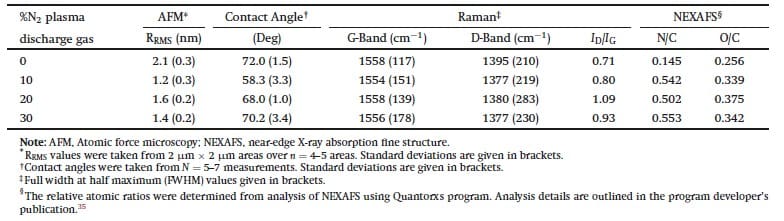
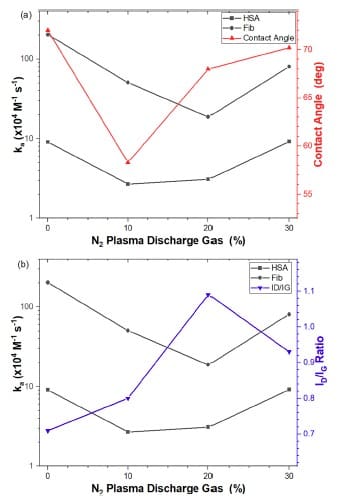
Water contact angles are summarised across the four FL-CNx film conditions (Table 1) and compared with SPR association kinetics for fibrinogen and human serum albumin as a function of the N₂ plasma discharge gas fraction (Fig. 4a). The comparison did not resolve: the authors conclude that "there is no definitive property within the films that correlates with the changes in protein binding kinetics."

Replication / reliability statement

"Contact angles were taken from N = 5–7 measurements. Standard deviations are given in brackets." (Table 1 note). This count applies to the home-built apparatus. The paper states no replicate count, temperature or humidity for the Dropometer's PTFE reading, and no measurement temperature or humidity for the film contact angles either.

What the Droplet Lab instrument did, and did not do

The Dropometer was used as the reference standard against which the authors validated their own home-built contact-angle apparatus, reading 108.7 ± 2.5° on a PTFE film. It did not measure the carbon nitride films: every contact angle in Table 1 was collected on "a home-built apparatus" using a DynaPro 90X USB microscope and DinoCapture V2.0 software. The Dropometer appears in one sentence of the Methods and contributes to 0 of the paper's 6 figures and 0 of its 2 tables. The principal outcomes — protein association and dissociation kinetics — were measured by surface plasmon resonance on a BiacoreX; film structure was characterised by AFM, Raman spectroscopy and synchrotron NEXAFS.

Paper Details

Title
Fullerene-like amorphous carbon nitride film surface properties and evaluating the initial adsorption kinetics of albumin and fibrinogen
Authors
Jason Maley; Mikhail Foursa; Sepehr Khatir; W.J. (Chris) Zhang; Akira Hirose; Ramaswami Sammynaiken
Journal
Canadian Journal of Chemistry
Year
2025
Volume
103
Pages / Article
203–214
Funding & interests
Supported by the Natural Sciences and Engineering Research Council of Canada (NSERC), the Canada Research Chair Program, and the University of Saskatchewan. Instrumentation at the Saskatchewan Structural Sciences Centre is funded by the Canada Foundation for Innovation and NSERC; NEXAFS was performed at the Canadian Light Source, supported by CFI, NSERC, CIHR, the Government of Saskatchewan and the University of Saskatchewan. All six authors are at the University of Saskatchewan. The authors declare there are no competing interests. Droplet Lab appears in no funding, acknowledgement, affiliation or author statement — the Dropometer is named solely as the independent commercial reference the authors checked their own apparatus against.
Article type
Peer-reviewed Research Article. Received 27 May 2024; accepted 14 October 2024; version of record online 7 April 2025. Part of a Special Issue, "Celebrating 20 years of Multidisciplinary Research Activity at the Saskatchewan Structural Sciences Centre."
Data availability
"Data generated or analyzed during this study are available from the corresponding author upon reasonable request." No public dataset or repository deposit; the underlying contact-angle and SPR measurements cannot be independently re-analysed from the publication alone.
Copyright
© 2025 The Authors. Permission for reuse (free in most cases) obtainable from copyright.com. Not published under an open CC licence — do not reproduce figures without clearing permission.

What Was Measured

Primary surface / interfacial measurement

Sessile water contact angle (degrees) was reported as a surface wettability metric for FL-CNx films prepared with different %N₂ plasma discharge gas (Table 1) — one of the seven data columns in that table, alongside AFM roughness, three Raman parameters and two NEXAFS atomic ratios. Water was the only test liquid; 2 µL drops. No surface energy was calculated and no second test liquid was used.

Supporting measurements

Film surface topography and roughness were characterised by AFM and reported alongside Raman spectroscopy and NEXAFS-derived atomic ratios in Table 1. Protein–surface binding kinetics (HSA and fibrinogen) were measured by surface plasmon resonance on a BiacoreX and compared with wettability trends (Fig. 4a) and with the Raman I(D)/I(G) ratio (Fig. 4b). Neither comparison resolved: "There is no definitive property within the films that correlates with the changes in protein binding kinetics."

Instruments Mentioned

Contact angle (sessile, imaging/analysis)

DynaPro 90X long working distance USB optical microscope; DinoCapture V2.0 (included with the microscope)

Contact angle instrument (verification reference)

Dropometer, Droplet Lab, Toronto, ON

AFM

4500 PicoSPM (Agilent Technologies, Tempe, AZ), intermittent contact mode

Raman spectroscopy

Renishaw InVia Raman microscope (Ar+ laser; Spectra Physics, Model 163‑M42‑010)

NEXAFS transmission experiments

10ID‑1(SM) beamline, Canadian Light Source (Saskatoon, Canada)

SPR

Biacore X instrument (Biacore Inc., Piscataway, NJ)

Confocal microscopy

modified Zeiss LSM410 (LSM Tech, Etters, PA), 1‑photon confocal mode

Role of the Dropometer

The paper cites a commercially available contact angle instrument as the verification reference for the authors' home-built sessile contact-angle setup. Their apparatus measured a PTFE film (Goodfellow, 0.05 mm) at 107.3 ± 2.2°, which the authors report as falling within the measured range of the reference instrument, 108.7 ± 2.5°. The paper's words: "This was within the measured range (108.7 ± 2.5°) of a commercially available contact angle instrument (Dropometer, Droplet Lab, Toronto, ON)."

The Dropometer's involvement ends there — with the PTFE cross-check. The water contact-angle dataset on the FL-CNx films themselves was collected on the home-built apparatus, and is used to compare wettability across films prepared with different %N₂ plasma discharge gas and to present wettability alongside SPR association kinetics for HSA and fibrinogen (Fig. 4a).

Method Snapshot

Notes: Water was the only test liquid, so no surface energy, no polar/dispersive split and no Zisman, OWRK, Fowkes or van Oss analysis was performed or is derivable from these data — the paper reports apparent water contact angles only. No measurement temperature or relative humidity is stated for either row. No advancing/receding angles, contact-angle hysteresis or roughness correction were measured, although AFM gives R(RMS) of 1.2–2.1 nm across the series, which the authors note is uniform enough that "the surface roughness of the films should not play a significant role in this case."

Sample set / series Preparation variable (as reported) Surface measurement output Measurement details (as reported) Instruments Conditions Output location Notes
FL‑CNx films on Au substrates %N₂ plasma discharge gas: 0, 10, 20, 30 Water contact angle (Deg) Sessile contact angle on a home-built apparatus; 2 µL water droplet; optical images collected and contact angles measured via microscope software DynaPro 90X long working distance USB optical microscope; DinoCapture V2.0 2 µL water droplet Table 1; Fig. 4 Table 1 note reports N = 5–7 measurements with standard deviations in brackets
Reference surface (PTFE film) PTFE film (Goodfellow, 0.05 mm thickness) Water contact angle (Deg) PTFE contact angle measured to verify the unit; compared to a commercially available contact angle instrument range DinoCapture V2.0 (with microscope); Dropometer, Droplet Lab, Toronto, ON Water contact angle measurement Methods text (Contact angle measurements) PTFE measured as 107.3 ± 2.2°; reported within 108.7 ± 2.5° range of the Dropometer instrument

Key Findings

Dropometer-cited verification of contact-angle workflow

The authors report a PTFE contact angle of 107.3 ± 2.2° from their home-built setup, and state it falls within the measured range (108.7 ± 2.5°) of a commercially available contact angle instrument — the Dropometer. This is the paper's only use of the Dropometer, and it is the reference side of the comparison.

Wettability varies across the N₂ plasma discharge gas series

Water contact angles reported in Table 1 are 72.0 (1.5)° (0% N₂), 58.3 (3.3)° (10% N₂), 68.0 (1.0)° (20% N₂), and 70.2 (3.4)° (30% N₂). The trend is not monotonic: wettability improves sharply at 10% N₂ and then falls back at 20% and 30%, ending close to the nitrogen-free film.

Best wettability reported at 10% N₂ (authors’ conclusion)

The paper's Conclusions: "Contact angle measurements showed that the incorporation of nitrogen into the FL-CNx films improved the hydrophilic surface properties, with the FL-CNx-10 film showing the best wettability."

SPR association kinetics presented alongside wettability

Figure 4a compares ka kinetics for fibrinogen and human serum albumin with the film surface wettability across the %N₂ plasma discharge gas series. Figure 4b makes the same comparison against the Raman I(D)/I(G) ratio. The kinetics themselves were measured by surface plasmon resonance, not by contact angle.

Order-of-magnitude changes in ka reported with nitrogen incorporation (Fig. 4 discussion)

Introducing higher at% N into the films (FL-CNx-10 and FL-CNx-20) reduced ka values by an order of magnitude for both HSA and fibrinogen — but the paper's next sentence reverses it: "However, this trend reverses and the ka values for HSA and Fib increase an order of magnitude for the FL-CNx-30 film." The effect is non-monotonic in nitrogen content, in the same way the contact angle is.

No film property correlated with the protein binding kinetics

The paper's stated conclusion, after comparing binding kinetics against wettability, roughness, sp² clustering and atomic composition in turn: "There is no definitive property within the films that correlates with the changes in protein binding kinetics. It is most likely a combination of different surface compositions which include the amount of sp² clustering as well as the different nitrogen and oxygen functional groups at the surface." In the Results the authors put it more cautiously still — the relationship between the kinetics and the film properties "is not very obvious and clear-cut." Contact angle was one of the properties tested and did not resolve it; neither did AFM roughness, which the authors ruled out because R(RMS) was near-identical across the four films.

Fibrinogen binds far faster than albumin measured by SPR

Association rate constants from BiacoreX SPR, fit to a 1:1 Langmuir model (Table 2): fibrinogen ka ranged from 18.8 to 203 × 10⁴ M⁻¹s⁻¹ against 2.7 to 9.2 × 10⁴ M⁻¹s⁻¹ for albumin — roughly 6- to 22-fold faster depending on film. Dissociation rates were comparable for both proteins across all films, so binding affinity was governed by association: "the ka plays a larger role in the variation of the protein's binding affinity to the surface." The authors caution that the 1:1 model "is quite simple, and it assumes that there is one independent site located on the surface", and that with multiple binding points per protein "the measured kinetics will be a result of the average of these different binding orientations."

Pre-adsorbed albumin blocked fibrinogen 34-fold

On the nitrogen-free FL-CNx-00 film, 500 nmol/L fibrinogen left approximately 680 RU (680 pg mm⁻²) on the bare surface. Over a surface pre-saturated with albumin (1200 RU immobilised), the same injection produced a baseline shift of only 20 RU — a 34-fold reduction in fibrinogen surface capacity. Confocal imaging of an albumin:fibrinogen mixture at the serum-like weight ratio showed albumin fluorescence essentially constant across all four films. The authors state the limit of the experiment explicitly: "it is unclear at this time from the measurement on whether the Fib actually bound to the FL-CNx surface (pinholes in the HSA film), or whether the Fib actually bound to the surface or to the HSA layer."

Figures & Visuals

What it shows

What it shows

Lists water contact angle (Deg) for FL-CNx-00/10/20/30 alongside AFM roughness (R RMS), Raman G-band, D-band and I(D)/I(G), and NEXAFS-derived N/C and O/C atomic ratios — contact angle is one of the table's seven data columns.

What it shows

What it shows

Shows the comparison of ka kinetics (HSA and fibrinogen) against film surface wettability for films prepared with different %N₂ plasma discharge gas. The companion panel, Figure 4b, plots the same kinetics against the Raman I(D)/I(G) ratio. Neither comparison produced a definitive correlation.

Why It Matters

The paper frames surface coatings for biomedical contexts in terms of chemistry at the outer surface interface: "When biomaterials come in contact with biofluids, proteins will adsorb to the surface of the biomaterial within seconds. This protein layer can mediate cellular adhesion if the proteins have the correct orientation and their functionality remains intact." Within this context, the authors report water contact angles as a wettability descriptor for FL‑CNx films prepared across a controlled N₂/Ar plasma discharge gas series.

The contact-angle dataset (Table 1) is then used as part of the paper's comparison between film surface properties and protein–surface interaction behaviour, including a direct comparison between wettability and SPR association kinetics for human serum albumin and fibrinogen (Fig. 4a). That comparison returned a negative result, and it is a useful one: the authors conclude that "there is no definitive property within the films that correlates with the changes in protein binding kinetics", attributing the binding behaviour instead to "a combination of different surface compositions which include the amount of sp² clustering as well as the different nitrogen and oxygen functional groups at the surface." Wettability alone does not predict how these films handle blood proteins — which is worth knowing before designing a coating on that assumption.

Practical Takeaways

Dropometer appears as a verification reference

The paper credits “Dropometer, Droplet Lab, Toronto, ON” as the commercially available contact angle instrument used as a reference range for verifying PTFE contact-angle measurements from the authors’ setup.

Wettability mapping across four FL‑CNx film conditions

Water contact angles are reported for films prepared with 0%, 10%, 20%, and 30% N₂ plasma discharge gas, enabling a direct wettability comparison across the deposition series (Table 1).

Lowest reported contact angle at 10% N₂ condition

Table 1 indicates the contact angle minimum occurred at 10% N₂ (58.3 (3.3)°), which the Conclusions describe as "the best wettability". The effect does not scale with nitrogen: 20% and 30% N₂ returned 68.0 (1.0)° and 70.2 (3.4)°, close to the nitrogen-free film's 72.0 (1.5)°. More nitrogen in the plasma discharge did not mean a more wettable film.

Wettability shown alongside protein association kinetics

The research presents contact angle (wettability) together with SPR association kinetics (ka) for fibrinogen and HSA across the %N₂ series (Fig. 4a), discussing substantial changes in ka values with nitrogen incorporation. The paper does not claim wettability explains those changes — it reports the opposite, that no single film property correlated with the binding kinetics, and points to surface functional-group distribution as the likelier driver: "the more hydrophilic nature suggests that presence or increased concentration of additional surface functional groups near the surface that may not be detected through the NEXAFS measurements."

What a water contact angle could not settle here

Single-liquid water contact angle told the authors the 10% N₂ film was the most wettable, and nothing about why the proteins behaved as they did. Roughness was ruled out because R(RMS) was near-identical across films (1.2–2.1 nm). NEXAFS atomic ratios were ruled out because FL-CNx-10 and FL-CNx-30 had nearly identical N/C and O/C yet very different kinetics. The authors' own reading is that the discriminating variable is the distribution of nitrogen and oxygen functional groups in the top few nanometres — a depth their bulk-sensitive methods could not reach, consistent with earlier EELS work on films from the same chamber showing surface oxygen exceeding bulk oxygen. Wettability was a screening measurement here, not an explanatory one.