



Contents
Case Study

In two published studies, every antimicrobial coating the group applied lowered the water contact angle of silicone catheters by 22° to 35°. The Dropometer measured each one.

Last Updated
October 18, 2026
Industry
Biomaterials and medical device coatings research
Location
Temuco, Chile
Customer since
2020
Papers
Frontiers in Bioengineering and Biotechnology, 2025; Bioengineering, 2026
Image
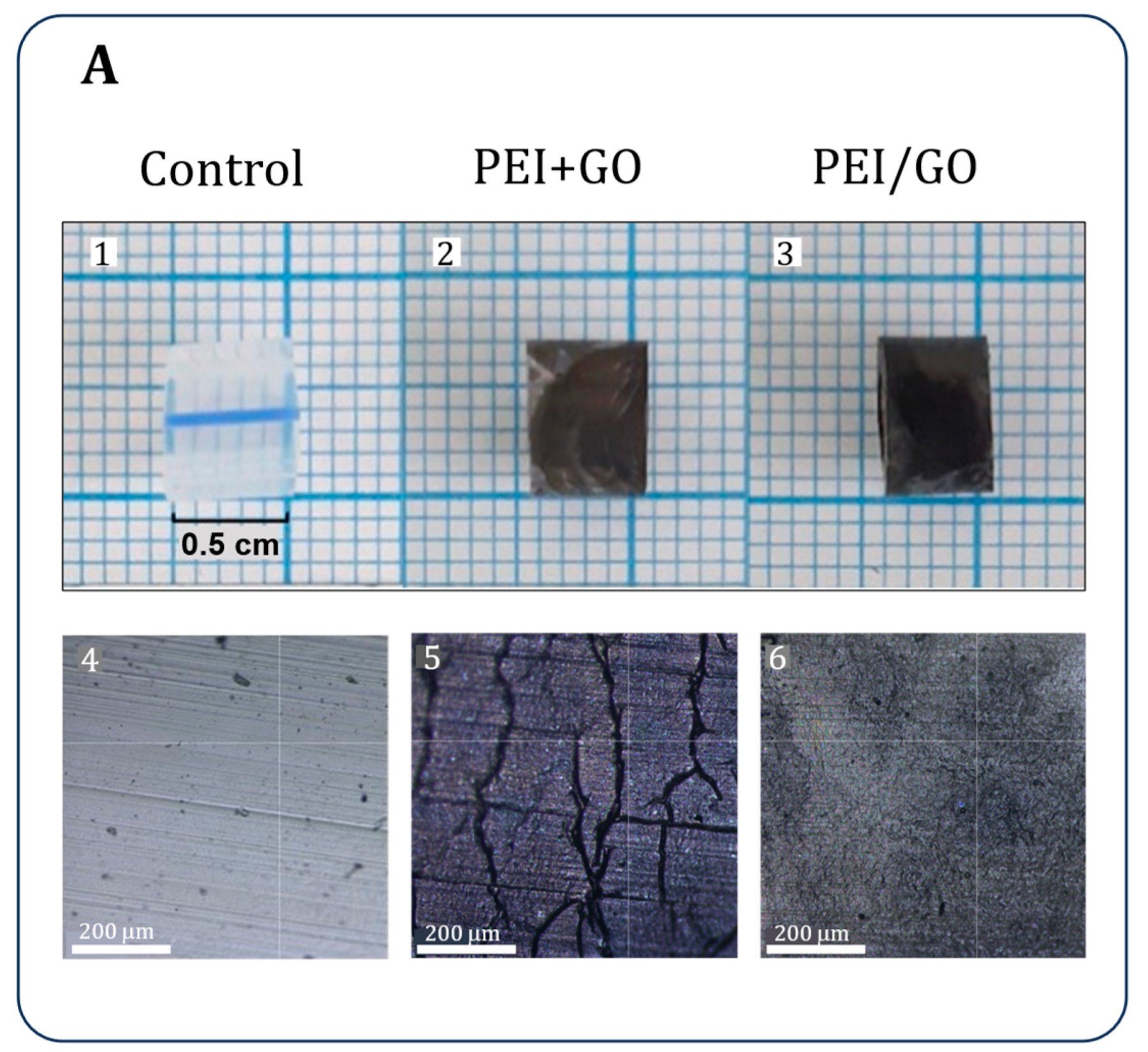
de América et al. 2026, Fig. 3A, cropped, CC BY
Named in two peer reviewed papers, 2025 and 2026 Drop shape method validated against a KRÜSS DSA100E in peer review Published contact angle accuracy of 0.35°

Dr. Jacobo Hernández Montelongo's group at Universidad Católica de Temuco, Chile, builds coatings that fight infection on silicone urinary catheters. Each new coating first had to be shown to cover and change the silicone. The group used the Dropometer for that check in a 2025 Frontiers in Bioengineering and Biotechnology paper on a silver coating, and in a 2026 Bioengineering paper on graphene oxide coatings.

Uncoated and graphene oxide coated silicone urinary catheter segments, with optical microscopy of each surface (de América et al. 2026, Fig. 3A, cropped, CC BY)
Abhimanyu Photo
Written by
Abhimanyu Bhandankar
Holds an MBA from Schulich School of Business and a BE in IT. He joined Droplet Lab in July 2019 and now leads sales and marketing.
CEO at Droplet Lab
Read More
Gurdeep-Saini-Photo
Technical Review by
Gurdeep Singh Saini
Holds a BASc in Mechanical Engineering from Ryerson University (now Toronto Metropolitan University) and an MASc from York University. He develops the automatic edge and baseline detection behind the Dropometer's analysis.
COO at Droplet Lab
Read More
Abhimanyu Photo
Written By

Abhimanyu Bhandankar

CEO at Droplet Lab

Holds an MBA from Schulich School of Business and a BE in IT. He joined Droplet Lab in July 2019 and now leads sales and marketing.

Gurdeep-Saini-Photo
Reviewed By

Gurdeep Singh Saini

COO at Droplet Lab

Holds a BASc in Mechanical Engineering from Ryerson University (now Toronto Metropolitan University) and an MASc from York University. He develops the automatic edge and baseline detection behind the Dropometer's analysis.

Primary outcome: every coating made the catheter surface more wettable, in both studies

Water contact angle on silicone urinary catheters, two studies

Static sessile drop, 10 µl water, five measurements per sample, as reported in each paper

2025 · 14Fr uncoated 100 ± 2°
2025 · 14Fr silver coating 69 ± 5°
2025 · 20Fr uncoated 103 ± 2°
2025 · 20Fr silver coating 68 ± 7°
2026 · 20 Fr uncoated 98.3 ± 1.0°
2026 · PEI+GO coating 76.4 ± 1.0°
2026 · PEI/GO coating 75.5 ± 1.0°

The 2025 silver layer by layer coating lowered the angle from 100 ± 2° to 69 ± 5° on 14Fr catheters and from 103 ± 2° to 68 ± 7° on 20Fr catheters. The 2026 graphene oxide coatings lowered it from 98.3 ± 1.0° to 76.4° and 75.5°. Neither paper states whether ± is a standard deviation. These values describe the coated surfaces, not the antibacterial results.

35° largest drop

20Fr catheter with the 2025 silver coating, 103° to 68°.

2 papers

Peer reviewed studies reporting Dropometer contact angles, in 2025 and 2026.

3 to 5 minutes

Per surface of five drops in the 2026 study, including sample positioning, imaging and analysis.

3 coatings

One silver and two graphene oxide coatings, each checked on real catheter material.

Executive Summary

Who

Dr. Jacobo Hernández Montelongo's group at the Laboratory of Biophysics and Biomaterials (LaBB), Department of Mathematical and Physical Sciences, Faculty of Engineering, Universidad Católica de Temuco, Chile. The group develops antimicrobial coatings for medical devices and pairs experiments with simulation, working with partner universities in Chile and abroad.

Problem

Catheter associated urinary tract infections are a major source of hospital infections. The group needed to show that each new coating really covered and changed the silicone catheter, before trusting its drug release and antibacterial results.

Solution

The Dropometer, in use in the group since 2020, measuring static water contact angle on real catheter pieces before and after coating. Contact angle sat alongside microscopy, roughness and spectroscopy as the direct check of how water meets the new surface.

Time to Value

May 2020: order. November 2020: delivered after pandemic shipping delays. November 2022: stage kit with 3D print files. August 2025: first catheter coating paper, in Frontiers in Bioengineering and Biotechnology. 2026: second catheter coating paper, in Bioengineering.

Results

Every coating lowered the water contact angle, so every coated catheter was more wettable than bare silicone. The drops ranged from 22° to 35° across one silver and two graphene oxide coatings. Drug release and antibacterial results came from other assays in each paper.

Highlights

22° to 35°

Contact angle drop, bare to coated

2

Peer reviewed papers using the Dropometer

3

Coatings checked on real catheters

2020

Customer since

Quote teaser

Droplet Lab provided a practical and accessible tool for performing these measurements in our laboratory.

Universidad Católica de Temuco, at a glance

Research focus

Biomaterials and antimicrobial coatings, combining experiments with molecular dynamics.

Products / applications

Antimicrobial coatings for silicone urinary catheters: a silver coating that releases ciprofloxacin, and graphene oxide coatings that release antimicrobial peptides.

Measurement stage

Laboratory characterisation, alongside microscopy, roughness, FTIR, drug release and antibacterial tests.

Users

A technician and a student: LaBB technician Tanya Plaza ran the 2025 drops, and first author Adriana de América ran the 2026 drops.

Materials and surfaces tested

Silicone Foley catheters, 14Fr and 20Fr, bare and coated, tested with water.

Key constraints

Small, curved samples; a research grant budget; a supplier on another continent.

The challenge: proving a coating changed a small, curved catheter surface

An antimicrobial coating is only useful if it actually covers and changes the device surface.

Why catheter coatings matter

Urinary catheters left in place can let bacteria reach the body. The group builds coatings to fight this on silicone catheters: a silver layer by layer coating that releases ciprofloxacin, and graphene oxide and PEI coatings that carry antimicrobial peptides. Our page on hydrophilic coating validation for catheters and medical devices and our Biotechnology guide cover this kind of work.

Why the surface has to change

A coating only works if it covers the silicone and holds its drug or peptide. Water contact angle is a quick check that the surface chemistry really changed after coating. Our contact angle measurement guide explains the method. Hydrated coatings are sometimes measured underwater by the captive bubble method; both studies used sessile drops in air.

Why these samples are hard

The samples were pieces cut from 14Fr and 20Fr silicone Foley catheters, 4.7 mm and 6.7 mm across. Every drop sits on a small, curved surface rather than a flat coupon. Fixed drop volume and repeated readings are the basics of reproducible contact angle measurement.

What success would require

Drops of the same volume on every sample, measured on the real device material, at a cost a university research group could fund. Static water contact angle by sessile drop is the approach described in ASTM D7334. Our guide to the best contact angle goniometer for advanced research compares options for labs like this one.

The insight: a quick wetting check on the real device shows whether the coating took

What Was Deployed

Delivered configuration: the contact angle, surface tension and surface energy modules of the Dropometer contact angle and surface tension kit. Both catheter papers credit Droplet Lab for their water contact angle data, and the 2025 paper shows drop images from the instrument in its Figure 3B. Our analyses of the silver layer by layer catheter coating paper and the GO PEI catheter coating paper set out what the instrument did and did not measure.
The Origin

From reading a paper to publishing two

On 10 May 2020 Dr. Hernández Montelongo asked Droplet Lab for a quote. The next day he wrote that he had read its paper on contact angle measurement, and chose the contact angle, surface tension and surface energy modules without the stage hardware. He paid the same day from a national research grant. The pandemic stopped parcels from Canada to Chile, and he confirmed receipt on 1 November 2020. In June 2022 Droplet Lab explained the liquid inputs for the Fowkes and Oss and Good surface energy methods, which the group was running with water, diiodomethane and glycerol. In November 2022 Droplet Lab visited Temuco and sent a replacement unit with a stage kit and 3D print files. A software update followed in March 2023, and an activation error was fixed with a new release in November 2023. The group then used the system in two catheter coating studies: a silver coating paper in Frontiers in Bioengineering and Biotechnology in August 2025, and a graphene oxide coating paper in Bioengineering in 2026. Watch the narrated customer story video.

Before vs After

Metric Before After
Wetting (Dropometer, both studies) Hydrophobic: water beads on bare silicone More wettable after every coating, by 22° to 35°
Ciprofloxacin released over 15 days (UV visible, 2025) About 30 µg/cm² About 70 µg/cm²
Inhibition zone, E. coli, 14Fr, no drug (agar diffusion, 2025) No activity 10 mm
Inhibition zone, E. coli, 14Fr, drug loaded (2025) 35 mm 40 mm
Inhibition zone, S. aureus, 14Fr, drug loaded (2025) 15 mm 27 mm

Rollout timeline

Timeline (high level)

May to November 2020: Order and delivery

  • Quote request on 10 May 2020; order and payment on 11 May
  • Shipping to Chile paused by the pandemic
  • Receipt confirmed on 1 November 2020

May to June 2022: Methods support

  • Group asked which liquid values the Fowkes and Oss and Good methods need
  • Droplet Lab's engineer explained the inputs in June 2022

November 2022: Visit and stage kit

  • Droplet Lab visited Temuco
  • Replacement unit and stage kit with 3D print files shipped

March to November 2023: Software

  • Software update released to the group in March 2023
  • Activation error fixed with release 1.4.1.0 in November 2023

August 2025: First catheter paper

  • Silver layer by layer coating study in Frontiers in Bioengineering and Biotechnology, volume 13, article 1614509
  • Water contact angle on 14Fr and 20Fr catheters, with drop images in Figure 3B

2026: Second catheter paper

  • Graphene oxide coating study in Bioengineering, volume 13, article 341
  • Contact angle results for the bare and both coated surfaces in Table 1

Proof and validation: what the two papers show, and what they do not

Test method

Both studies: static sessile drop with 10 µl water drops on silicone Foley catheter pieces, measured with a Droplet Lab system. 2025: 2.5 cm pieces of 14Fr (4.7 mm) and 20Fr (6.7 mm) catheters, bare and with a ten cycle silver layer by layer coating. 2026: 0.5 cm segments of a 20 Fr catheter, bare and with PEI+GO or PEI/GO coatings cured at 120 °C.

Sample size and operators

Five measurements per sample in both papers. Tanya Plaza, a technician at the group's Laboratory of Biophysics and Biomaterials (LaBB), ran the 2025 drops. Adriana de América, first author of the 2026 paper, ran those drops as a student. In the 2026 study, one surface of five drops took about 3 to 5 minutes, including sample positioning, image acquisition and contact angle determination (Dr. Hernández Montelongo, October 2026).

Repeatability / reproducibility

Spread was ± 2° on bare silicone and ± 5° to ± 7° on the silver coated catheters in 2025, and ± 1.0° for all three 2026 samples. Neither paper states whether ± is a standard deviation or a standard error.

Notes / assumptions

Sources: R. Pulido, N. Naveas, F. J. Fernández-Alonso, M. Manso-Silván, L. Soriano, C. Torres-Ulloa, K. Mena-Ulecia, G. Recio-Sánchez, J. P. Garcia-Sandoval, J. Hernández-Montelongo, “Drug Delivery System Based on an Antibacterial Layer-by-Layer Coating on Urinary Catheters: An Experimental and Simulation Approach”, Frontiers in Bioengineering and Biotechnology 13 (2025) 1614509, doi:10.3389/fbioe.2025.1614509, CC BY. A. de América, M. J. Fritte, P. Alarcón, K. Mena-Ulecia, G. Recio-Sánchez, K. Rischka, M. R. D. Silva, M. S. Dias, C. M. Maroneze, C. de Carvalho Castro Silva, J. Hernandez-Montelongo, “A Mechanistic, Architecture-Dependent Study Combining Experiments and Molecular Dynamics to Explain AMP Release from GO-PEI Coatings”, Bioengineering 13 (2026) 341, doi:10.3390/bioengineering13030341, CC BY. In both papers contact angle was one of several characterisation methods; roughness, chemistry, drug release and antibacterial results came from other instruments and assays.

Outcomes to date

Measured Outcomes

31° and 35°

Drop with the 2025 silver coating

On 14Fr and 20Fr catheters. Both sizes moved from hydrophobic to hydrophilic, which the authors link to the coating's carboxyl, ammonium and silver content.

22° and 23°

Drop with the 2026 graphene oxide coatings

Layered PEI+GO and embedded PEI/GO gave almost the same drop, confirming both coating routes changed the surface.

2

Catheter sizes measured

14Fr and 20Fr catheters showed the same trend in 2025, so the check held across sizes.

Operational Outcomes

Published output

Contact angle data in two open access papers under CC BY: Frontiers in Bioengineering and Biotechnology (2025) and Bioengineering (2026).

Technician and student run

LaBB technician Tanya Plaza ran the 2025 measurements. First author Adriana de América ran the 2026 measurements while she was a student.

Used across projects

The same instrument served a silver drug release coating and two peptide releasing graphene oxide coatings.

What the team said

Contact angle measurements were an important part of our surface characterization, allowing us to evaluate changes in wettability following the functionalization of silicone catheters. Droplet Lab provided a practical and accessible tool for performing these measurements in our laboratory.
Dr. Jacobo Hernández Montelongo - Associate Professor, Department of Mathematical and Physical Sciences, Faculty of Engineering, Universidad Católica de Temuco, Chile

What's next

Delivered

Silver layer by layer catheter coating study (Frontiers in Bioengineering and Biotechnology, 2025)
Graphene oxide catheter coating study (Bioengineering, 2026)

Planned

Sharing contact angle data from both studies with Droplet Lab's open contact angle dataset (agreed October 2026)

Frequently asked questions

Can you measure water contact angle on a catheter?

Yes. The group measured static water contact angle on pieces cut from 14Fr and 20Fr silicone Foley catheters, 4.7 mm and 6.7 mm across, before and after coating. Contact angle sat alongside microscopy, roughness and spectroscopy as a direct check of the new surface.

What did contact angle show about the coatings?

Every coating lowered the water contact angle, by 22° to 35° across one silver and two graphene oxide coatings, so every coated catheter was more wettable than bare silicone. Drug release and antibacterial results came from other assays.

Which papers used the Dropometer?

A 2025 paper in Frontiers in Bioengineering and Biotechnology on a silver layer by layer coating, and a 2026 paper in Bioengineering on graphene oxide coatings. Both credit Droplet Lab for their water contact angle data.

Next Step

Coating a medical device and need to show the surface changed?

The Dropometer measures water contact angle on real device parts, including small curved samples, and adds surface tension and surface energy in the same kit. Its drop shape method is validated against a KRÜSS DSA100E in peer review, with a published accuracy of 0.35°. Book a 15 minute demo and bring a coated and an uncoated part.