
Contents
Functional, Medical and Electronic Coatings
Hydrophilic Coatings on Medical Devices: Verify Each Catheter Hydrophilic Coating and Lubricious Coatings With Contact Angle Before Friction and Lubricity Testing
A hydrophilic coating only lowers friction if it is present, cured and evenly applied on a clean device surface. Measure water contact angle on the tubing before and after coating, and after hydration and simulated use, so weak coatings are caught before friction and particulate tests.
Who this is for: Medical device manufacturers, contract coating and coating services teams, and R&D groups working on catheters, guidewires, vascular devices and the surface of implantable medical devices.
Where it fits: Substrate cleaning checks, coating process control and release checks, alongside lubricity, coating integrity and particulate testing.
What it does not do: It does not measure lubricity, friction force, coating thickness or particulate shedding.
Method
Sessile drop water contact angle on tubing, mandrels and coupons; pendant drop surface tension of coating solutions
Standard
Fully compliant with SEMI/ASTM D7490-13 for substrate surface free energy
Setup
About 2 minutes
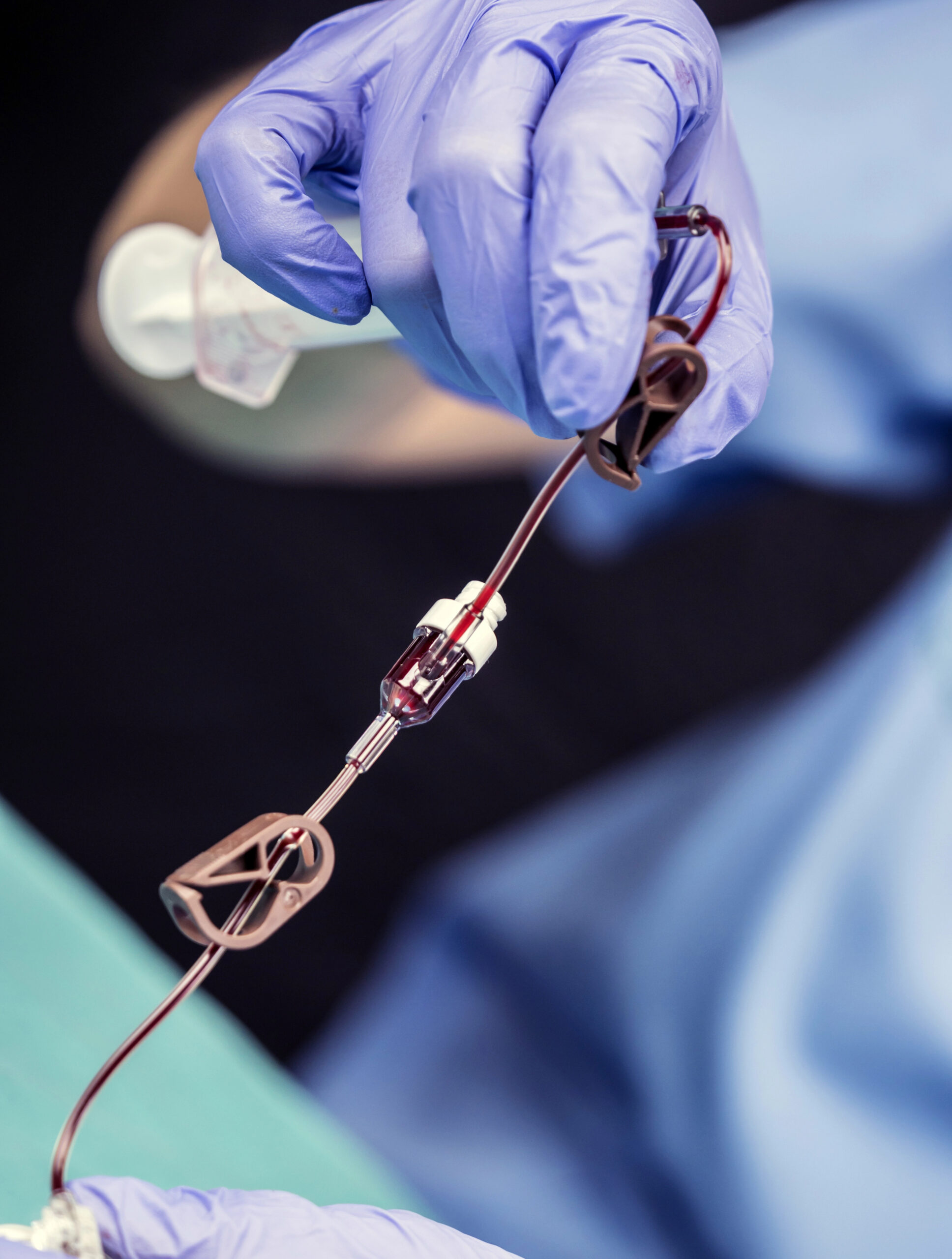
Why it matters
Why hydrophilic coating quality matters
0.65 vs 0.04 to 0.18
kinetic coefficient of friction of uncoated PVC catheters against PVP hydrophilic coated catheters in a laboratory comparison.
Burns et al., ACS Omega 9(20), 2024
13 of 24
animals had coating material in brain tissue after use of hydrophilic coated guiding sheaths; coating separated in saline in as little as 15 minutes.
Stanley et al., EuroIntervention 11, 2016
Sources: US Food and Drug Administration, Lubricious coating separation from intravascular medical devices: FDA safety communication, 23 November 2015; Burns J. et al., Comparing an integrated amphiphilic surfactant to traditional hydrophilic coatings for the reduction of catheter associated urethral microtrauma, ACS Omega, 2024; Stanley J.R.L. et al., Particulates from hydrophilic coated guiding sheaths embolise to the brain, EuroIntervention, 2016. Figures come from these sources, not from Droplet Lab measurements.
Quick reference
What this coating check does and what it does not
A quick reference for device and coating teams checking fit before reading further.
Evidence Box
Problem this solves
Hydrophilic coatings that are missing, under cured, uneven or applied on a contaminated device surface, so no one can be sure each device is coated properly.
Standards
Fully compliant with SEMI/ASTM D7490-13 for substrate surface free energy. FDA guidance asks for coating integrity, particulate and lubricity testing; contact angle supports, not replaces, those tests.
Peer reviewed method
The Dropometer drop shape method was validated against a KRUSS DSA100E in two peer reviewed papers, in Review of Scientific Instruments and Colloids and Surfaces A.
Customer case study
A US medical device manufacturer measured a water drop on a mandrel about 1 mm across, bought a Dropometer to check catheter surfaces before hydrophilic coating, and ordered a second unit within seven months.
Published research
A Chilean university group showed graphene oxide coatings lowered the water contact angle of silicone catheter segments from 98.3° to about 76° (Bioengineering, 2026).
Honest limit
A low contact angle shows a hydrophilic surface is present. It does not prove lubricity, durability or low particulate shedding.
Who this is for
What hydrophilic coating question are you trying to answer?
Pick the card closest to your role. Each one points to the part of this page that answers it.
Quality manager
You need evidence that each lot was cleaned, coated and cured as validated in the manufacturing process. A contact angle check on lot samples after the coating is applied gives a recorded release decision before friction and particulate tests.
Contact angle is not an FDA required test; treat it as an in process control.
Process engineer
You run dip coating or UV-curable coatings on tubing and guidewires. Contact angle before and after each step of the coating process shows whether cleaning, priming, coating or cure is drifting.
Read at a fixed time; water spreads into hydrophilic coatings quickly.
R&D engineer
You are developing a new type of coating, a hybrid coating or an antimicrobial layer. Contact angle shows how each formulation changes the device surface, before costly lubricity and durability studies.
Contact angle and friction do not always move together; test both.
Fit check
Is this the right check for your coated device?
It measures how water meets the device surface. It does not measure the performance of the coatings in the body.
✓
Good fit if
✓
You need to confirm a substrate is clean before coating.
✓
You need a quick check that a hydrophilic coating is present and cured.
✓
You compare coating formulations, primers or cure settings.
✓
You check coating uniformity along tubing or guidewires.
✓
You measure coating solution surface tension for dip coating.
-
Less relevant if
×
You need lubricity or drag force; that needs a pinch or friction test.
×
You need particulate counts or coating integrity imaging.
×
You need coating thickness.
×
The device is too fine or curved to hold a drop; use flat witness coupons.
Summary
How to verify hydrophilic coatings on medical devices
The answer in under a minute.
Measure water contact angle on the device surface three times: after cleaning, to confirm a clean substrate; after coating and cure, to confirm a hydrophilic coating is present; and after hydration or simulated use, to check it remains. Set gates from lots that passed your friction, integrity and particulate tests.
The Dropometer contact angle kit measures small drops on tubing, mandrels and coupons; our contact angle measurement guide and wettability glossary entry explain the method. Substrate surface free energy follows SEMI/ASTM D7490. A US medical device manufacturer uses it before hydrophilic coating, and a Chilean group published graphene oxide catheter coating results measured with it. Our medical device guide covers the wider context.
Expert Quote
Expert perspective on device surfaces
“
Because only the top few ångström decide wetting, an invisible contaminant film, even a monolayer picked up from the air, is enough to change how a liquid behaves on the surface.
The problem
Why hydrophilic coatings fail on devices
Hydrophilic coatings on medical devices are thin, loosely cross-linked polymer coatings used in medical devices, often based on PVP or PEG, that absorb water, become slippery and reduce friction, so catheters and guidewires can navigate vessels and the urinary tract with less friction and tissue damage. Common coating methods for medical devices like tubing, sheaths and guidewires are dip coating and spraying, and the coating application is followed by a cure, often with UV. The coating works only if it adheres to a clean device surface and is evenly applied and fully cured. When it is not, it can delaminate. FDA has received about 500 reports since 2014 of lubricious coatings separating from intravascular devices, and animal studies found coating particles in brain tissue. The consequences of coating failures range from extra friction to embolism. FDA guidance asks manufacturers to test coating integrity, particulates and lubricity, but those tests are slow and come late. Contact angle is a fast in process check on the surface itself: a contaminated substrate, a missed coating or an under cured layer all change how water wets the device long before a failed friction or particulate test.
Coated tubing feels less slippery than the validated lot.
Coating flakes, delaminates or sheds particles in testing.
Friction varies along the length of a catheter or guidewire.
Coating adhesion fails after a material or supplier change.
Results drift between coating runs, lines or contract coating sites.
Troubleshooting
Why a hydrophilic coating underperforms and what to check
Why:
Mould release, plasticisers, silicone and handling films stop the coating from adhering. Our guide to sample prep and contamination control covers clean handling.How to detect:
- Water contact angle on the cleaned tubing is higher than your clean baseline.
Corrective action:
Review cleaning or plasma treatment, then remeasure before coating. Our page on silicone contamination detection covers one common cause.Why:
- Many coatings applied to polymers need a primer or plasma step so the coating can bond to the material surface.
How to detect:
- The angle after priming or treatment is outside your band.
Corrective action:
Check primer and treatment settings, and remeasure. Our page on plasma treatment for adhesion covers treatment checks.Why:
- Dip speed, coating solution viscosity or dwell time leave bare or thin areas.
How to detect:
- Contact angle on coated parts is close to uncoated, or varies along the length.
Corrective action:
Check dip speed and the coating solution, including its surface tension; our surface tension measurement guide covers the method.Why:
- Low UV dose or short cure leaves the polymer coating loosely bound, so it can wash off or shed.
How to detect:
- The angle rises after a soak or rinse, as coating is lost.
Corrective action:
- Check lamp output, line speed and cure time, and repeat the soak test.
Why:
- Abrasion and repeated hydration can remove coating during simulated use.
How to detect:
- The angle rises after simulated use or cycling.
Corrective action:
- Review coating adhesion and cross linking, and confirm with integrity and particulate tests.
Why:
Drops on thin tubing are small and curved, so method choices change readings. Our experiment on treated and untreated surfaces shows the size of change to expect.How to detect:
Readings vary more than expected between operators. Our contact angle reference values for common surfaces give a sense check.Corrective action:
- Fix drop volume, reading time and fixture, or measure flat witness coupons coated alongside the devices.
Not sure whether your coating is going on right?
Send a coated and an uncoated sample, and we will compare the surfaces on a call.
Quality records
What a hydrophilic coating check record contains
Each check produces a record you can file with the lot. These records can feed into your existing quality records under ISO 13485, alongside friction, integrity and particulate results.
Device identity
Device, lot, substrate material, coating and primer lots, and contract coating site if used.
Process step
After cleaning, after coating and cure, or after hydration and simulated use.
Method settings
Drop volume, read time, fixture, and sites along the device length.
Readings
Contact angle at each site, the median and the spread.
Decision
Release, recoat or hold, with the operator and date.
Drop images
Automatic edge and baseline detection gives the same reading from the same image, so a reviewer can recheck any result.
Measurements
What to measure in the medical device coating process
Contact angle on the cleaned substrate
Why it matters: It shows whether the surface is clean enough for coatings to adhere.
How to interpret: Compare with your clean baseline for that material; thresholds are set per substrate from your own correlation with coating adhesion results.
When it is not enough: It does not identify the contaminant.
Contact angle on the coated, cured device
Why it matters: It shows that hydrophilic coatings on the surface are present and uniform.
How to interpret: Hydrophilic surfaces read low; read at a fixed time because water spreads into them.
When it is not enough: It does not measure lubricity or thickness.
Contact angle after soak or simulated use
Why it matters: A rise shows coating loss.
How to interpret: Compare with the same lot before testing.
When it is not enough: It does not count particles.
Surface tension of the coating solution
Why it matters: It affects how the solution wets the substrate in dip coating.
How to interpret: Track it batch to batch; a change can explain uneven coating.
When it is not enough: Viscosity and solids also matter.
Validation
Validated measurement approach for coated devices
How the Dropometer itself has been validated, and where teams developing coatings for medical devices have used it.
Peer reviewed method
The Dropometer drop shape method is published in Review of Scientific Instruments and Colloids and Surfaces A. Contact angle was validated against a KRUSS DSA100E, with a published accuracy of 0.35°.
See the validation papersCustomer evidence on catheters
A US medical device manufacturer with several thousand employees wanted to check catheter surfaces were clean before a hydrophilic coating went on. Its engineers watched a live demo measure a water drop on a mandrel about 1 mm across, bought a Dropometer in early 2025, and ordered a second unit within seven months.
Read the case study
QC Protocol
How to check a hydrophilic coating with contact angle
Six steps for one device and one coating. Repeat for each new material, coating or site.
1
Lock the method
Fix drop volume, read time, fixture, and sites along the device or on witness coupons.
2
Baseline the substrate
Measure cleaned, uncoated tubing from a lot that coated well.
3
Baseline the coated device
Measure coated, cured devices from a lot that passed friction, integrity and particulate tests.
4
Set gates
Set bands after cleaning, after coating and after a soak or simulated use, from validated lots.
5
Check each lot
Measure samples from each lot at each step, and trend the results by line and site.
6
Release, recoat or hold
Release inside the gates and investigate outside them. Our guide to the best contact angle goniometer for industrial QA covers production use.
“
We completed our gage R&R study on the unit and it performed very well.
Brandon Barbee
Corporate Quality Engineer, Zeus Industries, Polymer Manufacturing
Download the hydrophilic coating check SOP
A two page SOP you can adapt for your devices, with the method lock, sites along the device, gates at each process step, a troubleshooting table and a record sheet.
If the download did not start, click here to download.
Contact angle measurement with the Dropometer
Example output
Example lot log for a hydrophilic coated catheter
Example data only. Your values and gates will differ and must come from your own validated lots.
How to read this log
Example gates: at or below 75° on cleaned tubing, at or below 25° after coating and cure, and a rise of no more than 10° after a 30 minute soak. Lot 2 had a contaminated substrate. Lot 3 coated but rose sharply after the soak, pointing to under cure, so it is held for friction and particulate testing.
Example coated catheter lot log
| Lot | After cleaning (°) | After coating and cure (°) | After 30 min soak (°) | Result |
|---|---|---|---|---|
| Validated reference lot | 68 | 18 | 22 | Reference |
| Lot 1 | 70 | 19 | 24 | Release |
| Lot 2 | 86 | 31 | 44 | Hold; reclean substrate |
| Lot 3 | 69 | 20 | 41 | Hold; check cure |
| Lot 4 | 71 | 26 | 29 | Retest edge sites |
Example data, not customer data. Polyurethane tubing, 2 mm outer diameter; 0.5 µL water drops; three sites along the length; reading at 2 s after drop landing.
Signal order
The order to check signals when a coating fails
Check these in order. Each one rules out a cause before you look at the next.
1
Substrate angle
Rules out contamination; our page on surface cleanliness verification covers the check.
2
Primer or treatment
Confirms the surface was prepared for coating adhesion.
3
Coated angle
Shows the coating is present and uniform.
4
Angle after soak
Shows whether the coating remains after hydration.
5
Friction, integrity and particulates
Confirms performance with the tests FDA guidance describes.
FAQ
Common questions about hydrophilic coatings on medical devices
Questions device makers and coating services teams ask about coating checks.
How does a hydrophilic coating work?
Hydrophilic polymers such as PVP bind water and swell into a slippery gel layer. Burns and colleagues noted that the lubricity of PVP is strongly linked to being fully wetted. That is why hydrophilic coatings are activated by water or saline before use, and why a dry or damaged coating gives little friction benefit.
Does a low contact angle mean the coating is lubricious?
Not on its own. It shows the surface is hydrophilic. Irwin and colleagues found reductions of up to 40% in contact angle and friction values that testers did not feel as greater lubricity. Use contact angle as an in process check and confirm lubricity with drag force or friction testing.
What does FDA ask for?
FDA guidance for guidewires asks for coating integrity imaging at 40X or more after simulated use, particulate counts at 10, 25 and 50 µm or larger, and lubricity as drag force, for example a pinch test. It does not name contact angle; we position contact angle as a faster in process control alongside those tests.
Can you measure contact angle on a catheter?
Yes, with small drops and a steady fixture. A US medical device manufacturer watched a water drop measured on a mandrel about 1 mm across before buying. Very fine guidewires are harder, so many teams also coat flat witness coupons in the same run.
Why does the contact angle change while I measure?
Because of its hydrophilic nature, the coating absorbs water, so the drop spreads and the angle falls over seconds. Read at a fixed time after the drop lands, use the same drop volume, and compare lots measured the same way.
How is a hydrophilic coating different from a hydrophobic coating?
A hydrophilic coating attracts water and becomes slippery when wet. A hydrophobic coating, such as the PTFE coatings on many guidewires, repels water and lowers friction when dry. Each is a low friction coating and both are surface coatings, but they read very differently on contact angle, so set gates for each type of coating.
Which standards apply?
ISO 10555-1 sets general requirements for intravascular catheters. SEMI/ASTM D7490 covers surface free energy of substrates from two liquid contact angles, and the Dropometer is fully compliant with it. There is no dedicated contact angle standard for coated devices, so set and validate your own method.
Which instrument do we need?
One that places small drops, records images and fits on a production bench. The Dropometer sets up in about 2 minutes. Our pages on wafer cleaning and photoresist adhesion and surface cleanliness verification cover related cleaning checks.
Business impact
What changes when you check coatings with contact angle
Typical changes in how teams work. Benchmarks are given only where a published source exists.
Before and with contact angle coating checks
| Metric | Before Dropometer | With Dropometer | Indicative Benchmark |
|---|---|---|---|
| Substrate cleanliness | Assumed from the cleaning recipe | Contact angle on each lot before coating | No published benchmark; track on your own lots |
| Coating presence and cure | Found in friction tests | Contact angle after coating and after soak | Coating separation in about 500 FDA reports since 2014 |
| Friction performance | Friction test only | Unchanged; still needed | Kinetic COF 0.65 uncoated vs 0.04 to 0.18 PVP coated (Burns et al., 2024) |
| Particulate risk | Particulate test only | Unchanged; still needed | Coating material in 13 of 24 animals (Stanley et al., 2016) |
See the check on your own devices
Send a coated and an uncoated sample. We will show the measurement on a call.
Estimate the cost of coating rework
Enter your own numbers. The result is an estimate, not a Droplet Lab claim.
Coated device rework estimate
Estimate avoided recoat, scrap and investigation cost from hydrophilic coating failures.
Each Dropometer unit is US$5,000; the default models one unit.
Your own average cost to strip, reclean, recoat and retest one lot.
Use your own failure analysis; start low if unsure.
Scrap cost per event from coating related failures only, from your own records.
Result
~0
Monthly savings
~0
Payback period
~0
First year net benefit
Monthly savings = preventable rework cost + preventable scrap cost + other monthly savings.
Limits
What contact angle cannot tell you about a coated device
Honest limits, so you know when to reach for another test.
It does not measure lubricity or drag force.
It does not count particles or image coating defects.
It is not an FDA required test; validate it as your own in process control.
Hydrophilic coatings absorb the drop; fix the reading time.
Very fine or curved parts need small drops, a fixture or witness coupons.
It does not measure coating thickness.
Contact angle shows whether the device surface is clean and whether a hydrophilic coating is present and stays. Lubricity, coating thickness, integrity, particulates and biocompatibility need their own tests.
Related
Standards, evidence and related coating workflows
These pages cover the standard, the customer evidence and related cleaning checks for coated devices.
Standard
SEMI/ASTM D7490-13
Surface free energy of solids from two liquid contact angles.
Case study
US medical device manufacturer
Catheter surfaces checked before hydrophilic coating.
Case study
Universidad Católica de Temuco
Antimicrobial coatings on silicone urinary catheters.
Published paper
Graphene oxide and PEI catheter coatings
Contact angle on layered and embedded antimicrobial coatings.
Instrument
Dropometer
Contact angle and surface tension in one kit.
Related use case
Functional, medical and electronic coatings
All functional coating use cases in one place.
Related use case
Wafer cleaning and photoresist adhesion
Cleaning and priming checks before coating.
Related use case
Surface cleanliness verification
Contact angle checks after cleaning.
Guide
Medical device guide
Surface science for medical devices.
How this page was created
Editorial and technical transparency notes for this page.
Transparency Details
4 checklist items
01
Drafting assistance
Drafted with Claude Opus 5.5 (Anthropic) using web search for sources, then edited by the Droplet Lab team.
02
Technical review
Reviewed and edited for technical accuracy by the Droplet Lab Team.
03
Verification steps
Standard identifiers, units, thresholds and key procedural claims are checked against cited sources before publication.
04
Updates
Reviewed every 12 months or when the underlying method changes.
Report a correction
Spotted an issue in this summary? Send a correction request and our team will review it.
Correction Request
We work hard to keep this page accurate and up to date. If you spot an error (wrong revision/year, missing requirement, incorrect interpretation, or broken link), tell us and we'll review it.
Contact us to report a correction
Sources
References
1.
US Food and Drug Administration. Lubricious coating separation from intravascular medical devices: FDA safety communication. 23 November 2015. https://www.fda.gov/MedicalDevices/Safety/AlertsandNotices/ucm473794.htm
2.
US Food and Drug Administration. Intravascular catheters, wires, and delivery systems with lubricious coatings: labeling considerations. Guidance, 10 October 2019. https://www.fda.gov/media/113951/download
3.
US Food and Drug Administration. Coronary, peripheral, and neurovascular guidewires: performance tests and recommended labeling. Guidance, 10 October 2019. https://www.fda.gov/media/113959/download
4.
Stanley, J.R.L. et al. Particulates from hydrophilic coated guiding sheaths embolise to the brain. EuroIntervention 11:1435 to 1441, 2016. https://doi.org/10.4244/EIJY15M03_02
5.
Mehta, R.I. et al. Hydrophilic polymer emboli: an under recognized iatrogenic cause of ischemia and infarct. Modern Pathology 23(7):921 to 930, 2010. https://doi.org/10.1038/modpathol.2010.74
6.
Burns, J. et al. Comparing an integrated amphiphilic surfactant to traditional hydrophilic coatings for the reduction of catheter associated urethral microtrauma. ACS Omega 9(20):22410 to 22422, 2024. https://doi.org/10.1021/acsomega.4c02109
7.
Irwin, N. et al. Use of in vitro and haptic assessments in the characterisation of surface lubricity. Proceedings of the Institution of Mechanical Engineers, Part H, 2018. https://doi.org/10.1177/0954411918756155
8.
Ron, T. et al. Low friction thermoplastic polyurethane coatings imparted by surface segregation of amphiphilic block copolymers. Colloid and Interface Science Communications 44:100477, 2021. https://doi.org/10.1016/j.colcom.2021.100477
9.
ISO 10555-1:2023. Intravascular catheters: sterile and single use catheters, part 1: general requirements. https://www.iso.org/standard/76494.html
10.
A mechanistic, architecture dependent study combining experiments and molecular dynamics to explain AMP release from GO PEI coatings. Bioengineering, 2026. See our analysis of this paper. https://dropletlab.com/validation/citations/analysis/a-mechanistic-architecture-dependent-study-combining-experiments-and-molecular-dynamics-to-explain-amp-release-from-go-pei-coatings/
11.
Chen, X. et al. Contact angle measurement with a smartphone. Review of Scientific Instruments 89(3):035117, 2018. https://pubs.aip.org/aip/rsi/article-abstract/89/3/035117/368179/Contact-angle-measurement-with-a-smartphone
12.
Surface tension measurement with a smartphone using a pendant drop. Colloids and Surfaces A: Physicochemical and Engineering Aspects. https://www.sciencedirect.com/science/article/abs/pii/S0927775717307744