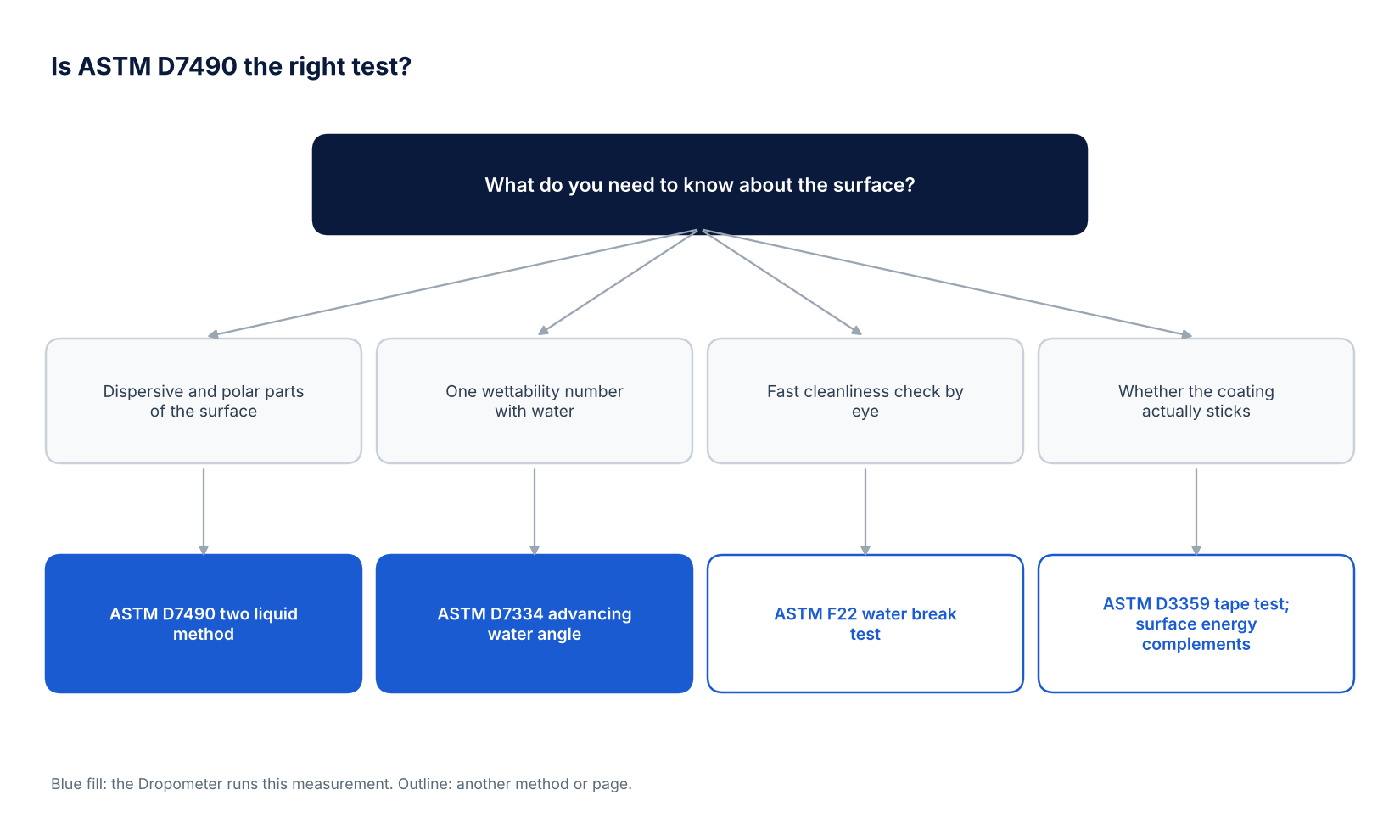

ASTM D7490-13(2022), Standard Test Method for Measurement of the Surface Tension of Solid Coatings, Substrates and Pigments using Contact Angle Measurements, from ASTM Subcommittee D01.23. We found no SEMI edition of this method.
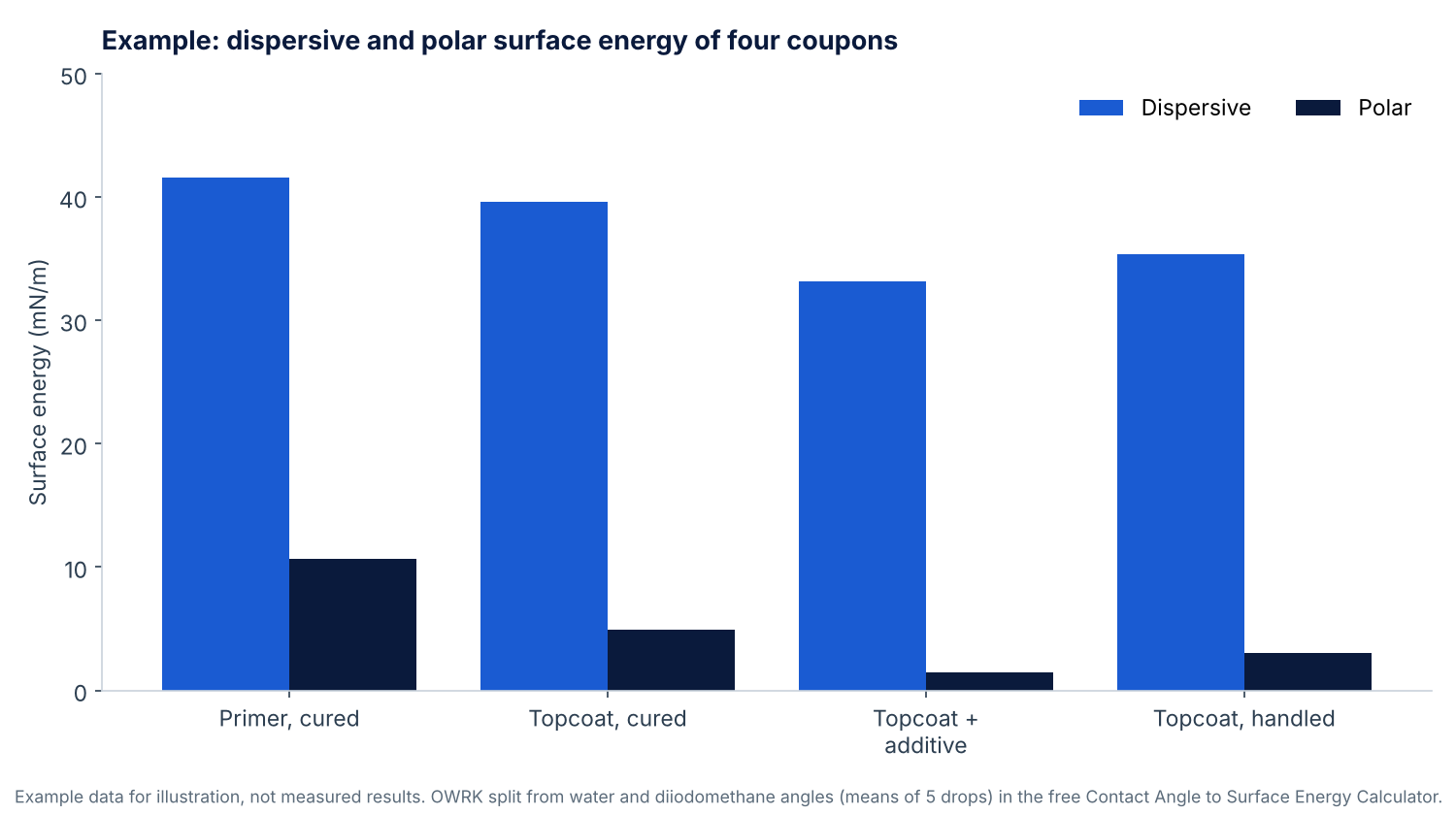
Fully compliant. The Dropometer measures the static contact angles of both liquids. D7490 needs a dispersive and polar split. The Dropometer software does Fowkes and van Oss Chaudhury Good. OWRK is not built in: users measure the angles with the Dropometer and run OWRK in the free Contact Angle to Surface Energy Calculator.
Contact angle range 10° to 175°, accuracy ±0.35°, display resolution 0.01°. Surface free energy up to 100 mN/m, accuracy ±0.03 mN/m. From the Dropometer product specification.
The drop shape method is validated against a KRUSS DSA100E in two peer reviewed papers. See our validation publications.
The US R&D site of a global maker of fused silica and quartz for semiconductor, optical fibre and optics markets bought a Dropometer with the surface energy module. They have not shared results yet. Read the case study.
Researchers used a Droplet Lab instrument to measure saline contact angle on titanium discs before and after plasma treatment. The angle on machined discs fell from 83.1° to 24.1° (Ho et al., Biomimetics, 2025). That study measured contact angle, not surface free energy. Read our analysis.
ASTM says the method is not designed as a QC or specification test. The split helps explain adhesion. It does not measure bond strength, so keep your peel or tape test.