


Contents
Fully compliant

ASTM D7334-08 standard practice for surface wettability of coatings, substrates and pigments by advancing contact angle measurement

Check how easily a coating, substrate or pigment surface wets by reading the advancing contact angle, the measurement ASTM D7334 describes. A lower angle means easier wetting. The Dropometer reads the advancing angle by adding liquid through the needle, with an accuracy of ±0.35°.

What brings you here?

Who this is for
Coating and paint makers, paint shops, substrate suppliers, pigment producers and adhesives R&D teams who need to know how well a surface wets.
Compliance tier
Fully compliant: the Dropometer reads the sessile drop advancing contact angle by adding liquid through the needle.
Measurement
Sessile drop advancing contact angle, 10° to 175° range, ±0.35° accuracy (Dropometer datasheet).
Setup
About 2 minutes. Battery powered, 1 kg, runs in the lab or next to the line.
Last updated
October 20, 2026

Free one page checklist for ASTM D7334: what to prepare, the settings to lock, how to grow the drop and what to record. Made for coating, substrate and pigment QC benches.

Talk to an expert

Book a 15 minute demo on your surfaces

Tell us your coating, substrate or pigment and your current wetting check. We will show the advancing angle live and tell you plainly where the Dropometer fits your QC plan and where it does not.

Book a 15 minute demo
View the official standard
Gurdeep-Saini-Photo
Written by
Gurdeep Singh Saini
Holds a BASc in Mechanical Engineering from Ryerson University (now Toronto Metropolitan University) and an MASc from York University. He develops the automatic edge and baseline detection behind the Dropometer's analysis.
COO at Droplet Lab
Read More
Droplet-Lab logo
Technical Review by
Droplet Lab Team
Droplet Lab builds precision instruments and software for surface science measurement, specialising in contact angle analysis and surface tension characterisation. Used by researchers across materials science, pharmaceuticals, coatings, and advanced manufacturing, Droplet Lab's Dropometer has contributed to studies published in peer-reviewed journals including Advanced Functional Materials (Impact Factor 19). The team combines instrument engineering with deep domain knowledge in wettability science with a focus on practical accuracy.
Read More
Verified against ASTM D7334
Gurdeep-Saini-Photo
Written By

Gurdeep Singh Saini

COO at Droplet Lab

Holds a BASc in Mechanical Engineering from Ryerson University (now Toronto Metropolitan University) and an MASc from York University. He develops the automatic edge and baseline detection behind the Dropometer's analysis.

Droplet-Lab logo
Reviewed By

Droplet Lab Team

Droplet Lab builds precision instruments and software for surface science measurement, specialising in contact angle analysis and surface tension characterisation. Used by researchers across materials science, pharmaceuticals, coatings, and advanced manufacturing, Droplet Lab's Dropometer has contributed to studies published in peer-reviewed journals including Advanced Functional Materials (Impact Factor 19). The team combines instrument engineering with deep domain knowledge in wettability science with a focus on practical accuracy.

Evidence box: ASTM D7334 and the Dropometer

Standard

ASTM D7334-08(2022), Standard Practice for Surface Wettability of Coatings, Substrates and Pigments by Advancing Contact Angle Measurement, from ASTM International Subcommittee D01.23. First published in 2008 and reapproved in 2013 and 2022.

Compliance tier

Fully compliant. The practice reads the advancing angle of a sessile drop on a coating, substrate or pressed pigment disk by goniometry. The Dropometer reads sessile drop advancing angles by adding liquid through the needle.

Instrument performance

Contact angle range 10° to 175°, accuracy ±0.35°, display resolution 0.01°, from the Dropometer product specification. The automatic dropper add-on doses down to 0.05 µL.

Peer reviewed method

The drop shape method is validated against a KRUSS DSA100E in two peer reviewed papers. See our validation publications.

Customer evidence

A Fortune 500 materials science company uses the Dropometer for contact angle and surface free energy work. Read the case study. We have no published client study run to ASTM D7334 yet.

What it does not tell you

ASTM notes that the angle cannot give a surface tension value directly. One advancing angle does not show receding behaviour, surface free energy or bond strength. Pair it with your adhesion test.
Executive summary

What this standard measures, who uses it and how the Dropometer fits

ASTM D7334 measures the surface wettability of coatings, substrates and pigments by reading the advancing contact angle of a sessile drop. Coating makers, paint shops, substrate suppliers and pigment producers use it to check surface cleanliness, pretreatment and how easily a pigment will disperse. The Dropometer is fully compliant: it reads the advancing angle by adding liquid through the needle, with ±0.35° accuracy.

The practice covers advancing angles only and supplements the goniometer maker's own instructions; it is not intended to replace them. Water is the usual test liquid, but solvents, surfactant or dispersant solutions and even liquid paints can be used. ASTM notes that a surface that is easy to wet is more likely to give good coating adhesion and appearance, and is less prone to crawling, cratering, pinholing and orange peel. For the defect side, see how to stop fisheyes, craters and crawling. For how the advancing angle differs from the receding angle, read advancing, receding and contact angle hysteresis.

The Dropometer contact angle and surface energy kit runs on battery, so you can test panels in the lab or next to the line. A Fortune 500 materials science company uses the Dropometer for contact angle and surface free energy work. If you are comparing instruments, see the best contact angle goniometer for industrial QA. For the wider sector, read the mechanical and industrial guide.

ASTM states that one contact angle cannot give a surface tension value directly. To go further, measure two or more liquids and calculate surface free energy. Fowkes, van Oss Chaudhury Good and Equation of State models are built into the software. OWRK is not built in: measure the angles with the Dropometer and run OWRK in the free Contact Angle to Surface Energy Calculator. The water angle also gives the work of adhesion between the liquid and the surface.

Further reading: why contact angle matters for coatings and adhesives QC, reproducible surface energy calculation, an experiment on surface free energy with multiple liquids and surface free energy reference values for common polymers.

How the Dropometer runs the advancing contact angle measurement

The ASTM D7334 measurement, step by step, in our own words

From coated panel or pigment disk to a recorded advancing angle

These steps outline the procedure. They do not replace the standard or the instrument instructions it builds on. Buy the current edition and follow its specimen, drop size and reading rules.

±0.35°

Contact angle accuracy

From the Dropometer product specification. Display resolution is 0.01°.

0.05 µL

Smallest dose

With the automatic dropper add-on, for slow, even drop growth. The manual dropper gives 5.29 µL per rotation.

About 2 min

Setup

Base plate, phone holder, LED and syringe. Battery for about 8 h, no PC needed.

1

Prepare the specimen

Use a cured coated panel, a bare substrate or a pigment disk pressed as the standard describes. Handle it by the edges, since skin oils change the angle. Condition specimens as the standard specifies.

2

Set up the Dropometer

Place the base plate on a level bench, mount the phone and LED, and fill the syringe with the test liquid, usually water. Lay the specimen flat on the sessile stage and focus on the needle tip.

3

Place a starting drop

Dispense a small starting drop onto the surface and leave the needle tip inside it. Keep the needle height the same for every drop. Do not touch the surface with the needle.

4

Grow the drop and read the advancing angle

Add liquid slowly through the needle with the manual dropper or the automatic dropper add-on. Read the angle as the contact line moves outward over dry surface. Automatic edge and baseline detection reads the left and right angles, so two operators get the same reading from the same image. Background: advancing, receding and hysteresis.

5

Repeat on fresh spots

Place several drops on fresh, dry areas of each specimen. Never reuse a wetted spot for an advancing reading. Coatings and pressed disks vary across the surface, so one drop is not enough.

6

Record and compare

Record the mean and spread, the liquid, drop growth, fit model and room conditions. Compare the mean with your accept limit. If you also need surface free energy, repeat with a second liquid and run OWRK, which is not built in, in the free Contact Angle to Surface Energy Calculator.

7

Watch the full measurement

This video shows a complete Dropometer contact angle measurement, from setup to result. It covers the steps above in one run.

Dropometer contact angle measurement, start to finish.

Validated measurement approach

Independent benchmarking and publication-based validation references.

Peer reviewed method

The Dropometer drop shape method is validated against a KRUSS DSA100E in two peer reviewed papers, one in Review of Scientific Instruments and one in Colloids and Surfaces A. Published contact angle accuracy is ±0.35°.

Read the validation papers

Customer evidence

We have no published client study run to ASTM D7334 yet. A Fortune 500 materials science company uses the Dropometer for contact angle and surface free energy work.

Read the case study

Set limits for surface wettability of coatings from your own surfaces

ASTM D7334 · advancing contact angle · coating and pigment QC

ASTM D7334 publishes no pass or fail angle. Its significance section notes that an advancing angle below 45° indicates wetting and that 10 to 20° indicates excellent wetting. With water, below 45° reads as hydrophilic and above 90° as hydrophobic (source: ASTM D7334-08(2022) summary).

Treat those bands as a guide, not a specification. Measure surfaces that coated or bonded well and surfaces that failed, with the same liquid, drop growth and reading point. Then set your accept limit from that correlation study and your adhesion or appearance results.

Repeat the study when you change cleaner, pretreatment, resin, additive or pigment grade. The Dropometer reads down to 10°, so surfaces in the excellent band near 10° sit at the bottom of its range.

Example output

Example data for illustration only. These are not measured results. Your own coatings, substrates, liquids and limits decide the numbers.

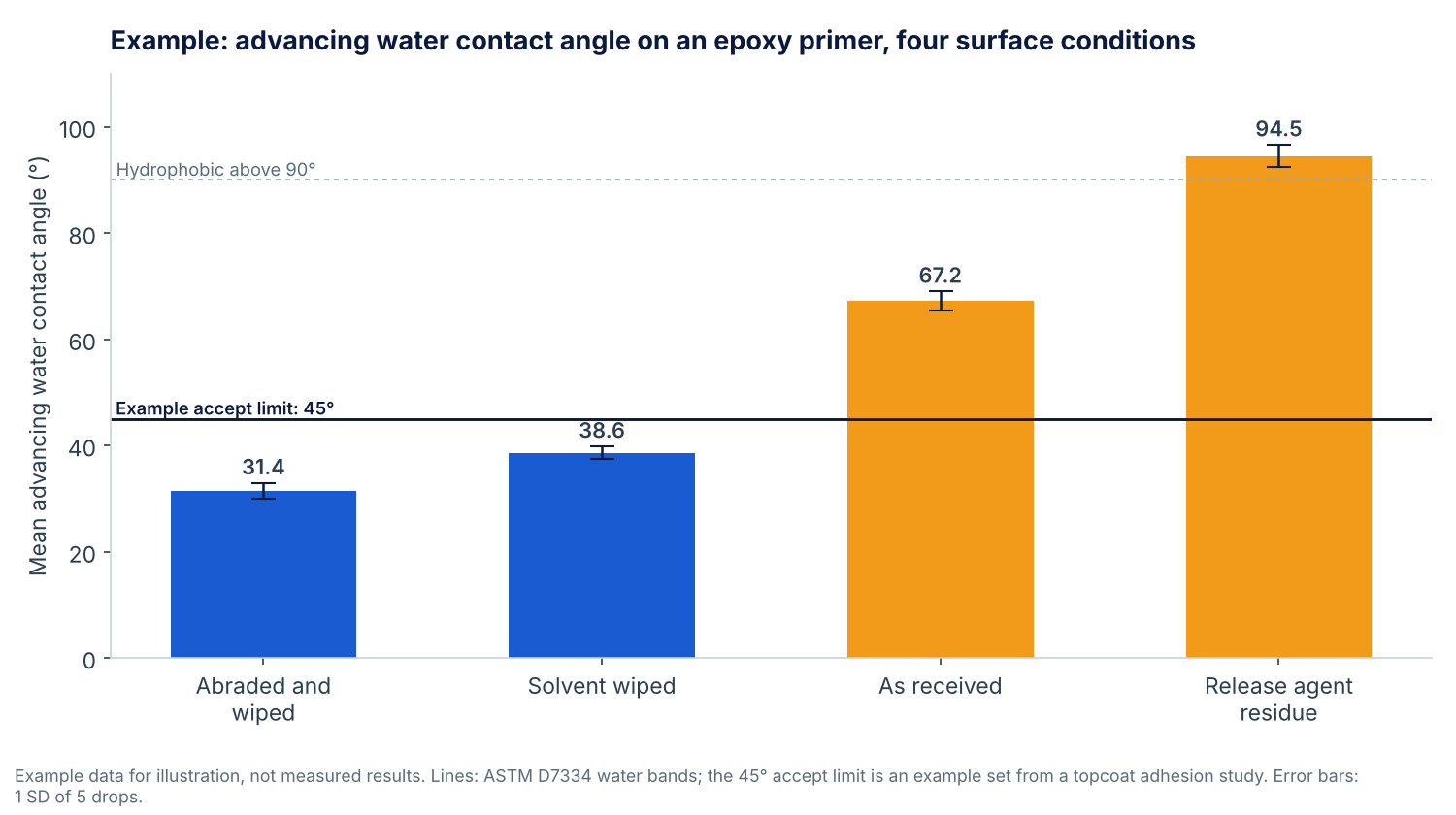
Example: advancing water contact angle on a cured epoxy primer before topcoat

Surface Drops (n) Advancing angle (°) Std dev (°) ASTM D7334 water band Decision
Primer, abraded and solvent wiped531.41.5Hydrophilic, below 45°Accept
Primer, solvent wiped538.61.2Hydrophilic, below 45°Accept
Primer, as received567.21.8Between 45° and 90°Hold: clean and retest
Primer, release agent residue594.52.1Hydrophobic, above 90°Reject: find the contamination

How to read this table

Each row is the mean of five drops on fresh spots of one panel. The band column uses the ASTM D7334 guide bands for water. The decision column uses an example accept limit of 45° or lower, set from a topcoat adhesion study.

Example output chart

The same example data as the table, plotted against the ASTM D7334 water bands and an example accept limit of 45°.

Bar chart of example advancing water contact angles on an epoxy primer in four surface conditions, with the as received and contaminated panels above a 45 degree example accept limit

Example data, not measured results.

Business impact

What changes when the wetting check is a measured advancing angle

Metric Before Dropometer With Dropometer Results
How wetting is checked Water break test or dyne pens, read by eye Advancing angle read from the drop image No published benchmark
Result format Pass or fail judgement An angle per drop, 0.01° display, ±0.35° accuracy Dropometer product specification
When problems show Crawling or cratering found after coating High angle found on the surface before coating ASTM D7334 significance section; no published benchmark for savings
Where it runs Shared lab goniometer In the lab or next to the line, on battery for up to 8 h Dropometer product specification

See the measurement on your own surfaces

Bring two panels: one that coated well and one that showed crawling or poor adhesion. We will measure both live.

ROI estimate

Estimate the cost of the coating failures this test can catch

Enter your own numbers. The defaults are examples, not Droplet Lab results.

Quality cost snapshot

Estimate what wetting related failures cost you.

Example only. Use what you see in a trial on your own samples.
Your own figure.
Your own estimate.

Result

~0
Estimated annual cost today
~0
Estimated annual cost avoided
~0
Payback period

Annual exposure combines audit/CAPA cost, customer rejections, and recall probability; avoided exposure applies the risk reduction percentage.

Method settings for advancing contact angles

Lock these before you compare results between shifts, labs or sites

Parameter Recommended Setting Technical Rationale
Test liquid Water, unless your procedure names another liquid Water is the common choice. The standard also allows solvents, surfactant or dispersant solutions and liquid paints.
Angle type Sessile drop, advancing angle The practice covers advancing angles only. The Dropometer grows the drop by adding liquid through the needle.
Drop size and growth As the standard specifies; slow, even addition, the same for every drop Fast addition can overshoot the true advancing angle. The automatic dropper add-on doses down to 0.05 µL.
Reading point As the contact line starts to move outward, the same rule every drop A fixed reading rule keeps operators and sites comparable.
Fit model Young-Laplace or polynomial, the same for every run Both models are in the Dropometer software. Do not mix them within one study.
Replicates Several drops on fresh, dry spots per specimen A spot already wetted reads differently, and surfaces vary from place to place.
Specimen Cured coating, bare substrate or pressed pigment disk, flat and level The standard extends the method to pigments by pressing the powder into a solid disk.
Environment Record room temperature and humidity The Dropometer runs at 10 to 45 °C and has no temperature control.

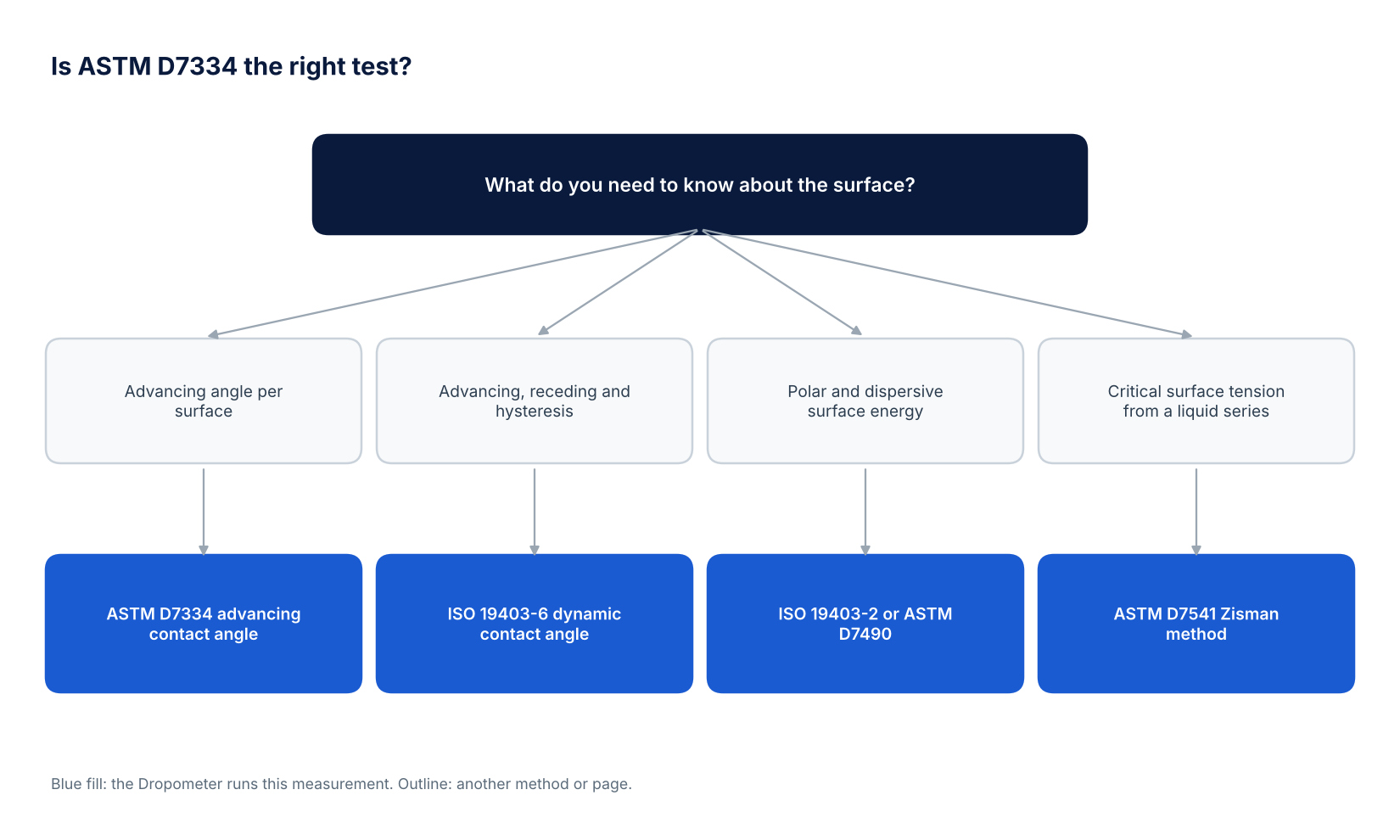
Is the D7334 standard practice for surface wettability the right test?

Pick the method by the question you need answered

Start: What do you need to know about the coating, substrate or pigment surface?

Advancing angle per surface

Signals:

You want a measured wetting value per panel, substrate or pigment disk for QC or development.

Rule-out:

Use ASTM D7334, this page. The Dropometer is fully compliant.

Advancing, receding and hysteresis

Signals:

You need to know how the surface dewets as well as how it wets, or how even it is.

Rule-out:

Use ISO 19403-6. The Dropometer reads both angles by adding and withdrawing liquid through the needle.

Surface free energy with polar and dispersive parts

Signals:

You need to know why a coating or adhesive fails, not just whether the surface wets.

Rule-out:

Use ISO 19403-2 or ASTM D7490. The Dropometer measures the angles for both.

Critical surface tension from a liquid series

Signals:

You need a Zisman style value from several liquids of known surface tension.

Rule-out:

Use ASTM D7541. The Dropometer measures the angle for each liquid.

Readings with a portable goniometer on the floor

Signals:

Your customer names the portable goniometer method for checks on the production floor.

Rule-out:

Use ASTM D8597. The Dropometer is partially compliant there: it is portable, not handheld.

Decision tree at a glance

Start from the question you need answered. Blue boxes are measurements the Dropometer runs.

Decision tree for choosing between ASTM D7334 advancing contact angle, ISO 19403-6 dynamic angles, ISO 19403-2 or ASTM D7490 surface free energy and ASTM D7541 critical surface tension

Is ASTM D7334 the right test?

Interpreting advancing contact angles on coatings and pigments

What the advancing angle tells you, and what it does not

Lower advancing angle, easier wetting: ASTM D7334 notes that an advancing angle below 45° indicates wetting and 10 to 20° indicates excellent wetting.
Water sorts surfaces into three bands: With water, below 45° reads as hydrophilic, above 90° as hydrophobic, and 45 to 90° sits in between.
Advancing reads the less wettable patches: The advancing angle responds strongly to low energy spots such as release agent or oil. That is why a contaminated panel stands out.
Angle is not adhesion: A low angle shows the surface wets. It does not prove a coating will bond or say what contaminated the surface.
Expert perspective

Why the advancing angle is the one to watch

Droplet adhesion is three-dimensional. Two side-view angles give an estimate; the whole story is how the angle and the contact line vary all the way around the drop.

Dr. Alidad Amirfazli

Department of Mechanical Engineering, York University, Co-founder and Scientific Advisor, Droplet Lab

Common pitfalls and limits

Honest limits of the method and of the Dropometer

The Dropometer reads from 10°. Surfaces that wet almost completely, below 10°, are outside its range.
Add liquid slowly. The camera runs at 10 frames per second, which suits slow drop growth, not millisecond spreading studies.
Never take an advancing reading on a spot that is already wet. Use fresh, dry areas for each drop.
Rough, porous or loosely pressed pigment disks can absorb the liquid or give an apparent angle that reflects texture.
The Dropometer has no temperature or humidity control. Record room conditions and keep them steady.
One advancing angle does not give surface tension or surface free energy. Use two or more liquids for that.
FAQ

Frequently asked questions

What does ASTM D7334 measure?

It measures the advancing contact angle of a liquid drop on a coating, substrate or pressed pigment disk, to judge how easily the surface wets. It is a sessile drop goniometer method and covers advancing angles only. It supplements the goniometer maker's own instructions.

Can the Dropometer run ASTM D7334?

Yes. The Dropometer reads the sessile drop advancing angle by adding liquid through the needle, with ±0.35° accuracy over 10° to 175°. Buy the current edition of the standard, follow its drop size and reading rules, and validate the method in your own lab.

Why does ASTM D7334 use the advancing angle?

The advancing angle is read as liquid moves over dry surface, which is what a coating does when it is applied. It responds strongly to low energy contamination such as oils and release agents. For the receding angle and hysteresis as well, see ISO 19403-6.

What advancing contact angle shows good wetting?

ASTM D7334 notes that below 45° indicates wetting and 10 to 20° indicates excellent wetting. These are guides, not pass or fail limits. Set your own limit from surfaces that coated well and surfaces that failed. The Dropometer reads down to 10°.

Can I test pigments with ASTM D7334?

Yes. The standard extends the method to pigments by pressing the powder into a solid disk, then measuring the angle of water, a dispersant solution or a mill base on it. You press the disk yourself. The Dropometer then reads the angle on the disk surface.

How is ASTM D7334 different from ASTM D8597?

Both read a sessile drop contact angle on coatings, substrates and pigments. D7334 covers the advancing angle with a goniometer, where the Dropometer is fully compliant. D8597 covers portable goniometers used on the production floor, where the Dropometer is partially compliant because it is portable, not handheld. See ASTM D8597.

Can I get surface free energy from advancing angles?

Not from one liquid. ASTM D7334 says the angle cannot give a surface tension value directly. Measure two or more liquids, then use Fowkes, van Oss Chaudhury Good or Equation of State in the software. OWRK is not built in: run it in the free Contact Angle to Surface Energy Calculator.

Legal note

This page summarises ASTM D7334 in our own words and does not reproduce the standard. Buy the current edition from ASTM before you write a procedure. Droplet Lab does not certify compliance. Your own method validation does.

How this page was created

Sources, review and tools

Transparency 4 checklist items
01

Sources

ASTM D7334-08(2022) listing (ASTM store); ASTM D7334-08(2022) scope and significance (GlobalSpec); ASTM D7334-08 summary (Nimonik); ISO 19403-6:2024 listing, the Dropometer product specification and Droplet Lab validation papers.

02

Drafting assistance

Drafted with Claude (Anthropic) from the sources listed, then reviewed by Droplet Lab.

03

What we did not do

We did not copy text from the standard. Buy the current edition for the full procedure.

04

Last checked

October 2026

Report a correction

Spotted an issue in this summary? Send a correction request and our team will review it.

Correction Request

We work hard to keep this page accurate and up to date. If you spot an error (wrong revision/year, missing requirement, incorrect interpretation, or broken link), tell us and we'll review it.

Contact us to report a correction

References

1. ASTM D7334-08(2022). store.astm.org/d7334-08r22.html
2. ASTM D7334-08(2022) scope and significance (GlobalSpec). standards.globalspec.com/std/14510986/astm-d7334-08-2022
3. ASTM D7334-08 summary (Nimonik). standards.nimonik.com/products/astm/d7334/08/
4. ISO 19403-6:2024 listing. iso.org/standard/87266.html
5. Droplet Lab. Peer reviewed validation papers in Review of Scientific Instruments and Colloids and Surfaces A. dropletlab.com/validation/publications/
6. Droplet Lab. Dropometer product specification, 2026. dropletlab.com/products/dropometer/