Contents

Client Citation Analysis

Drug Delivery System Based on an Antibacterial Layer-by-Layer Coating on Urinary Catheters: An Experimental and Simulation Approach

Can a thin polysaccharide and silver coating on silicone Foley catheters both kill bacteria on contact and release more antibiotic? Researchers from Universidad Católica de Temuco and partner universities in Chile, Spain and Mexico built a carboxymethylcellulose and chitosan silver layer by layer coating, loaded it with ciprofloxacin and found it released about 70 µg/cm² versus about 30 µg/cm² for uncoated catheters. A Droplet Lab water contact angle system measured the wettability change, from 100 ± 2° to 69 ± 5° on 14Fr catheters and from 103 ± 2° to 68 ± 7° on 20Fr catheters.

At-a-Glance Summary

Primary surface measurement reported

Static water contact angle with a 10 µL water drop and five measurements. Both catheter sizes moved from hydrophobic to hydrophilic after coating: 100 ± 2° to 69 ± 5° for 14Fr and 103 ± 2° to 68 ± 7° for 20Fr.

Research question

Can a layer by layer coating of carboxymethylcellulose (CMC) and chitosan silver (CHI-Ag) on commercial silicone catheters combine contact killing with controlled ciprofloxacin release, and can a diffusion model describe that release?

Headline finding

The coating, about 1.3 to 1.6 µm thick, released about 70 µg/cm² of ciprofloxacin over 15 days, more than twice the uncoated catheters. Against S. aureus, coated and drug loaded samples gave the largest inhibition zones; against E. coli, the authors describe coated and uncoated drug loaded samples as similar.

Paper Details

Authors
Ruth Pulido, Nelson Naveas, Francisco Javier Fernández-Alonso, Miguel Manso-Silván, Leonardo Soriano, Carlos Torres-Ulloa, Karel Mena-Ulecia, Gonzalo Recio-Sánchez, Juan Paulo Garcia-Sandoval, Jacobo Hernández-Montelongo
Affiliation
Universidad Católica de Temuco, Temuco, Chile (corresponding author), with Universidad de Antofagasta (Chile), Universidad Autónoma de Madrid (Spain), Universidad San Sebastián (Chile) and Universidad de Guadalajara (Mexico)
Journal
Frontiers in Bioengineering and Biotechnology
Year
2025 (published 29 August 2025)
Volume
13
Issue / Article
Article 1614509
Licence
CC BY (Creative Commons Attribution License, as stated in the paper; version not given in the text)
Static sessile drop water contact angle plus surface, chemical, release and antibacterial tests
Measurement scope
Methods used
  • Water contact angle: water contact angle measuring system (Dropletlab, Canada)
  • Roughness: Dektak 150 stylus profilometer (Veeco)
  • Thickness, cross sections and silver mapping: Hitachi SU-3500 variable pressure SEM with Oxford INCA EDX
  • Surface chemistry: ATR FTIR (Agilent Cary 630), XPS, RBS and methylene blue / Rose Bengal dye uptake
  • Drug release: UV visible spectrophotometer (Thermo Scientific Evolution 220) at 275 nm over 15 days
  • Antibacterial activity: agar diffusion against E. coli ATCC 25922 and S. aureus ATCC 25923
  • Modelling: Fick's second law diffusion model and ab initio molecular dynamics (Orca 5.0.1)
14Fr and 20Fr Foley silicone catheters (Chen Kang), cut to 2.5 cm
Samples tested
Two catheter sizes, four states
  • Uncoated (pristine) 14Fr and 20Fr
  • Layer by layer coated (ten CMC / CHI-Ag cycles, silver reduced with ascorbic acid)
  • Uncoated and ciprofloxacin loaded
  • Coated and ciprofloxacin loaded
  • Contact angle is reported for the uncoated and coated states only
Water for contact angle; PBS for drug release
Liquids and media
Probe liquid and test media
  • Contact angle probe liquid: water, 10 µL drop
  • Drug loading: ciprofloxacin 1.33 mg/mL for 12 h, then 24 h rest
  • Release medium: PBS at 37 °C, pH 7.6, 50 rpm

Classification

This study sits where medical device coatings, antibacterial surfaces and controlled drug release meet, with wettability as the surface check.

What Was Measured

Primary surface / interfacial measurement

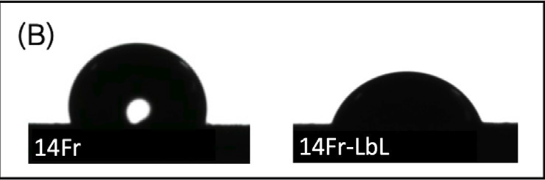
Static water contact angle on uncoated and layer by layer coated 14Fr and 20Fr silicone catheter pieces, using a 10 µL water drop and five measurements. Figure 3B shows the drop images for the 14Fr pair.

Supporting measurements

A Dektak 150 profilometer measured roughness, SEM with EDX measured coating thickness and silver content, and FTIR, XPS, RBS and dye uptake tracked surface chemistry. A UV visible spectrophotometer followed ciprofloxacin release, agar diffusion tested antibacterial activity, and a diffusion model plus molecular dynamics interpreted the release.

Instruments Mentioned

Water contact angle measuring system (Dropletlab, Canada)

Static sessile drop water contact angle on uncoated and coated catheters

Dektak 150 stylus profilometer (Veeco, United States)

Surface roughness before and after coating

Hitachi SU-3500 VP SEM with Oxford Instruments INCA X-sight EDX

Cross sections, coating thickness and silver mass percent

Agilent Cary 630 FTIR with ATR accessory

Chemical groups of silicone, CMC and chitosan

XPS (TAIB Instruments) and RBS (CMAM, Madrid)

Surface composition and silver depth profile

Thermo Scientific Evolution 220 UV visible spectrophotometer

Dye absorbance and ciprofloxacin concentration during release

Harrick Plasma oxygen plasma system

Surface activation before coating (preparation, not measurement)

Role of the Droplet Lab instrument

The paper credits a water contact angle measuring system from Dropletlab, Canada, used in static sessile drop mode with a 10 µL water drop and five measurements. No model name, software or fitting method is given.

Droplet Lab's contact angle instrument today is the <a href="/products/dropometer/">Dropometer</a>. In this study the Droplet Lab instrument supplied the wettability data for uncoated and coated 14Fr and 20Fr catheters, and the drop images in Figure 3B.

Those values showed the coating turned a hydrophobic silicone surface hydrophilic. The authors attribute the shift to carboxylic groups in CMC, ammonium groups in chitosan and silver in the coating.

Roughness, thickness, chemistry, drug release and antibacterial results all came from other instruments and assays listed on this page.

Contact angle gave the study its direct reading that the coating changed how water meets the catheter surface. The authors discuss this hydrophilic shift, with the higher roughness, as a possible factor in bacterial adhesion that silver and ciprofloxacin may counter.

Bring This Measurement Into Your Lab

To check that a coating has changed a catheter or device surface, measure water contact angle before and after treatment with the Dropometer.

Method Snapshot

Droplet Lab measurement protocol

Parameter Value as reported
Instrument as named Water contact angle measuring system (Dropletlab, Canada)
Mode Static sessile drop
Probe liquid Water
Drop volume 10 µL
Replicates Five measurements
Samples Uncoated and coated 14Fr (4.7 mm outer diameter) and 20Fr (6.7 mm) silicone catheter pieces
Reported as Angle ± value, as given in the Results text
Fit model, software, temperature, drop age Not stated in the paper

Coating, drug loading and release conditions

Step Conditions as reported
Sample preparation Catheters cut to 2.5 cm and both ends sealed with silicone
Surface activation Oxygen plasma, 0.2 mmHg, 15 min
Primer layer PEI 1 mg/mL, pH 4, 15 min, then rinse
Layer by layer cycle CMC 0.1% m/v, pH 4, 10 min; rinse; CHI-Ag (0.1% m/v chitosan with 0.1 mM AgNO3), pH 4, 10 min; rinse
Cycles Ten
Silver reduction Ascorbic acid, 3 h, then rinse, seals removed and dried
Drug loading Ciprofloxacin 1.33 mg/mL, 12 h immersion, then 24 h rest
Release test PBS, 37 °C, pH 7.6, 50 rpm, 15 days, triplicate

Key Findings

Coating made both catheters hydrophilic

Droplet Lab water contact angle fell from 100 ± 2° to 69 ± 5° on 14Fr catheters and from 103 ± 2° to 68 ± 7° on 20Fr catheters after coating.

Thin, rougher, silver bearing film

SEM showed coatings of 1.3 ± 0.2 µm (14Fr) and 1.6 ± 0.4 µm (20Fr). Roughness rose from 0.46 to 0.93 µm and from 0.70 to 1.18 µm, and EDX found about 1.5 to 1.6% silver by mass.

More than twice the antibiotic released

Coated catheters released about 70 µg/cm² of ciprofloxacin over 15 days, against about 30 µg/cm² for uncoated catheters.

Largest inhibition zones with coating plus drug

Coated and drug loaded samples gave 40 and 35 mm zones against E. coli and 27 and 23 mm against S. aureus. The authors note these exceed the CLSI thresholds they cite, 26 and 21 mm, and describe coated and uncoated drug loaded samples as similar against E. coli.

Model and simulation support the release data

A Fick's second law model fitted release with a diffusivity of 1.744 × 10⁻⁵ cm²/h. Partition coefficients were higher for coated samples, suggesting stronger drug affinity for the film.

Measured Values by Sample

Water contact angle values reported in the Results text for each catheter size before and after coating, all from the Droplet Lab instrument.

Water contact angle by catheter and coating state

Sample Water contact angle Wettability as described
14Fr uncoated 100 ± 2° Hydrophobic
14Fr layer by layer coated 69 ± 5° Hydrophilic
20Fr uncoated 103 ± 2° Hydrophobic
20Fr layer by layer coated 68 ± 7° Hydrophilic

Figures & Visuals

One figure in the paper contains Droplet Lab data: panel B of Figure 3 shows water drops on uncoated and coated 14Fr catheters. The article is open access under a Creative Commons Attribution (CC BY) licence as stated in the paper; the version is not printed in the text.

Figure 3: Catheter coating characterization

Panel B shows water contact angle images of the uncoated (hydrophobic) and coated (hydrophilic) 14Fr catheter from the Droplet Lab instrument. Panels A, C and D show catheter photos, dye absorbance and FTIR spectra from other methods. Credit: Pulido et al., Front. Bioeng. Biotechnol. 2025, 13:1614509, CC BY.

Why It Matters

Catheter associated urinary tract infections are a leading cause of healthcare associated infections. This study pairs a contact killing silver coating with antibiotic release on a commercial catheter, and uses wettability to check that the surface changed.

Works on a commercial catheter

The coating was built on off the shelf 14Fr and 20Fr Foley silicone catheters, not on flat model substrates.

Wettability as a coating check

Water contact angle fell clearly on both sizes, from hydrophobic to hydrophilic, which the authors attribute to carboxylic and ammonium groups and silver in the coating.

Two antibacterial routes in one film

The silver film acted as an antibacterial surface and released more ciprofloxacin. Against S. aureus, coating plus drug gave clearly larger zones than either alone.

Water contact angle fell to 68 to 69° on both coated sizes

Coated catheters released about 70 µg/cm² of ciprofloxacin

Same wettability trend on 14Fr and 20Fr catheters

Authors call for biofilm testing under dynamic conditions next

Expert Perspective

Expert Perspective

What a liquid responds to is only the outermost few ångström of a surface — the skin, not the bulk. Change that skin and you change the wetting, even if the material underneath is identical.

Dr Alidad Amirfazli

Professor, Department of Mechanical Engineering, York University, Co-founder and Scientific Advisor, Droplet Lab

Practical Takeaways

Measure every size you coat

The study measured both catheter diameters before and after coating and found the same trend with similar end values.

Pair angle with roughness

Roughness rose on both sizes after coating, and the authors discuss it together with the hydrophilic shift when considering bacterial adhesion.

Watch the spread after coating

The ± values grew from 2° on bare silicone to 5° and 7° on coated surfaces, which is useful context when setting acceptance limits.

FAQ

Frequently Asked Questions

What did the Droplet Lab instrument measure in this study?

It measured static water contact angle by sessile drop on uncoated and coated 14Fr and 20Fr silicone catheter pieces, using a 10 µL water drop and five measurements. Roughness, thickness, chemistry, drug release and antibacterial activity were measured with other instruments and assays.

How much did the coating change the water contact angle?

On 14Fr catheters the angle went from 100 ± 2° to 69 ± 5°, and on 20Fr catheters from 103 ± 2° to 68 ± 7°. The authors describe this as a move from hydrophobic to hydrophilic and link it to carboxylic groups in CMC, ammonium groups in chitosan and silver in the coating.

Does a more hydrophilic catheter surface mean less bacterial adhesion?

Not necessarily. The authors note that higher roughness and the hydrophilic shift may enhance bacterial adhesion, but that silver and ciprofloxacin may counter early colonization. They state that longer term biofilm studies under dynamic conditions are still needed.

Which measurement settings does the paper report for contact angle?

It reports static sessile drop mode, a 10 µL water drop and five measurements. Temperature, drop age at capture and the fitting method are not stated in the paper.

Citation

Use the formal reference below when citing the original paper.

Formal Reference

Pulido, R., Naveas, N., Fernández-Alonso, F. J., Manso-Silván, M., Soriano, L., Torres-Ulloa, C., Mena-Ulecia, K., Recio-Sánchez, G., Garcia-Sandoval, J. P., & Hernández-Montelongo, J. (2025). Drug delivery system based on an antibacterial layer-by-layer coating on urinary catheters: An experimental and simulation approach. Frontiers in Bioengineering and Biotechnology, 13, 1614509. https://doi.org/10.3389/fbioe.2025.1614509

Short Cite + DOI

Pulido et al., Frontiers in Bioengineering and Biotechnology 2025, 13, 1614509. DOI: 10.3389/fbioe.2025.1614509