Contents

Client Citation Analysis

Stopping, Opening, and Redirecting Fluid Flow in Paper-Based Microfluidic Devices Using Thermoresponsive Gelatin Valves

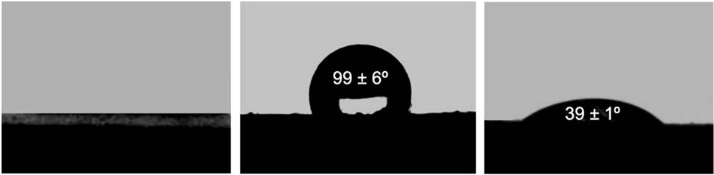
Can a small spot of gelatin act as a valve on paper, holding liquid back until it is warmed? Prof. Sana Jahanshahi-Anbuhi's lab at Concordia University deposited gelatin on paper channels and found that a 30 mg/mL valve, gelled at 4 °C for 15 min, stayed closed for the full 35 min test and opened in about 20 s at 40 °C. Dropometer images of 3 µL water drops, analysed in ImageJ, tracked the surface change: untreated paper absorbed the drop, the closed valve read 99 ± 6° and the opened valve read 39 ± 1°.

At-a-Glance Summary

Primary surface measurement reported

Static water contact angle on Whatman grade 1 paper. Untreated paper absorbed the drop with no measurable static angle, the closed valve read 99 ± 6° and the opened valve read 39 ± 1° (Fig. 5A to C).

Research question

Can gelatin, deposited straight onto a paper channel with no chemical modification, act as a low cost valve that stays closed through an assay step and opens on mild heating?

Headline finding

A 30 mg/mL gelatin valve gelled at 4 °C for 15 min stayed closed for the 35 min observation period and opened in about 20 s at 40 °C. Built into a single shot malathion test, it gave a calculated detection limit of 0.24 µM, below the Health Canada guideline of about 0.88 µM.

Paper Details

Authors
Abdolali Mehrjou, Seyed Hamid Safiabadi Tali, Mohsen Ghiasi Tarzi, Zubi Sadiq, Sana Jahanshahi-Anbuhi
Affiliation
Department of Chemical and Materials Engineering, Gina Cody School of Engineering, Concordia University, Montréal, Québec, Canada
Journal
RSC Advances
Year
2026 (published 5 October 2026)
Volume
16 (Issue 46)
Pages / Article
60239 to 60249
Licence
Creative Commons Attribution 4.0 (CC BY 4.0), as stated by the publisher
Sessile drop water contact angle plus porometry, SEM, flow timing and a colorimetric enzyme assay
Measurement scope
Methods used
  • Water contact angle: Dropometer (Droplet Lab Inc., Canada), images analysed in ImageJ with the Drop Analysis plugin
  • Pore structure: capillary flow porometer (Anton Paar Quantachrome 3Gzh)
  • Morphology: scanning electron microscopy
  • Device fabrication: Parafilm heating and CO2 laser cutting, patterns drawn in Inkscape 1.1.1
  • Valve actuation: hot plate, 37 to 60 °C
  • Assay readout: Canon Pixma TS5020 scanner at 600 dpi, ImageJ 1.54p grayscale intensity
Whatman grade 1 filter paper, untreated and gelatin treated
Samples tested
Three surface states
  • Untreated paper
  • Closed valve region, 30 mg/mL gelatin gelled at 4 °C for 15 min, before heating
  • Valve region after heating open and fluid passage
Deionized water for contact angle
Liquids and media
Probe liquid and test media
  • Contact angle: deionized water, 3 µL drop
  • Valve tests: dyed deionized water
  • Assay: malathion standards in Tris buffer with 5% methanol, and spiked St. Lawrence River water

Classification

This study sits where paper microfluidics, temperature responsive materials and low cost water testing meet, with wettability as one of the checks on how the valve works.

What Was Measured

Primary surface / interfacial measurement

Static water contact angle with 3 µL deionized water drops on untreated Whatman grade 1 paper, on the closed 30 mg/mL gelatin valve region and on the valve region after heating and fluid passage (Fig. 5A to C).

Supporting measurements

A capillary flow porometer measured accessible through pores in untreated and gelatin treated paper, and SEM imaged the fibre network. Dyed water tracked valve retention and opening time on a hot plate. For the assay, a desktop scanner and ImageJ measured blue colour intensity across malathion standards and spiked river water.

Instruments Mentioned

Dropometer (Droplet Lab Inc., Canada)

Water contact angle drop images on untreated paper, the closed valve and the opened valve

ImageJ, Drop Analysis plugin

Contact angle analysis of the drop images

Anton Paar Quantachrome 3Gzh capillary flow porometer

Accessible through pore distribution

Scanning electron microscope

Fibre network before and after gelatin treatment and heating

CO2 laser cutter

Channel patterning in the Parafilm heating and laser cutting method

Hot plate

Valve actuation at 37 to 60 °C

Canon Pixma TS5020 scanner with ImageJ 1.54p

Grayscale intensity of the assay detection zone

Role of the Dropometer

The paper states that water contact angles were measured with a Dropometer instrument from Droplet Lab Inc., Canada, using a 3 µL drop of deionized water. The drop images were analysed in ImageJ with the Drop Analysis plugin, not in the Dropometer app.

The Dropometer supplied the three wettability readings in Figure 5A to C. Untreated paper absorbed the drop too fast for a static angle, the closed valve read 99 ± 6°, and the valve read 39 ± 1° after it had been heated open and liquid had passed.

The authors read the high closed state angle as suppressing spontaneous wicking, and the lower angle after heating as consistent with restored wetting. Read together with porometry, they conclude that gelatin changes both wettability and the accessible pore pathways, without settling which effect dominates.

Valve timing, pore structure, morphology and all malathion results came from other methods listed on this page.

Contact angle gave the study a direct reading of how gelatin changed the paper surface in each valve state. Through the cos θ term in the Young Laplace relation the authors discuss, an angle above 90° on the closed valve corresponds to a capillary pressure that opposes wicking.

Bring This Measurement Into Your Lab

To see how a treatment changes a paper or other porous surface, measure water contact angle on each state with the Dropometer.

Method Snapshot

Droplet Lab measurement protocol

Parameter Value as reported
Instrument as named Dropometer instrument (Droplet Lab Inc., Canada)
Mode Static sessile drop
Probe liquid Deionized water
Drop volume 3 µL
Image analysis ImageJ with the Drop Analysis plugin
Samples Untreated Whatman grade 1 paper; closed 30 mg/mL gelatin valve region; valve region after heating open and fluid passage
Reported as Angle ± value; untreated paper gave no measurable static angle
Temperature, drop age, number of drops Not stated in the paper

Valve fabrication and test conditions

Step Conditions as reported
Device Whatman grade 1 paper bonded to Parafilm M by heating, channels cut with a CO2 laser
Gelatin Type A porcine gelatin, 10 to 45 mg/mL in deionized water, heated at 65 °C for 10 min
Deposit 0.5 µL on the valve region, giving a treated zone about 5 mm long
Gelling 4 °C for 15 min (chosen); ambient cooling and shorter times also tested
Retention test 7 µL dyed water at 20 ± 2 °C, observed for up to 35 min, four valves per condition
Actuation Hot plate at 37 to 60 °C; time until the liquid front crossed the treated zone, n = 4
Storage Sealed zip bags at 20 ± 2 °C (about 50 to 60% RH) or 4 °C; tested after one week, one month and two months
Assay (single shot) 15 µL sample through a bypass channel, 15 min inhibition at 20 ± 2 °C, then 40 °C to open the valve

Key Findings

Gelatin turned absorbent paper water repellent

Untreated paper absorbed the 3 µL drop with no measurable static angle. The closed 30 mg/mL valve read 99 ± 6°, and after heating and liquid passage the region read 39 ± 1°: wettable enough to wick, but not back to untreated paper.

Concentration and cooling set the seal

Valves of 30 mg/mL and above stopped flow for the 35 min observation period, while 10 mg/mL valves failed within about 5 to 8 min. Only cooling at 4 °C for 15 min kept all four replicate valves closed; ambient cooling leaked within about 4 min.

Mild heat opens the valve

At 40 °C the chosen valve opened in about 20 s. Above 55 °C every tested concentration opened in under 20 s, while at 37 to 45 °C higher concentrations opened more slowly.

Storage affects sealing more than opening

Fresh and one week old valves stayed closed for 35 min. After one and two months, retention ranged from about 5 to 19 min depending on storage, but every stored valve still opened within about 1.5 min at 40 °C.

A single shot pesticide test

In a single shot enzyme (AChE) inhibition test for malathion, the valve held back the substrate during a 15 min incubation. The calculated detection limit was 0.24 µM, and spiked St. Lawrence River water gave recoveries of 74.9 to 86.1%. The authors present it as a proof of concept screening platform.

Measured Values by Sample

Water contact angle values reported for each surface state, all from Dropometer drop images analysed in ImageJ.

Water contact angle by valve state

Sample Water contact angle Wettability as described
Untreated Whatman grade 1 paper No measurable static angle Drop rapidly absorbed
Closed gelatin valve (30 mg/mL), before heating 99 ± 6° Reduced wettability; barrier to spontaneous wicking
Valve region after heating and fluid passage 39 ± 1° Wettable enough to support capillary transport

Figures & Visuals

One figure in the paper contains Dropometer data: panels A to C of Figure 5 show water drops on untreated paper, the closed valve and the opened valve. The article is open access under a Creative Commons Attribution 4.0 licence.

Figure 5: Contact angle and porometry

Panels A to C show water drop images on untreated paper, the closed gelatin valve and the valve after heating, captured with the Dropometer and analysed in ImageJ. Panel D shows pore distributions from a capillary flow porometer. Credit: Mehrjou et al., RSC Adv. 2026, 16, 60239, CC BY 4.0.

Why It Matters

Multistep paper assays need a reliable way to hold a reagent back and release it on cue. This study shows a valve made from off the shelf gelatin, and uses wettability as one of the checks on why it holds.

No synthesis or grafting

Gelatin was deposited straight into the paper channel, with no polymer synthesis, surface grafting or moving parts.

Wettability as a valve check

The closed valve read 99 ± 6° on paper that otherwise absorbed the drop, and 39 ± 1° once opened, which the authors link to stopping and then supporting capillary flow.

Fewer manual steps

A bypass channel let one 15 µL sample addition replace a second liquid addition, with the valve timing the substrate release.

Closed valve 99 ± 6°, opened valve 39 ± 1°

Opens in about 20 s at 40 °C

Calculated malathion detection limit of 0.24 µM

Authors call for humidity controlled storage tests and better packaging next

Expert Perspective

Expert Perspective

What a liquid responds to is only the outermost few ångström of a surface — the skin, not the bulk. Change that skin and you change the wetting, even if the material underneath is identical.

Dr Alidad Amirfazli

Professor, Department of Mechanical Engineering, York University, Co-founder and Scientific Advisor, Droplet Lab

Practical Takeaways

Measure every valve state

The study measured untreated paper, the closed valve and the opened valve, which shows both the barrier and how far wetting recovers.

Record when paper absorbs the drop

Untreated paper gave no static angle. Reporting that outcome is as useful as a number when comparing treated and untreated zones.

Expect some change to remain after opening

The opened valve read 39 ± 1°, not the near instant wetting of untreated paper, which the authors suggest may come from gelatin left on the fibres.

FAQ

Frequently Asked Questions

What did the Dropometer measure in this study?

It captured images of 3 µL deionized water drops on untreated Whatman grade 1 paper, on the closed gelatin valve and on the valve after it was heated open. The angles were analysed in ImageJ with the Drop Analysis plugin. Pore structure, morphology, valve timing and the malathion assay came from other methods.

What contact angles were reported?

Untreated paper absorbed the drop and gave no measurable static angle. The closed 30 mg/mL valve read 99 ± 6°, and the valve read 39 ± 1° after heating and liquid passage (Figure 5A to C).

Does contact angle alone explain why the valve stays closed?

No. The authors combine the high closed state angle with porometry, which showed fewer accessible pore pathways, and SEM, which showed no complete filling of the fibre network. They conclude that wettability and pore pathways both change, but that their data do not show which one dominates.

How does this study relate to the lab's earlier work?

The devices were made with the Parafilm heating and laser cutting method the lab reported in 2023, where Dropometer readings showed no measurable change in the Parafilm after the laser step. See our analysis of the Parafilm heating and laser cutting study.

Citation

Use the formal reference below when citing the original paper.

Formal Reference

Mehrjou, A., Safiabadi Tali, S. H., Ghiasi Tarzi, M., Sadiq, Z., & Jahanshahi-Anbuhi, S. (2026). Stopping, opening, and redirecting fluid flow in paper-based microfluidic devices using thermoresponsive gelatin valves. RSC Advances, 16, 60239–60249. https://doi.org/10.1039/d6ra07964d

Short Cite + DOI

Mehrjou et al., RSC Advances 2026, 16, 60239. DOI: 10.1039/d6ra07964d