



Contents
Case Study

One engineering department at the University of Alberta bought a Dropometer in 2020. A second department bought its own, and measured a drop going from 133° to 15° at 3.6 V.

Last Updated
October 18, 2026
Industry
Engineering research: microfluidics and soft materials
Location
Edmonton, Alberta, Canada
Customer since
June 2020
Departments
Chemical and Materials Engineering; Mechanical Engineering
Instrument
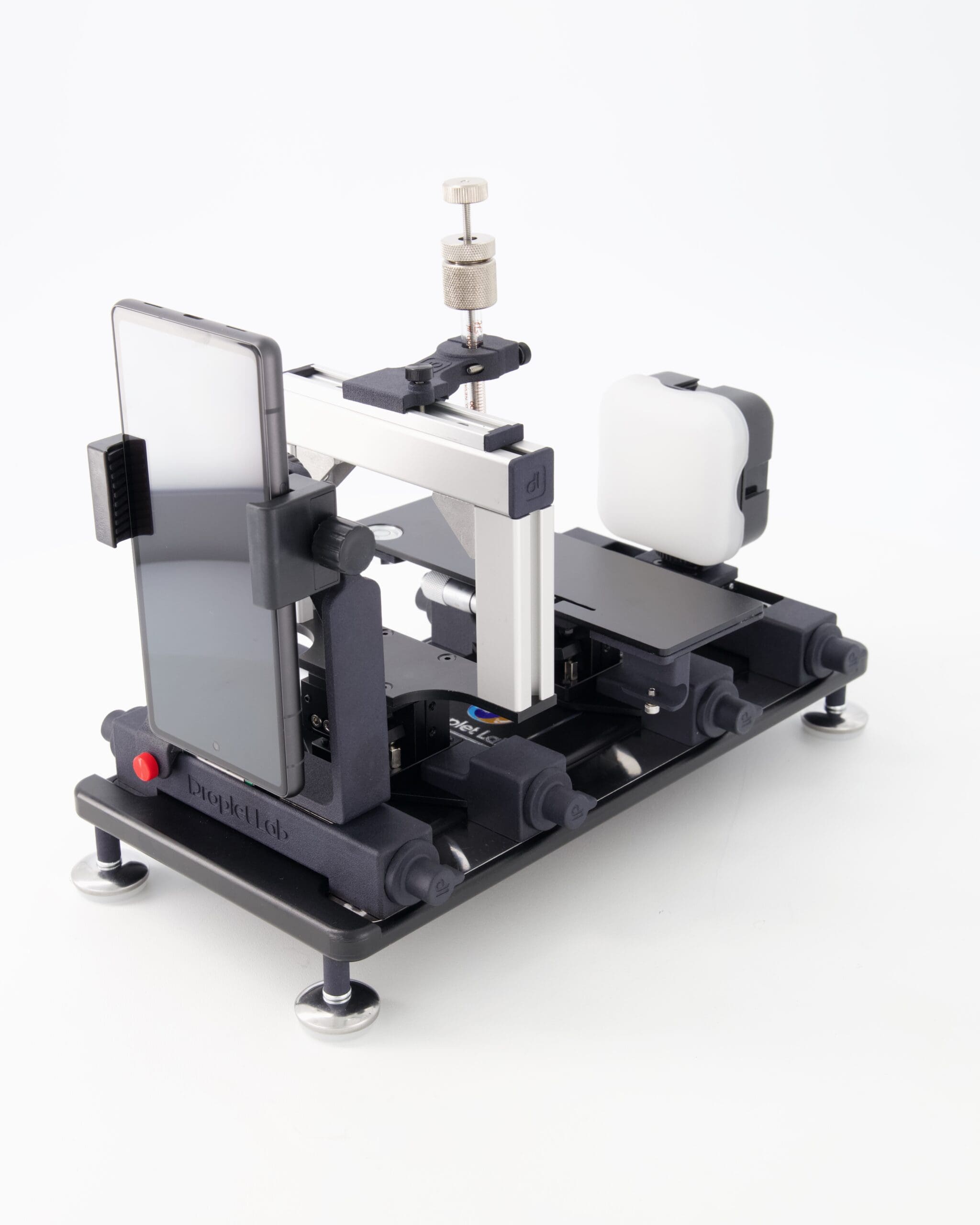
2 Dropometers (current model shown)
Repeat purchase: a second engineering department bought its own unit Drop shape method validated against a KRÜSS DSA100E in peer review Two peer reviewed validation papers, published accuracy 0.35°

Prof. Hyun-Joong Chung's group in Chemical and Materials Engineering ordered a Dropometer with all four measurements in June 2020 and shared it with textile science researchers. By July 2022, Prof. Dan Sameoto's IMPACT Lab in Mechanical Engineering had bought its own unit. An MSc student used it to measure low voltage electrowetting for an adaptive infrared camouflage concept.

Dropometer contact angle instrument with phone camera, sample stage and light source (current model)
Abhimanyu Photo
Written by
Abhimanyu Bhandankar
Holds an MBA from Schulich School of Business and a BE in IT. He joined Droplet Lab in July 2019 and now leads sales and marketing.
CEO at Droplet Lab
Read More
Gurdeep-Saini-Photo
Technical Review by
Gurdeep Singh Saini
Holds a BASc in Mechanical Engineering from Ryerson University (now Toronto Metropolitan University) and an MASc from York University. He develops the automatic edge and baseline detection behind the Dropometer's analysis.
COO at Droplet Lab
Read More
Abhimanyu Photo
Written By

Abhimanyu Bhandankar

CEO at Droplet Lab

Holds an MBA from Schulich School of Business and a BE in IT. He joined Droplet Lab in July 2019 and now leads sales and marketing.

Gurdeep-Saini-Photo
Reviewed By

Gurdeep Singh Saini

COO at Droplet Lab

Holds a BASc in Mechanical Engineering from Ryerson University (now Toronto Metropolitan University) and an MASc from York University. He develops the automatic edge and baseline detection behind the Dropometer's analysis.

Primary outcome: nearly complete wetting at 3.6 V, measured with the second unit

Contact angle of a water drop under oil, before and after voltage

Water with 3 wt% SDS on aluminium metalized polyester, under dodecane (Xiaoruo Sun, MSc thesis, University of Alberta, 2023, Figure 13)

0 V, drop not wetting 133°
3.6 V DC, nearly complete wetting 15°

With no voltage, the drop sat at 133°. At 3.6 V DC it spread to 15°, nearly complete wetting, and the thesis reports the wetting as fully repeatable. A lipid bilayer that forms on its own acted as the dielectric, which kept the actuation voltage below 5 V.

2 Dropometers

One in Chemical and Materials Engineering (ordered June 2020) and one in the IMPACT Lab, Mechanical Engineering (bought by July 2022).

133° → 15° at 3.6 V

Contact angle of a water drop under dodecane before and after voltage (Xiaoruo Sun, MSc thesis, University of Alberta, 2023, Figure 13).

Below 5 V actuation

A lipid bilayer that forms on its own acted as the dielectric, so a few volts were enough to wet the drop.

About 1 s switching

The thesis reports an average actuation time of 1.00 ± 0.33 s for the drop to wet. This was not a Dropometer reading.

Executive Summary

Who

Two engineering groups at the University of Alberta in Edmonton. Prof. Hyun-Joong Chung's soft materials group in Chemical and Materials Engineering has had a Dropometer since 2020. Prof. Dan Sameoto's IMPACT Lab in Mechanical Engineering, which builds microfluidic devices in polyethylene, had bought its own unit by July 2022.

Problem

Both groups needed wetting measurements in their own labs. The Chung group wanted contact angle, sliding angle, surface tension and surface energy for students working on many materials, including fabrics. The IMPACT Lab needed to prove that a water drop under oil really spread when voltage was applied, because electrowetting only works if the contact angle moves.

Solution

In June 2020 the Chung group ordered a manual Dropometer with all four measurements through university procurement. By July 2022 the IMPACT Lab had bought its own Dropometer, with help from Dr Alidad Amirfazli, Droplet Lab's Co-founder and Scientific Advisor. Droplet Lab supported the first unit with a free software update and remote help.

Time to Value

October 2019: introductory call with the Chung group. 22 June 2020: purchase order for the first unit. September 2020: first unit received. February 2021: textile science students measure fabrics. By July 2022: the IMPACT Lab has its own unit. March 2023: free software update for the first unit. 2023: MSc thesis completed with results from the IMPACT Lab's unit.

Results

With its own unit, the IMPACT Lab recorded a water drop under oil moving from 133° at 0 V to 15° at 3.6 V DC, nearly complete wetting. The result is in Figure 13 of an MSc thesis completed in 2023, which names the Droplet Lab instrument in its methods. The first unit has served students in chemical and materials engineering and in textile science since 2020.

Highlights

2

Dropometers, two departments

133° → 15°

Contact angle at 3.6 V DC

3.6 V DC

Voltage for nearly complete wetting

1

MSc thesis with Dropometer results

University of Alberta, at a glance

Research focus

Microfluidic devices in polyethylene (IMPACT Lab, Mechanical Engineering) and soft materials (Chemical and Materials Engineering).

Products / applications

Adaptive visible and thermal infrared camouflage skins in polyethylene, low voltage electrowetting, and fabric wetting.

Measurement stage

Research and development, graduate theses and student projects.

Users

Graduate students and postdoctoral researchers in chemical and materials engineering, mechanical engineering and textile science.

Materials and surfaces tested

Aluminium metalized polyester under dodecane, water with SDS, and fabrics.

Key constraints

Drops imaged through oil on flexible film; wetting must repeat at under 5 V; shared use by changing student cohorts.

The challenge: electrowetting is only real if the angle moves

A drop under oil, on a flexible film, at a few volts.

What the IMPACT Lab needed

The group was building microfluidic skins in polyethylene that change how they look in visible and thermal infrared light. Pumping liquid through small channels was slow, and flow in plastic channels depends on polymer microfluidic channel wettability and on the capillary number. So the thesis turned to electrowetting, where a few volts make a drop spread over an electrode.

Why this sample is hard to measure

The test drop is distilled water with 3 wt% SDS on aluminium metalized polyester, covered by dodecane with 0.8 wt% sorbitan trioleate. The drop has to be imaged through oil, on a film that can flex, while voltage is applied. Our contact angle measurement guide explains how a drop image becomes an angle.

What was at stake

A low voltage design is only useful if the drop truly wets, so the contact angle is the pass or fail signal. The oil layer also had to stay under 1 mm thick to pass thermal infrared. Adaptive camouflage of this kind is one of the topics in our aviation and space guide.

The insight: a second unit in the lab where the device was built

What Was Deployed

First unit, Chemical and Materials Engineering (purchase order 22 June 2020, received September 2020): a manual Dropometer with contact angle, sliding angle, surface tension and surface energy. In February 2024 Droplet Lab also gave the group app licences for its own iPhone. Second unit, IMPACT Lab, Mechanical Engineering (bought by July 2022): the Dropometer contact angle and surface tension kit, used for the electrowetting tests. The thesis calls it a Droplet Lab "digital tensiometer setup" used "for accurate measurement and monitoring of the droplet" (Section 3.2.3). Drops were placed with the kit's threaded plunger syringe. Read our analysis of Xiaoruo Sun's thesis for the full method.
The Origin

One department bought first. A second followed.

Droplet Lab first spoke with Prof. Hyun-Joong Chung in October 2019, after an email in September. In June 2020 his group ordered a manual Dropometer with all four measurements, and it arrived that September. In February 2021 Prof. Chung invited the students using it, including textile science researchers measuring water contact angle on fabrics, to share feedback directly with Droplet Lab.

In March 2022 a quote request for a manual Dropometer came in from Prof. Dan Sameoto's IMPACT Lab in Mechanical Engineering. When Droplet Lab followed up in July 2022, Prof. Sameoto replied that the lab had already bought one, and that Dr Alidad Amirfazli, Droplet Lab's Co-founder and Scientific Advisor, "helped out with that acquisition". On a call that month, Prof. Sameoto shared feedback on the software, which went to Droplet Lab's engineering team the same week.

MSc student Xiaoruo Sun then used the lab's unit to measure electrowetting for adaptive infrared camouflage. The thesis, completed in 2023, reports the drop moving from 133° to 15° at 3.6 V DC.

Before vs After

Metric Before After
Dropometers in Chemical and Materials Engineering None One, ordered June 2020
Dropometers in the IMPACT Lab, Mechanical Engineering None One, bought by July 2022
Contact angle, water drop with 3 wt% SDS under dodecane 133° at 0 V 15° at 3.6 V DC
Wetting state of the drop Not wetting Nearly complete wetting
Theses with Droplet Lab instrument results None One MSc thesis (2023)

Rollout timeline

Timeline (high level)

2019 to 2020: First unit

  • Introductory call with Prof. Chung's group in October 2019
  • Purchase order 22 June 2020; unit received in September 2020

2021: Shared use

  • Textile science students measure water contact angle on fabrics
  • Droplet Lab gives imaging tips on lighting and focus

By July 2022: Second unit

  • IMPACT Lab in Mechanical Engineering has its own Dropometer, bought with help from Dr Alidad Amirfazli
  • July 2022 feedback call; suggestions passed to engineering

Up to 2023: Electrowetting tests

  • Drop measured at 0 V and 3.6 V DC: 133° to 15°
  • MSc thesis completed in 2023

2023 to 2024: Software

  • Free software update for the first unit in March 2023
  • February 2024: app activation issue fixed the same day; app licences provided for the group's own iPhone

Proof and validation: what the thesis shows, and what it does not

Test method

Electrowetting on a self assembled dielectric. A distilled water drop with 3 wt% SDS sits on aluminium metalized polyester under dodecane with 0.8 wt% sorbitan trioleate. A DC voltage is applied across the drop and the electrode. The Droplet Lab instrument captured the drop images, and the thesis used it to determine the contact angle change (Section 3.2.3, Figure 13).

Sample size and operators

The thesis does not state the drop volume, the number of drops or the number of actuations. Drops were placed with the kit's threaded plunger syringe.

Repeatability / reproducibility

The thesis reports the wetting as fully repeatable. It gives single values (133° and 15°) without a spread.

Notes / assumptions

This is a thesis, not a peer reviewed paper, and Droplet Lab did not run these tests. The thesis figures are not reproduced here; see Figure 13 in the thesis. The first unit's fabric measurements were not published.

Outcomes to date

Measured Outcomes

133° → 15°

Contact angle, 0 V to 3.6 V DC

Nearly complete wetting of an SDS water drop under dodecane on metalized polyester, reported as fully repeatable.

Below 5 V

Actuation voltage

The thesis credits a lipid bilayer that forms on its own, acting as the dielectric. Its thickness was estimated from capacitance, not from the contact angle.

Under 1 mm

Dodecane layer for infrared

From the thesis's thermal infrared tests, not a Dropometer reading: the dodecane layer must be under 1 mm to pass enough thermal infrared.

Operational Outcomes

Repeat purchase

A second engineering department on campus now has its own Dropometer.

Shared across disciplines

The first unit served chemical and materials engineering and textile science students.

Thesis completed

An MSc thesis completed in 2023 names the Droplet Lab instrument in its methods.

What's next

Delivered

First Dropometer in Chemical and Materials Engineering (2020)
Second Dropometer in the IMPACT Lab, Mechanical Engineering (by July 2022)
MSc thesis on low voltage electrowetting for infrared camouflage (2023)

In Pilot

Thesis data invited into Droplet Lab's open contact angle dataset (October 2026)

Planned

Automatic analysis module for the IMPACT Lab's unit

Frequently asked questions

Can the Dropometer measure electrowetting?

Yes. The IMPACT Lab at the University of Alberta read the same water drop under dodecane at 0 V and at 3.6 V DC, and recorded it moving from 133° to 15°, nearly complete wetting. The result is in an MSc thesis completed in 2023.

Can you measure a drop through oil?

In this study the test drop of water with 3 wt% SDS sat on aluminium metalized polyester under a dodecane layer, and was imaged through the oil. Drops were placed with the kit's threaded plunger syringe.

Why does the university have two Dropometers?

Prof. Hyun-Joong Chung's group in Chemical and Materials Engineering ordered the first in June 2020 and shared it with textile science researchers. By July 2022 the IMPACT Lab in Mechanical Engineering had bought its own unit, so it could measure beside the device under test.

Next Step

Need to prove your surface actually wets?

If your device depends on a drop spreading, you need the contact angle before and after. The Dropometer measures contact angle, sliding angle, surface tension and surface energy at your own bench, with a drop shape method validated against a KRÜSS DSA100E in peer review. Setup takes about 2 minutes. Book a 15 minute demo and bring a sample.