
Material Wettability, Wicking and Microfluidics
Polymer Microfluidic Channel Wettability: Contact Angle for PDMS and Thermoplastic Chips After Plasma and Coating
Channels fill, droplets form and cells attach according to the wetting of a polymer skin that changes within hours of treatment. Measure water contact angle on matched coupons after each treatment and before bonding, and track how long the surface holds.
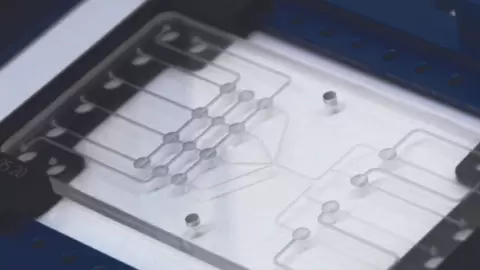
Validated measurement approach for polymer chips
How the Dropometer itself has been validated, and how a polyethylene microfluidics lab used it.
Peer reviewed method
The Dropometer drop shape method is published in Review of Scientific Instruments and Colloids and Surfaces A. Contact angle was validated against a KRUSS DSA100E, with a published accuracy of 0.35°.
See the validation papersCustomer evidence from a microfluidics lab
The IMPACT Lab at the University of Alberta builds microfluidic devices in polyethylene and bought its own Dropometer by July 2022. An MSc thesis from the lab recorded a water drop with SDS under dodecane on metalized polyester moving from 133° at 0 V to 15° at 3.6 V DC, reported as fully repeatable. It is a thesis, not a peer reviewed paper.
Read the citation analysisHow to check wettability on polymer chips
Six steps per treatment run. Keep every step identical between runs.
1
Prepare coupons
Cast or mold flat coupons of the same polymer and lot as the chip, and clean them the same way.
2
Baseline
Measure an untreated coupon to set the native angle for this lot.
3
Treat together
Treat the coupon in the same plasma or coating run as the chips, next to them.
4
Measure at once
Read the coupon within a locked time after treatment, using fresh spots.
5
Measure at use
Read again at the time of bonding or use, and log the hours since treatment. Our capillary number entry explains why wetting sets filling.
6
Record
Log polymer, treatment, timing and results. Our guide to the best contact angle goniometer for industrial QA covers routine use.
Download the microfluidic channel wettability SOP
A two page SOP you can adapt for your chips, with the coupon and timing lock, decision rules, a troubleshooting table and a record sheet.
Contact angle measurement with the Dropometer
Report a correction
Spotted an issue in this summary? Send a correction request and our team will review it.
Correction Request
We work hard to keep this page accurate and up to date. If you spot an error (wrong revision/year, missing requirement, incorrect interpretation, or broken link), tell us and we'll review it.
Contact us to report a correctionReferences
1.
Kim, Chaudhury, Owen. Hydrophobic recovery of polydimethylsiloxane elastomer exposed to partial electrical discharge. Journal of Colloid and Interface Science 226:231 to 236, 2000. https://www.lehigh.edu/~mkc4/our%20papers/Kim%202000_JCIS.pdf
2.
Elvira, Gielen, Tsai, Nightingale. Materials and methods for droplet microfluidic device fabrication. Lab on a Chip, 2022. https://pubs.rsc.org/en/content/articlehtml/2022/lc/d1lc00836f
3.
Trantidou et al. Microsystems and Nanoengineering 3:16091, 2017. https://discovery-pp.ucl.ac.uk/id/eprint/1558843/1/micronano201691.pdf
4.
Jahangiri, Hakala, Jokinen. Long term hydrophilization of polydimethylsiloxane (PDMS) for capillary filling microfluidic chips. Microfluidics and Nanofluidics 24:2, 2020. https://aaltodoc.aalto.fi/items/846d3c86-0db5-443d-82b1-6ca7a2f408d2
5.
Balestrieri et al. Microfluidics and Nanofluidics 29:69, 2025. https://link.springer.com/article/10.1007/s10404-025-02821-8
6.
Hemmila et al. Rapid, simple and cost effective treatments to achieve long term hydrophilic PDMS surfaces, 2012. https://trepo.tuni.fi/bitstream/10024/125558/1/hemmila_rapid_simple_and_cost_effective_treatments.pdf
7.
O'Brien et al. Systematic characterization of hydrophilized polydimethylsiloxane. arXiv 2007.09138, 2020. https://arxiv.org/abs/2007.09138
8.
Dawaymeh et al. Polymers 13(14):2305, 2021. https://www.mdpi.com/2073-4360/13/14/2305/htm
9.
Scheicher et al. Patterned surface activation of cyclo olefin polymers for biochip applications. Periodica Polytechnica Chemical Engineering 58(1):61 to 67, 2014. https://pp.bme.hu/ch/article/download/7203/6191
10.
Ozgen, Aksoy, Hasirci, Hasirci. Surface characterization and radical decay studies of oxygen plasma treated PMMA films. Surface and Interface Analysis 45(4):844 to 853, 2013. https://avesis.hacettepe.edu.tr/yayin/27dc3c1d-219a-47d9-ae94-767f13b15964/surface-characterization-and-radical-decay-studies-of-oxygen-plasma-treated-pmma-films
11.
Lin, Pfeiffer, Lillehoj. RSC Advances 7:37374 to 37379, 2017. https://pubs.rsc.org/en/content/articlepdf/2017/ra/c7ra07435b
12.
Sowers et al. Capillary driven flow of polydimethylsiloxane in open rectangular microchannels. Soft Matter 12:5818 to 5823, 2016. https://faculty.engineering.asu.edu/jagan/wp-content/uploads/sites/18/2016/11/Soft_Matter.pdf
13.
Abate et al. Photoreactive coating for high contrast spatial patterning of microfluidic device wettability. Lab on a Chip 8(12):2157 to 2160, 2008. https://pubs.rsc.org/en/content/articlehtml/2008/lc/b813405g
14.
Sun, X. Polyethylene based microfluidic system approaches to achieve adaptive visible and thermal camouflage applications. MSc thesis, University of Alberta, 2023. See our citation analysis. https://dropletlab.com/validation/citations/analysis/polyethylene-based-microfluidic-system-approaches-to-achieve-adaptive-visible-and-thermal-camouflage-applications/
15.
University of Alberta case study: two departments, one electrowetting result. See the case study. https://dropletlab.com/validation/case-studies/university-of-alberta-electrowetting-contact-angle/
16.
ASTM D7334-08(2022). Surface wettability of coatings, substrates and pigments by advancing contact angle measurement. https://store.astm.org/d7334-08r22.html
17.
ISO 19403-2:2024. Paints and varnishes, wettability, part 2: determination of the surface free energy of solid surfaces by measuring the contact angle. https://www.iso.org/standard/87262.html
18.
Chen, X. et al. Contact angle measurement with a smartphone. Review of Scientific Instruments 89(3):035117, 2018. https://pubs.aip.org/aip/rsi/article-abstract/89/3/035117/368179/Contact-angle-measurement-with-a-smartphone
19.
Surface tension measurement with a smartphone using a pendant drop. Colloids and Surfaces A: Physicochemical and Engineering Aspects. https://www.sciencedirect.com/science/article/abs/pii/S0927775717307744