
Contents
Surfactants, CMC, Emulsions and Foams

Transformer Oil Testing: Trend Oil Interfacial Tension to See Insulating Oil Degradation Early

Interfacial tension falls as transformer oil ages and polar oxidation products build up. Trend it on each oil sample with a quick pendant drop screen between formal laboratory tests, so the units that need full analysis and oil maintenance are found sooner.
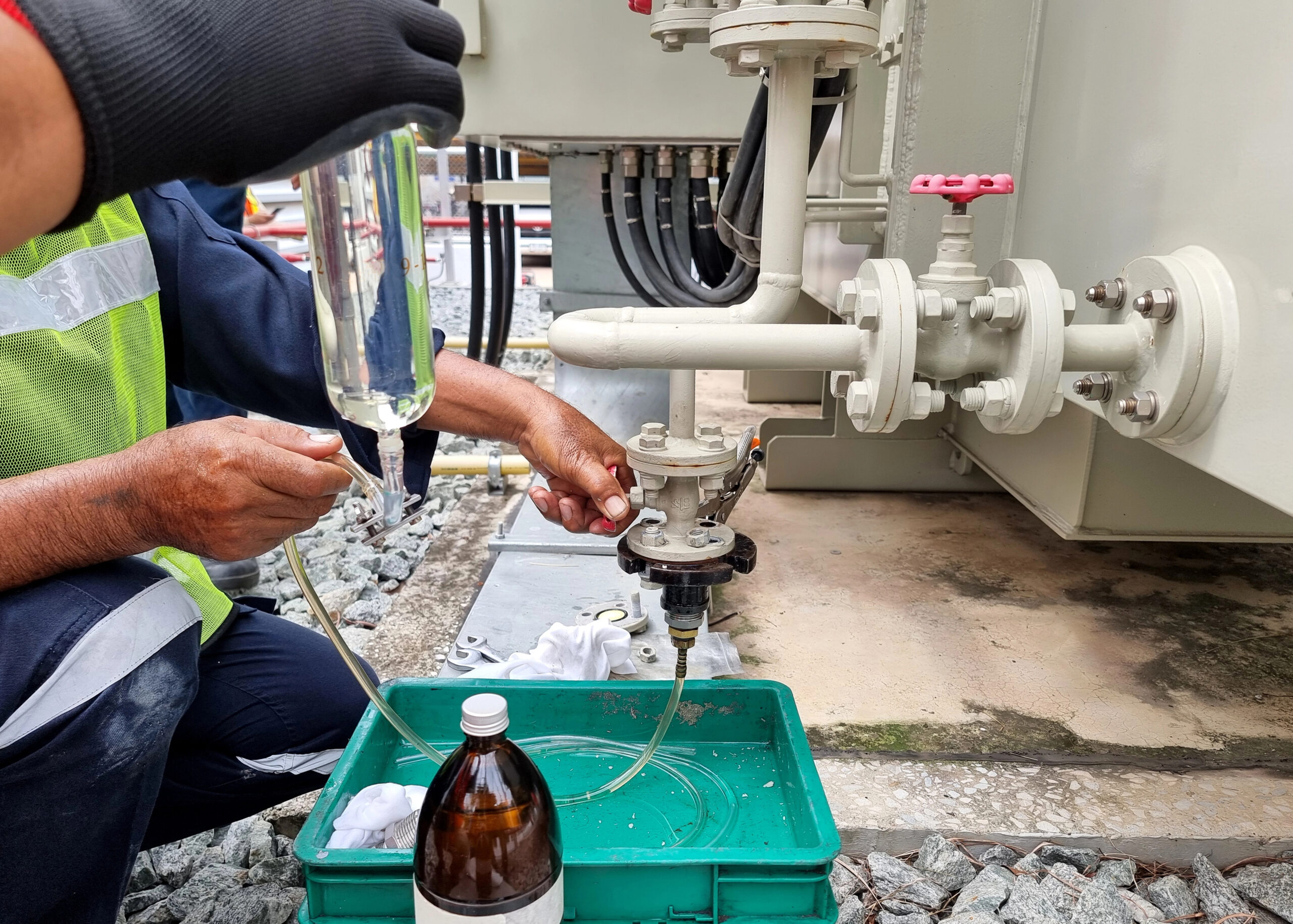

Who this is for: Utility and industrial transformer maintenance teams, oil testing laboratories, oil reclamation services and insulating oil suppliers.

Where it fits: Screening and trending oil samples between ring method laboratory tests, and comparing new, in service and reclaimed oil.

What it does not do: It does not give ASTM D971 or IEC 62961 compliance results, or measure acidity, moisture, breakdown voltage or dissolved gases.

Method
Pendant drop interfacial tension, water drop in oil, at a locked drop age
Standard
Optical screen; ASTM D971 and IEC 62961 ring methods remain the reference for reported results
Setup
About 2 minutes
Abhimanyu Photo
Written by
Abhimanyu Bhandankar
Holds an MBA from Schulich School of Business and a BE in IT. He joined Droplet Lab in July 2019 and now leads sales and marketing.
CEO at Droplet Lab
Read More

Droplet-Lab logo
Technical Review by
Droplet Lab Team
Droplet Lab builds precision instruments and software for surface science measurement, specialising in contact angle analysis and surface tension characterisation. Used by researchers across materials science, pharmaceuticals, coatings, and advanced manufacturing, Droplet Lab's Dropometer has contributed to studies published in peer-reviewed journals including Advanced Functional Materials (Impact Factor 19). The team combines instrument engineering with deep domain knowledge in wettability science with a focus on practical accuracy.
Read More

Abhimanyu Photo
Written By

Abhimanyu Bhandankar

CEO at Droplet Lab

Holds an MBA from Schulich School of Business and a BE in IT. He joined Droplet Lab in July 2019 and now leads sales and marketing.

Droplet-Lab logo
Reviewed By

Droplet Lab Team

Droplet Lab builds precision instruments and software for surface science measurement, specialising in contact angle analysis and surface tension characterisation. Used by researchers across materials science, pharmaceuticals, coatings, and advanced manufacturing, Droplet Lab's Dropometer has contributed to studies published in peer-reviewed journals including Advanced Functional Materials (Impact Factor 19). The team combines instrument engineering with deep domain knowledge in wettability science with a focus on practical accuracy.

Why it matters

Why oil interfacial tension matters

40 to 50 mN/m

interfacial tension of good clean transformer oil against water, according to a peer reviewed review of insulation diagnostic techniques.

N'cho et al., Energies 9(5):367, 2016 (review figure)

About 22 mN/m

is where sludging begins, the same review notes, and it recommends reclaiming the oil when interfacial tension falls to about 25 mN/m.

N'cho et al., Energies 9(5):367, 2016 (review figure)

964 major failures

were recorded over 167,459 transformer years in an international survey, with dielectric failures the most significant failure mode.

CIGRE Technical Brochure 642, Transformer reliability survey, 2015

Sources: N'cho J.S., Fofana I., Hadjadj Y., Beroual A., Review of physicochemical based diagnostic techniques for assessing insulation condition in aged transformers, Energies, 2016; CIGRE Working Group A2.37, Transformer reliability survey, Technical Brochure 642, 2015. Review figures are not standard limits; use the limits in the guide your utility follows. Figures come from these sources, not from Droplet Lab measurements.

Quick reference

What this transformer oil screen does and what it does not

A quick reference for transformer maintenance and oil laboratory teams checking fit before reading further.

Evidence Box

Problem this solves

Oil samples sent away and read months later, so falling interfacial tension and rising sludge risk are seen late.

Standards

ASTM D971 and IEC 62961 measure interfacial tension by the ring method. This pendant drop screen supports trending between those tests; it does not replace them.

Peer reviewed method

The Dropometer drop shape method was validated against a KRUSS DSA100E in two peer reviewed papers, in Review of Scientific Instruments and Colloids and Surfaces A.

Customer case study

A University of Waterloo rheology lab uses a Droplet Lab pendant drop tensiometer for surface and interfacial tension, reported in seven publications.

Published research

No published study yet compares pendant drop with the ring method for transformer oil. Build your own correlation first.

Honest limit

Interfacial tension is one oil test among several in any assessment of power transformer condition. Acidity, moisture, breakdown voltage and dissolved gases need their own tests.

Who this is for

What transformer oil question are you trying to answer?

Pick the card closest to your role. Each one points to the part of this page that answers it.

Transformer maintenance engineer

You look after a fleet of oil filled units and want to monitor oil quality between laboratory reports. A quick interfacial tension trend on each oil sample shows which units to send for full transformer oil analysis first.

Use the limits in your own maintenance guide for decisions, not the screen alone.

Oil testing laboratory

You run routine oil analysis for many customers. A pendant drop screen on incoming samples can flag low readings for priority ring method testing, once you have checked how the two methods compare on your oils.

Report ring method values when a standard result is required.

Oil reclamation or supplier QC

You treat aged oil or supply new insulating oil. Interfacial tension before and after treatment shows whether reclaimed oil is back near new oil values.

Compare against new oil of the same type; mineral and ester oils differ.
Fit check

Is this the right screen for your transformer oil?

It trends one sign of oil condition quickly. It does not give a full oil condition report.

Good fit if

You want to trend oil interfacial tension between laboratory tests.
You prioritise many oil samples for full laboratory analysis.
You compare new, in service and reclaimed oil.
You check oil reclamation or treatment results on site.
You teach or study oil and water interfaces.

Less relevant if

You need a ring method result to report against a standard.
You need acidity, water content, dissipation factor or breakdown voltage.
You need dissolved gas analysis to diagnose a transformer fault.
Your oil is too dark to see a clear drop edge.
Summary

How to trend transformer oil degradation with interfacial tension

The answer in under a minute.

Oxidation fills aged transformer oil with polar products that lower its interfacial tension against water. Measure each oil sample by pendant drop at a locked drop age, compare it with the last result for the same unit, and send falling samples for ring method testing and full analysis before sludge forms.

The Dropometer surface tension and interfacial tension kit runs the screen. The ASTM D971 ring method and IEC 62961 remain the reference methods, and our interfacial tension glossary entry and surface tension measurement guide explain the physics. A University of Waterloo rheology lab uses the same pendant drop method, and our utilities guide covers the wider sector.

Expert Quote

Expert perspective on measuring interfaces

The critical micelle concentration is not a number you look up; it is where the surface-tension curve flattens, and the only honest way to know it is to measure it.

Dr. Alidad Amirfazli

Professor, Department of Mechanical Engineering, York University; Co-founder, Scientific Advisor, Droplet Lab

The problem

Why transformer oil degradation is hard to catch early

In a power transformer, mineral oil and paper insulation work together as the transformer insulation. The oil must insulate, cool and carry information about the condition of the oil and the solid insulation around it. During the ageing process, heat, oxygen and moisture drive oxidation; thermal stress speeds it up. Oxidation produces acids and polar compounds that dissolve in the oil, lower its interfacial tension against water and later form sludge on windings and cellulose paper. Degradation of oil shortens transformer life and the service life of the cellulose, and sludge can reduce cooling and transformer performance. Utilities run regular testing of oil samples for acidity, moisture content, breakdown voltage, dielectric strength, dissipation factor and dissolved gases, alongside interfacial tension by the ring method in ASTM D971 or IEC 62961. A peer reviewed review puts good clean oil at 40 to 50 mN/m and notes that sludging begins near 22 mN/m. The difficulty is time. Samples go to an outside laboratory, results return weeks later, and many units are tested only once a year, so a fast fall in interfacial tension can be missed between tests. Teams need a quick way to see which units are degrading so that the right oil samples are tested first.

Oil color darkens between sampling rounds.
Interfacial tension falls while acidity rises.
Sludge appears on windings, radiators or the tank floor.
Laboratory results arrive weeks after the oil sample was taken.
Reclaimed oil reads below new oil of the same type.
Troubleshooting

Why transformer oil IFT readings mislead and what to do

Why:

  • Oxidation creates acids and polar compounds that move to the oil and water interface and lower interfacial tension.

How to detect:

  • Interfacial tension falls as acid number rises; N'cho and colleagues note a definite relationship between the two.

Corrective action:

  • Send the oil sample for full laboratory analysis and plan oil treatment, reclamation or replacement under your maintenance guide.

Why:

  • Interfacial tension keeps falling as polar compounds reach the interface, so readings depend on time. The ASTM D971 ring reading is taken within about 60 s; IEC 62961 records it near 180 s.

How to detect:

  • The same oil reads lower when measured later in the drop's life.

Corrective action:

Read every sample at the same drop age. Our guide to reproducible surface tension measurement covers timing.

Why:

  • Dirty bottles, wrong caps, light and air exposure, or carry over from the last sample add surface active contaminants.

How to detect:

  • One sample reads low against its unit's trend while others are steady.

Corrective action:

  • Resample in clean glass bottles with your standard sampling procedure and clean the cell and needle between samples.

Why:

  • Pendant drop needs the density difference between water and oil at the test temperature; a wrong value shifts every reading.

How to detect:

  • New oil reads well away from its supplier value.

Corrective action:

  • Measure or look up densities at the test temperature and hold temperature steady.

Why:

  • Heavily aged oil can be dark, which lowers image contrast at the drop edge.

How to detect:

  • Edge detection is patchy or the fit residual rises.

Corrective action:

  • Improve backlighting, check the fit on your darkest oils, and send those samples straight to the laboratory if the edge is unclear.

Why:

  • Mineral oil, natural esters and synthetic esters start at different interfacial tension values and age differently.

How to detect:

  • Units with similar age give very different readings.

Corrective action:

  • Set baselines and bands separately for each oil type.

Not sure the screen will track your laboratory results?

Send a few oil samples with ring method results, and we will compare them on a call.

Lab records

What a transformer oil screening record contains

Each result produces a record you can file in your asset management system next to laboratory results. It can feed into your existing maintenance records.

Unit and sample

Transformer, voltage class, oil type, sampling point, date and oil temperature.

Method settings

Drop configuration, densities, test temperature, drop age and number of drops.

Readings

Interfacial tension per drop, the median and spread, and the change since the last sample.

Laboratory link

The matching ring method, acidity and moisture results when they arrive.

Decision

Next routine sample, send to laboratory, or plan oil treatment.

Drop images

Automatic edge and baseline detection gives the same reading from the same image, so a reviewer can recheck any result.

Measurements

What to measure in transformer oil

Trend

Oil interfacial tension against water, per unit over time

Why it matters: A falling trend is an early sign of oxidation and polar contaminant build up.

How to interpret: Compare with the same unit's last results and with new oil of the same type. The N'cho review notes about 25 mN/m as a point to reclaim mineral oil; set your bands from the limits in the maintenance guide your utility follows.

When it is not enough: It does not show moisture ingress, dielectric strength or a developing fault.

Reference

Ring method interfacial tension

Why it matters: ASTM D971 and IEC 62961 results are what maintenance guides and contracts refer to.

How to interpret: Run ring method tests on a share of samples and compare them with pendant drop readings.

When it is not enough: Ring results at 60 s and 180 s differ, so state which method was used.

Companion

Acidity

Why it matters: Acidity rises as interfacial tension falls; together they describe oil degradation.

How to interpret: The Myers index divides interfacial tension by acidity and falls with age (Mavrikakis and Siderakis, 2025).

When it is not enough: It needs a laboratory titration.

Other tests

Moisture, breakdown voltage and dissolved gas analysis

Why it matters: They cover moisture, dielectric condition and faults that interfacial tension cannot see.

How to interpret: Keep them in your routine oil analysis programme.

When it is not enough: Interfacial tension screening does not replace them.

Validation

Validated measurement approach for oil interfacial tension

How the Dropometer itself has been validated, and where pendant drop tensiometry has been used.

Peer reviewed method

The Dropometer drop shape method is published in Review of Scientific Instruments and Colloids and Surfaces A. Contact angle was validated against a KRUSS DSA100E, with a published accuracy of 0.35°.

See the validation papers

Customer evidence in pendant drop tensiometry

A University of Waterloo rheology lab added a Droplet Lab pendant drop tensiometer in 2024 and reported surface and interfacial tension in seven publications, including oil and water emulsion work. No published study yet compares pendant drop with the ring method for transformer oil, so build your own correlation on your oils first.

Read the case study
QC Protocol

How to screen transformer oil samples by interfacial tension

Six steps per oil sample. Set bands once per oil type.

1

Take the oil sample

Use your standard sampling procedure, clean glass bottles, and protect the sample from light and air.

4

Read at the locked drop age

Read interfacial tension at the same drop age every time, repeat the set number of drops, and record the median. Check new oil against reference values for common liquids.

5

Compare with the trend

Compare with the unit's last result and with your screening bands.

6

Route the sample

Send watch and act samples for ring method testing and full analysis, and record the decision.

We completed our gage R&R study on the unit and it performed very well.

Brandon Barbee

Corporate Quality Engineer, Zeus Industries, Polymer Manufacturing

Download the transformer oil IFT screening SOP

A two page SOP you can adapt for your oils, with the method lock, how to set screening bands against ring method results, a troubleshooting table and a record sheet.

Pendant drop surface tension measurement with the Dropometer

Pendant drop surface tension measurement with the Dropometer

Example output

Example interfacial tension screening log for a transformer fleet

Example data only. Your bands must come from your own maintenance guide and ring method comparison.

How to read this log

Example bands for one mineral oil: normal at or above 32 mN/m, watch from 25 to 32 mN/m, act below 25 mN/m, plus any fall of more than 4 mN/m since the last sample. Unit C dropped fast and goes to the laboratory early. Unit D is near the point where the N'cho review says sludging begins.

Example transformer oil IFT screening log

Unit Oil Last IFT (mN/m) This IFT (mN/m) Change (mN/m) Result
Reference New mineral oil 44 44 0 Reference
A In service 37 36 1 lower Normal
B In service 31 29 2 lower Watch
C In service 34 28 6 lower Send to laboratory
D In service 25 23 2 lower Act

Example data, not customer data. Mineral oil; pendant water drop in oil at 25 °C, read at a fixed drop age, median of 3 drops.

Signal order

The order to check signals on an oil sample

Check these in order. Each one rules out a cause before you look at the next.

1

Sample and oil type

Rules out oil contamination from sampling and mixed oil types.

2

Method settings

Confirms densities, temperature and drop age match the method.

3

New oil reference

Confirms new oil reads as before.

4

Trend for the unit

Shows how fast interfacial tension is falling.

FAQ

Common questions about transformer oil interfacial tension

Questions maintenance teams and oil laboratories ask about IFT screening.

Oxidation creates acids and other polar compounds. They collect at the oil and water interface and lower interfacial tension. N'cho and colleagues note a definite relationship between acid number and interfacial tension: as acidity rises, interfacial tension drops. That is why a falling trend is an early warning of oil degradation and later sludge.

A peer reviewed review puts good clean mineral oil at 40 to 50 mN/m, recommends reclaiming near 25 mN/m and notes sludging begins near 22 mN/m. These are review figures, not standard limits. For decisions, use the limits in IEC 60422, IEEE C57.106 or the guide your utility follows.

No. ASTM D971 and IEC 62961 are ring methods, and only ring results meet them. IEC 62961 includes a drop volume annex, not pendant drop. We found no published study comparing pendant drop with the ring method for transformer oil. Use pendant drop to screen and trend, and our ASTM D2285 page covers the withdrawn drop weight method.

Mostly timing. Interfacial tension keeps falling as polar compounds reach the interface. ASTM D971 reads within about 60 s, IEC 62961 near 180 s, and a pendant drop reading depends on drop age. Lock the drop age, compare with ring results on the same samples, and set your bands from that comparison.

No. Dissolved gas analysis detects faults such as overheating and arcing from the dissolved gases they produce. Interfacial tension tracks oxidation and polar contamination. Keep both, with moisture, acidity, breakdown voltage and dissipation factor, in your routine oil analysis programme.

Yes, as a trend, with care. Ester oils start at different interfacial tension values from mineral oil and age differently, and IEC 62961 chose 180 s partly to separate aged esters. Set baselines and bands per oil type, and do not compare ester results with mineral oil limits.

Yes. Measure the oil before and after reclamation, and compare reclaimed oil with new oil of the same type. A reading close to new oil shows the polar compounds were removed. Confirm the result with ring method interfacial tension and acidity before the oil returns to service.

Business impact

What changes when you trend oil interfacial tension

Typical changes in how teams work. Benchmarks are given only where a published source exists.

Before and with transformer oil IFT screening

Metric Before Dropometer With Dropometer Indicative Benchmark
Time to a reading Weeks for an outside laboratory Minutes per sample on site or in house No published benchmark; track on your own samples
Sample priority Every sample treated the same Falling samples sent first No published benchmark; track on your own fleet
Oil treatment timing Planned from annual results Planned from the trend Reclaim near 25 mN/m; sludging near 22 mN/m (N'cho et al., 2016, review)
Fleet condition Annual snapshot Trend between laboratory tests 70% acceptable, 12% fair, 18% poor in one 150 kV fleet (Mavrikakis and Siderakis, 2025)

See the screen on your own oil samples

Send a few samples with ring method results. We will show the comparison on a call.

Estimate the value of earlier oil intervention

Enter your own numbers. The result is an estimate, not a Droplet Lab claim.

Earlier oil intervention estimate

Estimate avoided cost from oil problems caught earlier.

Each Dropometer unit is $5,000; the default models 1 unit.
Your own average cost of urgent sampling, treatment or outage for one unit.
No published benchmark. Use your own records; start low if unsure.
Extra cost when sludge or late treatment is found, from your own records.

Result

~0
Monthly savings
~0
Payback period
~0
First year net benefit

Monthly savings = preventable rework cost + preventable scrap cost + other monthly savings.

Limits

What interfacial tension cannot tell you about a transformer

Honest limits, so you know when to reach for another test.

It does not give ASTM D971 or IEC 62961 results.
Readings depend on drop age; lock it.
It needs correct densities at the test temperature.
Very dark oils can make the drop edge hard to detect.
It does not detect faults; keep dissolved gas analysis.
Bands must be set per oil type from your own comparison.

Pendant drop interfacial tension trends oil oxidation and polar contamination quickly. Compliance results, acidity, moisture, dielectric condition, faults and the state of the paper need their own tests.

How this page was created

Editorial and technical transparency notes for this page.

Transparency Details 4 checklist items
01

Drafting assistance

Drafted with Claude Opus 5.5 (Anthropic) using web search for sources, then edited by the Droplet Lab team.

02

Technical review

Reviewed and edited for technical accuracy by the Droplet Lab Team.

03

Verification steps

Standard identifiers, units, thresholds and key procedural claims are checked against cited sources before publication.

04

Updates

Reviewed every 12 months or when the underlying method changes.

Report a correction

Spotted an issue in this summary? Send a correction request and our team will review it.

Correction Request

We work hard to keep this page accurate and up to date. If you spot an error (wrong revision/year, missing requirement, incorrect interpretation, or broken link), tell us and we'll review it.

Contact us to report a correction
Sources

References

1.
N'cho, J.S., Fofana, I., Hadjadj, Y., Beroual, A. Review of physicochemical based diagnostic techniques for assessing insulation condition in aged transformers. Energies 9(5):367, 2016. https://doi.org/10.3390/en9050367
2.
CIGRE Working Group A2.37. Transformer reliability survey. Technical Brochure 642, 2015. https://e-cigre.org/publication/642-transformer-reliability-survey
3.
Mavrikakis, N., Siderakis, K. Effects of aging on condition of in service transformer oil: the study case of 150 kV/20 kV substations in Crete. Energies 18(18):4900, 2025. https://doi.org/10.3390/en18184900
4.
Hadjadj, Y., Fofana, I., Sabau, J., Briosso, E. Assessing insulating oil degradation by means of turbidity and UV/VIS spectrophotometry measurements. IEEE Transactions on Dielectrics and Electrical Insulation 22(5):2653 to 2660, 2015. https://doi.org/10.1109/TDEI.2015.005111
5.
Abu Bakar, N., Abu Siada, A., Islam, S., El Naggar, M. A new technique to measure interfacial tension of transformer oil using UV Vis spectroscopy. IEEE Transactions on Dielectrics and Electrical Insulation 22(2):1275 to 1282, 2015. https://doi.org/10.1109/TDEI.2015.7076831
6.
Elele, U. et al. Oil quality index model verification and validation using total acid number and interfacial tension experimental data. IEEE Transactions on Dielectrics and Electrical Insulation 31(3):1340 to 1349, 2024. https://doi.org/10.1109/TDEI.2024.3357665
7.
Wang, Z.D., Liu, Q., Tee, S.J. Prognosis of transformer health through oil data analysis. TechCon Euro, 2013. https://research.manchester.ac.uk/en/publications/prognosis-of-transformer-health-through-oil-data-analysis/
8.
ASTM D971-20. Standard test method for interfacial tension of insulating liquids against water by the ring method. See our ASTM D971 page. https://store.astm.org/d0971-20.html
9.
IEC 62961:2018. Insulating liquids: test methods for the determination of interfacial tension of insulating liquids, determination with the ring method. See our IEC 62961 page. https://webstore.iec.ch/publication/27653
10.
IEC 60422:2024. Mineral insulating oils in electrical equipment: supervision and maintenance guidance. https://webstore.iec.ch/en/publication/66421
11.
IEEE C57.106-2015 (inactive reserved). IEEE guide for acceptance and maintenance of insulating mineral oil in electrical equipment. https://standards.ieee.org/ieee/C57.106/5361
12.
ASTM D2285-99 (withdrawn 2008). Interfacial tension of electrical insulating oils of petroleum origin against water by the drop weight method. https://store.astm.org/d2285-99.html
13.
Chen, X. et al. Contact angle measurement with a smartphone. Review of Scientific Instruments 89(3):035117, 2018. https://pubs.aip.org/aip/rsi/article-abstract/89/3/035117/368179/Contact-angle-measurement-with-a-smartphone
14.
Surface tension measurement with a smartphone using a pendant drop. Colloids and Surfaces A: Physicochemical and Engineering Aspects. https://www.sciencedirect.com/science/article/abs/pii/S0927775717307744