


Contents
Partially compliant

ASTM D2285 (withdrawn): test method for interfacial tension of electrical insulating oils of petroleum origin against water

ASTM D2285 measured the interfacial tension between petroleum based insulating oil and water by the drop weight method, as a fast field check on oil ageing. ASTM withdrew it in 2008 with no replacement. With the optional cuvette, the Dropometer measures the same property by pendant drop. Pendant drop is an alternative method, not the drop weight method the standard specifies: if a contract or customer requires an ASTM D2285 result, run a correlation study on your own samples first.

What brings you here?

Who this is for
Utilities, field crews and oil testing labs that screened insulating oil with ASTM D2285, and teams that need a replacement field check.
Compliance tier
Partially compliant: the Dropometer measures oil and water interfacial tension by pendant drop with the optional cuvette, an alternative method to the drop weight method the standard specifies.
Standard status
ASTM D2285-99 was withdrawn in 2008 with no replacement (ASTM listing).
Setup
About 2 minutes. Battery powered, 1 kg, runs on a field bench or beside your ring tensiometer.
Last updated
October 23, 2026

Free one page checklist for oil against water by pendant drop, written for teams moving off ASTM D2285: what to prepare, how to set up the optional cuvette, which drop age to lock and what to record.

Talk to an expert

Book a 15 minute demo on your own oils

Tell us your oils, how you screened them under ASTM D2285 and how you test today. We will run a pendant drop of oil and water in the optional cuvette live and show where a ring result still applies.

Book a 15 minute demo
View the official standard
Gurdeep-Saini-Photo
Written by
Gurdeep Singh Saini
Holds a BASc in Mechanical Engineering from Ryerson University (now Toronto Metropolitan University) and an MASc from York University. He develops the automatic edge and baseline detection behind the Dropometer's analysis.
COO at Droplet Lab
Read More
Droplet-Lab logo
Technical Review by
Droplet Lab Team
Droplet Lab builds precision instruments and software for surface science measurement, specialising in contact angle analysis and surface tension characterisation. Used by researchers across materials science, pharmaceuticals, coatings, and advanced manufacturing, Droplet Lab's Dropometer has contributed to studies published in peer-reviewed journals including Advanced Functional Materials (Impact Factor 19). The team combines instrument engineering with deep domain knowledge in wettability science with a focus on practical accuracy.
Read More
Verified against ASTM D2285
Gurdeep-Saini-Photo
Written By

Gurdeep Singh Saini

COO at Droplet Lab

Holds a BASc in Mechanical Engineering from Ryerson University (now Toronto Metropolitan University) and an MASc from York University. He develops the automatic edge and baseline detection behind the Dropometer's analysis.

Droplet-Lab logo
Reviewed By

Droplet Lab Team

Droplet Lab builds precision instruments and software for surface science measurement, specialising in contact angle analysis and surface tension characterisation. Used by researchers across materials science, pharmaceuticals, coatings, and advanced manufacturing, Droplet Lab's Dropometer has contributed to studies published in peer-reviewed journals including Advanced Functional Materials (Impact Factor 19). The team combines instrument engineering with deep domain knowledge in wettability science with a focus on practical accuracy.

Evidence box: the ASTM D2285 standard test method

Standard

ASTM D2285-99, Standard Test Method for Interfacial Tension of Electrical Insulating Oils of Petroleum Origin Against Water by the Drop Weight Method, from ASTM International Committee D27. ASTM lists it as withdrawn in 2008 with no replacement. See the ASTM listing.

Compliance tier

Partially compliant. With the optional cuvette, the Dropometer measures oil against water interfacial tension by pendant drop, the property D2285 reported by drop weight. It is an alternative method. A required D2285 result needs a correlation study on your own samples; a current reported result needs a ring tensiometer to ASTM D971 or IEC 62961.

Instrument performance

Interfacial tension by pendant drop with the optional cuvette: the datasheet gives no accuracy or range for it. Surface tension against air, used for the test water screen, runs up to 75 mN/m with ±0.03 mN/m accuracy and 0.01 mN/m resolution, static and dynamic (Dropometer product specification). No temperature control: it runs at 10 to 45 °C.

Peer reviewed method

The drop shape method is validated against a KRUSS DSA100E in two peer reviewed papers. See our validation publications.

Customer evidence

We have no published client paper or case study on insulating oil yet. A university shared research facility uses the Dropometer for liquid in liquid work like the optional cuvette setup: pendant drop interfacial tension of lipid solutions in mineral oil against buffer. Read the case study.

What it does not tell you

A pendant drop value from the optional cuvette is not a drop weight value or a ring value. It tracks the same property, but the offset to old D2285 records or to ring results comes only from a correlation study on your own oils.
Executive summary: electrical insulating oils against water

What this withdrawn standard measured, who used it and where the Dropometer fits

ASTM D2285 measured the interfacial tension of petroleum based electrical insulating oil against water by the drop weight method, a quick field check for polar ageing products and contaminants. ASTM withdrew it in 2008 with no replacement. Utilities and field crews used it to screen oil in service between full lab tests. For the term itself, see the interfacial tension glossary entry.

In a drop weight test, drops of one liquid form at a tip inside the other and fall away when their weight overcomes the interfacial tension holding them. The size of each falling drop gives the tension after a correction factor. The last edition, D2285-99, read the value under non equilibrium conditions and notes it may not suit highly viscous fluids. Its apparatus, drop rate, temperature and calculation are as the standard specifies.

The Dropometer pendant drop tensiometer is partially compliant here. With the optional cuvette it measures the same property, oil against water interfacial tension, by pendant drop: it fits the shape of one hanging drop instead of weighing falling ones. Pendant drop is an alternative method, not the drop weight method the standard specifies. If a contract or customer requires an ASTM D2285 result, run a correlation study on your own samples first.

Because D2285 is withdrawn, a reported result today usually names the ring method in ASTM D971 or IEC 62961. For trending oil between those lab tests, see screening insulating oil ageing by pendant drop. The Dropometer also screens your test water: surface tension against air up to 75 mN/m with ±0.03 mN/m accuracy (Dropometer product specification). Bench habits are in reproducible surface tension measurement, with water values in our surface tension reference values for common liquids.

For the wider picture, read the electrical and electronics guide, the surface tension measurement guide and why water forms droplets in oil but oil spreads in water. A university shared research facility uses the Dropometer for liquid in liquid work, the setup the optional cuvette serves: pendant drop interfacial tension between oil and aqueous phases.

Further reading: the oil and water classroom experiment and choosing a tensiometer for surfactant and CMC research.

How the Dropometer fits the interfacial test for insulating oils

Oil against water by pendant drop, step by step, for teams that used ASTM D2285

From oil sample to a trended value, with the Dropometer and the optional cuvette

These steps show how the Dropometer measures oil against water by pendant drop, and where a ring result still applies. They do not reproduce ASTM D2285, which is withdrawn. For a reported result, buy the current edition of ASTM D971 or IEC 62961 and follow its timing, temperature and water rules.

Withdrawn 2008

ASTM D2285 status

No replacement, per the ASTM listing. Current reported results use ASTM D971 or IEC 62961.

Optional cuvette

Oil against water

Oil against water by pendant drop in the optional cuvette.

About 2 min

Setup

Base plate, phone holder, LED, syringe and cuvette. Battery powered, no PC needed.

1

Take the oil sample and its densities

Draw the oil into a clean, dry container using your usual sampling practice for electrical insulating oil. Keep it sealed and out of light until you test it. Record the equipment, date, oil type and the oil and water densities: the drop shape fit needs both.

2

Screen the test water

Hang pendant drops of the test water in air and read the surface tension against an accept band set from clean water in your own room. A low reading points to contaminated water or glassware. Clean the syringe, needle and cuvette as described in sample preparation and contamination control.

3

Set up the optional cuvette

For clear, new oil, fill the optional cuvette with oil and hang a water drop from a straight needle, because water is denser. For dark aged oil, fill the cuvette with water and release an oil drop upward from an upturned needle, so the light path stays in clear water. Use one setup for the whole trend.

4

Read at one fixed drop age

Form the drop, start the timer and record tension against drop age. D2285 read the value under non equilibrium conditions, so pick one drop age and keep it. Reading at 60 s lets your values sit beside ASTM D971 ring results. Repeat on several fresh drops and reject any with a poor fit or a bubble.

5

Correlate before you compare

Pendant drop is an alternative method, not the drop weight method ASTM D2285 specifies. Before you compare with old D2285 records or ring based limits, measure a set of retained or shared oils both ways. For a reported result, run a ring tensiometer to ASTM D971 or IEC 62961.

6

Record and trend

Record the drop orientation, drop age, mean and spread, water screen result, room temperature and sample details. Compare with the unit's earlier pendant drop results and your maintenance limits. For bench habits, see reproducible surface tension measurement.

7

Watch the full measurement

This video shows a complete Dropometer pendant drop surface tension measurement, from setup to result. It covers the steps above in one run.

Dropometer pendant drop surface tension, start to finish.

Validated measurement approach

Independent benchmarking and publication-based validation references.

Peer reviewed method

The Dropometer drop shape method is validated against a KRUSS DSA100E in two peer reviewed papers, one in Review of Scientific Instruments and one in Colloids and Surfaces A.

Read the validation papers

Customer evidence

We have no published client paper or case study on insulating oil yet. A university shared research facility uses the Dropometer for liquid in liquid work like the optional cuvette setup, including pendant drop interfacial tension between oil and aqueous phases, and for contact angle work across several labs.

Read the case study

Set limits from your oil plan, and correlate before you compare

ASTM D2285 · legacy drop weight records · oil condition

The public scope of ASTM D2285 sets no pass or fail value for the oil. Limits come from your oil specification or maintenance guide. IEC 60422 Ed. 5.0 (2024), the IEC guide for mineral oils in service, cites IEC 62961 and ASTM D971 for this test, not D2285 (source: IEC 60422 Ed. 5.0 preview).

As one lab's published guide, OELCHECK lists at least 40 mN/m for mineral oil as delivered and at least 35 mN/m for oil from a new system. Its floors for usable oil in service are 22 mN/m inhibited, 20 mN/m uninhibited and 18 mN/m for ester based oil (source: OELCHECK interfacial tension guide). These are ring based values. Neither drop weight nor pendant drop results map onto them directly, so check the offset in your own correlation study.

Keep old D2285 field records as their own trend. Drop weight reads falling drops and pendant drop reads one hanging drop at a set age, so the two can give different numbers on the same oil. Join the trends only through a correlation on retained or shared samples.

IEC 62961 shows the model to copy. Its informative Annex A gives a drop volume method, a close relative of drop weight, and a correlation between it and the ring (source: IEC 62961 preview).

The datasheet gives no accuracy or range for the optional cuvette's interfacial tension readings. Set your own repeatability from replicate drops on a reference oil, and recheck it with each new batch of test water.

Example output

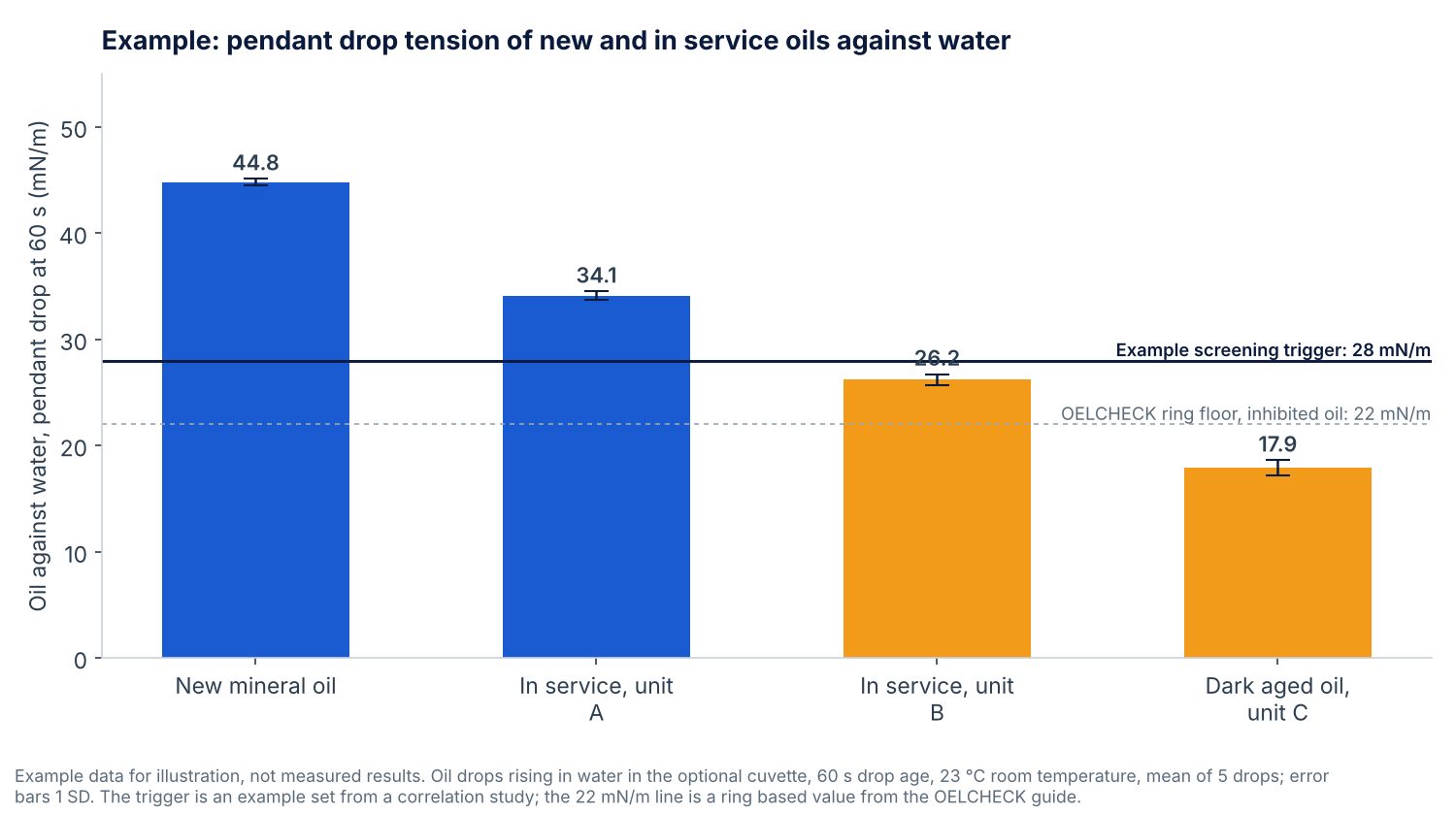
Example data for illustration only. These are not measured results. Your own oils, room conditions, correlation study and limits decide the numbers.

Example: new and in service insulating oils, pendant drop against water in the optional cuvette

Oil sample Drops (n) Mean at 60 s drop age (mN/m) Std dev (mN/m) Screen result Next step
New mineral oil, as delivered544.80.3Above triggerBaseline for the unit's trend
In service oil, unit A534.10.4Above triggerKeep the normal sampling interval
In service oil, unit B526.20.5Below triggerSend for a ring test to ASTM D971
Dark aged oil, unit C517.90.7Below trigger and ring floorConfirm by ring, then act per your guide

How to read this table

Each row is the mean of five oil drops rising in water from an upturned needle in the optional cuvette, read at a 60 s drop age at 23 °C room temperature. The screening trigger of 28 mN/m is an example, set from a correlation study against ring results. The 22 mN/m floor for inhibited oil in service comes from the OELCHECK guide and is a ring value.

Example output chart

The same example data as the table, plotted against an example screening trigger and a ring based floor for inhibited oil in service.

Bar chart of example pendant drop oil against water tension for four oils, falling from about 45 mN/m for new oil to about 18 mN/m for dark aged oil, with an example 28 mN/m screening trigger and a 22 mN/m ring based floor

Example data, not measured results.

Business impact

What changes when a withdrawn field check becomes a pendant drop trend

Metric Before Dropometer With Dropometer Results
Field screen of oil in service Drop weight check to a method withdrawn in 2008 Pendant drop with the optional cuvette at a fixed drop age No published benchmark
Record A calculated value from falling drops Drop image and tension against drop age saved per sample No published benchmark
Reported standard result ASTM D2285, now withdrawn with no replacement Ring to ASTM D971 or IEC 62961, or your own correlation study ASTM D2285-99 listing
Test water check Not part of a quick field screen Each water batch screened by pendant drop, ±0.03 mN/m surface tension accuracy Dropometer product specification

See it on your own oils

Bring a new oil, an aged one and your test water. We will measure them live with the optional cuvette and show where a ring result still applies.

ROI estimate

Estimate the cost of the oil problems a bench trend can catch early

Enter your own numbers. The defaults are examples, not Droplet Lab results.

Quality cost snapshot

Estimate what wetting related failures cost you.

Example only. Use what you see in a trial on your own samples.
Your own figure.
Your own estimate.

Result

~0
Estimated annual cost today
~0
Estimated annual cost avoided
~0
Payback period

Annual exposure combines audit/CAPA cost, customer rejections, and recall probability; avoided exposure applies the risk reduction percentage.

Method settings for petroleum insulating oils

Lock these before you compare results between runs, sites or methods

Parameter Recommended Setting Technical Rationale
Liquid pair Petroleum based electrical insulating oil against water This was the scope of ASTM D2285. It notes the method may not suit highly viscous fluids.
Method Standard: drop weight. Dropometer: pendant drop with the optional cuvette Pendant drop is an alternative method, not the drop weight method the standard specifies. Correlate before you compare.
Standard status ASTM D2285-99, withdrawn 2008, no replacement For a reported result today, use the ring method in ASTM D971 or IEC 62961.
Drop orientation Water drop in clear oil, or oil drop rising in water for dark oil, as the sample allows The camera must see a sharp drop edge. Light through clear water keeps contrast when aged oil is dark.
Drop age One fixed age for every drop, for example 60 s to match ASTM D971 The value falls as ageing products reach the interface, so readings at different ages do not compare.
Densities Oil and water densities at test temperature, measured or from your records The drop shape fit uses the density difference. Drop weight calculations use densities too.
Temperature As the standard specifies, or as your current method sets Tension falls as temperature rises. The Dropometer has no temperature control, so condition the liquids and record room temperature.
Fit model and replicates Young-Laplace, the same for every run; several fresh drops per sample One drop cannot show spread.

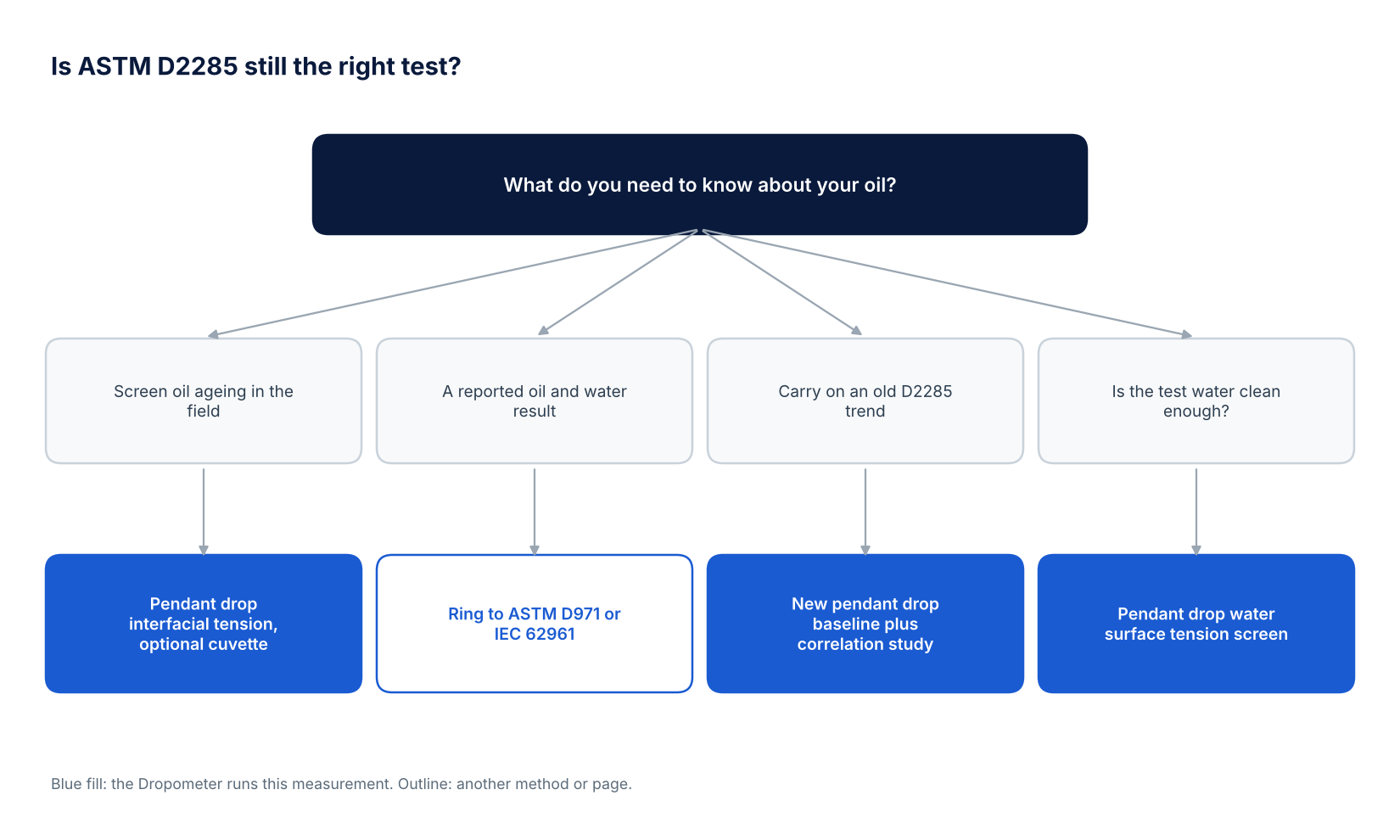
Is ASTM D2285 still the right test?

Pick the method by the question you need answered

Start: What do you need to know about your insulating oil?

Screen oil ageing in the field or at the bench

Signals:

You used D2285 as a quick check and want oil and water tension on more samples, more often.

Rule-out:

Measure it by pendant drop with the Dropometer and the optional cuvette, at one fixed drop age. See screening insulating oil ageing.

A reported oil and water result

Signals:

A contract, customer or utility needs a standard result, and D2285 is withdrawn.

Rule-out:

Use a ring tensiometer to ASTM D971 or IEC 62961. Use pendant drop in its place only after a correlation study on your own oils.

Carry on a D2285 trend

Signals:

You hold years of drop weight results and want new values on the same chart.

Rule-out:

Start a new pendant drop baseline and run both methods on retained or shared samples. Join the trends only through that correlation.

Is the test water clean enough?

Signals:

Results drift and you suspect the water or glassware, not the oil.

Rule-out:

Screen the water by pendant drop in air with the Dropometer. See surface tension measurement.

Decision tree at a glance

Start from the question you need answered. Blue boxes are measurements the Dropometer runs. A reported ring result to the standard is not one of them.

Decision tree showing that field screening by pendant drop with the optional cuvette, a new baseline with a correlation study and the test water screen run on the Dropometer, while a reported result needs a ring tensiometer to ASTM D971 or IEC 62961

Is ASTM D2285 still the right test?

Interpreting results

What the oil and water value tells you, and what it does not

Lower value, more polar compounds: ASTM describes the D2285 value as a sign of hydrophilic compounds from contamination, oil oxidation or ageing of materials in contact with the oil. A falling trend points to ageing oil.
Drop weight and pendant drop can differ: Falling drops and one hanging drop see the interface for different times. Use your correlation study before you compare a cuvette result with an old D2285 value.
Drop age changes the number: The value falls as ageing products reach the interface, most of all in aged oil. Keep one drop age per trend.
A low water reading voids the run: Water below its band means contaminated water or glassware. Fix that before you test oil, or the oil value reads low.
Oil surface tension is not the oil and water value: Ageing products gather at the oil and water boundary. The oil's surface tension against air is a different quantity.
Expert perspective

Why drop age and method matter for oil and water values

The critical micelle concentration is not a number you look up; it is where the surface-tension curve flattens, and the only honest way to know it is to measure it.

Dr. Alidad Amirfazli

Department of Mechanical Engineering, York University, Co-founder and Scientific Advisor, Droplet Lab

Common pitfalls and limits

Honest limits of the method and of the Dropometer

Pendant drop with the optional cuvette is an alternative method, not the drop weight method ASTM D2285 specifies. Correlate before you report it against D2285 records.
ASTM D2285 is withdrawn. Do not quote it as the current method in a new procedure or contract.
For the optional cuvette, no interfacial tension accuracy or range is published. Do not borrow the surface tension accuracy figure for it.
Dark aged oil lowers edge contrast when you look through it. Use an oil drop rising in water where the sample allows, or send unclear samples to the ring lab.
The Dropometer has no temperature control. Condition the liquids, record room temperature and keep the room steady across a trend.
Mixing drop ages, or water in oil and oil in water setups, in one trend hides real change. Note both on every result.
FAQ

Frequently asked questions

Is ASTM D2285 still an active standard?

No. ASTM lists D2285-99 as withdrawn in 2008 with no replacement (source: ASTM listing). It lapsed under the ASTM rule that a standard must be revised or reapproved within eight years. You can still buy the historical copy, but a new procedure should name a current method.

What did ASTM D2285 measure?

It measured the interfacial tension between petroleum based electrical insulating oil and water by the drop weight method, under non equilibrium conditions. ASTM framed it as a fairly quick procedure suited to field use. A low value points to hydrophilic compounds from contamination, oil oxidation or ageing of materials in contact with the oil.

Can the Dropometer run ASTM D2285 with the optional cuvette?

Not the drop weight method itself, so its tier is partially compliant. With the optional cuvette it measures the same property, oil against water interfacial tension, by pendant drop. Pendant drop is an alternative method, not the drop weight method the standard specifies; if a contract or customer requires an ASTM D2285 result, run a correlation study on your own samples first. The datasheet gives no interfacial tension accuracy or range for the optional cuvette, so set your repeatability from replicate drops.

What replaced ASTM D2285 for a reported result?

ASTM named no replacement. Most labs now report oil against water by the ring method in ASTM D971 or IEC 62961. IEC 62961 also gives a drop volume method, a close relative of drop weight, in an informative annex with a correlation to the ring (source: IEC 62961 preview).

Can I put pendant drop results on the same chart as old D2285 results?

Only after a correlation study. Drop weight reads falling drops and pendant drop reads one hanging drop at a set age, so the numbers can differ on the same oil. Measure retained or shared samples both ways, find the offset, and mark the method change on the chart. Never treat the two as interchangeable without it.

What value means the oil needs attention?

The public scope of D2285 sets none. Limits come from your oil specification or maintenance guide, such as IEC 60422 for mineral oil. As one lab's guide, OELCHECK lists at least 40 mN/m for new mineral oil as delivered and a floor of 22 mN/m for inhibited oil in service (source: OELCHECK). These are ring values, so map them to pendant drop results through your own correlation study.

Legal note

This page summarises ASTM D2285 in our own words and does not reproduce it. ASTM withdrew D2285 in 2008 with no replacement; for a reported result, buy the current edition of ASTM D971 or IEC 62961. The Dropometer is partially compliant: it measures oil and water interfacial tension by pendant drop with the optional cuvette, an alternative method to drop weight. Droplet Lab does not certify compliance. Your own method validation does.

How this page was created

Sources, review and tools

Transparency 4 checklist items
01

Sources

ASTM D2285-99 listing (withdrawn 2008, no replacement); normdocs catalogue: ASTM D2285-99, withdrawn February 2008 under the eight year rule; ASTM D971-20 listing; IEC 62961:2018 listing (IEC webstore), the Dropometer product specification and Droplet Lab validation papers.

02

Drafting assistance

Drafted with Claude (Anthropic) from the sources listed, then reviewed by Droplet Lab.

03

What we did not do

We did not copy text from the standard. Buy the current edition for the full procedure.

04

Last checked

October 2026

Report a correction

Spotted an issue in this summary? Send a correction request and our team will review it.

Correction Request

We work hard to keep this page accurate and up to date. If you spot an error (wrong revision/year, missing requirement, incorrect interpretation, or broken link), tell us and we'll review it.

Contact us to report a correction

References

1. ASTM D2285-99 (withdrawn 2008). store.astm.org/d2285-99.html
2. normdocs catalogue: ASTM D2285-99, withdrawn February 2008 under the eight year rule. catalogue.normdocs.ru/catalog/com.normdocs.astm.card.d2285-99/Standard
3. ASTM D971-20 listing. store.astm.org/d0971-20.html
4. IEC 62961:2018 listing (IEC webstore). webstore.iec.ch/publication/27653
5. Droplet Lab. Peer reviewed validation papers in Review of Scientific Instruments and Colloids and Surfaces A. dropletlab.com/validation/publications/
6. Droplet Lab. Dropometer product specification, 2026. dropletlab.com/products/dropometer/