“
Surface tension versus concentration is one of the few measurements that lets you watch a surfactant reorganise an interface in real time: read the curve, not just the endpoint.

ISO 1409 measures the surface tension of diluted polymer dispersions and rubber latex with a Du Noüy ring (Method A) or a Wilhelmy plate (Method B) at 23 ± 1 °C. The Dropometer is partially compliant: it measures the same property by pendant drop, with ±0.03 mN/m accuracy (Dropometer datasheet). Pendant drop is an alternative method, not the ring or plate method the standard specifies, and the Dropometer has no temperature control. If a contract or customer requires an ISO 1409 result, run a correlation study on your own samples first.
What brings you here?
Quality manager
You need a surface tension number per lot without waiting for the ring tensiometer. A pendant drop reading gives a value you can trend, beside the ring results your customers ask for.
Process engineer
You need to know whether a lot will wet formers, fabric or paper the way the last one did. Measure lots that ran well and lots that failed, then set limits from your own data.
R&D
You need to see how surfactant choice changes surface tension, and how fast it reaches the surface. Use the decision tree to pick the method and the instrument.
Free one page checklist for latex surface tension by pendant drop beside ISO 1409: how to prepare the latex, the settings to lock, what to record and how to correlate with your ring results. Made for latex and dispersion QC benches.
Talk to an expert
Tell us your latex or dispersion, its solids content and your current ring check. We will show a pendant drop reading live and tell you plainly where it fits beside ISO 1409 and where it does not.


Droplet Lab builds precision instruments and software for surface science measurement, specialising in contact angle analysis and surface tension characterisation. Used by researchers across materials science, pharmaceuticals, coatings, and advanced manufacturing, Droplet Lab's Dropometer has contributed to studies published in peer-reviewed journals including Advanced Functional Materials (Impact Factor 19). The team combines instrument engineering with deep domain knowledge in wettability science with a focus on practical accuracy.
ISO 1409:2020, Plastics/rubber, Polymer dispersions and rubber latices (natural and synthetic), Determination of surface tension. Sixth edition of this international standard from ISO/TC 45/SC 3, the International Organization for Standardization committee for rubber raw materials including latex, confirmed at the 2025 systematic review. It replaces ISO 1409:2006 and adds the plate method. In Germany, DIN ISO 1409:2008-11 adopted the 2006 edition, titled determination of surface tension by the ring method; DIN lists it as withdrawn.
Partially compliant. ISO 1409 specifies a Du Noüy ring or a Wilhelmy plate, with a bath held at 23 ± 1 °C. The Dropometer measures the same property, the surface tension of the diluted latex, by pendant drop. Pendant drop is an alternative method, not the ring or plate method the standard specifies, and the Dropometer has no temperature control. If a contract or customer requires an ISO 1409 result, run a correlation study on your own samples first.
Pendant drop surface tension up to 75 mN/m, accuracy ±0.03 mN/m, resolution 0.01 mN/m, static and dynamic, from the Dropometer product specification.
The drop shape method is validated against a KRUSS DSA100E in two peer reviewed papers. See our validation publications.
We have no published client paper or case study on latex surface tension yet. For good bench practice, see reproducible surface tension measurement.
Surface tension shows how much surfactant sits at the surface. It does not measure stability, viscosity or film formation, so pair it with your other latex tests.
What this standard measures, who uses it and how the Dropometer fits
ISO 1409 measures the surface tension of polymer dispersions and natural or synthetic rubber latex, diluted to 40% total solids, with a Du Noüy ring (Method A) or a Wilhelmy plate (Method B). Latex producers, compounders and makers of dipped goods, adhesives, coatings and carpet backing use it to check surfactant level and wetting from lot to lot. The Dropometer is partially compliant: it gets the result the standard is after, latex surface tension, by pendant drop with ±0.03 mN/m accuracy (Dropometer datasheet). Pendant drop is an alternative method, not the ring or plate method the standard specifies, and the Dropometer has no temperature control for the 23 ± 1 °C test. If a contract or customer requires an ISO 1409 result, run a correlation study on your own samples first.
The 2020 edition is the sixth. It added the plate method and states that the ring method is preferred in a dispute. Method A is valid for polymer dispersions and rubber latices with a viscosity less than 200 mPa·s, and Method B is not for latex with cationic surfactants. For the method behind the numbers, see the surface tension measurement guide and our notes on reproducible surface tension measurement.
The Dropometer pendant drop tensiometer runs on battery and needs only a syringe of latex, so you can screen lots at the reactor or compounding area between ring tests. Keep a ring or plate tensiometer for results you report to ISO 1409 until your correlation study supports pendant drop. Check it first with water against surface tension reference values for common liquids. If you are choosing an instrument for routine checks, read the best tensiometer for production QC.
ISO 1409 measures surface tension against air. With the optional cuvette, the Dropometer also measures interfacial tension by pendant drop of one liquid in another, which suits oil and water work such as insulating oil ageing checks.
Further reading: the plastics guide and a lubricant base oil maker using a modular Dropometer.
The ISO 1409 sample preparation, with a pendant drop reading, step by step in our own words
These steps outline the sample preparation in ISO 1409 and a pendant drop reading of the same property. They do not replace the standard document. Pendant drop is an alternative method, so label the reading as pendant drop. Buy the current edition and follow its dilution, temperature and calibration rules.
From the Dropometer product specification. Resolution is 0.01 mN/m, range up to 75 mN/m.
Base plate, phone holder, LED and syringe. No PC needed.
Held to ±1 °C in a bath. The Dropometer has no temperature control, so condition the latex and record the room.
Find the total solids of the lot, then dilute with carbon dioxide free grade 3 water to 40% total solids, as the standard specifies. Dilute further if viscosity could exceed 200 mPa·s. Find the density of the diluted latex too, as the standard describes, because pendant drop needs it.
ISO 1409 tests at 23 °C ± 1 °C, or 27 °C ± 1 °C in tropical countries. The Dropometer has no temperature control. Condition the latex and the water in a room or bath at the test temperature, and record the room temperature at the bench.
Level the base plate, mount the phone and LED, and fill a clean syringe with the same grade 3 water. Read a pendant drop of water and compare it with a value from surface tension of common liquids at your room temperature.
Fill a clean syringe with freshly stirred latex, free of air bubbles. Enter the latex density. Form a pendant drop large enough to show a clear neck, and keep the size similar for every drop.
Latex can form a skin, and surfactant keeps moving to a new surface, so read every drop at the same drop age. The Young-Laplace fit gives the surface tension from the drop profile. Use a fresh drop for each reading and flush the needle with water between lots.
Record the mean and spread, solids content, density, drop age and room temperature. Label the result as pendant drop, an alternative method to the ISO 1409 ring, and compare it with limits from your own correlation study against the ring method.
This video shows a complete Dropometer pendant drop surface tension measurement, from setup to result. It covers the steps above in one run.
Independent benchmarking and publication-based validation references.
Peer reviewed method
The Dropometer drop shape method is validated against a KRUSS DSA100E in two peer reviewed papers, one in Review of Scientific Instruments and one in Colloids and Surfaces A. Published surface tension accuracy is ±0.03 mN/m.
Customer evidence
We have no published client paper or case study on latex surface tension yet. Our bench practice notes show how to get repeatable pendant drop readings on surfactant solutions.
ISO 1409 · latex surface tension · dispersion QC
ISO 1409 calibrates the ring or plate tensiometer against a standard mass or a reference liquid such as water or toluene. For the Dropometer, check the setup with a pendant drop of the same grade 3 water and compare it with a published value at your room temperature (see surface tension of common liquids).
The standard gives a temperature coefficient for latex of about 0.1 mN/m lower per °C rise, between 20 and 30 °C (source: ISO 1409:2020, apparatus clause). So a room 2 °C off the 23 °C test temperature shifts a reading by about 0.2 mN/m. Record the room temperature with every result.
ISO 1409 publishes no pass or fail value. Pendant drop and ring readings are not interchangeable without a correlation study. Measure the same diluted lots by Method A and by pendant drop, at the same temperature and drop age, then set your accept limits from that data. Repeat the study when you change polymer, surfactant package or solids content.
Example data for illustration only. These are not measured results. Your own latex, dilution, drop age and limits decide the numbers.
| Sample | Total solids (%) | Drops (n) | Mean surface tension (mN/m) | Std dev (mN/m) | Decision |
|---|---|---|---|---|---|
| Water check (grade 3) | n/a | 5 | 72.3 | 0.1 | Matches reference value: run the latex |
| Natural rubber latex, lot A | 40.0 | 5 | 41.2 | 0.3 | Accept |
| Carboxylated SBR latex | 40.0 | 5 | 44.6 | 0.4 | Accept |
| Natural rubber latex, lot B | 40.0 | 5 | 36.1 | 0.5 | Below band: check surfactant dosing, confirm by ring |
Each row is the mean of five fresh pendant drops in a room at 23 °C. The decision column uses an example accept band of 38 to 46 mN/m, set from a correlation study against the ring method. The water row checks the setup before the latex runs.
The same example latex data as the table, plotted against an example accept band. The water check is left out of the chart.
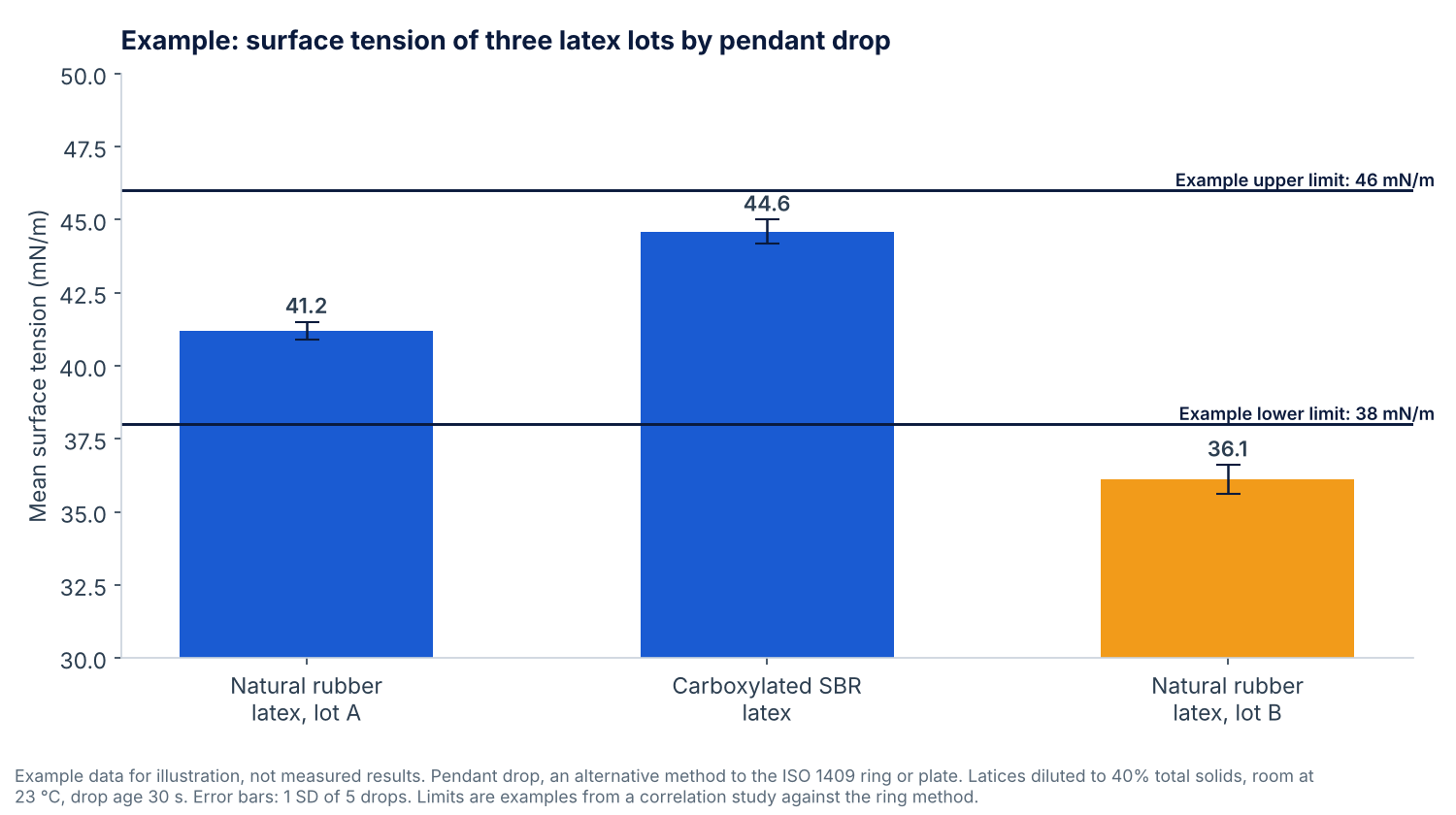
Example data, not measured results.
What changes when you can read latex surface tension at the line
| Metric | Before Dropometer | With Dropometer | Results |
|---|---|---|---|
| Where the check runs | Ring tensiometer in a central lab | At the reactor or compounding area, on battery for up to 8 h | Dropometer product specification |
| Sample needed | About 25 cm³ of diluted latex in a dish | A syringe of diluted latex | ISO 1409 procedure; no published benchmark for the syringe volume |
| Result format | Maximum ring or plate force, converted to mN/m | Surface tension from the drop profile, ±0.03 mN/m accuracy | Dropometer product specification |
| Test temperature | Bath held at 23 °C ± 1 °C | Room conditioned and recorded; no temperature control | ISO 1409 apparatus clause; Dropometer product specification |
Bring two lots: one that ran well and one that did not. We will measure both live and compare them with your ring results.
Enter your own numbers. The defaults are examples, not Droplet Lab results.
Quality cost snapshot
Result
Annual exposure combines audit/CAPA cost, customer rejections, and recall probability; avoided exposure applies the risk reduction percentage.
Lock these before you compare pendant drop results with ring results
| Parameter | Recommended Setting | Technical Rationale |
|---|---|---|
| Method | Pendant drop; label the result as pendant drop | The standard specifies a Du Noüy ring (Method A) or a Wilhelmy plate (Method B). Pendant drop is an alternative method, so correlate it with the ring on your own latex. |
| Total solids | 40% ± 1%, as the standard specifies | The standard dilutes to this level. Record the final solids if you dilute further. |
| Viscosity | Below 200 mPa·s | The ring method limit. A viscous drop also takes longer to settle, so wait until it stops moving. |
| Density | Measured on the diluted latex, as the standard describes | Pendant drop needs the density. An error here moves the result. |
| Temperature | 23 °C ± 1 °C room; record it | The standard sets this test temperature. The Dropometer runs at 10 to 45 °C and has no temperature control. |
| Drop age | Fixed, the same for every drop | Surfactant keeps adsorbing and latex can skin, so the reading changes with time. |
| Fit model | Young-Laplace | The pendant drop fit in the Dropometer software. |
| Replicates | Several fresh drops per lot | Report the mean and spread. Flush the needle with water between lots. |
Pick the method by the question you need answered
Start: What do you need to know about your latex or dispersion?
You want a surface tension number per lot to trend surfactant level.
Use a pendant drop reading on the Dropometer. It measures the same property by an alternative method to the ring or plate. Set limits from a correlation study against the ring method.
Your customer or specification names ISO 1409, or two labs disagree.
Pendant drop is an alternative method, not the ring or plate method the standard specifies. Use a ring tensiometer to Method A, or a plate tensiometer to Method B, with a bath at 23 °C, or run a correlation study on your own samples first. The standard prefers Method A in a dispute.
You need the tension between two liquids, for example insulating oil and water.
Use the Dropometer with the optional cuvette: it measures interfacial tension by pendant drop of one liquid in another. For insulating oil test methods, see ASTM D971 / IEC 62961.
You compare surfactant packages and need surface tension over drop age, not one value.
Use dynamic pendant drop on the Dropometer, read at 0.1 s and later. See the surface tension measurement guide.
Start from the question you need answered. Blue boxes are the measurements the Dropometer runs: pendant drop surface tension, dynamic pendant drop, and interfacial tension with the optional cuvette. A result reported to ISO 1409 needs a ring or plate tensiometer, or a correlation study first.
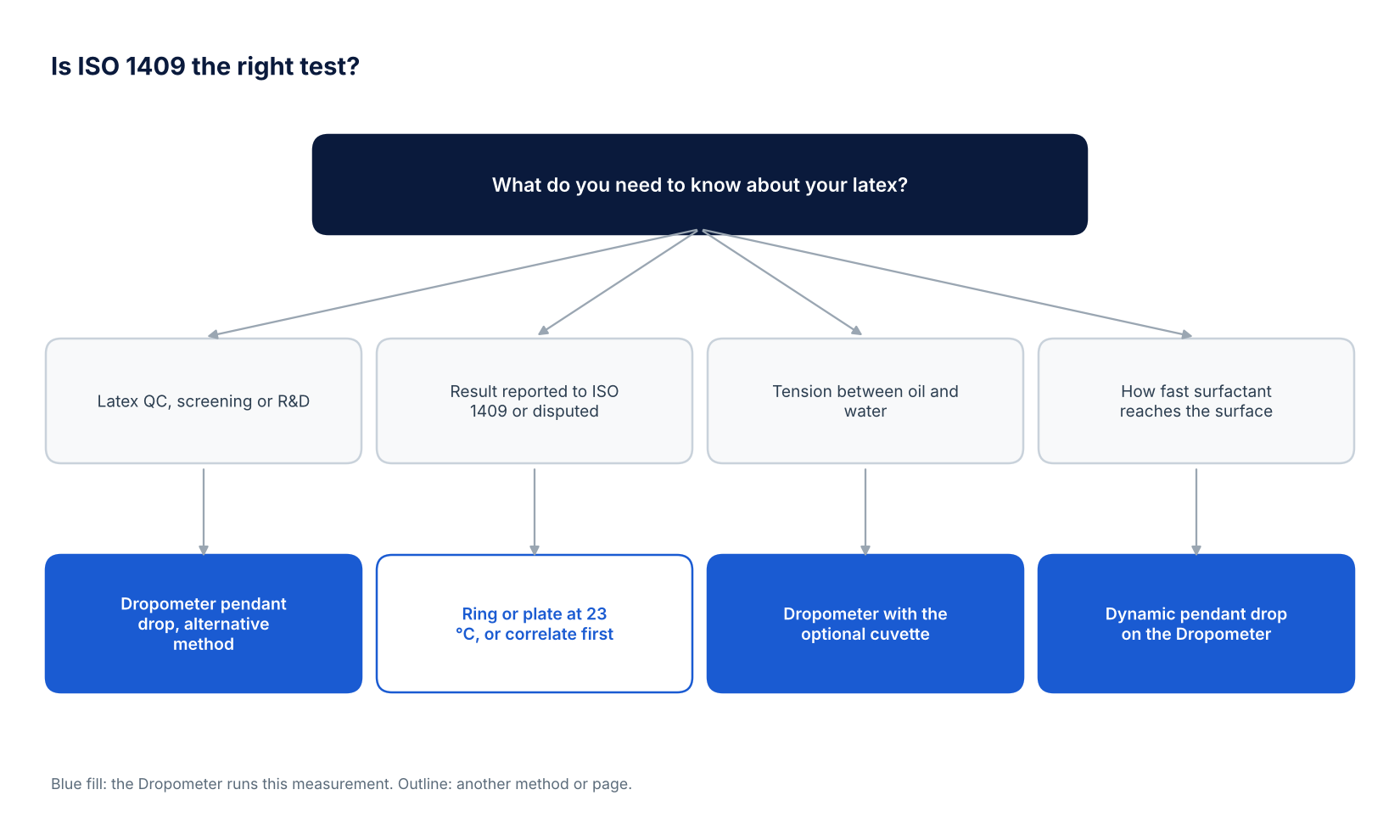
Is ISO 1409 the right test?
What latex surface tension tells you, and what it does not
Honest limits of the method and of the Dropometer
It measures the surface tension of polymer dispersions and natural or synthetic rubber latex against air. The latex is diluted to 40% total solids, held at 23 °C, and measured with a Du Noüy ring (Method A) or a Wilhelmy plate (Method B).
ISO 1409:2020, the sixth edition. ISO confirmed it at the 2025 systematic review. It replaced ISO 1409:2006, which covered the ring method only, and added the plate method with its own precision data.
Partially compliant. The Dropometer gets the result ISO 1409 is after, latex surface tension, with ±0.03 mN/m accuracy (Dropometer datasheet). Pendant drop is an alternative method, not the ring or plate method the standard specifies, and the Dropometer has no temperature control. If a contract or customer requires an ISO 1409 result, run a correlation study on your own samples first.
The ring method (Method A) is preferred in a dispute and applies below 200 mPa·s. The plate method (Method B) is not for latex with cationic surfactants. Follow the method your customer or specification names.
Not automatically. The methods measure the surface in different ways, and surfactant adsorption over time affects each one differently. Measure the same lots by both methods at the same temperature, then set your limits from that correlation study.
Yes, with the optional cuvette: it forms a pendant drop of one liquid inside another, such as water in insulating oil. ISO 1409 itself covers surface tension against air. For oil and water test methods, see ASTM D971 / IEC 62961.
DIN ISO 1409:2008-11 was the German adoption of ISO 1409:2006, for the determination of the surface tension of polymer dispersions and rubber latices by the ring method. DIN lists it as withdrawn. The current international edition is ISO 1409:2020, which adds the plate method. If a specification still cites DIN ISO 1409, agree with your customer which edition applies.
This page summarises ISO 1409 in our own words and does not reproduce the standard. Buy the current edition from ISO or your national standards body before you write a procedure. The Dropometer is partially compliant: pendant drop is an alternative method, not the ring or plate method the standard specifies. If a contract or customer requires an ISO 1409 result, run a correlation study on your own samples first. Droplet Lab does not certify compliance. Your own method validation does.
Sources, review and tools
ISO 1409:2020 listing (ISO); ISO 1409:2020 listing (Austrian Standards); ISO 1409:2020 preview pages (iTeh): foreword, scope, principle, apparatus, sample preparation; ASTM D1417-16(2026) listing, the Dropometer product specification and Droplet Lab validation papers.
Drafted with Claude (Anthropic) from the sources listed, then reviewed by Droplet Lab.
We did not copy text from the standard. Buy the current edition for the full procedure.
October 2026
Spotted an issue in this summary? Send a correction request and our team will review it.
Correction Request
We work hard to keep this page accurate and up to date. If you spot an error (wrong revision/year, missing requirement, incorrect interpretation, or broken link), tell us and we'll review it.
Contact us to report a correction