
Contents
Material Wettability, Wicking and Microfluidics

Polymer Microfluidic Channel Wettability: Contact Angle for PDMS and Thermoplastic Chips After Plasma and Coating

Channels fill, droplets form and cells attach according to the wetting of a polymer skin that changes within hours of treatment. Measure water contact angle on matched coupons after each treatment and before bonding, and track how long the surface holds.
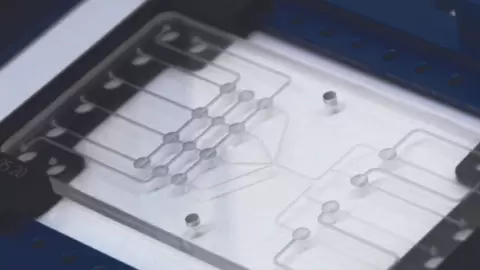
Who this is for: Microfluidic device developers and labs working in PDMS, PMMA, COC, COP, polystyrene, polycarbonate and polyethylene.

Where it fits: Plasma and coating checks, hydrophobic recovery tracking, material selection and the methods section of a paper.

What it does not do: It cannot measure inside a closed, bonded channel; it reads open surfaces and matched coupons.

Method
Sessile drop water contact angle on open chip halves or matched coupons, repeated over time
Standard
No channel wettability standard found; ASTM D7334 covers advancing contact angle on coatings and substrates
Setup
About 2 minutes
Why it matters

Why channel wettability needs measuring, not assuming

7.2° to about 93°

water contact angle on PDMS right after oxygen plasma, and one day later without a coating, as the surface recovered.

Trantidou et al., Microsystems and Nanoengineering 3:16091, 2017

5° to 80°

contact angle measured inside plasma treated PDMS chips stored in water, from day 0 to day 10, while filling slowed.

Balestrieri et al., Microfluidics and Nanofluidics 29:69, 2025

21.0° at 30 days

contact angle of PDMS after plasma plus a PVA coating, against recovery within a day for plasma alone.

Trantidou et al., Microsystems and Nanoengineering 3:16091, 2017

Sources: Trantidou T. et al., Microsystems and Nanoengineering 3:16091, 2017; Balestrieri et al., Microfluidics and Nanofluidics, 2025. Figures come from these sources, not from Droplet Lab measurements.

Quick reference

What this channel wettability check does and what it does not

A quick reference for microfluidic teams checking fit before reading further.

Evidence Box

Problem this solves

Channels that fill unevenly or trap bubbles, droplets that will not form, and plasma treatments that fade before the chip is used.

Standards

No standard covers microfluidic channel wettability. ASTM D7334 covers advancing contact angle on coatings and substrates, and ISO 19403-2 covers surface free energy from contact angles.

Peer reviewed method

The Dropometer drop shape method was validated against a KRUSS DSA100E in two peer reviewed papers, in Review of Scientific Instruments and Colloids and Surfaces A.

Customer case study

The University of Alberta IMPACT Lab, which builds microfluidic devices in polyethylene, measured a drop under oil moving from 133° to 15° at 3.6 V on its own Dropometer.

Customer publication

An MSc thesis on polyethylene microfluidic camouflage names the Droplet Lab instrument for contact angle in its methods and reports the change in Figure 13.

Honest limit

A drop cannot be placed inside a bonded channel, so the check reads open halves or coupons treated in the same run.

Who this is for

What channel wettability question are you trying to answer?

Pick the card closest to your role. Each one points to the part of this page that answers it.

Microfluidic device engineer

You plasma treat or coat chips so they fill and bond. A contact angle on a matched coupon after treatment, and again before use, shows the surface is still where the design needs it.

Treated PDMS recovers toward hydrophobic within hours; record the time since treatment.

Droplet microfluidics researcher

Your droplets need hydrophobic channels for water in oil, or hydrophilic channels for oil in water. Contact angle on the channel material confirms the wetting before you blame the surfactant.

Check the wetting of the continuous phase, not just water.

Process or quality engineer

You move chips from PDMS prototypes to thermoplastic production. A locked contact angle check on each lot shows treatment and molding stay consistent.

Mold release and handling residues change the angle; clean coupons the same way.
Fit check

Is this the right check for your chips?

It measures water contact angle on open polymer surfaces and coupons. It does not see inside a bonded channel.

Good fit if

You plasma treat PDMS or thermoplastics before bonding or use.
You need to know how fast a treatment fades.
You compare coatings that keep channels hydrophilic.
You choose a polymer for a new chip design.
You can treat a flat coupon in the same run as the chip.

Less relevant if

You need wetting inside a bonded channel; use flow or imaging tests.
Your channels are below the size a coupon can represent.
You need dynamic wetting at flow speed.
You need surface chemistry; use XPS or FTIR.
Summary

How contact angle supports polymer microfluidic chips

The answer in under a minute.

Measure water contact angle on the open chip half or a coupon of the same polymer, treated in the same run, right after treatment and again at the time of use. Compare against the untreated polymer and a locked target. If the angle has drifted back, the channel will not fill or form droplets the way the design expects.

The Dropometer contact angle kit runs the measurement. The University of Alberta case study shows a polyethylene microfluidics lab measuring wetting change under oil, and the polyethylene microfluidic camouflage thesis reports the method. Our contact angle measurement guide and aviation and space guide explain more.

Expert Quote

Expert perspective on the surface a liquid sees

What a liquid responds to is only the outermost few ångström of a surface: the skin, not the bulk. Change that skin and you change the wetting, even if the material underneath is identical.

Dr. Alidad Amirfazli

Professor, Department of Mechanical Engineering, York University; Co-founder, Scientific Advisor, Droplet Lab

The problem

Why polymer channel wetting is hard to control

Native PDMS beads water at about 107 to 120°, and common thermoplastics sit between about 70 and 110°: published values put PMMA near 70 to 80° and COC near 109°. Water in oil droplets need channel walls the oil wets, and oil in water droplets need walls the water wets, so one published threshold for water in oil droplets is a contact angle above about 92°. Capillary filling depends on the cosine of the contact angle, so a channel that should fill on its own will slow or stop as the walls become less hydrophilic. Oxygen plasma makes PDMS wet almost completely, but the effect does not last: low molecular weight chains move back to the surface, and one study measured 7.2° right after plasma and about 93° a day later. Thermoplastics recover more slowly but still change; plasma treated COC recovered substantially within 4 weeks in air in one study. Storage, temperature and coatings all change how fast this happens. A drop cannot be placed inside a bonded channel, so most labs never measure the surface the liquid will meet at the time of use.

Channels fill slowly, unevenly or not at all.
Bubbles get trapped at corners and junctions.
Droplets wet the wall instead of pinching off.
A chip that worked on Monday fails on Friday.
Bonding fails after plasma treatment.
Troubleshooting

Why channel wetting drifts and what to check

Why:

  • Low molecular weight chains in PDMS migrate back to the treated surface within hours to days.

How to detect:

  • The coupon angle rises with time since treatment.

Corrective action:

  • Bond and fill within a locked time, store in water or cold, or add a coating.

Why:

  • Chamber position, gas flow, power and time change how much of the surface is treated.

How to detect:

  • The angle right after treatment is higher than usual, or spread across the coupon is large.

Corrective action:

  • Place coupons beside chips in each run and log plasma settings.

Why:

  • The continuous phase must wet the walls, so the same channel cannot make both droplet types.

How to detect:

  • Droplets wet the wall or the dispersed phase spreads along the channel.

Corrective action:

  • Match wall wetting to the droplet type and pattern wettability where both are needed.

Why:

  • Uncured oligomers, mold release and handling films change the native angle.

How to detect:

  • The untreated baseline differs from earlier lots.

Corrective action:

  • Measure an untreated coupon per lot and clean coupons the same way as chips.

Why:

  • Coatings that keep channels hydrophilic differ widely in how long they last.

How to detect:

  • The coated coupon angle drifts over storage.

Corrective action:

  • Track coated coupons over your real storage time before you commit to a coating.

Not sure your treatment lasts until use?

Send treated and untreated coupons, and we will measure them on a call.

Lab records

What a channel wettability record contains

Each check produces a record you can file with the chip lot and cite in a methods section.

Material

Polymer, grade, cure or molding conditions and lot.

Treatment

Plasma gas, power and time, or coating and cure.

Timing

Time since treatment and storage conditions at each reading.

Readings

Angle per spot, mean and spread, with n.

Device result

Fill, bond or droplet result for chips from the same run.

Drop images

Automatic edge and baseline detection gives the same reading from the same image, so a reviewer can recheck any result.

Measurements

What to measure on polymer microfluidic surfaces

Baseline

Water contact angle on the untreated polymer

Why it matters: It confirms the material lot and cleaning before treatment.

How to interpret: Published values: PDMS about 107 to 120°, PMMA about 70 to 80°, COC about 109°. Use your own lot as the reference.

When it is not enough: It does not show residue that only appears after treatment.

Treatment

Angle right after plasma or coating

Why it matters: It shows the treatment reached the surface.

How to interpret: Plasma treated PDMS reads below about 10° in published work; a higher value points to a weak run.

When it is not enough: Near full wetting, small angles carry large relative error.

Recovery

Angle at the time of bonding or use

Why it matters: It is the surface the liquid will actually meet.

How to interpret: Compare with a target set from chips that fill and form droplets correctly.

When it is not enough: A coupon only stands in for the chip if treated and stored the same way.

Hysteresis

Advancing and receding angles

Why it matters: Filling follows the advancing angle, and pinning follows hysteresis.

How to interpret: Extracted PDMS has been reported at 112° advancing and 84° receding.

When it is not enough: It does not show dynamic wetting at flow speed.

Validation

Validated measurement approach for polymer chips

How the Dropometer itself has been validated, and how a polyethylene microfluidics lab used it.

Peer reviewed method

The Dropometer drop shape method is published in Review of Scientific Instruments and Colloids and Surfaces A. Contact angle was validated against a KRUSS DSA100E, with a published accuracy of 0.35°.

See the validation papers

Customer evidence from a microfluidics lab

The IMPACT Lab at the University of Alberta builds microfluidic devices in polyethylene and bought its own Dropometer by July 2022. An MSc thesis from the lab recorded a water drop with SDS under dodecane on metalized polyester moving from 133° at 0 V to 15° at 3.6 V DC, reported as fully repeatable. It is a thesis, not a peer reviewed paper.

Read the citation analysis
QC Protocol

How to check wettability on polymer chips

Six steps per treatment run. Keep every step identical between runs.

1

Prepare coupons

Cast or mold flat coupons of the same polymer and lot as the chip, and clean them the same way.

2

Baseline

Measure an untreated coupon to set the native angle for this lot.

3

Treat together

Treat the coupon in the same plasma or coating run as the chips, next to them.

4

Measure at once

Read the coupon within a locked time after treatment, using fresh spots.

5

Measure at use

Read again at the time of bonding or use, and log the hours since treatment. Our capillary number entry explains why wetting sets filling.

We completed our gage R&R study on the unit and it performed very well.

Brandon Barbee

Corporate Quality Engineer, Zeus Industries, Polymer Manufacturing

Download the microfluidic channel wettability SOP

A two page SOP you can adapt for your chips, with the coupon and timing lock, decision rules, a troubleshooting table and a record sheet.

Contact angle measurement with the Dropometer

Contact angle measurement with the Dropometer

Example output

Example polymer chip wettability log

Example data only. Your values will differ with polymer, treatment and storage.

How to read this log

Native PDMS read high, as expected. Right after plasma it wetted strongly. By the next day it had drifted most of the way back, so chips stored that long would not fill the same way. The coated coupon held its angle. The PMMA coupon after treatment stayed within its target. Our page on plasma treatment for adhesion covers treatment checks for bonding.

Example polymer chip wettability log

Coupon Time since treatment Contact angle (°) Spread (°) Target Decision
PDMS, untreated n/a 108 2 Baseline Reference
PDMS, oxygen plasma 5 min 12 3 Below 30° Use now
PDMS, oxygen plasma 24 h 78 5 Below 30° Retreat or do not use
PDMS, plasma plus hydrophilic coating 24 h 25 3 Below 30° Use
PMMA, plasma 24 h 38 3 Below 45° Use

Example data, not customer data. Water drops of a fixed volume on flat coupons treated with the chips; n = 3 spots per coupon.

Signal order

The order to check signals on chip wettability

Check these in order. Each one rules out a cause before you look at the next.

1

Untreated baseline

Confirms the polymer lot and cleaning are as before.

2

Angle right after treatment

Shows the treatment reached the surface.

3

Angle at time of use

Shows how much the surface recovered.

4

Spread across the coupon

Shows whether treatment was even.

FAQ

Common questions about polymer microfluidic channel wettability

Questions microfluidic teams ask about contact angle on chip materials.

Hours to days without a coating. One study measured 7.2° right after plasma and about 93° a day later. Chips stored in water went from 5° to 80° over 10 days in another. Storage at minus 80 °C kept the angle below 15° for 100 days in a third. Measure your own chips at the time you use them.

Not with a sessile drop. Labs measure a flat coupon of the same polymer, cleaned, treated and stored with the chips, or the open half before bonding. One published method estimates the angle from the meniscus curvature inside an all PDMS channel, which needs its own imaging setup.

The continuous phase must wet the walls. Water in oil droplets need hydrophobic walls, and oil in water droplets need hydrophilic walls. One published example puts the switch near 92°. Untreated PDMS cannot make oil in water droplets, which is why many labs plasma treat or coat it.

Results vary widely. Plasma plus PVA held 21.0° at 30 days in one study. Grafted PEG and PVP stayed hydrophilic for over six months in another, while sputtered oxide layers lost hydrophilicity within 2 days. Track any coating on coupons over your real storage time.

Less quickly, but they still change. Plasma lowered PMMA from about 70° to 26° and COP from 91° to about 30° in published work. UV ozone treated COC recovered substantially within 4 weeks in air, and storage in dry or vacuum conditions slowed it. Measure at the time of use.

Capillary filling depends on the cosine of the contact angle, so as the walls recover toward hydrophobic, the driving force falls. One study saw flow velocity fall as time since plasma increased. Our capillary number entry explains how wetting and flow interact.

Not for channels. ASTM D7334 covers advancing contact angle on coatings and substrates, and ISO 19403-2 covers surface free energy. Report your coupon, treatment, timing and storage so others can repeat the result.

Business impact

What changes when you check every treatment run

Typical changes in how teams work. Benchmarks are given only where a published source exists.

Before and with a check on every treatment run

Metric Before Dropometer With Dropometer Indicative Benchmark
Treatment check Assumed to work Coupon read after every run Plasma PDMS 7.2° right after treatment (Trantidou et al., 2017)
Shelf life of treated chips Found by failed fills Coupon read at time of use 5° to 80° in 10 days in water (Balestrieri et al., 2025)
Coating choice Chosen by trial Coated coupons tracked over storage PVA 21.0° at 30 days (Trantidou et al., 2017)
Scrap from faded chips Not measured Tracked per run No published benchmark; track on your own runs

See the measurement on your own chip materials

Send treated and untreated coupons. We will show the readings on a call.

Estimate saved chips from catching faded treatments

Enter your own numbers. The result is an estimate, not a Droplet Lab claim.

Microfluidic chip run estimate

Estimate saved chips from catching faded treatments.

Each Dropometer unit is US$5,000; the default models one unit.
Your own cost of chips, reagents and time when a run fails to fill or bond.
Coupon preparation and contact angle reads after treatment and at use.
No published benchmark. Use your own estimate and start low if unsure.

Result

~0
Candidates saved per month
~0
Monthly savings
~0
Payback period
~0
First year net benefit

Monthly savings = materials saved + technician time saved from reduced iterations.

Limits

What contact angle cannot tell you about a channel

Honest limits, so you know when to reach for another test.

It cannot read inside a bonded channel.
A coupon only represents the chip if treated in the same run.
Treated PDMS changes by the hour.
Static angles do not show dynamic wetting at flow speed.
Very low angles near full wetting have large relative error.
It does not identify surface chemistry.

Contact angle shows the wetting of an open polymer surface at one time. Wetting inside a bonded channel, dynamic wetting at flow speed and surface chemistry need their own tests.

How this page was created

Editorial and technical transparency notes for this page.

Transparency Details 4 checklist items
01

Drafting assistance

Drafted with Claude Opus 5.5 (Anthropic) using web search for sources, then edited by the Droplet Lab team.

02

Technical review

Reviewed and edited for technical accuracy by the Droplet Lab Team.

03

Verification steps

Standard identifiers, units, thresholds and key procedural claims are checked against cited sources before publication.

04

Updates

Reviewed every 12 months or when the underlying method changes.

Report a correction

Spotted an issue in this summary? Send a correction request and our team will review it.

Correction Request

We work hard to keep this page accurate and up to date. If you spot an error (wrong revision/year, missing requirement, incorrect interpretation, or broken link), tell us and we'll review it.

Contact us to report a correction
Sources

References

1.
Kim, Chaudhury, Owen. Hydrophobic recovery of polydimethylsiloxane elastomer exposed to partial electrical discharge. Journal of Colloid and Interface Science 226:231 to 236, 2000. https://www.lehigh.edu/~mkc4/our%20papers/Kim%202000_JCIS.pdf
2.
Elvira, Gielen, Tsai, Nightingale. Materials and methods for droplet microfluidic device fabrication. Lab on a Chip, 2022. https://pubs.rsc.org/en/content/articlehtml/2022/lc/d1lc00836f
3.
Trantidou et al. Microsystems and Nanoengineering 3:16091, 2017. https://discovery-pp.ucl.ac.uk/id/eprint/1558843/1/micronano201691.pdf
4.
Jahangiri, Hakala, Jokinen. Long term hydrophilization of polydimethylsiloxane (PDMS) for capillary filling microfluidic chips. Microfluidics and Nanofluidics 24:2, 2020. https://aaltodoc.aalto.fi/items/846d3c86-0db5-443d-82b1-6ca7a2f408d2
5.
Balestrieri et al. Microfluidics and Nanofluidics 29:69, 2025. https://link.springer.com/article/10.1007/s10404-025-02821-8
6.
Hemmila et al. Rapid, simple and cost effective treatments to achieve long term hydrophilic PDMS surfaces, 2012. https://trepo.tuni.fi/bitstream/10024/125558/1/hemmila_rapid_simple_and_cost_effective_treatments.pdf
7.
O'Brien et al. Systematic characterization of hydrophilized polydimethylsiloxane. arXiv 2007.09138, 2020. https://arxiv.org/abs/2007.09138
8.
Dawaymeh et al. Polymers 13(14):2305, 2021. https://www.mdpi.com/2073-4360/13/14/2305/htm
9.
Scheicher et al. Patterned surface activation of cyclo olefin polymers for biochip applications. Periodica Polytechnica Chemical Engineering 58(1):61 to 67, 2014. https://pp.bme.hu/ch/article/download/7203/6191
10.
Ozgen, Aksoy, Hasirci, Hasirci. Surface characterization and radical decay studies of oxygen plasma treated PMMA films. Surface and Interface Analysis 45(4):844 to 853, 2013. https://avesis.hacettepe.edu.tr/yayin/27dc3c1d-219a-47d9-ae94-767f13b15964/surface-characterization-and-radical-decay-studies-of-oxygen-plasma-treated-pmma-films
11.
Lin, Pfeiffer, Lillehoj. RSC Advances 7:37374 to 37379, 2017. https://pubs.rsc.org/en/content/articlepdf/2017/ra/c7ra07435b
12.
Sowers et al. Capillary driven flow of polydimethylsiloxane in open rectangular microchannels. Soft Matter 12:5818 to 5823, 2016. https://faculty.engineering.asu.edu/jagan/wp-content/uploads/sites/18/2016/11/Soft_Matter.pdf
13.
Abate et al. Photoreactive coating for high contrast spatial patterning of microfluidic device wettability. Lab on a Chip 8(12):2157 to 2160, 2008. https://pubs.rsc.org/en/content/articlehtml/2008/lc/b813405g
14.
Sun, X. Polyethylene based microfluidic system approaches to achieve adaptive visible and thermal camouflage applications. MSc thesis, University of Alberta, 2023. See our citation analysis. https://dropletlab.com/validation/citations/analysis/polyethylene-based-microfluidic-system-approaches-to-achieve-adaptive-visible-and-thermal-camouflage-applications/
15.
University of Alberta case study: two departments, one electrowetting result. See the case study. https://dropletlab.com/validation/case-studies/university-of-alberta-electrowetting-contact-angle/
16.
ASTM D7334-08(2022). Surface wettability of coatings, substrates and pigments by advancing contact angle measurement. https://store.astm.org/d7334-08r22.html
17.
ISO 19403-2:2024. Paints and varnishes, wettability, part 2: determination of the surface free energy of solid surfaces by measuring the contact angle. https://www.iso.org/standard/87262.html
18.
Chen, X. et al. Contact angle measurement with a smartphone. Review of Scientific Instruments 89(3):035117, 2018. https://pubs.aip.org/aip/rsi/article-abstract/89/3/035117/368179/Contact-angle-measurement-with-a-smartphone
19.
Surface tension measurement with a smartphone using a pendant drop. Colloids and Surfaces A: Physicochemical and Engineering Aspects. https://www.sciencedirect.com/science/article/abs/pii/S0927775717307744