
Surface science explainer
How Surface Tension Lets Insects Walk on Water
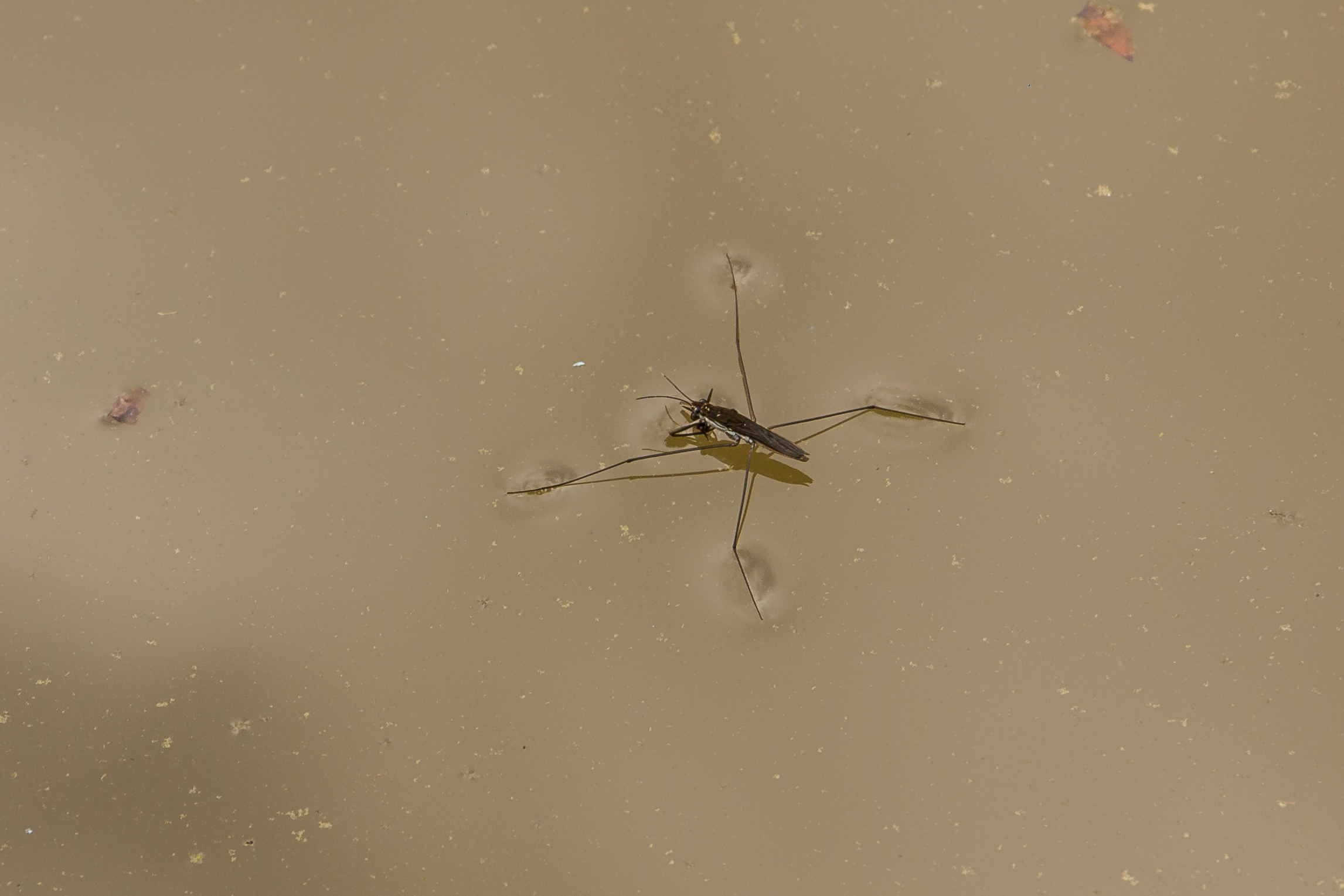
Water striders stand on water because their legs are covered in tiny wax-coated hairs that water cannot wet. The surface bends under each leg instead of breaking, and surface tension along that dimple holds the insect up. One leg can support about 15 times the insect's body weight (Gao and Jiang, 2004).


Droplet Lab Team
Droplet Lab builds precision instruments and software for surface science measurement, specialising in contact angle analysis and surface tension characterisation. Used by researchers across materials science, pharmaceuticals, coatings, and advanced manufacturing, Droplet Lab's Dropometer has contributed to studies published in peer-reviewed journals including Advanced Functional Materials (Impact Factor 19). The team combines instrument engineering with deep domain knowledge in wettability science with a focus on practical accuracy.
How can an insect stand on water without sinking?
Short answer: the insect is so light, and its legs so water repellent, that surface tension can carry its weight. The water surface curves down under each leg like a stretched sheet, and that curved surface pushes back up.
Gao and Jiang (2004) measured the maximum supporting force of a single water strider leg at about 15 times the insect's total body weight. Six legs give it a large safety margin, even when it pushes off to jump.
Why does surface tension matter more for small creatures?
Surface tension acts along the length of the contact line, while weight grows with volume. Shrink an animal and its weight falls much faster than the length of its legs.
A useful yardstick is the capillary length of water, about 2.7 mm. It follows from water's surface tension and density (Vargaftik et al., 1983). Below this size, surface tension tends to beat gravity; above it, gravity wins.
This is why water walking is limited to small, light animals such as water striders, some spiders and a few insects (Bush and Hu, 2006).
Why don't a water strider's legs get wet?
The legs are covered in thousands of tiny needle-shaped hairs, each with fine grooves along its length. Air gets trapped between the hairs, so water touches mostly air and only a little solid.
Gao and Jiang (2004) measured a water contact angle of about 168° on the leg. That puts it firmly in the superhydrophobic range, well above the roughly 108° water reaches on smooth PTFE (Fox and Zisman, 1950).
Contact angle is the standard way to put a number on this behaviour. The contact angle measurement guide explains how it is measured, and the sliding angle guide covers how easily drops roll away.
Expert Quote
A surface can pin a drop at a high angle yet never let it roll. High repellency and easy roll-off are different properties, and a single contact angle won't tell you which one you have.

How do water striders move across the surface?
For years it was unclear how striders push themselves forward. Hu, Chan and Bush (2003) filmed them and found the middle legs drive the water backwards like oars.
Each stroke sheds small vortices under the surface, and those vortices carry the momentum that pushes the insect forward. The team also built a small robot strider that moved the same way.
What happens if you add soap to the water?
Soap lowers water's surface tension, so the same leg dimple produces much less upward force. Soap can also wet the waxy hairs, letting water into the gaps that held air.
A strider on soapy water sinks or struggles to stay up. It is a classic classroom demonstration of what surfactants do at an interface.
Students can quantify the same effect in Experiment 2: the effect of surfactants on surface tension, or build their own water repellent surface in Experiment 1: superhydrophobic surfaces on glass.
What do water striders teach us about surfaces?
Two properties work together: a liquid with high surface tension and a solid that water cannot wet. Engineers copy this pairing in water repellent fabrics, anti-icing coatings and small floating robots.
The same pairing is what quality labs check when they measure contact angle on a treated or coated part. The surface tension guide covers the liquid side of that measurement.
Where can you go deeper?
These pages cover the methods, standards and data behind this post.
- Buying guide: Best Tensiometer for Teaching Labs
- Glossary: Static surface tension
- Classroom experiment: Exp 3: Surface tension of water & temperature effect
- Open dataset: Surface Tension of Common Liquids
- Tool: Free Contact Angle Tool
- Related post: Exploring the Science Behind Water's High Surface Tension
Turn this into a classroom measurement
Measure surface tension and contact angle with your students, and see the method we validated in peer review.
Frequently Asked Questions
Only small, light ones with water repellent legs. Weight grows faster than leg length as size increases, so larger animals cannot rely on surface tension alone (Bush and Hu, 2006).
If you place it gently, the water surface bends under it and surface tension supports it, much like a strider's leg. Push it through the surface and it sinks, because steel is far denser than water.
Soap lowers surface tension and can wet the hairs on the legs. Both reduce the upward force, so the insect can no longer stay on the surface.
About 2.7 mm at room temperature. It is calculated from surface tension and density and marks the size below which surface tension dominates over gravity.