


Contents
Partially compliant

ISO 6889: interfacial tension of surfactant solutions against oil

ISO 6889 measures the interfacial tension between a surfactant solution and a second liquid by drawing a liquid film up with a stirrup or ring until it breaks. The Dropometer measures interfacial tension by pendant drop with the optional cuvette, so it gets the same end result by an alternative method. Pendant drop is an alternative method, not the stirrup or ring method the standard specifies; if a contract or customer requires an ISO 6889 result, run a correlation study on your own samples first.

What brings you here?

Who this is for
Surfactant makers, emulsion, detergent and agrochemical formulators, and university colloid and interface groups.
Compliance tier
Partially compliant: the Dropometer measures interfacial tension by pendant drop with the optional cuvette. That is an alternative to the stirrup or ring method the standard specifies.
Measurement
Interfacial tension by pendant drop of one liquid inside another, with the optional cuvette. No accuracy figure or range is published for it (Dropometer datasheet).
Setup
About 2 minutes. Battery powered, 1 kg, runs on the bench or at the plant.
Last updated
October 18, 2026

Free one page checklist for pendant drop interfacial tension with the optional cuvette next to ISO 6889: what to prepare, the settings to lock, how to run a concentration series and what to record. Made for surfactant and emulsion labs.

Talk to an expert

Book a 15 minute demo on your surfactant and oil

Tell us your surfactant, your oil phase and how you test them today. We will measure the pair live by pendant drop with the optional cuvette and tell you plainly where the Dropometer fits next to your ring or stirrup tensiometer and where it does not.

Book a 15 minute demo
View the official standard
Gurdeep-Saini-Photo
Written by
Gurdeep Singh Saini
Holds a BASc in Mechanical Engineering from Ryerson University (now Toronto Metropolitan University) and an MASc from York University. He develops the automatic edge and baseline detection behind the Dropometer's analysis.
COO at Droplet Lab
Read More
Droplet-Lab logo
Technical Review by
Droplet Lab Team
Droplet Lab builds precision instruments and software for surface science measurement, specialising in contact angle analysis and surface tension characterisation. Used by researchers across materials science, pharmaceuticals, coatings, and advanced manufacturing, Droplet Lab's Dropometer has contributed to studies published in peer-reviewed journals including Advanced Functional Materials (Impact Factor 19). The team combines instrument engineering with deep domain knowledge in wettability science with a focus on practical accuracy.
Read More
Verified against ISO 6889
Gurdeep-Saini-Photo
Written By

Gurdeep Singh Saini

COO at Droplet Lab

Holds a BASc in Mechanical Engineering from Ryerson University (now Toronto Metropolitan University) and an MASc from York University. He develops the automatic edge and baseline detection behind the Dropometer's analysis.

Droplet-Lab logo
Reviewed By

Droplet Lab Team

Droplet Lab builds precision instruments and software for surface science measurement, specialising in contact angle analysis and surface tension characterisation. Used by researchers across materials science, pharmaceuticals, coatings, and advanced manufacturing, Droplet Lab's Dropometer has contributed to studies published in peer-reviewed journals including Advanced Functional Materials (Impact Factor 19). The team combines instrument engineering with deep domain knowledge in wettability science with a focus on practical accuracy.

Evidence box

Standard

ISO 6889:1986, Surface active agents: determination of interfacial tension by drawing up liquid films, second edition, from ISO/TC 91. ISO last reviewed and confirmed it in 2024. It reads the highest force on a stirrup or ring drawn up through the film between two liquid phases in a measuring cup.

Compliance tier

Partially compliant. The Dropometer gets the end result the standard is after: interfacial tension by pendant drop with the optional cuvette. Pendant drop is an alternative method, not the stirrup or ring method the standard specifies. If a contract or customer requires an ISO 6889 result, run a correlation study on your own samples first.

Instrument performance

Interfacial tension runs by pendant drop with the optional cuvette; the Dropometer datasheet publishes no accuracy figure or range for it. The published surface tension figures, up to 75 mN/m with ±0.03 mN/m accuracy, apply to drops in air only.

Peer reviewed method

The drop shape method is validated against a KRUSS DSA100E in two peer reviewed papers. See our validation publications.

Customer evidence

Researchers studying phase inversion and emulsion stability used the Dropometer to measure pendant drop interfacial tension of surfactant and cellulose nanocrystal solutions against an oil, plus surface tension in air (Colloids and Interfaces, 2025). Read our analysis of the paper.

What it does not tell you

Interfacial tension shows how far a surfactant lowers the tension between two liquids. It does not predict emulsion stability on its own. Pair it with the stability test your product needs.
Executive summary

What this standard measures, who uses it and how the Dropometer fits

ISO 6889 measures the interfacial tension between a solution of surface active agents and a second liquid that does not mix with it, by drawing up the liquid film between them with a stirrup or ring. Surfactant makers, emulsion and detergent formulators and university colloid groups use it to compare how well a surfactant lowers the tension between water and oil. The Dropometer is partially compliant: it measures interfacial tension by pendant drop with the optional cuvette, the same end result by a different method. Pendant drop is an alternative method, not the stirrup or ring method the standard specifies; if a contract or customer requires an ISO 6889 result, run a correlation study on your own samples first.

In the standard, the two liquids sit in a measuring cup. A stirrup or ring in contact with the film between them is pulled up, and the tensiometer records the highest force before the film breaks. ISO says the force must pass through a maximum, or the reading is not valid. ISO last confirmed the 1986 edition in 2024. For background on the molecules involved, read our guide to understanding surfactants and the chemicals guide.

The Dropometer pendant drop tensiometer hangs a drop of the denser liquid, often the surfactant solution, inside the lighter liquid in the optional cuvette, then fits the drop shape. No accuracy figure or range is published for interfacial tension, so your correlation data sets the limits. Formulators use the reading to screen emulsifiers, as in emulsion stability and phase separation control. Researchers used the Dropometer to measure the interfacial tension of surfactant and nanocrystal solutions against oil in an emulsion study, and a university rheology lab uses the Dropometer for pendant drop surface tension.

Further reading: the surface tension measurement guide, reproducible surface tension measurement, choosing a tensiometer for surfactant and CMC research, CMC reference values for common surfactants and a classroom experiment on how surfactants change surface tension.

How the Dropometer fits the workflow

Pendant drop interfacial tension of a surfactant solution in oil, with the optional cuvette, step by step

From two liquids to an interfacial tension curve

These steps describe a pendant drop measurement on the Dropometer with the optional cuvette. They are not the stirrup or ring procedure of ISO 6889 and do not replace it. Buy the current edition and follow it for any result you report to the standard.

Optional cuvette

Interfacial tension

A pendant drop of one liquid hangs inside the other. No accuracy figure or range is published for it.

10 fps

Camera frame rate

Readings from about 0.1 s of drop age. Fine for surfactant ageing, not millisecond studies.

About 2 min

Setup

Base plate, phone holder, LED and syringe. No PC needed.

1

Prepare the two liquids

Make up the surfactant solution in clean glassware with the water your method names, and have the second liquid ready. The outer liquid must be clear so the camera sees the drop. Bring both to room temperature or the temperature the standard specifies, and note the density of each at that temperature.

2

Set up and check with water

Level the base plate, mount the phone and LED, and fit a clean needle. Hang a drop of pure water in air and read its surface tension. Compare it with the reference value for your room temperature before you fill the optional cuvette.

3

Fill the optional cuvette

Fill the clean optional cuvette with the lighter liquid, usually the oil. Lower the needle tip into it. The drop must be the denser liquid, so it hangs down from the needle inside the outer liquid.

4

Hang the drop and let it age

Form a pendant drop of the surfactant solution large enough to show a clear neck. Surfactant takes time to reach the interface, so the tension falls with drop age. Read every drop at the same age, or follow it over several readings until it settles.

5

Read the interfacial tension

Enter both densities. The software fits the Young-Laplace equation to the drop profile, using the density difference between the drop and the liquid around it. Automatic edge detection gives the same reading from the same image. Reject drops with bubbles, a poor fit or a near round shape.

6

Repeat, record and report the method

Read several fresh drops at each concentration, from the weakest solution to the strongest, and change the oil when it clouds. Record the method as pendant drop with the optional cuvette, plus drop age, both densities, room temperature and mean with spread. State that these are not stirrup or ring results to ISO 6889. See CMC reference values to sense check a break point.

7

Watch the full measurement

This video shows a complete Dropometer pendant drop surface tension measurement, from setup to result. It covers the steps above in one run.

Dropometer pendant drop surface tension, start to finish.

Validated measurement approach

Independent benchmarking and publication-based validation references.

Peer reviewed method

The Dropometer drop shape method is validated against a KRUSS DSA100E in two peer reviewed papers, one in Review of Scientific Instruments and one in Colloids and Surfaces A. The datasheet publishes no accuracy figure for interfacial tension with the optional cuvette.

Read the validation papers

Customer evidence

A university research team used the Dropometer to measure pendant drop interfacial tension of surfactant and nanocrystal solutions against an oil, in a study of emulsion phase inversion published in Colloids and Interfaces in 2025. We have no published client study run to ISO 6889 itself.

Read our analysis

Check the setup, check the oil, then correlate

ISO 6889 · interfacial tension · surfactant and emulsion work

Check the setup with pure water in air before each session. The reference surface tension is 72.74 mN/m at 20 °C and 71.97 mN/m at 25 °C (source: IAPWS R1-76(2014)). This checks the needle scale, focus and fit. It is a surface tension check, not an interfacial tension check.

Then hang a drop of pure water inside your clean oil in the optional cuvette and follow it over a few readings. With clean liquids the value stays steady. A value that keeps falling with drop age points to surface active impurities in the oil, the water or the glassware.

ISO 6889 is a test method. Your product specification or your customer sets the limits. No accuracy figure is published for interfacial tension on the Dropometer, and stirrup or ring values can differ from pendant drop values, because each method reads the interface at a different age and in a different way. Pendant drop is an alternative method, not the stirrup or ring method the standard specifies.

If you work to an ISO 6889 limit, run a correlation study. Measure the same pairs of liquids on your stirrup or ring tensiometer and on the Dropometer with the optional cuvette, at the same temperature, then set your pendant drop limits from that data. Repeat the study when you change surfactant family, oil or test temperature. See reproducible surface tension measurement for bench practice.

Example output

Example data for illustration only. These are not measured results. Your own surfactant, oil, water quality and temperature decide the numbers.

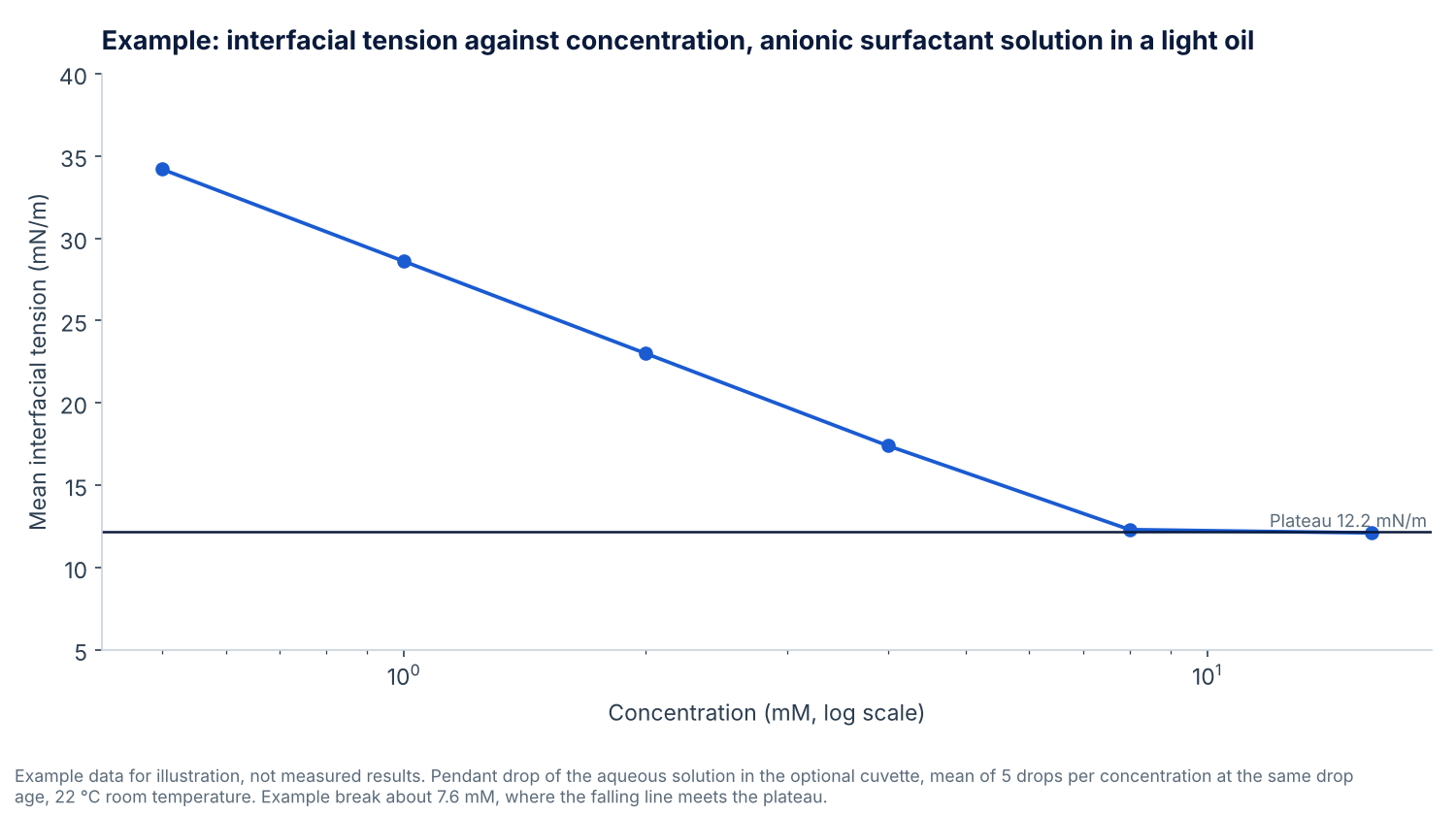
Example: anionic surfactant solution against a light oil, pendant drop in the optional cuvette, six concentrations

Concentration (mM) Drops (n) Interfacial tension (mN/m) Std dev (mN/m) Reading
0.5534.20.3Below break: falling
1528.60.3Below break: falling
2523.00.2Below break: falling
4517.40.2Below break: falling
8512.30.2Above example break: plateau
16512.10.2Above example break: plateau

How to read this table

Each row is the mean of five drops of the aqueous solution hanging in the same example light oil, read at the same drop age at 22 °C room temperature. Pure water against this oil read 48.0 mN/m in the example. The example break of about 7.6 mM is where the straight line through the first four points meets the plateau of 12.2 mN/m.

Example output chart

The same example data as the table, on a log concentration axis, with the plateau and the example break marked.

Line chart of example interfacial tension between an anionic surfactant solution and a light oil, falling from 34.2 to 12.3 mN/m as concentration rises, then levelling off at about 12.2 mN/m above an example break of 7.6 mM

Example data, not measured results.

Business impact

What changes when pendant drop sits next to your stirrup or ring tensiometer

Metric Before Dropometer With Dropometer Results
Sample per reading A measuring cup holding both liquid phases One drop hanging in the outer liquid in the optional cuvette No published benchmark
Interface age One reading as the film is drawn up and breaks Readings over drop age from about 0.1 s Dropometer product specification, 10 frames per second
Result format Highest force on the stirrup or ring Interfacial tension from the drop shape fit with the optional cuvette; no published accuracy figure Dropometer product specification
Reported ISO 6889 value Stirrup or ring tensiometer Still needs the stirrup or ring tensiometer ISO 6889 scope

See the measurement on your own liquids

Bring a surfactant you know well, one you are screening and your oil. We will measure both pairs live by pendant drop with the optional cuvette.

ROI estimate

Estimate the cost of the formulation and emulsion failures this test can catch

Enter your own numbers. The defaults are examples, not Droplet Lab results.

Quality cost snapshot

Estimate what wetting related failures cost you.

Example only. Use what you see in a trial on your own samples.
Your own figure.
Your own estimate.

Result

~0
Estimated annual cost today
~0
Estimated annual cost avoided
~0
Payback period

Annual exposure combines audit/CAPA cost, customer rejections, and recall probability; avoided exposure applies the risk reduction percentage.

Method settings

Lock these before you compare pendant drop results between runs or sites

Parameter Recommended Setting Technical Rationale
Method Pendant drop with the optional cuvette, reported as an alternative method ISO 6889 specifies a stirrup or ring drawn up through the film.
Which liquid hangs The denser liquid as the drop; the lighter, clear liquid in the cuvette A pendant drop hangs down, so it must be denser than the liquid around it.
Liquid densities Both entered, measured at the test temperature The Young-Laplace fit needs the density difference between the two liquids.
Drop age at reading Fixed for every drop, or read at a steady value Surfactant keeps reaching the interface, so the tension falls with age.
Fit model Young-Laplace The standard fit for a pendant drop profile in the Dropometer software.
Replicates Several fresh drops per concentration Report the mean and spread, as you would for stirrup or ring readings.
Concentration order Weakest to strongest; rinse the needle and refresh the oil between solutions Surfactant left in the needle or carried into the oil lowers the next reading.
Environment Record room temperature; condition both liquids first The Dropometer has no temperature control and runs at 10 to 45 °C.

Is ISO 6889 the right test?

Pick the method by the question you need answered

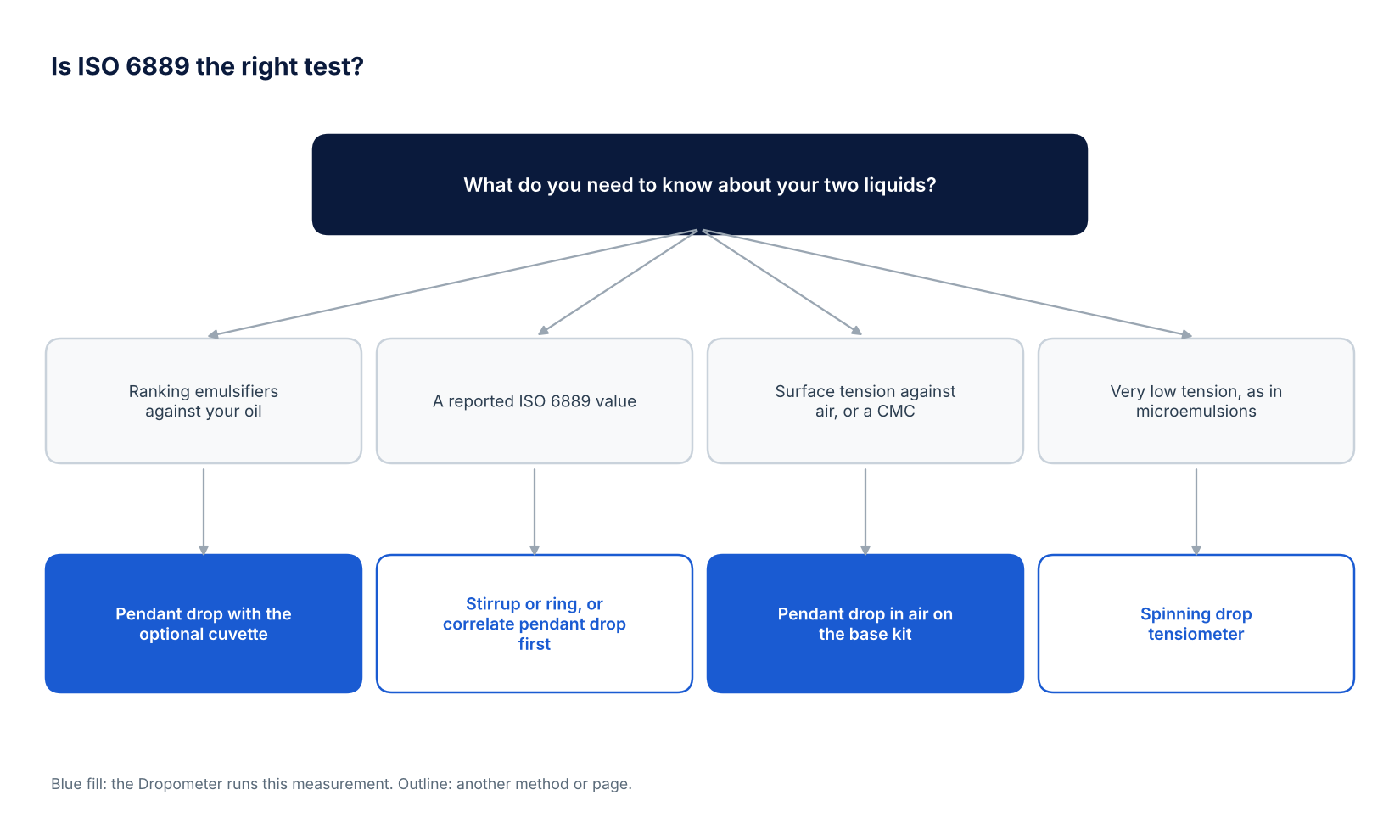
Start: What do you need to know about your two liquids?

Ranking emulsifiers against your oil

Signals:

You want to compare how far surfactants lower the tension between water and your oil, in R&D or screening.

Rule-out:

Use pendant drop with the optional cuvette on the Dropometer. See emulsion stability and phase separation control.

A reported ISO 6889 value

Signals:

Your customer or specification asks for a result to ISO 6889.

Rule-out:

The standard specifies a stirrup or ring tensiometer. Pendant drop with the optional cuvette is an alternative method: run a correlation study on your own samples before you report against an ISO 6889 limit. EN 14210 also uses a stirrup or ring.

Surface tension against air

Signals:

You need the surface tension of the solution itself, or a CMC curve, not the tension against a second liquid.

Rule-out:

Use pendant drop in air on the base kit. See ASTM D1331 for the ring and plate standard.

Very low tension, as in microemulsions

Signals:

The tension between your liquids is so low that a hanging drop stretches and falls before it settles.

Rule-out:

Use a spinning drop tensiometer. Pendant drop needs a drop that holds a stable shape on the needle.

Decision tree at a glance

Start from the question you need answered. Blue boxes are measurements the Dropometer runs.

Decision tree for choosing between pendant drop with the optional cuvette for emulsifier ranking, a stirrup or ring tensiometer for a reported ISO 6889 value, pendant drop in air for surface tension, and a spinning drop tensiometer for very low tension

Is ISO 6889 the right test?

Interpreting results

What an interfacial tension value tells you, and what it does not

Lower tension, easier emulsifying: A lower interfacial tension means less energy is needed to break one liquid into small droplets in the other.
Falling line, then a plateau: Interfacial tension drops as surfactant is added, then levels off. The break sits near the CMC in that liquid pair.
Age changes the number: A fresh interface reads higher than an aged one. Compare values only at the same drop age.
Tension is not stability: A low value helps form an emulsion. It does not prove the emulsion will stay stable on the shelf.
Expert perspective

Why the tension between oil and water shows what a surfactant does

The critical micelle concentration is not a number you look up; it is where the surface-tension curve flattens, and the only honest way to know it is to measure it.

Dr. Alidad Amirfazli

Department of Mechanical Engineering, York University, Co-founder and Scientific Advisor, Droplet Lab

Common pitfalls and limits

Honest limits of the method and of the Dropometer

Interfacial tension needs the optional cuvette, a clear outer liquid and a clear density difference. No accuracy figure is published for it, so set limits from your own correlation study.
Pendant drop is an alternative method, not the stirrup or ring method ISO 6889 specifies. Do not swap results without a correlation study on your own samples.
The Dropometer has no temperature control. Condition both liquids and record room temperature (operating 10 to 45 °C).
Trace surfactant in the oil, on the needle or on the cuvette lowers readings. Check your clean oil against water first and rinse between solutions.
Very low tensions make the drop stretch and fall from the needle. Use a spinning drop tensiometer for those.
The camera runs at 10 frames per second. That suits readings from about 0.1 s of drop age, not millisecond adsorption studies.
FAQ

Frequently asked questions

What does ISO 6889 measure?

It measures the interfacial tension between a solution of surface active agents and a second liquid that does not mix with it. A stirrup or ring in contact with the film between the two liquids is drawn up, and the highest force before the film breaks gives the result. ISO says the force must pass through a maximum, or the reading is not valid.

Can the Dropometer run ISO 6889?

It gets the same end result by a different method, so it is partially compliant. It measures interfacial tension by pendant drop with the optional cuvette. Pendant drop is an alternative method, not the stirrup or ring method the standard specifies; if a contract or customer requires an ISO 6889 result, run a correlation study on your own samples first.

Is ISO 6889 still current?

Yes. The current edition is ISO 6889:1986, the second edition, and ISO last reviewed and confirmed it in 2024 (source: ISO 6889:1986 listing). Check the edition your customer names before you write your procedure.

How is ISO 6889 different from EN 14210?

Both measure the interfacial tension of surfactant solutions against a second liquid with a stirrup or ring. EN 14210 is the European standard, and its listing gives a range of 4 to 50 mN/m (source: EN 14210:2003 listing). Quote the one your customer names. See EN 14210.

How do I measure interfacial tension with the Dropometer?

Use the optional cuvette. Fill it with the lighter, clear liquid, hang a drop of the denser liquid from the needle inside it and enter both densities. The software fits the drop shape. No accuracy figure or range is published for interfacial tension, so correlate with your stirrup or ring results before you compare values.

Does a lower interfacial tension mean a more stable emulsion?

Not on its own. A lower value makes droplets easier to form, but stability also depends on droplet size, the film around each droplet and the continuous phase. Use interfacial tension as an early screen, then run your stability test. See emulsion stability and phase separation control.

Does the Dropometer control test temperature?

No. The Dropometer has no temperature control and runs at 10 to 45 °C. Condition both liquids to the temperature your method sets, record room temperature with each result, and use densities measured at that temperature.

Legal note

This page summarises ISO 6889 in our own words and does not reproduce the standard. Buy the current edition from ISO before you write a procedure. The Dropometer is partially compliant: it measures interfacial tension by pendant drop with the optional cuvette, an alternative to the stirrup or ring method the standard specifies. Droplet Lab does not certify compliance. Your own method validation does.

How this page was created

Sources, review and tools

Transparency 4 checklist items
01

Sources

ISO 6889:1986 listing (ISO/TC 91, confirmed 2024); DIN Media: ISO 6889:1986-03 listing; CSA Group store: ISO 6889:1986 listing; BSI Knowledge: ISO 6889:1986 listing, the Dropometer product specification and Droplet Lab validation papers.

02

Drafting assistance

Drafted with Claude (Anthropic) from the sources listed, then reviewed by Droplet Lab.

03

What we did not do

We did not copy text from the standard. Buy the current edition for the full procedure.

04

Last checked

October 2026

Report a correction

Spotted an issue in this summary? Send a correction request and our team will review it.

Correction Request

We work hard to keep this page accurate and up to date. If you spot an error (wrong revision/year, missing requirement, incorrect interpretation, or broken link), tell us and we'll review it.

Contact us to report a correction

References

1. ISO 6889:1986. iso.org/standard/13412.html
2. DIN Media: ISO 6889:1986-03 listing. dinmedia.de/en/standard/iso-6889/684998
3. CSA Group store: ISO 6889:1986 listing. csagroup.org/store/product/iso_013412
5. Droplet Lab. Peer reviewed validation papers in Review of Scientific Instruments and Colloids and Surfaces A. dropletlab.com/validation/publications/
6. Droplet Lab. Dropometer product specification, 2026. dropletlab.com/products/dropometer/