
EN 14210:2003, Surface active agents: determination of interfacial tension of solutions of surface active agents by the stirrup or ring method, from CEN/TC 276. The listing gives a range of 4 to 50 mN/m between two liquids that do not mix. CEN confirmed it in 2024. In Germany, DIN EN 14210 replaced DIN 53993.
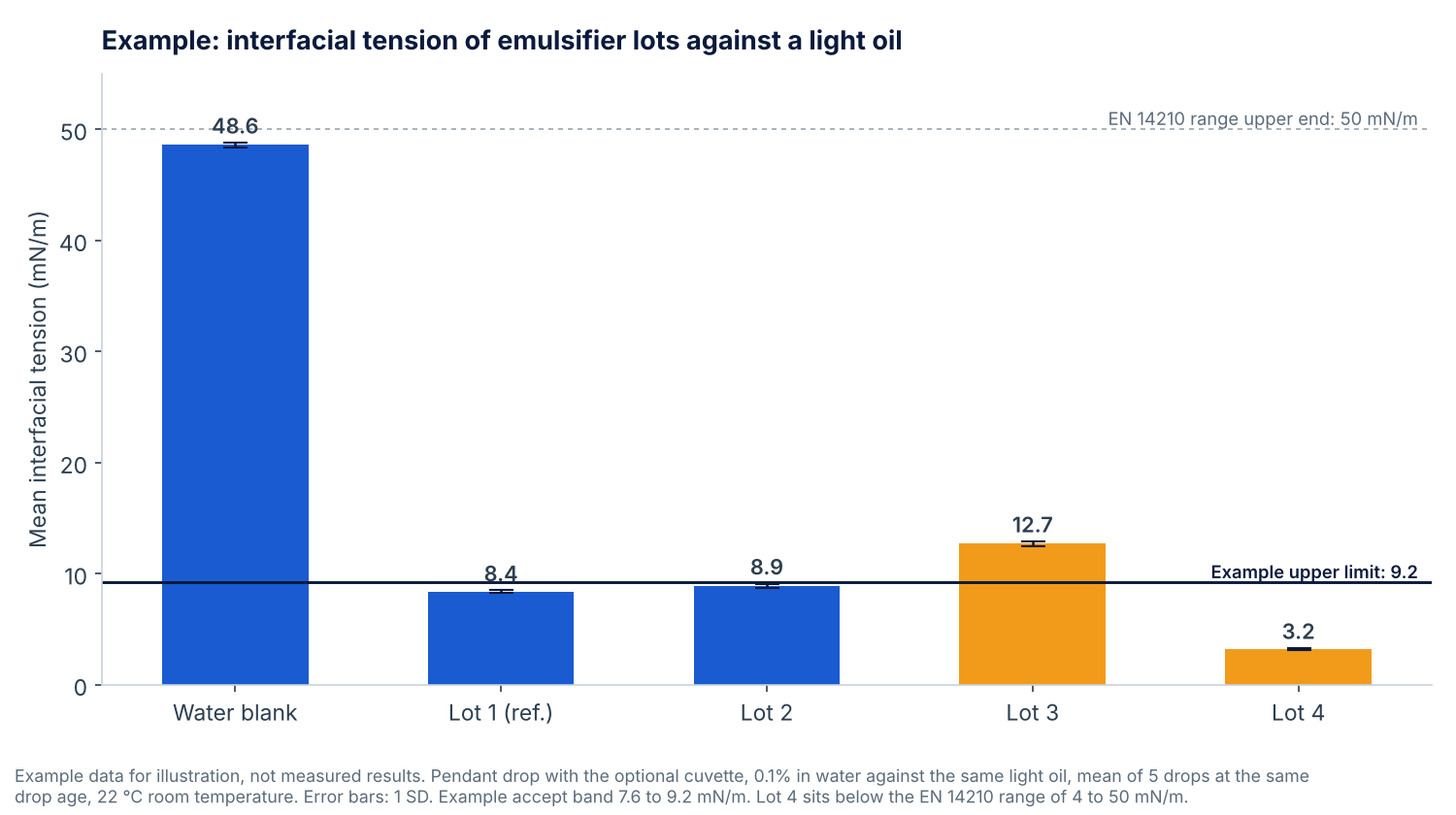
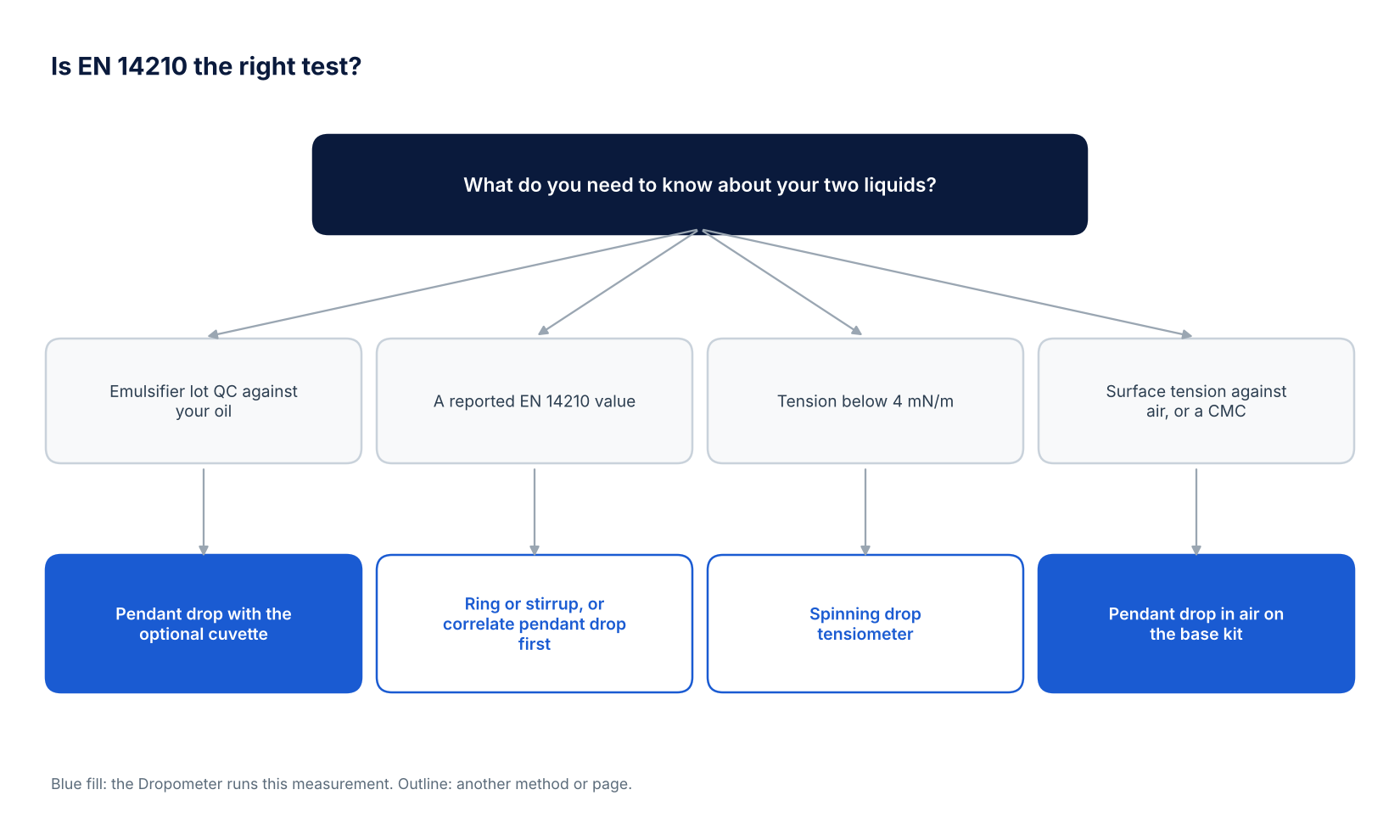
Partially compliant. The Dropometer gets the end result the standard is after: interfacial tension, by pendant drop with the optional cuvette. Pendant drop is an alternative method, not the stirrup or ring method the standard specifies; if a contract or customer requires an EN 14210 result, run a correlation study on your own samples first.
Interfacial tension runs by pendant drop with the optional cuvette; the Dropometer product specification gives no accuracy figure or range for it. Surface tension in air, used for the daily water check, reads up to 75 mN/m with ±0.03 mN/m accuracy (Dropometer product specification).
The drop shape method is validated against a KRUSS DSA100E in two peer reviewed papers. See our validation publications.
Researchers studying emulsion phase inversion used the Dropometer to measure pendant drop interfacial tension of anionic, cationic, non ionic and zwitterionic surfactant solutions and cellulose nanocrystal suspensions in a cuvette of oil (Colloids and Interfaces, 2025). Read our analysis of the paper.
Interfacial tension shows how far a surfactant lowers the tension between two liquids. It does not predict emulsion stability on its own, which also depends on droplet size and the film around each droplet. Pair it with your stability test.