


Contents
Complements workflow

API RP 13B-1 and RP 13B-2: field testing of water based and nonaqueous drilling fluids, and the surface tension checks around them

API RP 13B sets the field tests for drilling fluids: RP 13B-1 for water based muds and RP 13B-2 for oil based, or nonaqueous, muds. It covers density, rheology, filtration, solids, chemistry and electrical stability, and has no surface tension, interfacial tension or wettability test. The Dropometer does not run any RP 13B test. It complements the workflow in the lab: surface tension of surfactant solutions, filtrates and base fluids, oil and brine interfacial tension with the optional cuvette, and contact angle on barite, rock or steel, to qualify additives and explain results.

What brings you here?

Who this is for
Drilling fluid labs, mud service companies and suppliers of surfactants, emulsifiers and wetting agents.
Compliance tier
Complements workflow: the Dropometer runs none of the RP 13B tests. It adds surface tension and contact angle checks, and interfacial tension with the optional cuvette, on additives, filtrates, base fluids and solids.
Measurement
Pendant drop surface tension up to 75 mN/m, ±0.03 mN/m accuracy; contact angle 10° to 175°, ±0.35° accuracy; interfacial tension with the optional cuvette, no published accuracy figure (Dropometer datasheet).
Setup
About 2 minutes. Battery powered, 1 kg, runs on the lab bench.
Last updated
October 20, 2026

Free one page checklist for the surface tension and wetting checks that sit around API RP 13B: what to prepare, the settings to lock and what to record. Made for drilling fluid labs.

Talk to an expert

Book a 15 minute demo on your fluids

Tell us your mud system, surfactants and current lab tests. We will show the measurement live and tell you plainly where the Dropometer fits around API RP 13B and where it does not.

Book a 15 minute demo
View the official standard
Gurdeep-Saini-Photo
Written by
Gurdeep Singh Saini
Holds a BASc in Mechanical Engineering from Ryerson University (now Toronto Metropolitan University) and an MASc from York University. He develops the automatic edge and baseline detection behind the Dropometer's analysis.
COO at Droplet Lab
Read More
Droplet-Lab logo
Technical Review by
Droplet Lab Team
Droplet Lab builds precision instruments and software for surface science measurement, specialising in contact angle analysis and surface tension characterisation. Used by researchers across materials science, pharmaceuticals, coatings, and advanced manufacturing, Droplet Lab's Dropometer has contributed to studies published in peer-reviewed journals including Advanced Functional Materials (Impact Factor 19). The team combines instrument engineering with deep domain knowledge in wettability science with a focus on practical accuracy.
Read More
Verified against API RP 13B
Gurdeep-Saini-Photo
Written By

Gurdeep Singh Saini

COO at Droplet Lab

Holds a BASc in Mechanical Engineering from Ryerson University (now Toronto Metropolitan University) and an MASc from York University. He develops the automatic edge and baseline detection behind the Dropometer's analysis.

Droplet-Lab logo
Reviewed By

Droplet Lab Team

Droplet Lab builds precision instruments and software for surface science measurement, specialising in contact angle analysis and surface tension characterisation. Used by researchers across materials science, pharmaceuticals, coatings, and advanced manufacturing, Droplet Lab's Dropometer has contributed to studies published in peer-reviewed journals including Advanced Functional Materials (Impact Factor 19). The team combines instrument engineering with deep domain knowledge in wettability science with a focus on practical accuracy.

Evidence box: API RP 13B-1, RP 13B-2 and the Dropometer

Standard

API RP 13B-1, Testing Water-based Drilling Fluids, sixth edition, January 2026, and API RP 13B-2, Field Testing Nonaqueous-based Drilling Fluids, sixth edition, July 2023, from the American Petroleum Institute. Many labs still cite the 2019 fifth edition of RP 13B-1. Earlier editions were also published as ISO 10414-1 and ISO 10414-2.

Compliance tier

Complements workflow. RP 13B measures density, viscosity and gel strength, filtration, liquids and solids content, sand, chemistry and, for nonaqueous muds, electrical stability. The Dropometer measures none of these. It adds surface tension and contact angle checks, and interfacial tension with the optional cuvette, before or after the RP 13B tests.

Instrument performance

Surface tension by pendant drop up to 75 mN/m, accuracy ±0.03 mN/m, resolution 0.01 mN/m, static and dynamic. Contact angle 10° to 175°, accuracy ±0.35°. Interfacial tension by pendant drop with the optional cuvette, with no published accuracy figure. From the Dropometer product specification.

Peer reviewed method

The drop shape method is validated against a KRUSS DSA100E in two peer reviewed papers. See our validation publications.

Customer evidence

We have no published client paper or case study on drilling fluids yet. For the related workflow, see drilling and fracturing fluid surfactant screening.

What it does not tell you

A surface tension or contact angle reading does not give mud weight, rheology, fluid loss or electrical stability. Keep running RP 13B, and use the wetting checks to qualify additives and explain results.
Executive summary: field testing water based and nonaqueous drilling fluids

What this practice covers, who uses it and how the Dropometer fits

API RP 13B is the American Petroleum Institute recommended practice for field testing drilling fluids: Part 1, RP 13B-1, covers water based muds and Part 2, RP 13B-2, covers oil based muds, now called nonaqueous drilling fluids. Mud engineers, fluids labs and service companies use it to measure drilling fluid density (mud weight) with a mud balance, rheology, filtration, sand content, liquids and solids contents, methylene blue capacity, pH, alkalinity and lime content, chloride, calcium and total hardness, and, for invert muds, electrical stability. The Dropometer complements this workflow. It measures none of the RP 13B quantities and does not replace any of its tests. It adds lab checks on the liquids and solids behind the mud: surface tension of surfactant solutions, filtrates and base fluids, oil and brine interfacial tension with the optional cuvette, and contact angle on barite, rock or steel.

Neither part lists a surface tension, interfacial tension or wettability test. The closest link is the RP 13B-2 electrical stability test, which industry glossaries describe as a sign of the emulsion and oil wetting qualities of an invert mud. The annexes on activity, aniline point, oil retained on cuttings and sag do not measure wetting either. So wetting checks sit before RP 13B, when you qualify an additive, or after it, when you look for the cause of a poor result.

The Dropometer pendant drop tensiometer reads surface tension up to 75 mN/m with ±0.03 mN/m accuracy, static and dynamic, on a lab bench. For the full screening workflow, see drilling and fracturing fluid surfactant screening. Lower interfacial tension raises the capillary number, which is why many surfactant packages target it. For background, read the oil and gas guide and the surface tension measurement guide.

Further reading: reproducible surface tension measurement, surface tension of common liquids, including water, choosing a tensiometer for production QC and the coffee ring effect, which explains why a drying drop of filtrate leaves a residue ring.

How the Dropometer fits around the drilling fluid tests

A surface tension check around API RP 13B, step by step, in our own words

From additive lot or filtrate to a recorded surface tension

These steps outline one way to add a pendant drop check before or after your RP 13B tests. They are not part of RP 13B and do not replace it. Buy the current editions and run their tests as written.

±0.03 mN/m

Surface tension accuracy

From the Dropometer product specification. Resolution is 0.01 mN/m.

Up to 75 mN/m

Surface tension range

Covers surfactant solutions, filtrates, base oils and water. Concentrated brines can read above it.

Cuvette

Optional accessory

Needed for oil and brine interfacial tension and for contact angles on samples held under base oil.

1

Run your RP 13B tests as written

Measure density, rheology, filtration, solids and chemistry, and electrical stability for nonaqueous muds, as the current edition specifies. The Dropometer does not run these tests. The checks below sit before or after them.

2

Choose the liquid to check

Pick what the question needs: a fixed dilution of a surfactant, emulsifier or wetting agent in your make up water, a clear filtrate from the filtration test, or the base fluid. Whole weighted mud does not form a clean pendant drop.

3

Prepare the samples

Let samples reach room temperature and record it. Filter or settle out solids. Use clean glassware and make each dilution the same way, because small amounts of surfactant change surface tension.

4

Set up the Dropometer

Level the base plate, mount the phone and LED, and fill a clean syringe with the sample. Check the setup on pure water first. For oil and brine interfacial tension, fill the optional cuvette with the outer liquid.

5

Capture and read

Form a pendant drop and read the surface tension from its shape. Read static values at a fixed age, or use dynamic mode at fixed times of about 0.1 s and later. Repeat with fresh drops.

6

Record next to the RP 13B results

Record the mean, spread, sample, lot, dilution and room temperature on the same sheet as your RP 13B results. Compare with your reference lot and hold band. For wettability, see ASTM G205 for oil and water angles on steel.

7

Watch the full measurement

This video shows a complete Dropometer pendant drop surface tension measurement, from setup to result. It covers the steps above in one run.

Dropometer pendant drop surface tension, start to finish.

Validated measurement approach

Independent benchmarking and publication-based validation references.

Peer reviewed method

The Dropometer drop shape method is validated against a KRUSS DSA100E in two peer reviewed papers, one in Review of Scientific Instruments and one in Colloids and Surfaces A. Published surface tension accuracy is ±0.03 mN/m.

Read the validation papers

Customer evidence

We have no published client paper or case study on drilling fluids yet. The surfactant screening use case shows how surface tension readings, and interfacial tension readings with the optional cuvette, rank drilling and fracturing fluid chemicals.

Read the use case

Set your limits from your own fluids

API RP 13B · additive QC · surface tension

API RP 13B gives no surface tension, interfacial tension or contact angle limit, because it does not measure them (source: API RP 13B-2 sixth edition listing and the RP 13B-1 scope).

Check the setup first on pure water, which reads about 72 mN/m at room temperature (source: surface tension of common liquids). Then measure a reference lot of each surfactant, emulsifier or wetting agent that performed well in your mud.

Set the hold band from your own correlation study: compare lot readings with the RP 13B results and field performance of the muds they went into. Repeat the study when you change make up water, base fluid or supplier.

Example output

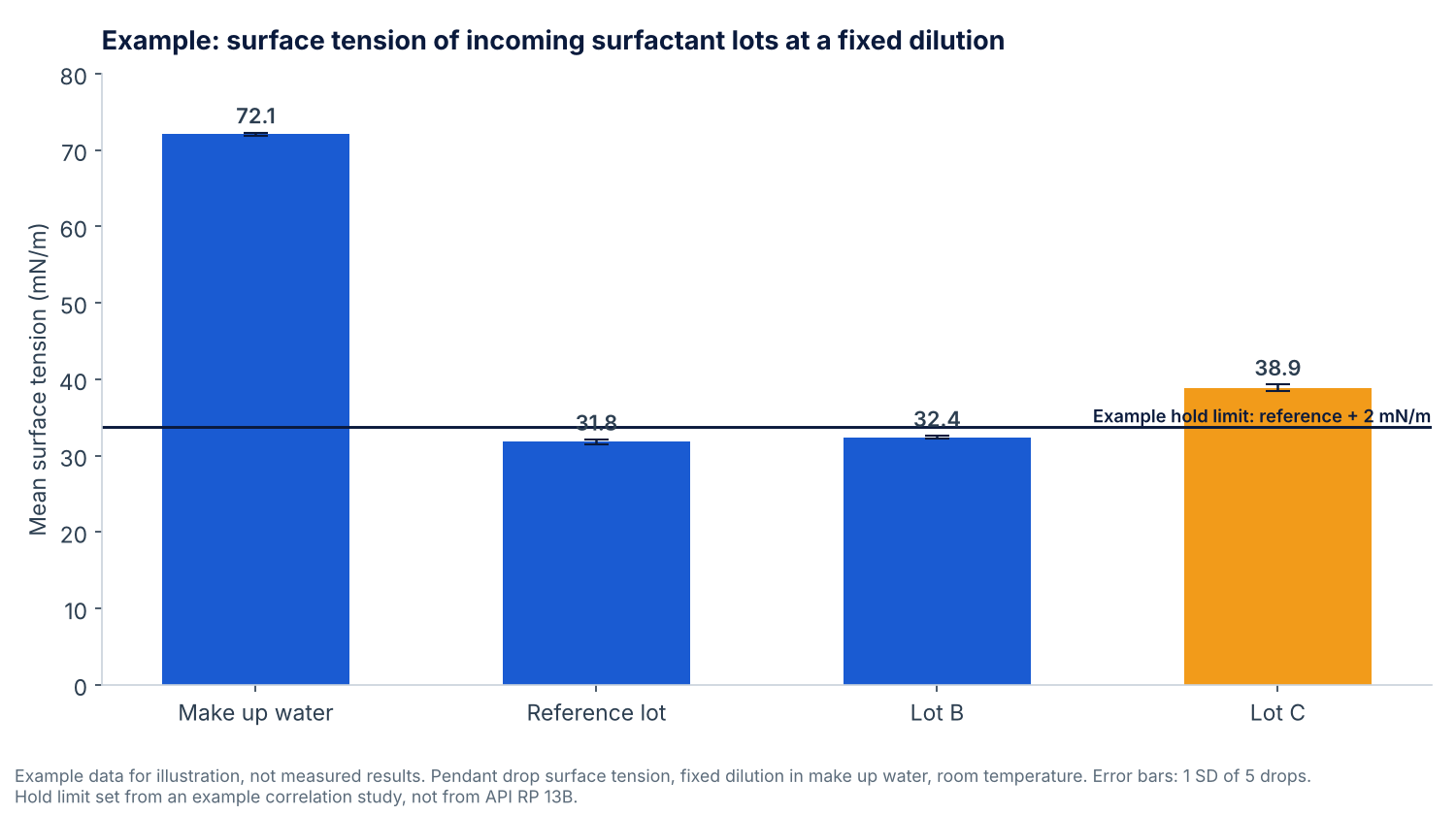
Example data for illustration only. These are not measured results. Your own additives, water and limits decide the numbers.

Example: incoming surfactant lots, pendant drop surface tension of a fixed dilution in make up water

Sample Drops (n) Mean surface tension (mN/m) Std dev (mN/m) Change vs reference lot (mN/m) Decision
Make up water (setup check)572.10.2Not applicableSetup check in expected range
Surfactant, reference lot531.80.30.0Reference
Surfactant, lot B532.40.2+0.6Within example band: release
Surfactant, lot C538.90.4+7.1Outside example band: hold and test in mud

How to read this table

Each row is the mean of five pendant drops. The water row checks the setup. The decision column uses an example hold band of 2 mN/m above the reference lot, set from a correlation study with RP 13B results.

Example output chart

The same example data as the table, plotted against an example hold limit 2 mN/m above the reference lot.

Bar chart of example pendant drop surface tension for make up water and three surfactant lots, with the reference lot and a hold limit 2 mN/m above it

Example data, not measured results.

Business impact

What changes when additive quality is a measured number

Metric Before Dropometer With Dropometer Results
How additive lots are checked Supplier data sheet and a trial mud Surface tension of a fixed dilution, read by pendant drop No published benchmark
Result format Pass or fail in a later mud test A value per drop, ±0.03 mN/m accuracy Dropometer product specification
Record Lab notebook entry Drop image and value saved per measurement No published benchmark
Mud weight, rheology, fluid loss, electrical stability RP 13B test kit Still the RP 13B test kit API RP 13B-1 and 13B-2 scope

See the measurement on your own additives

Bring a surfactant lot that worked and one you doubt. We will measure both live by pendant drop.

ROI estimate

Estimate the cost of the additive problems this check can help catch

Enter your own numbers. The defaults are examples, not Droplet Lab results.

Quality cost snapshot

Estimate what wetting related failures cost you.

Example only. Use what you see in a trial on your own samples.
Your own figure.
Your own estimate.

Result

~0
Estimated annual cost today
~0
Estimated annual cost avoided
~0
Payback period

Annual exposure combines audit/CAPA cost, customer rejections, and recall probability; avoided exposure applies the risk reduction percentage.

Method settings for additive, filtrate and base fluid checks

Lock these before you compare lots, labs or wells

Parameter Recommended Setting Technical Rationale
Sample Additive dilution, clear filtrate or base fluid Whole weighted mud has solids and gel strength, so it does not hang as a clean drop.
Dilution Fixed concentration in your own make up water Surface tension depends on concentration, so lots are only comparable at the same dilution.
Drop type Pendant drop; liquid in liquid with the optional cuvette for interfacial tension Surface tension needs air around the drop. Interfacial tension needs the second liquid.
Drop age Fixed static age, or dynamic readings from about 0.1 s Surfactants take time to reach the surface. The camera runs at 10 frames per second.
Fit model Young-Laplace, the same for every run Pendant drop shape follows the Young-Laplace equation. Do not change the model within a study.
Replicates At least five fresh drops per sample Fresh drops avoid evaporation and ageing of one drop.
Setup check Pure water before each session A water reading far from about 72 mN/m points to a dirty syringe or needle.
Environment Room temperature, recorded RP 13B runs some tests at raised temperature and pressure. The Dropometer has no temperature control and runs at 10 to 45 °C.

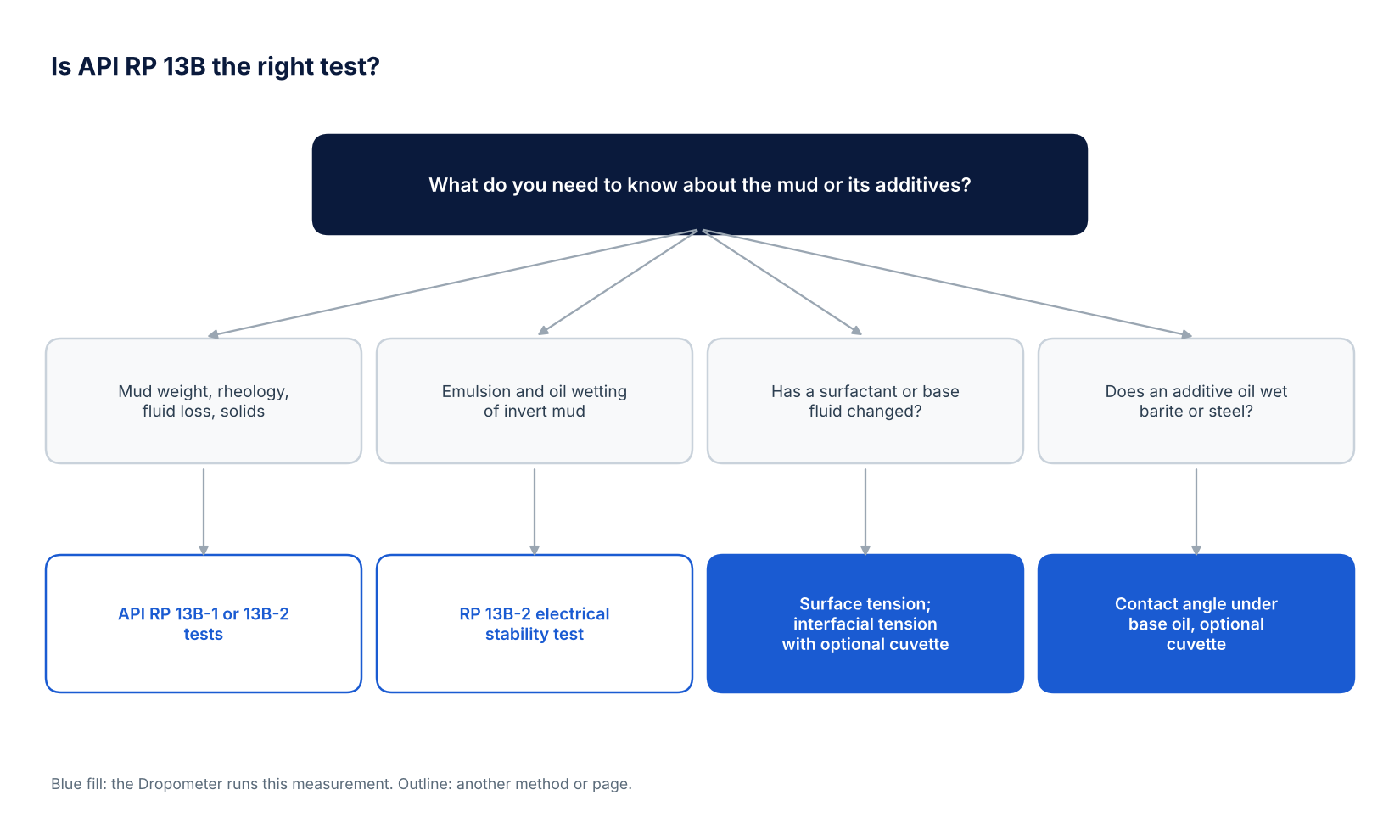
Is API RP 13B the right test?

Pick the method by the question you need answered

Start: What do you need to know about the mud or its additives?

Mud weight, rheology, fluid loss or solids

Signals:

You need the properties a mud report lists for the well.

Rule-out:

Use API RP 13B-1 for water based muds or RP 13B-2 for nonaqueous muds. The Dropometer does not run these tests.

Emulsion and oil wetting of an invert mud

Signals:

You want the standard check on an oil based or synthetic based mud.

Rule-out:

Use the RP 13B-2 electrical stability test. A contact angle can help explain a low reading but does not replace it.

Has a surfactant or base fluid lot changed?

Signals:

You qualify incoming chemicals or trace why a mud behaved differently.

Rule-out:

Measure pendant drop surface tension on a fixed dilution, or interfacial tension with the optional cuvette. The Dropometer runs this. See surfactant screening.

Does an additive oil wet barite, rock or steel?

Signals:

You screen wetting agents or study formation damage.

Rule-out:

Measure a contact angle on a flat sample held under base oil, with the optional cuvette. For core samples see API RP 40.

Decision tree at a glance

Start from the question you need answered. Blue boxes are measurements the Dropometer runs. The RP 13B tests themselves are not.

Decision tree for choosing between the API RP 13B mud tests, the RP 13B-2 electrical stability test, pendant drop surface tension, interfacial tension with the optional cuvette, and contact angle under base oil

Is API RP 13B the right test?

Interpreting results

What the reading tells you, and what it does not

Higher surface tension, less active surfactant: At a fixed dilution, a lot that reads higher than the reference likely has less active material or a different blend.
Lower interfacial tension, stronger emulsifier action: Emulsifiers lower oil and brine interfacial tension, which the Dropometer measures with the optional cuvette. A change from your reference can point to a weak or contaminated lot.
Angle through water shows oil wetting: On barite, rock or steel under base oil, a higher angle through the water drop means a more oil wet surface.
Wetting explains, RP 13B decides: These readings help explain a poor electrical stability or fluid loss result. The mud still passes or fails on its RP 13B tests.
Expert perspective

Why the liquids behind the mud are worth measuring

Place a drop and just read it and you get an apparent angle: a value somewhere between advancing and receding that isn't much use. Zisman settled that in the fifties.

Dr. Alidad Amirfazli

Department of Mechanical Engineering, York University, Co-founder and Scientific Advisor, Droplet Lab

Common pitfalls and limits

Honest limits of the method and of the Dropometer

Whole weighted mud does not form a clean pendant drop. Measure additive dilutions, clear filtrate or base fluid instead.
Concentrated brines can read above 75 mN/m, the top of the surface tension range. Report those as above range.
The Dropometer has no temperature control and does not test under pressure. Results are at room temperature, not downhole or flowline conditions.
Interfacial tension runs with the optional cuvette and has no published accuracy figure. Check the setup on a known liquid pair first.
The camera runs at 10 frames per second. Dynamic readings start at about 0.1 s, not at the millisecond ages a bubble pressure tensiometer reaches.
Loose cuttings are too rough and irregular for a reliable contact angle. Use flat chips, coupons or pressed pellets.
FAQ

Frequently asked questions

What does API RP 13B cover?

API RP 13B is the API recommended practice for field testing drilling fluids. RP 13B-1 covers water based muds and RP 13B-2 covers nonaqueous, or oil based, muds. Together they cover density, viscosity and gel strength, filtration, liquids and solids content, sand, chemistry and, for nonaqueous muds, electrical stability.

Does API RP 13B include a surface tension or wettability test?

No. Neither part lists a surface tension, interfacial tension or wettability test. The closest link is the RP 13B-2 electrical stability test, which the SLB Energy Glossary describes as a sign of the emulsion and oil wetting qualities of an oil based mud.

Can the Dropometer run API RP 13B?

No. RP 13B measures mud weight, rheology, filtration, solids, chemistry and electrical stability, and the Dropometer measures none of these. It complements the workflow in the lab: surface tension of additives, filtrates and base fluids, interfacial tension with the optional cuvette, and contact angle on barite, rock or steel. These checks help qualify additives and explain RP 13B results.

Why measure the surface tension of drilling fluid additives?

Surfactants, emulsifiers and wetting agents work at interfaces, so a lot that reads differently at the same dilution may behave differently in the mud. The Dropometer reads surface tension by pendant drop with ±0.03 mN/m accuracy. Set your hold band from your own correlation with mud results. See reproducible surface tension measurement.

Can the Dropometer measure oil and brine interfacial tension for invert emulsion muds?

Yes, with the optional cuvette, by pendant drop of one liquid in the other. Use the clear base fluid and brine, with and without the emulsifier. The datasheet gives no interfacial tension accuracy figure, so check the setup on a known liquid pair first.

Does a contact angle replace the electrical stability test in API RP 13B-2?

No. Electrical stability is the RP 13B-2 test and stays in the mud report. A contact angle of a brine drop on barite or steel under base oil, with the optional cuvette, can help show whether an additive oil wets the solids, which may explain a low electrical stability reading. Relate the two only through your own data.

Legal note

This page summarises API RP 13B-1 and RP 13B-2 in our own words and does not reproduce either document. Buy the current editions from API before you write a procedure. The Dropometer complements the workflow: it measures surface tension, interfacial tension with the optional cuvette and contact angle, and runs none of the RP 13B tests. Droplet Lab does not certify compliance. Your own method validation does.

How this page was created

Sources, review and tools

Transparency 4 checklist items
01

Sources

API RP 13B-2, Field Testing Nonaqueous-based Drilling Fluids, sixth edition, 2023 (Accuris, API store); API RP 13B-2 fifth edition, 2014 (historical, Accuris); API Series 13 drilling fluid materials listing (Accuris), RP 13B-1 fifth edition 2019 and earlier editions; API RP 13B-1 sixth edition listing (Nimonik), the Dropometer product specification and Droplet Lab validation papers.

02

Drafting assistance

Drafted with Claude (Anthropic) from the sources listed, then reviewed by Droplet Lab.

03

What we did not do

We did not copy text from the standard. Buy the current edition for the full procedure.

04

Last checked

October 2026

Report a correction

Spotted an issue in this summary? Send a correction request and our team will review it.

Correction Request

We work hard to keep this page accurate and up to date. If you spot an error (wrong revision/year, missing requirement, incorrect interpretation, or broken link), tell us and we'll review it.

Contact us to report a correction

References

1. API RP 13B-1 (6th ed., 2026) / API RP 13B-2 (6th ed., 2023). store.accuristech.com/standards/api-rp-13b-2
2. API RP 13B-2 fifth edition, 2014 (historical, Accuris). store.accuristech.com/standards/api-rp-13b-2
3. API Series 13 drilling fluid materials listing (Accuris), RP 13B-1 fifth edition 2019 and earlier editions. store.accuristech.com/atis/subgroups/16787
4. API RP 13B-1 sixth edition listing (Nimonik). standards.nimonik.com/products/api/rp-13b-1/
5. Droplet Lab. Peer reviewed validation papers in Review of Scientific Instruments and Colloids and Surfaces A. dropletlab.com/validation/publications/
6. Droplet Lab. Dropometer product specification, 2026. dropletlab.com/products/dropometer/