“
Wettability is set by the top five to ten ångström of a surface: what the liquid actually sees. It doesn't matter what lies beneath; that outermost layer is what you are really measuring.

API RP 40 sets recommended practices for core analysis, and asks that wettability be measured as soon as possible after the core leaves the formation. With the optional cuvette, the Dropometer reads wettability as an oil and brine contact angle on a flat rock or mineral surface, with ±0.35° accuracy. Contact angle on a flat surface is an alternative method, not the core plug Amott or USBM test many core labs use; if a contract or customer requires an API RP 40 wettability result, run a correlation study on your own samples first.
What brings you here?
Core analyst
You need a quick wettability reference before cleaning, storage and restoration change the rock. An oil and brine contact angle gives you a number per surface that you can log next to your core data.
Reservoir engineer
You need to know whether the rock is water wet, neutral or oil wet before you trust relative permeability and capillary pressure data. Set angle bands from your own correlation with core plug tests.
R&D
You need to see whether a surfactant or brine shifts rock toward water wet. Use the decision tree to see which question the angle answers and which tests you still need.
Free one page checklist for an API RP 40 wettability reference by contact angle: what to prepare, the settings to lock, the drop geometry and what to record. Made for core and reservoir labs.
Talk to an expert
Tell us your rock, crude and brine. We will show the captive drop measurement live and tell you plainly which parts of your core analysis the Dropometer covers and which it does not.


Droplet Lab builds precision instruments and software for surface science measurement, specialising in contact angle analysis and surface tension characterisation. Used by researchers across materials science, pharmaceuticals, coatings, and advanced manufacturing, Droplet Lab's Dropometer has contributed to studies published in peer-reviewed journals including Advanced Functional Materials (Impact Factor 19). The team combines instrument engineering with deep domain knowledge in wettability science with a focus on practical accuracy.
API Recommended Practice 40, Recommended Practices for Core Analysis, second edition, February 1998. It replaced RP 40 (1960) and RP 27. API's store, run by Accuris, lists this edition as withdrawn, with no newer edition shown. It is still cited in core analysis work.
Partially compliant. RP 40 section 2.6 aims to measure wettability as soon as possible after core recovery, as a reference. With the optional cuvette, the Dropometer gives that reading as an oil and brine contact angle on a flat rock or mineral surface. It does not run the saturation, porosity, permeability or supplementary tests, or core plug Amott and USBM tests.
Contact angle range 10° to 175°, accuracy ±0.35°, display resolution 0.01°, from the Dropometer product specification. With the optional cuvette, the Dropometer also runs captive bubbles, captive drops under a submerged sample, and interfacial tension by pendant drop of one liquid in another.
The drop shape method is validated against a KRUSS DSA100E in two peer reviewed papers. See our validation publications.
We have no published client paper or case study on reservoir rock wettability yet. For a related workflow, see wettability alteration screening.
A contact angle on a flat surface does not capture pore geometry, mixed wetting inside the pores or a whole plug's response. Amott and USBM indices do. Pair the angle with your core lab tests.
What this practice covers, who uses it and how the Dropometer fits
API RP 40 is the American Petroleum Institute's recommended practice for core analysis: how to plan coring, handle and preserve core, and measure saturation, porosity and permeability. Core labs, reservoir engineers and operators use it to keep core data comparable. Its section on preserving wettability asks for a wettability reading as soon as possible after the core is recovered. The Dropometer is partially compliant: with the optional cuvette it reads wettability as an oil and brine contact angle on a flat rock or mineral surface, with ±0.35° accuracy. It does not measure saturation, porosity or permeability, and it does not run Amott or USBM tests on core plugs.
Contact angle on a flat surface is an alternative method, not the core plug imbibition or centrifuge test many labs pair with RP 40; if a contract or customer requires a wettability index, run a correlation study on your own samples first. RP 40 warns that drilling fluid, coring fluid, clays and storage can all change wettability, so a quick early reading gives you a reference before those effects build up. For bench practice, see reproducible contact angle measurement.
The Dropometer contact angle and surface energy kit runs on battery power in the core lab. With the same optional cuvette it also measures oil and brine interfacial tension by pendant drop. To screen chemicals that shift rock wetting, see wettability alteration screening for surfactants and chemicals. For background, read the oil and gas guide and the contact angle measurement guide.
Further reading: water contact angle reference values for common surfaces, choosing a contact angle goniometer for industrial QA and the Leidenfrost effect, a wetting effect on very hot surfaces.
A contact angle wettability reference for API RP 40 work, step by step, in our own words
These steps outline one common way to take a contact angle wettability reading with the Dropometer and the optional cuvette. They do not replace API RP 40 or your core lab methods. Set the surfaces, liquids, ageing and drop volume in your own written method.
From the Dropometer product specification. Display resolution is 0.01°.
Covers most water wet to strongly oil wet readings. A drop that spreads flat on clean quartz reads below range.
Holds the brine and the submerged rock or mineral surface for the captive oil drop. The same optional cuvette runs oil and brine interfacial tension.
Cut and polish flat slices from the rock, or use quartz or calcite plates as model surfaces. Clean and dry them the same way every time and handle them by the edges. RP 40 warns that cleaning and storage can change wettability, so record each step.
Soak the surfaces in formation brine or a matched synthetic brine, then in crude oil if your method restores reservoir wetting. Record ageing time and conditions. RP 40 notes that water saturation, temperature and time all affect restored wettability.
Level the base plate, mount the phone and LED, and fill the optional cuvette with brine. Hold the surface face down in the brine. Custom holders are available on request.
Release the crude oil drop below the submerged surface in the optional cuvette, so it rises and settles. A captive drop under a submerged sample is a supported Dropometer setup. Keep the drop volume the same for every drop.
Capture the drop at the reading time your method sets. Automatic edge and baseline detection reads the left and right angles, so two operators get the same reading from the same image. Report the angle through the water phase.
Repeat on fresh areas. Record the mean, spread, rock, crude, brine, ageing and room temperature. Then compare the angles with Amott or USBM results on sister plugs. To screen chemicals that shift wetting, see wettability alteration screening.
This video shows a complete Dropometer contact angle measurement, from setup to result. It covers the steps above in one run.
Independent benchmarking and publication-based validation references.
Peer reviewed method
The Dropometer drop shape method is validated against a KRUSS DSA100E in two peer reviewed papers, one in Review of Scientific Instruments and one in Colloids and Surfaces A. Published contact angle accuracy is ±0.35°.
Customer evidence
We have no published client paper or case study on reservoir rock wettability yet. The wettability alteration use case shows how oil and water contact angles screen chemicals that shift wetting.
API RP 40 · rock wettability · oil and brine contact angle
API RP 40 asks for an early wettability reference but, in the text we could review, gives no contact angle limits. A common reference table gives approximate bands, read through the water: water wet from 0° to about 60 to 75°, neutral from there to about 105 to 120°, and oil wet above that (source: AAPG Wiki, Wettability, Table 1).
Contact angle tests on model surfaces use cleaned quartz or calcite, aged in brine and then with a crude oil drop, as described in a Schlumberger review (source: Abdallah et al., Oilfield Review, 2007). The same review notes that Amott and USBM indices run from about +1 for strongly water wet to about minus 1 for strongly oil wet.
So set your own bands from a correlation study. Measure angles on flat surfaces cut from the same rock as sister plugs, then compare them with the Amott or USBM results from your core lab. Repeat the study when you change rock type, crude, brine or ageing method.
Example data for illustration only. These are not measured results. Your own rock, crude, brine, ageing and bands decide the numbers.
| Surface | Treatment | Drops (n) | Mean angle through water (°) | Std dev (°) | Example band |
|---|---|---|---|---|---|
| Quartz plate | Brine only | 5 | 28.6 | 1.9 | Water wet |
| Quartz plate | Aged in crude A | 5 | 84.1 | 3.2 | Neutral |
| Calcite plate | Aged in crude A | 5 | 131.7 | 4.0 | Oil wet |
| Calcite plate | Aged, then surfactant B soak | 5 | 92.5 | 3.6 | Neutral |
| Carbonate rock slice | Aged in crude A | 5 | 118.3 | 5.8 | Oil wet |
Each row is the mean of five drops on fresh areas. The band column uses example cut points of 75° and 105°, inside the approximate ranges in the AAPG Wiki table. Your own bands come from a correlation study with core plug tests.
The same example data as the table, plotted against example wettability bands at 75° and 105°.
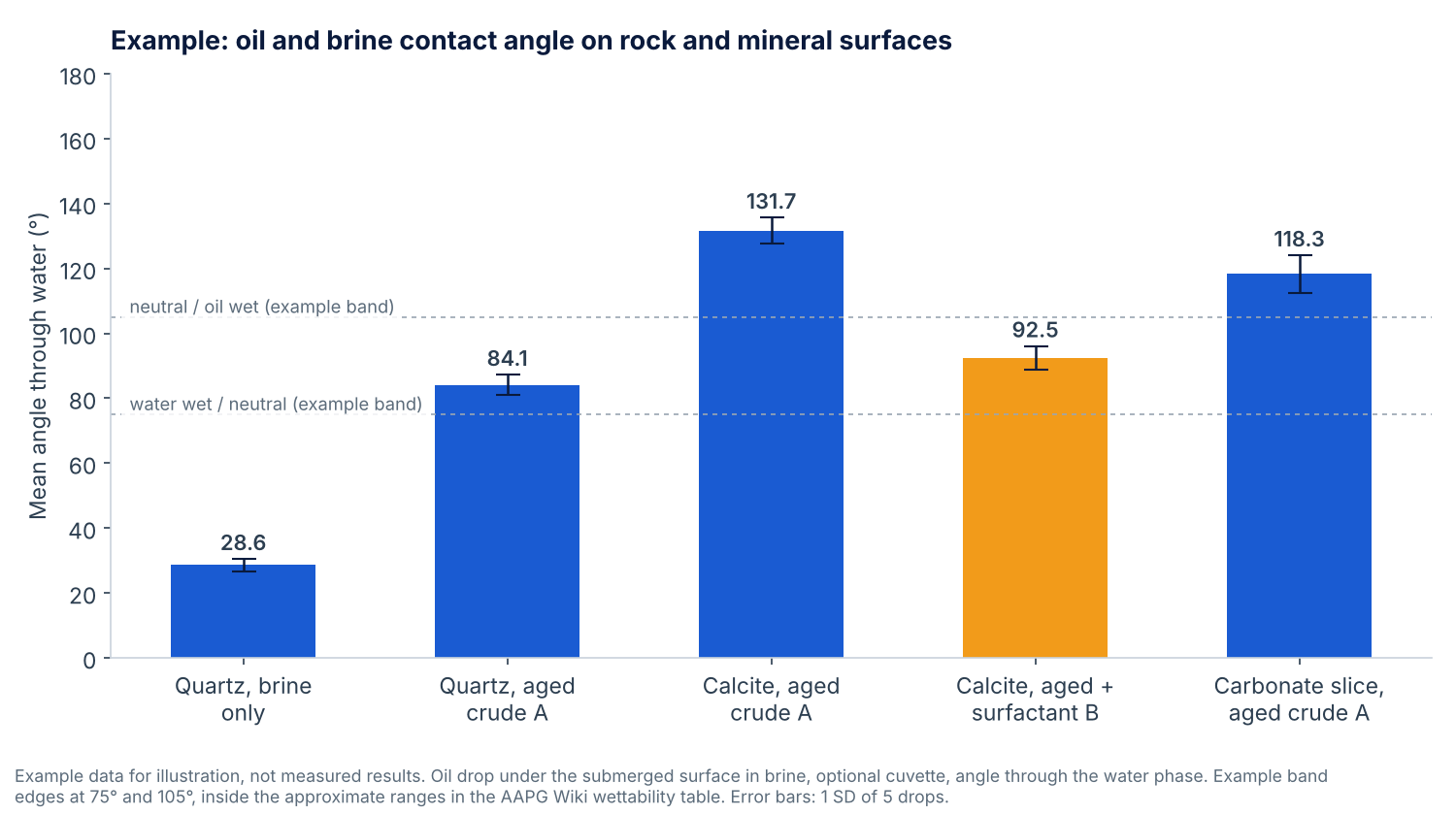
Example data, not measured results.
What changes when the wettability reference is a measured angle
| Metric | Before Dropometer | With Dropometer | Results |
|---|---|---|---|
| Early wettability reference | None, or judged from field behaviour | Oil and brine contact angle on a flat surface from the same rock | API RP 40 section 2.6 aim |
| Result format | Water wet or oil wet, by judgement | An angle per drop, 0.01° display, ±0.35° accuracy | Dropometer product specification |
| Record | Lab notebook entry | Drop image and angle saved per measurement | No published benchmark |
| Wettability index on core plugs | Amott or USBM in a core lab | Still need the core lab | Abdallah et al., Oilfield Review 2007 |
Bring a flat rock slice or mineral plate, your crude and your brine. We will measure the angle live under brine.
Enter your own numbers. The defaults are examples, not Droplet Lab results.
Quality cost snapshot
Result
Annual exposure combines audit/CAPA cost, customer rejections, and recall probability; avoided exposure applies the risk reduction percentage.
Lock these before you compare rocks, wells or treatments
| Parameter | Recommended Setting | Technical Rationale |
|---|---|---|
| Surface | Flat, polished slice of the rock, or a quartz or calcite plate | A drop needs a flat surface. Pores and roughness change the apparent angle. |
| Bulk phase | Brine in the optional cuvette | Most crudes are opaque. A clear bulk phase lets the camera see the drop outline. |
| Drop phase and geometry | Crude oil drop under the submerged surface, captive drop in the optional cuvette | The oil rises onto the surface. A water drop under clear model oil is the other common layout. |
| Angle convention | Through the water phase, stated in the report | Most wettability studies report it this way. Higher angles then mean more oil wet. |
| Ageing | As your method sets, recorded for every surface | Crude components adsorb over time, and RP 40 notes time and temperature affect restored wettability. |
| Drop volume | As your method sets, fixed for every drop | The automatic dropper add on doses down to 0.05 µL. |
| Static or moving contact line | Static angle at a fixed reading time; advancing and receding if your method needs them | The Dropometer reads advancing and receding angles by adding or withdrawing liquid through the needle. |
| Environment | Room temperature, recorded | The Dropometer has no temperature control, does not test under pressure and runs at 10 to 45 °C. |
Pick the method by the question you need answered
Start: What do you need to know about your rock and fluids?
You want an early wettability reference, or a quick comparison of rocks, crudes, brines or chemicals.
Use an oil and brine contact angle, this page. The Dropometer is partially compliant and runs it as a captive oil drop under the submerged surface, with the optional cuvette.
You need an Amott or USBM index for reservoir models or a contract.
Use a core lab with imbibition cells, a flood cell or a centrifuge. The Dropometer does not run these tests. The angle can help you choose which plugs to send.
You need routine core analysis data on plugs or whole core.
Use the API RP 40 core lab methods. The Dropometer does not measure these properties.
You study how a surfactant or brine changes oil and water behaviour.
The Dropometer measures it by pendant drop with the optional cuvette. See ASTM G205 for oil and water wetting on steel.
Start from the question you need answered. Blue boxes are measurements the Dropometer runs, with the optional cuvette.
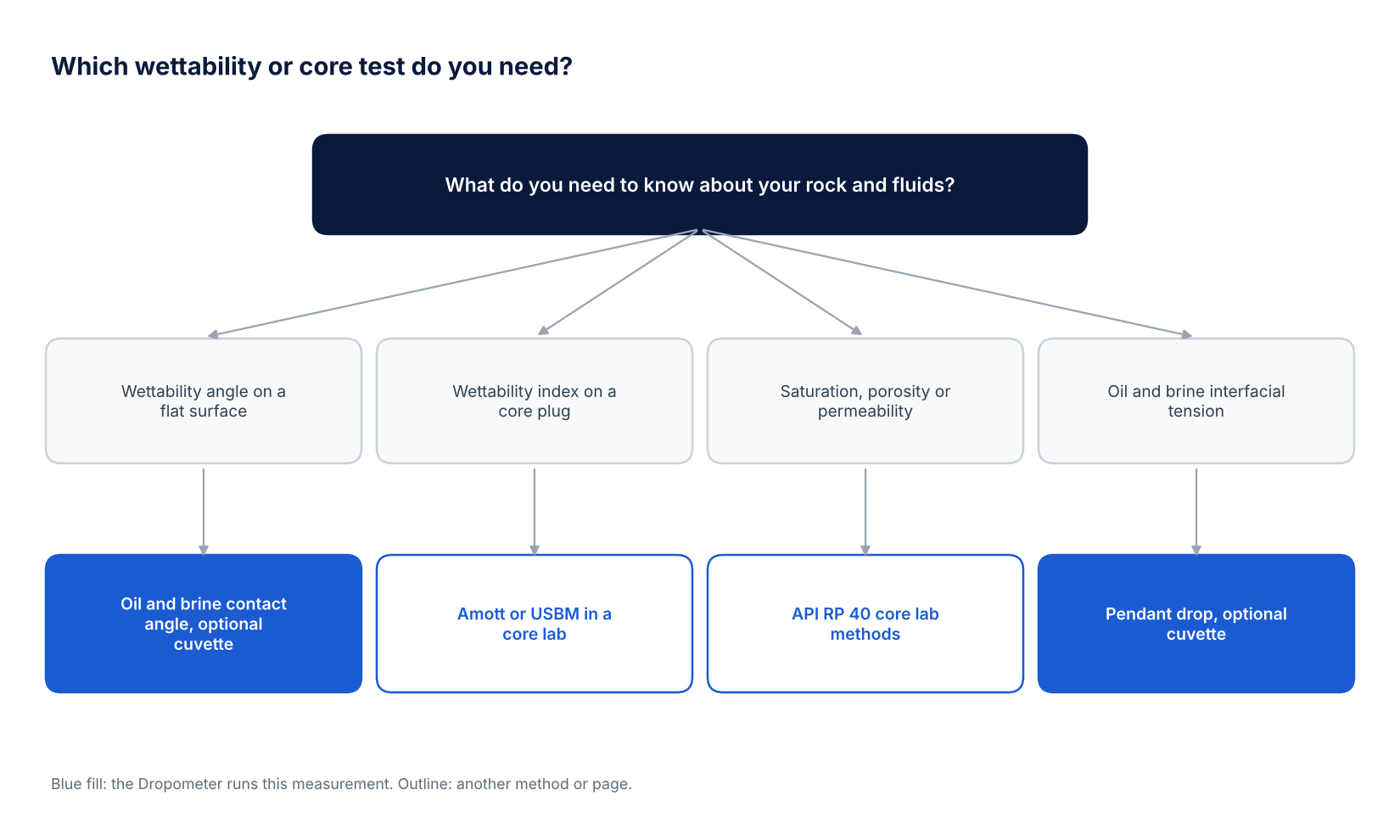
Which wettability or core test do you need?
What the angle tells you, and what it does not
Honest limits of the method and of the Dropometer
API RP 40 sets recommended practices for core analysis in eight sections: planning a coring program, wellsite handling and preservation, core screening and preparation, fluid saturation, porosity, permeability, supplementary tests and reporting. It excludes two and three phase relative permeability. The second edition dates from February 1998.
RP 40 treats wettability mainly as something to protect. It warns that drilling fluid, clays and storage can change it, and section 2.6 aims to measure wettability as soon as possible after recovery as a reference. In the text we could review it names no Amott, USBM or contact angle procedure. Check your copy before you write a method.
In part. With the optional cuvette, the Dropometer gives a wettability reading as an oil and brine contact angle on a flat rock or mineral surface, with ±0.35° accuracy. It does not measure saturation, porosity or permeability, so you need core lab equipment for the rest of RP 40.
No. Amott uses spontaneous and forced imbibition on a core plug, and USBM uses a centrifuge, so both need a core lab. Contact angle on a flat surface is an alternative method, not the core plug Amott or USBM test; if a contract or customer requires an API RP 40 wettability result or a wettability index, run a correlation study on your own samples first.
No single limit is published in API RP 40. A common reference table, read through the water, gives water wet up to about 60 to 75°, neutral up to about 105 to 120°, and oil wet above that. See the AAPG Wiki wettability page. Set your own bands from sister plug tests.
Yes. A wettability angle looks at oil and brine on the rock at the same time, so the surface must sit in brine. The optional cuvette holds the brine and the submerged surface, and the oil drop is released under it as a captive drop. The same optional cuvette runs captive bubbles and oil and brine interfacial tension by pendant drop.
API's store, run by Accuris, lists the 1998 second edition as withdrawn, and no newer edition is listed. Many labs and contracts still cite it. Check with API, or with your client, which edition or replacement method your work must follow.
This page summarises API RP 40 in our own words and does not reproduce it. Buy the edition your contract names before you write a procedure. The Dropometer is partially compliant: it gives a contact angle wettability reading with the optional cuvette, not saturation, porosity, permeability or Amott and USBM indices. Droplet Lab does not certify compliance. Your own method validation does.
Sources, review and tools
API RP 40 listing, Accuris (API store): 2nd edition, 1998, withdrawn; API RP 40 listing, GlobalSpec: February 1998, inactive; API RP 40, Recommended Practices for Core Analysis, 2nd edition (Energistics copy; sections 1 to 2.6.1 reviewed); Abdallah et al., Fundamentals of Wettability, Oilfield Review, Summer 2007, the Dropometer product specification and Droplet Lab validation papers.
Drafted with Claude (Anthropic) from the sources listed, then reviewed by Droplet Lab.
We did not copy text from the standard. Buy the current edition for the full procedure.
October 2026
Spotted an issue in this summary? Send a correction request and our team will review it.
Correction Request
We work hard to keep this page accurate and up to date. If you spot an error (wrong revision/year, missing requirement, incorrect interpretation, or broken link), tell us and we'll review it.
Contact us to report a correction