
API RP 13B-1, Testing Water-based Drilling Fluids, sixth edition, January 2026, and API RP 13B-2, Field Testing Nonaqueous-based Drilling Fluids, sixth edition, July 2023, from the American Petroleum Institute. Many labs still cite the 2019 fifth edition of RP 13B-1. Earlier editions were also published as ISO 10414-1 and ISO 10414-2.
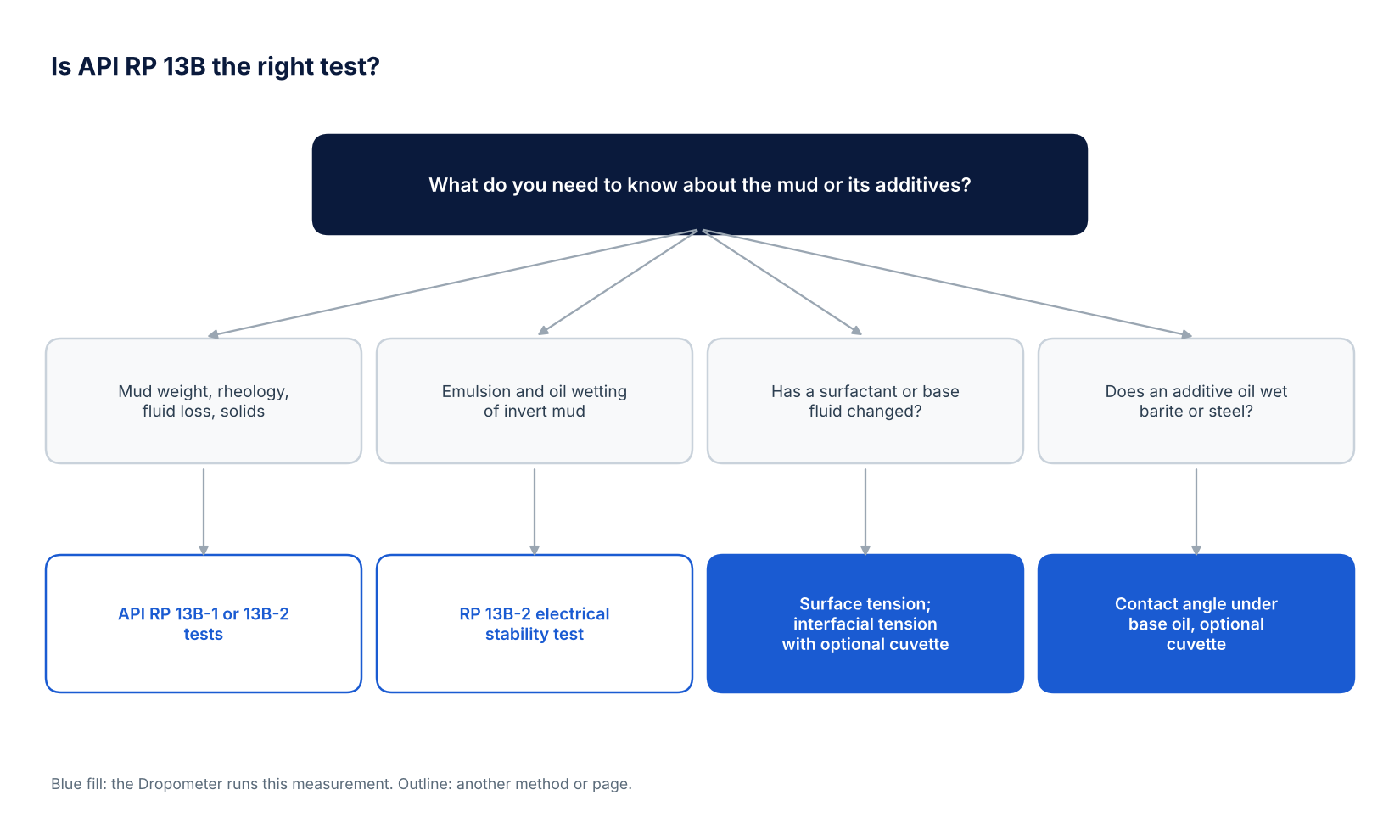
Complements workflow. RP 13B measures density, viscosity and gel strength, filtration, liquids and solids content, sand, chemistry and, for nonaqueous muds, electrical stability. The Dropometer measures none of these. It adds surface tension and contact angle checks, and interfacial tension with the optional cuvette, before or after the RP 13B tests.
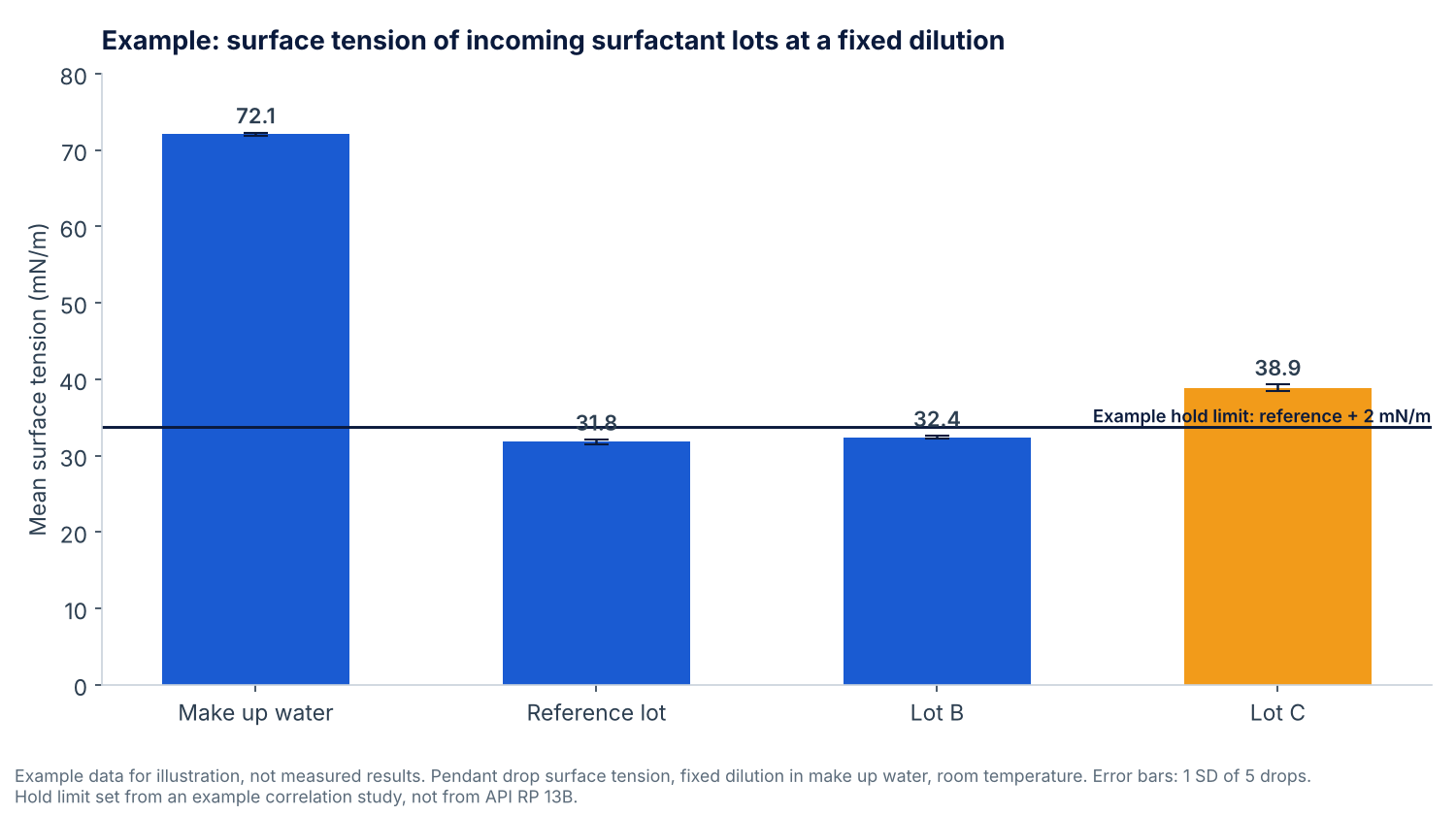
Surface tension by pendant drop up to 75 mN/m, accuracy ±0.03 mN/m, resolution 0.01 mN/m, static and dynamic. Contact angle 10° to 175°, accuracy ±0.35°. Interfacial tension by pendant drop with the optional cuvette, with no published accuracy figure. From the Dropometer product specification.
The drop shape method is validated against a KRUSS DSA100E in two peer reviewed papers. See our validation publications.
We have no published client paper or case study on drilling fluids yet. For the related workflow, see drilling and fracturing fluid surfactant screening.
A surface tension or contact angle reading does not give mud weight, rheology, fluid loss or electrical stability. Keep running RP 13B, and use the wetting checks to qualify additives and explain results.