“
What a liquid responds to is only the outermost few ångström of a surface: the skin, not the bulk. Change that skin and you change the wetting, even if the material underneath is identical.

EN 15802 shows how well stone, brick, mortar and other porous heritage materials shed water by reading the static water contact angle. The Dropometer reads that angle from 10° to 175° with ±0.35° accuracy (product specification), so it covers most treated surfaces. Untreated stone often absorbs the drop or reads below 10°: record those drops as below range.
What brings you here?
Conservation scientist
You need to compare water repellents and consolidants on the same stone with a number, not a description. A timed static angle per drop gives you values you can compare across treatments and ageing steps.
Product developer
You need to show how your product performs on real stone, fresh and after ageing. Fix the reading time, measure several positions, and set limits from your own correlation data.
Conservator
You need to know whether a contact angle answers your question, or whether you also need water absorption or roughness data. Use the decision tree to pick the test.
Free one page checklist for EN 15802: what to prepare, the settings to lock, how to time the reading on absorbing stone and what to record. Made for conservation and treatment testing labs.
Talk to an expert
Tell us your stone, treatment and current check. We will measure live and tell you plainly which part of EN 15802 the Dropometer covers and which it does not.


Droplet Lab builds precision instruments and software for surface science measurement, specialising in contact angle analysis and surface tension characterisation. Used by researchers across materials science, pharmaceuticals, coatings, and advanced manufacturing, Droplet Lab's Dropometer has contributed to studies published in peer-reviewed journals including Advanced Functional Materials (Impact Factor 19). The team combines instrument engineering with deep domain knowledge in wettability science with a focus on practical accuracy.
EN 15802:2009, Conservation of cultural property: test methods: determination of static contact angle, from CEN/TC 346. National editions such as UNI EN 15802:2010, SIST EN 15802:2010 and BS EN 15802:2009 (published January 2010) are identical. See the BSI listing.
Partially compliant. The Dropometer measures the static water contact angle on porous specimens from 10° to 175°. Untreated or weakly treated stone can absorb the drop or read below 10°, outside that range, so those drops are recorded as below range.
Contact angle range 10° to 175°, accuracy ±0.35°, display resolution 0.01°, camera 10 frames per second, from the Dropometer product specification.
The drop shape method is validated against a KRUSS DSA100E in two peer reviewed papers. See our validation publications.
We have no published client paper on stone or heritage materials yet. For typical values on other materials, see water contact angle reference values.
A high angle shows the surface sheds water at the moment of reading. It does not show how deep a treatment went, how much water the stone takes up over hours, or whether it still lets vapour out. Pair it with absorption and permeability tests.
What this standard measures, who uses it and how the Dropometer fits
EN 15802 measures the static contact angle of a water drop on porous inorganic materials used in cultural property, such as stone, brick, mortar and plaster, whether untreated, treated or aged. Conservation scientists, conservators and suppliers of water repellents use it to compare treatments and to follow how they age. The Dropometer is partially compliant: it reads the static water contact angle from 10° to 175° with ±0.35° accuracy (product specification), but untreated stone often absorbs the drop or reads below 10°, outside that range.
The method places a drop of water on the specimen and reads the angle from the drop profile at a set time. On porous stone the drop soaks in, so the angle falls with time and the reading time matters as much as the angle. For the term itself, see the contact angle glossary entry. For the method in depth, read the contact angle measurement guide.
The Dropometer contact angle and surface energy kit runs on battery and captures drop images at 10 frames per second. That suits a reading at a fixed time, such as several seconds after the drop lands, but not millisecond absorption studies. For wider context on building materials, read our construction guide. To keep results comparable between operators and labs, follow our notes on reproducible contact angle measurement.
Further reading: water contact angle reference values for common surfaces, choosing a contact angle goniometer for industrial QA and the Leidenfrost effect, or why drops skate on very hot surfaces.
The EN 15802 measurement, step by step, in our own words
These steps outline the procedure and show where the Dropometer reaches its limit. They do not replace the standard. Buy the current edition and follow its drop volume, reading time and specimen rules.
From the Dropometer product specification. Display resolution is 0.01°.
Untreated stone can absorb the drop or read below 10°. Record those drops as below range.
10 frames per second: fine for a reading at a set time, not for millisecond absorption studies.
Cut or select specimens with a flat, level test face. Note the stone, the treatment, the application date and any ageing step. Use the number, size and pre conditioning the standard specifies, so the stone holds the same moisture for every test.
Place the base plate on a level bench, mount the phone and LED, and fill a clean syringe with water of the grade the standard specifies. Lay the specimen flat on the sessile stage, test face up. Use the automatic dropper add-on (down to 0.05 µL) or the manual dropper (5.29 µL per rotation) to set the drop volume.
Dispense the drop volume the standard specifies onto a fresh area, without touching the stone with the needle. Start the app's multi capture as the drop lands, so you have a series of images at 10 frames per second and a known time zero.
Read the angle from the image at the reading time the standard specifies. Automatic edge and baseline detection reads the left and right angles, so two operators get the same reading from the same image. If the drop has soaked in or reads below 10°, record it as not measurable or below range.
Place drops at several positions on each specimen. Stone varies in porosity and treatments soak in unevenly, so one drop is not enough. Studies that cite EN 15802 report 15 positions per specimen (Materials, 2018).
Record the mean, spread, reading time, number of drops below range, treatment, ageing step and room conditions. Compare the mean with your own limit. For habits that keep results comparable, see reproducible contact angle measurement.
This video shows a complete Dropometer contact angle measurement, from setup to result. It covers the steps above in one run.
Independent benchmarking and publication-based validation references.
Peer reviewed method
The Dropometer drop shape method is validated against a KRUSS DSA100E in two peer reviewed papers, one in Review of Scientific Instruments and one in Colloids and Surfaces A. Contact angle accuracy is ±0.35° (Dropometer product specification).
Customer evidence
We have no published client paper on stone or heritage materials yet. Our open data set lists water contact angles on common surfaces, so you can see what typical values look like before you test your own stone.
EN 15802 · water repellency · treatment testing
The public listings of EN 15802 give no pass or fail angle (source: BS EN 15802:2009 listing). Many conservation studies treat 90° as the line between hydrophilic and hydrophobic behaviour (for example, a 2024 study of hydrophobic coatings on limestone). Use that as a reference line, not as a specification.
Set your own limit from a correlation study. Measure untreated, treated and aged specimens of the same stone, at the same reading time, and compare the angles with how well each specimen keeps water out, for example by capillary absorption to EN 15801. Pick the angle that separates good from poor performance.
Check where your results sit against the Dropometer range of 10° to 175°. Treated stone usually reads well inside it. Untreated or weakly treated stone can read below 10° or absorb the drop before the reading time: record those drops as below range or not measurable, and do not report a value for them. Repeat the study when you change the stone, the product, the application rate or the ageing method.
Example data for illustration only. These are not measured results. Your own stone, treatment, ageing method and limits decide the numbers.
| Specimen | Drops (n) | Mean angle at reading time (°) | Std dev (°) | Decision |
|---|---|---|---|---|
| Untreated limestone | 15 | Absorbed or below 10 (below range) | n/a | Not measurable: expected for untreated stone |
| Water repellent A | 15 | 128.4 | 3.1 | Accept |
| Water repellent A, after ageing | 15 | 121.9 | 3.8 | Accept |
| Water repellent B | 15 | 104.6 | 4.2 | Accept |
| Water repellent B, after ageing | 15 | 82.7 | 5.6 | Below 90°: review the treatment |
Each row is the mean of 15 drops read at the same set time after deposition. The decision column uses an example limit of 90° or higher, a reference line many conservation studies use; set yours from your own correlation study. The untreated stone absorbed the drops or read below 10°, outside the Dropometer range, so no value is given.
The same example data as the table, plotted against the example 90° limit and the bottom of the Dropometer range. The untreated stone is left out because it absorbed the drops or read below 10°.
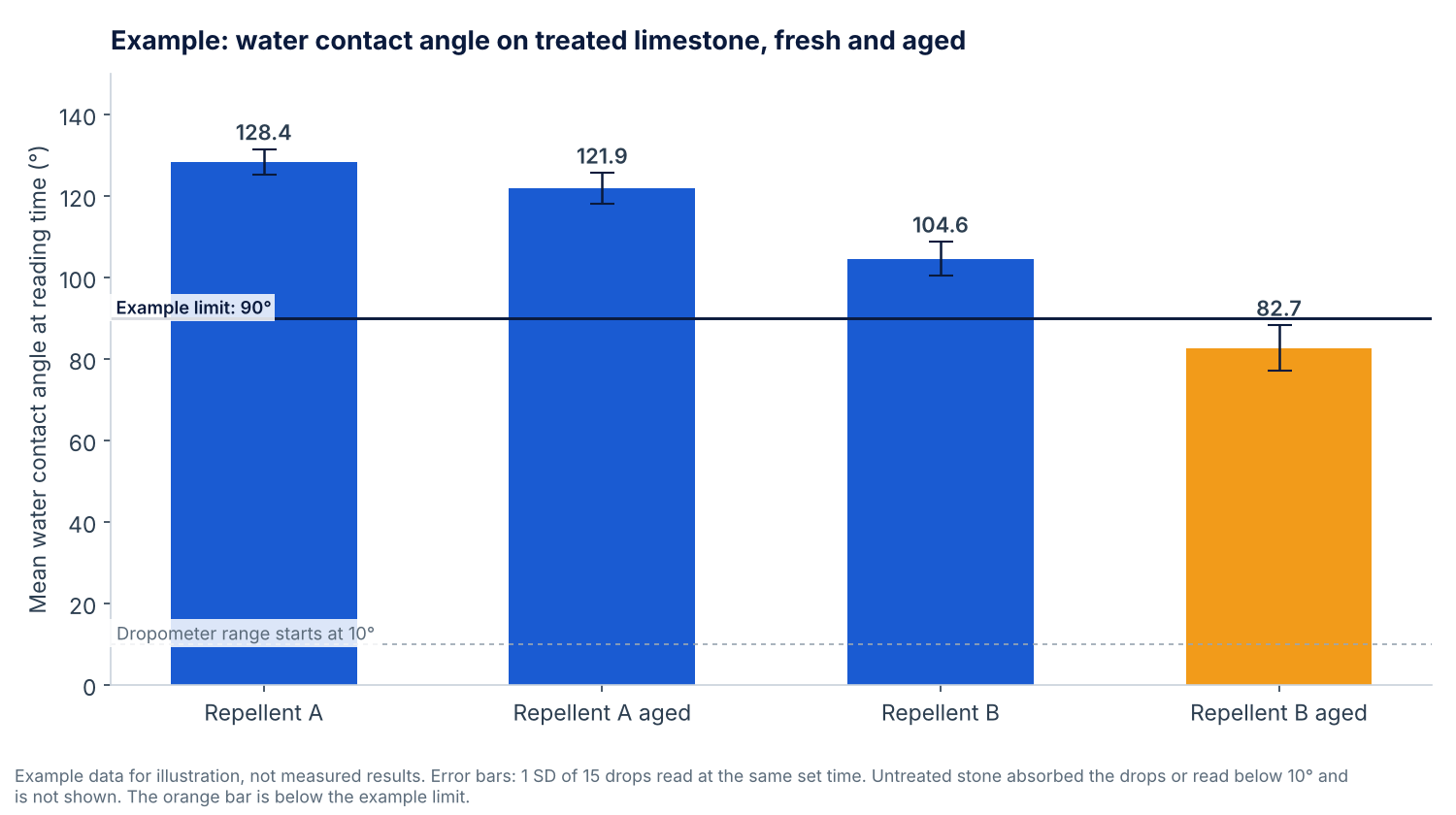
Example data, not measured results.
What changes when water repellency is a timed, measured angle
| Metric | Before Dropometer | With Dropometer | Results |
|---|---|---|---|
| How the check is made | Drop beading judged by eye | Static water contact angle read from the drop image | No published benchmark |
| Result format | Description or photo | An angle per drop, 0.01° display, ±0.35° accuracy | Dropometer product specification |
| Timing on absorbing stone | Reading time estimated by hand | Image series at 10 frames per second from the moment the drop lands | Dropometer product specification |
| Untreated stone below 10° | Lab goniometer rated for low angles | Recorded as below range or not measurable | Dropometer range 10° to 175°, product specification |
Bring an untreated and a treated specimen of the same stone. We will measure both live and show how the angle changes with time.
Enter your own numbers. The defaults are examples, not Droplet Lab results.
Quality cost snapshot
Result
Annual exposure combines audit/CAPA cost, customer rejections, and recall probability; avoided exposure applies the risk reduction percentage.
Lock these before you compare treatments, ageing steps or labs
| Parameter | Recommended Setting | Technical Rationale |
|---|---|---|
| Test liquid | Water, of the grade the standard specifies | This is a water contact angle method. Impure water gives false readings. |
| Drop type | Sessile drop, static angle | The method reads a drop resting on a level test face. |
| Drop volume | As the standard specifies, fixed for every drop | Studies citing EN 15802 report 5 µL drops. A changing volume changes how fast the drop soaks in. |
| Reading time | As the standard specifies, fixed for every drop | On porous stone the angle falls as water soaks in. Studies citing the standard report 10 s or 30 s. |
| Capture | Multi capture at 10 frames per second from deposition | Gives a known time zero and lets you check the angle at the set time. |
| Measuring range | 10° to 175°; record lower or absorbed drops as below range | Dropometer product specification. Untreated stone often reads below 10°. |
| Fit model | Young-Laplace or polynomial, the same for every run | Both models are in the Dropometer software. Do not mix them within one study. |
| Environment | Record room temperature and humidity | The Dropometer runs at 10 to 45 °C and has no temperature or humidity control. |
Pick the method by the question you need answered
Start: What do you need to know about the stone surface?
You want a measured angle to compare treatments or ageing steps on the same stone.
Use EN 15802, this page. The Dropometer is partially compliant and covers angles from 10° to 175°.
The drop soaks in before the reading time, or you need uptake over minutes or hours.
Use a water absorption test such as capillary absorption to EN 15801. A contact angle cannot give a value here.
A treatment, cleaning or weathering step may have changed the surface texture.
Measure areal roughness to ISO 25178. Roughness also shifts the apparent angle.
You need to know why a coating, mortar or adhesive does or does not bond to the stone.
Measure angles with two or more liquids, as in DIN EN 828. The Dropometer runs this on non absorbing surfaces.
Start from the question you need answered. Blue boxes are measurements the Dropometer runs.
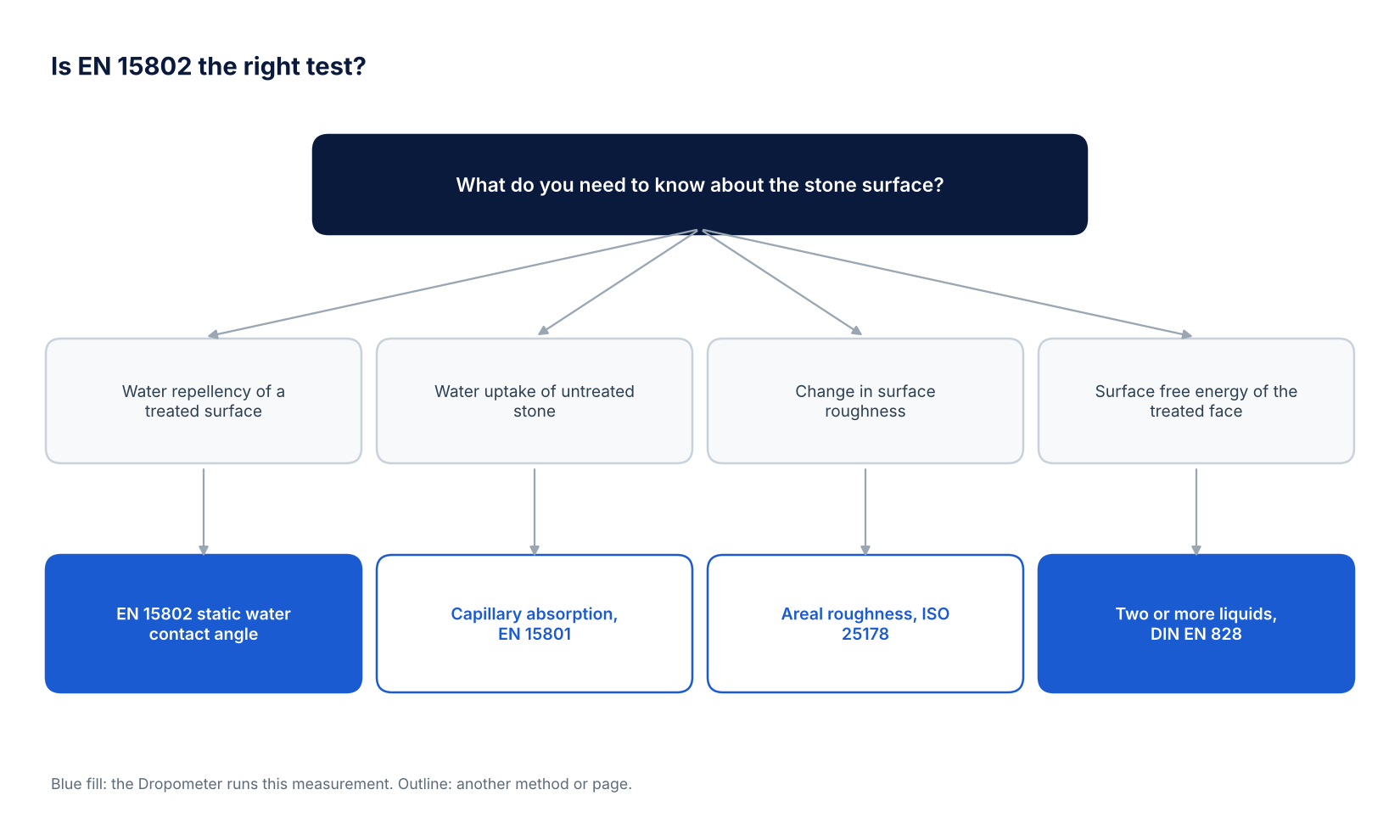
Is EN 15802 the right test?
What the angle tells you, and what it does not
Honest limits of the method and of the Dropometer
It measures the static contact angle of a water drop on porous inorganic materials used in cultural property, such as stone, brick and mortar. It applies to untreated, treated and aged materials. Conservation labs use it mainly to compare water repellent treatments and to follow how they age.
No. CEN published EN 15802 in December 2009. National bodies then issued identical editions, such as UNI EN 15802:2010 in Italy and SIST EN 15802:2010 in Slovenia, which is why both years appear. See the BSI listing.
In part. The Dropometer measures the static water contact angle on porous specimens from 10° to 175° with ±0.35° accuracy (product specification). That covers most treated stone. Untreated stone often absorbs the drop or reads below 10°, outside that range, so record those drops as below range.
Follow your copy of the standard. Studies that cite EN 15802 report 5 µL drops read 10 s after deposition (Materials, 2018), and a 2025 study states the standard sets 30 s (iScience, 2025). Both are well within a camera running at 10 frames per second.
The public listings give no pass or fail angle. Many conservation studies use 90° as the line between hydrophilic and hydrophobic, for example this 2024 limestone study. Set your own limit from a correlation study on your stone, fresh and aged.
Porous stone draws water in through its pores, so the drop shrinks and the angle drops. Evaporation adds to this. That is why EN 15802 fixes a reading time. The Dropometer app's multi capture records images at 10 frames per second, so you can read the angle at the set time and see the trend.
No. A high angle shows the surface sheds water at the moment of reading. It does not show how much water the stone takes up over time or whether vapour can still escape. Pair EN 15802 with a water absorption test such as EN 15801.
This page summarises EN 15802 in our own words and does not reproduce the standard. Buy the current edition from your national standards body before you write a procedure. The Dropometer is partially compliant with this method. Droplet Lab does not certify compliance. Your own method validation does.
Sources, review and tools
BSI Knowledge: BS EN 15802:2009 listing (current, identical to EN 15802:2009); iTeh: EN 15802:2009 listing (CEN/TC 346, scope, contents); UNI: UNI EN 15802:2010 listing (in force since 4 February 2010); EN 15801:2009 listing (capillary water absorption), the Dropometer product specification and Droplet Lab validation papers.
Drafted with Claude (Anthropic) from the sources listed, then reviewed by Droplet Lab.
We did not copy text from the standard. Buy the current edition for the full procedure.
October 2026
Spotted an issue in this summary? Send a correction request and our team will review it.
Correction Request
We work hard to keep this page accurate and up to date. If you spot an error (wrong revision/year, missing requirement, incorrect interpretation, or broken link), tell us and we'll review it.
Contact us to report a correction