


Contents
Fully compliant

DIN EN 828: surface free energy from contact angle, before you bond

Find out whether a surface is ready to bond by measuring its surface free energy, the method DIN EN 828 describes for adhesives. The Dropometer reads the contact angle of each test liquid with ±0.35° accuracy (Dropometer product specification), on a drop shape method validated in two peer reviewed papers. The free calculator then turns those angles into OWRK surface free energy.

What brings you here?

Who this is for
Adhesive and primer makers, automotive and industrial suppliers and anyone who bonds, coats or pretreats parts.
Compliance tier
Fully compliant: the Dropometer measures the static contact angles this method describes, and OWRK runs in the free calculator.
Measurement
Sessile drop contact angle of three to eight liquids, 10° to 175° range, ±0.35° accuracy (Dropometer datasheet).
Setup
About 2 minutes. Battery powered, 1 kg, runs at the bonding line or in the lab.
Last updated
October 20, 2026

Free one page checklist for DIN EN 828: what to prepare, which settings to lock, how many drops per liquid and what to record. Made for bonding and adhesives labs.

Talk to an expert

Book a 15 minute demo on your substrate

Tell us your substrate, pretreatment and current readiness check. We will run the measurement live and tell you plainly where the Dropometer fits your bonding plan and where it does not.

Book a 15 minute demo
View the official standard
Gurdeep-Saini-Photo
Written by
Gurdeep Singh Saini
Holds a BASc in Mechanical Engineering from Ryerson University (now Toronto Metropolitan University) and an MASc from York University. He develops the automatic edge and baseline detection behind the Dropometer's analysis.
COO at Droplet Lab
Read More
Droplet-Lab logo
Technical Review by
Droplet Lab Team
Droplet Lab builds precision instruments and software for surface science measurement, specialising in contact angle analysis and surface tension characterisation. Used by researchers across materials science, pharmaceuticals, coatings, and advanced manufacturing, Droplet Lab's Dropometer has contributed to studies published in peer-reviewed journals including Advanced Functional Materials (Impact Factor 19). The team combines instrument engineering with deep domain knowledge in wettability science with a focus on practical accuracy.
Read More
Verified against DIN EN 828:2013
Gurdeep-Saini-Photo
Written By

Gurdeep Singh Saini

COO at Droplet Lab

Holds a BASc in Mechanical Engineering from Ryerson University (now Toronto Metropolitan University) and an MASc from York University. He develops the automatic edge and baseline detection behind the Dropometer's analysis.

Droplet-Lab logo
Reviewed By

Droplet Lab Team

Droplet Lab builds precision instruments and software for surface science measurement, specialising in contact angle analysis and surface tension characterisation. Used by researchers across materials science, pharmaceuticals, coatings, and advanced manufacturing, Droplet Lab's Dropometer has contributed to studies published in peer-reviewed journals including Advanced Functional Materials (Impact Factor 19). The team combines instrument engineering with deep domain knowledge in wettability science with a focus on practical accuracy.

Evidence box

Standard

DIN EN 828:2013-04, the German version of EN 828:2013, Adhesives: Wettability: Determination by measurement of contact angle and surface free energy of solid surface. It replaces DIN EN 828:1998-01 (DIN Media listing). BS EN 828:2013 is the UK adoption. German title: Klebstoffe: Benetzbarkeit: Bestimmung durch Messung des Kontaktwinkels und der freien Oberflächenenergie fester Oberflächen. The 1998 edition determined the critical surface tension of the solid surface instead.

Compliance tier

Fully compliant. The Dropometer measures the static sessile drop contact angles, left and right, that this method reads for each liquid, which feed the determination of the surface free energy.

Instrument performance

Contact angle range 10° to 175°, accuracy ±0.35°, display resolution 0.01°. Surface free energy up to 100 mN/m, accuracy ±0.03 mN/m. Both from the Dropometer product specification.

Surface energy models

OWRK and Wu are not built into the Dropometer software. You measure the angles with the Dropometer and run OWRK in the free Contact Angle to Surface Energy Calculator. The software calculates Equation of State, Fowkes and van Oss Chaudhury Good.

Peer reviewed method

The drop shape method is validated against a KRUSS DSA100E in two peer reviewed papers. See our validation publications.

Customer evidence

A Fortune 500 materials science company uses the Dropometer for contact angle and surface free energy work. Read the case study.

What it does not tell you

Surface free energy shows whether an adhesive can wet the surface. It does not measure bond strength. Keep your lap shear or peel test.
Executive summary

What this standard measures, who uses it and how the Dropometer fits

DIN EN 828 measures the static contact angle of several test liquids on a solid surface and turns those angles into a surface free energy, split into disperse and polar parts. Adhesive makers, automotive suppliers and bonding engineers use it to judge whether a surface is ready to bond, coat or pretreat. The Dropometer is fully compliant with this measurement and reads each drop with ±0.35° accuracy (Dropometer product specification).

The method places ten drops of each of three to eight known liquids on a flat test piece and reads the left and right angle of every drop (DIN Media summary). The liquids need different polar and disperse parts. The mean angles then go into a statistical fit across all liquids, which gives the polar and disperse parts of the solid. This is the two part approach known as OWRK (Owens Wendt Rabel Kaelble). Check the expression of results section in your copy for the exact calculation.

The Dropometer contact angle and surface energy kit measures every angle this method needs. OWRK is not built into the Dropometer software: you measure the angles with the Dropometer and run OWRK in the free Contact Angle to Surface Energy Calculator. The Dropometer software itself calculates Equation of State, Fowkes and van Oss Chaudhury Good. For the line workflow, see how to prevent adhesive failure before bonding. A Fortune 500 materials science company uses the Dropometer for contact angle and surface free energy work.

Further reading: the surface energy measurement guide, the mechanical and industrial guide, why contact angle matters for coatings and adhesives QC, wettability in our glossary, how to make contact angle measurements reproducible, experiment 4 on treated and untreated surfaces, surface free energy reference values for common polymers and how the Dropometer compares with the Brighton Science Surface Analyst.

How the Dropometer fits the measurement of contact angle

The DIN EN 828 measurement, step by step, in our own words

From test piece to a surface free energy

These steps outline the procedure. They do not replace the standard. Buy the current edition and follow its liquids, drop volume, measuring conditions and calculation.

±0.35°

Contact angle accuracy

From the Dropometer product specification. Display resolution is 0.01°.

About 2 min

Setup

Base plate, phone holder, LED and syringe. No PC needed.

Free

OWRK calculator

Enter the mean angle for each liquid and the calculator fits all liquids at once.

1

Prepare the test pieces

Use flat test pieces, cleaned or pretreated the way your process does it. Handle them by the edges, since skin oils change the angles. Condition and store them as the standard describes.

2

Choose and check the liquids

Pick three to eight liquids with different polar and disperse parts, such as water and diiodomethane plus at least one more. Use the liquid data the standard lists, or your own table. You can check each liquid's total surface tension by pendant drop on the Dropometer, up to 75 mN/m.

3

Set up the Dropometer

Place the base plate on a level bench, mount the phone and LED, and fill a clean syringe with the first liquid. Lay the test piece flat on the sessile stage. Use a clean syringe and needle for each liquid.

4

Place and read ten drops per liquid

Dispense the drop volume the standard specifies, kept small so gravity has little effect on the angle. Capture each drop at the same time after placing it. Automatic edge and baseline detection reads the left and right angles, so two operators get the same reading from the same image.

5

Calculate the surface free energy

Enter the mean angle for each liquid in the free Contact Angle to Surface Energy Calculator and run OWRK. It fits all liquids at once and reports the disperse and polar parts. OWRK is not built into the Dropometer software, which calculates Equation of State, Fowkes and van Oss Chaudhury Good.

6

Record and compare

Record the mean and spread per liquid, the liquid data used, the model, the disperse and polar parts and the room conditions. Compare the result with your accept limit. For ways to keep results steady, see reproducible contact angle measurement.

7

Watch the full measurement

This video shows a complete Dropometer contact angle measurement, from setup to result. It covers the steps above in one run.

Dropometer contact angle measurement, start to finish. Repeat it with each test liquid.

Validated measurement approach

Independent benchmarking and publication-based validation references.

Peer reviewed method

The Dropometer drop shape method is validated against a KRUSS DSA100E in two peer reviewed papers, one in Review of Scientific Instruments and one in Colloids and Surfaces A. Published contact angle accuracy is ±0.35°.

Read the validation papers

Customer evidence

We have no published client paper on DIN EN 828 testing yet. A Fortune 500 materials science company uses the Dropometer for contact angle and surface free energy work.

Read the case study

Set your limits from your own adhesive bonds

DIN EN 828 · surface free energy · bond readiness

DIN EN 828 tells you how to measure and calculate surface free energy. The public summaries from DIN Media and BSI publish no pass or fail value, so set your limits from your own correlation study.

Measure test pieces that bonded well and test pieces that failed your lap shear or peel test. Compare both the total surface free energy and the polar part, since a contaminated surface often loses polar part first. Set your accept limit from that data. For a starting point on typical polymers, see our surface free energy reference values.

Keep the same liquids, liquid data and model for the whole study, and run OWRK in the free calculator the same way each time. Repeat the study when you change substrate, pretreatment, adhesive or liquid supplier.

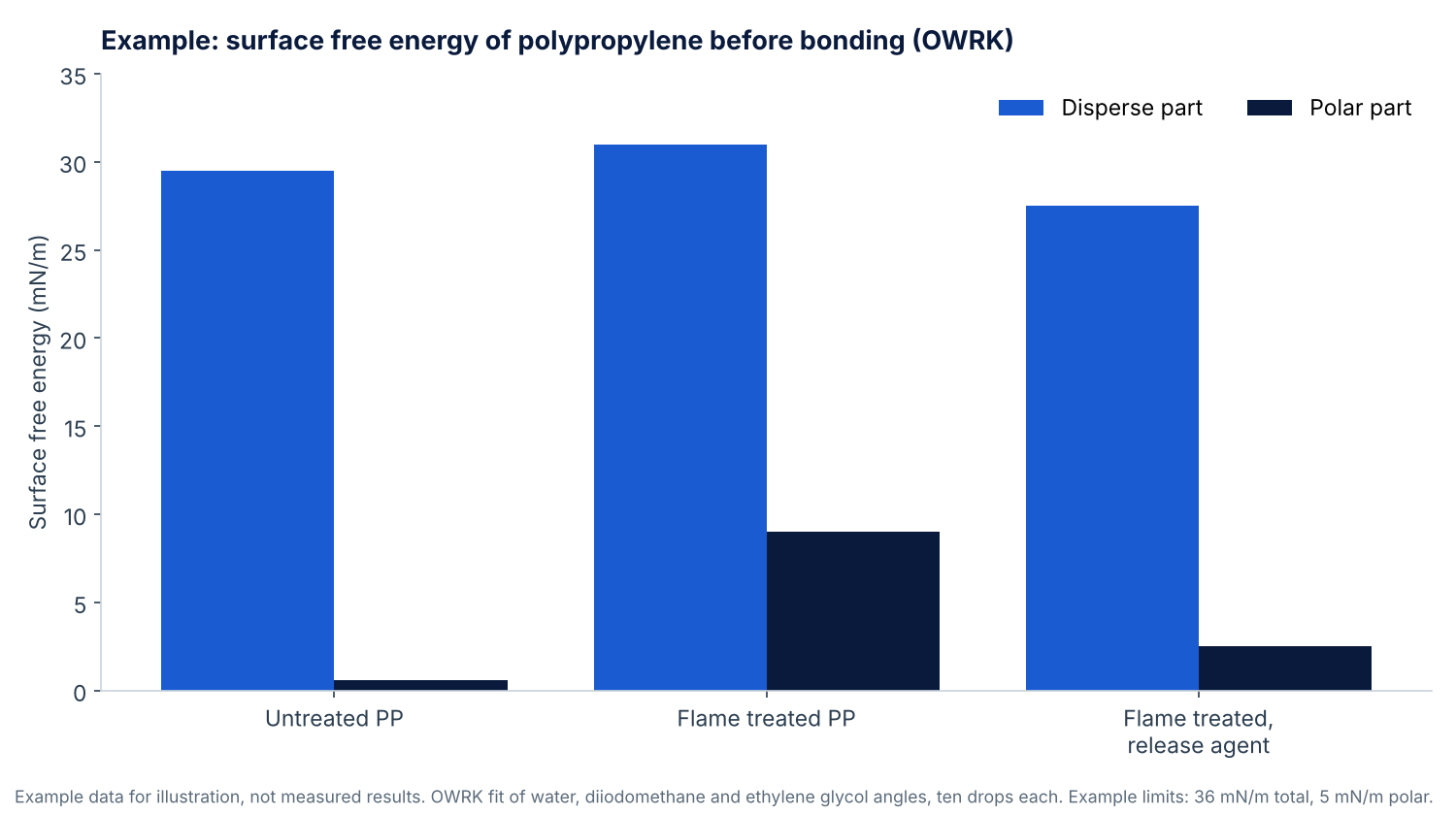
Example output: wettability of polypropylene before bonding

Example data for illustration only. These are not measured results. Your own substrate, pretreatment and limits decide the numbers.

Example: polypropylene parts before bonding, three liquids, OWRK

Surface Water (°) Diiodomethane (°) Ethylene glycol (°) SFE: disperse + polar (mN/m) Decision
Untreated PP98.758.468.929.5 + 0.6 = 30.1Reference: not ready to bond
Flame treated PP72.455.837.431.0 + 9.0 = 40.0Accept: ready to bond
Flame treated PP, release agent on surface91.061.962.427.5 + 2.5 = 30.0Hold: clean and retest

How to read this table

Each angle is the mean of ten drops. Surface free energy comes from an OWRK fit across the three liquids in the free calculator, using its water, diiodomethane and ethylene glycol values. The decision uses example limits of 36 mN/m total and 5 mN/m polar, set from a bond study.

Example output chart

The same example data as the table, with each surface free energy split into its disperse and polar parts.

Grouped bar chart of example disperse and polar surface free energy for untreated, flame treated and contaminated polypropylene, showing the polar part rising after flame treatment and falling with release agent

Example data, not measured results.

Business impact

What changes when bond readiness is a measured number

Metric Before Dropometer With Dropometer Results
How readiness is judged Dyne pens or a water break test, read by eye Surface free energy with disperse and polar parts, from measured angles No published benchmark
Result format Pass or fail at each ink level An angle per drop, 0.01° display, ±0.35° accuracy Dropometer product specification
Record Operator note Drop image and angle saved per measurement, with the model used No published benchmark
Where it runs Shared lab goniometer At the bonding line, on battery for up to 8 h Dropometer product specification

See the measurement on your own parts

Bring two parts: one that bonded well and one that failed. We will measure both live.

ROI estimate

Estimate the cost of the bond failures this test can catch

Enter your own numbers. The defaults are examples, not Droplet Lab results.

Quality cost snapshot

Estimate what wetting related failures cost you.

Example only. Use what you see in a trial on your own samples.
Your own figure.
Your own estimate.

Result

~0
Estimated annual cost today
~0
Estimated annual cost avoided
~0
Payback period

Annual exposure combines audit/CAPA cost, customer rejections, and recall probability; avoided exposure applies the risk reduction percentage.

Method settings for contact angles and liquids

Lock these before you compare results between shifts, sites or suppliers

Parameter Recommended Setting Technical Rationale
Test liquids Three to eight known liquids with different polar and disperse parts The fit needs a spread in polarity to separate the two parts (DIN Media summary).
Liquid data Surface tension with polar and disperse parts, from the standard or your table Use the same values every run. Check total surface tension by pendant drop, up to 75 mN/m.
Drops per liquid Ten, left and right angle on each The standard averages many readings (DIN Media summary).
Drop type Sessile drop, static angle The method reads resting drops on a flat test piece.
Drop volume Small, as the standard specifies, fixed for every drop Keeps the effect of gravity on the angle low.
Reading time As the standard specifies, fixed for every drop Liquids can spread or evaporate, so the time must not vary.
Fit model Young-Laplace or polynomial, the same for every run Both models are in the Dropometer software. Do not mix them within one study.
Surface energy model OWRK in the free calculator, recorded on every result Values from different models do not compare. OWRK is not built into the Dropometer software.
Environment As the standard specifies; record temperature and humidity The Dropometer runs at 10 to 45 °C and has no temperature or humidity control.

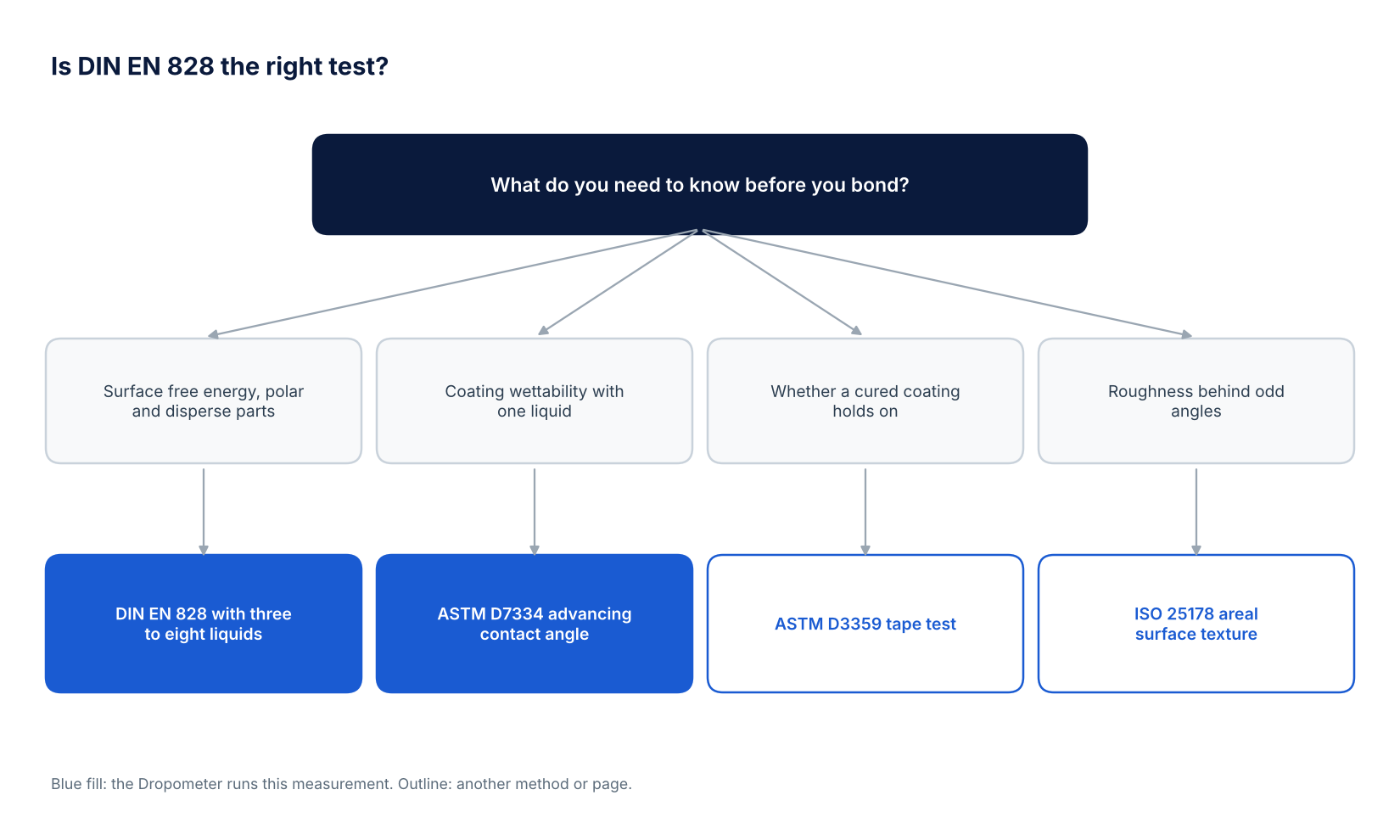
Is DIN EN 828 the right test?

Pick the method by the question you need answered

Start: What do you need to know before you bond?

Surface free energy with polar and disperse parts

Signals:

You need to know whether a surface is ready to bond, coat or pretreat, and why it fails when it does.

Rule-out:

Use DIN EN 828, this page. The Dropometer is fully compliant, with OWRK in the free calculator.

Wettability of a coating with one liquid

Signals:

You compare coatings, substrates or pigments by one advancing angle.

Rule-out:

Use ASTM D7334. The Dropometer measures advancing angles by adding liquid through the needle.

Whether a cured coating holds on

Signals:

You need to rate adhesion of a coating that is already applied and cured.

Rule-out:

Use a tape test such as ASTM D3359. Surface free energy complements it.

Roughness behind odd angles

Signals:

Angles vary from spot to spot on a machined, blasted or textured part.

Rule-out:

Measure texture with ISO 25178. Roughness changes the apparent angle.

Decision tree at a glance

Start from the question you need answered. Blue boxes are measurements the Dropometer runs.

Decision tree for choosing between DIN EN 828 surface free energy, ASTM D7334 advancing contact angle, the ASTM D3359 tape test and ISO 25178 surface texture

Is DIN EN 828 the right test?

Interpreting contact angle and surface free energy results

What the surface free energy tells you, and what it does not

Higher energy, better wetting: An adhesive wets a surface well when the surface free energy is above the adhesive's own surface tension.
Watch the polar part: Pretreatment mostly raises the polar part. Contamination often removes it first, even when the total looks normal.
Check the fit: If one liquid sits far off the OWRK line, check that liquid, its data and the drop images before you trust the result.
Energy is not bond strength: A high surface free energy shows the adhesive can wet. It does not prove the joint will hold.
Expert perspective

Why surface energy comes before the bond test

Adhesion fails at the interface long before it fails in the joint; surface energy tells you whether that interface was ever ready to bond in the first place.

Dr. Alidad Amirfazli

Department of Mechanical Engineering, York University, Co-founder and Scientific Advisor, Droplet Lab

Common pitfalls and limits

Honest limits of the method and of the Dropometer

Mechanical surface roughness and chemical homogeneity both influence the angles, and the standard notes their effect on the result.
Old or contaminated test liquids give wrong angles. Keep them capped and replace them on a schedule.
Values from OWRK, Fowkes, Equation of State or van Oss Chaudhury Good do not compare. Record the model.
The Dropometer has no temperature or humidity control. Record room conditions and keep them steady.
The camera runs at 10 frames per second. That suits a reading at a fixed time, not millisecond spreading or absorption studies.
FAQ

Frequently asked questions

What does DIN EN 828 measure?

DIN EN 828 works by measuring the static contact angle of a liquid wetting the solid surface, for several known liquids. It turns them into a surface free energy with disperse and polar parts. It helps predict whether a particular adhesive will wet a particular adherend, so users apply it to judge whether a surface is ready to bond, coat or pretreat.

Which surface free energy model does EN 828 use?

It fits the mean angles of three to eight liquids with known polar and disperse parts in one statistical fit. That is the two part approach known as OWRK (Owens Wendt Rabel Kaelble). Check the expression of results section of your copy for the exact calculation and liquid data.

Can the Dropometer run DIN EN 828?

Yes. The Dropometer measures the static contact angles the method reads, with ±0.35° accuracy. OWRK is not built into the Dropometer software: you measure the angles with the Dropometer and run OWRK in the free Contact Angle to Surface Energy Calculator. The software calculates Equation of State, Fowkes and van Oss Chaudhury Good.

How many liquids and drops does DIN EN 828 need?

The DIN Media summary describes ten drops of each of three to eight liquids, with left and right angles read on every drop. The liquids need different polar and disperse parts, such as water and diiodomethane plus at least one more.

Does a high surface free energy guarantee a good bond?

No. It shows the adhesive can wet the surface. Bond strength also depends on cure, joint design and the adhesive itself. Keep your lap shear or peel test, and use surface free energy to catch poor surfaces before bonding.

Is DIN EN 828 the same as BS EN 828?

Yes, in content. Both are national adoptions of EN 828:2013. DIN EN 828:2013-04 replaced DIN EN 828:1998-01. Quote the designation your customer names in the specification.

Legal note

This page summarises DIN EN 828 in our own words and does not reproduce the standard. Buy the current edition from DIN Media or your national standards body before you write a procedure. Droplet Lab does not certify compliance. Your own method validation does.

How this page was created

Sources, review and tools

Transparency 4 checklist items
01

Sources

DIN Media listing, DIN EN 828:2013-04; BSI listing, BS EN 828:2013; BS EN 828:2013 preview (contents, scope, terms); GlobalSpec listing, DIN EN 828, the Dropometer product specification and Droplet Lab validation papers.

02

Drafting assistance

Drafted with Claude (Anthropic) from the sources listed, then reviewed by Droplet Lab.

03

What we did not do

We did not copy text from the standard. Buy the current edition for the full procedure.

04

Last checked

October 2026

Report a correction

Spotted an issue in this summary? Send a correction request and our team will review it.

Correction Request

We work hard to keep this page accurate and up to date. If you spot an error (wrong revision/year, missing requirement, incorrect interpretation, or broken link), tell us and we'll review it.

Contact us to report a correction

References

1. DIN EN 828:2013-04 (EN 828:2013). dinmedia.de/en/standard/din-en-828/154898690
3. BS EN 828:2013 preview (contents, scope, terms). webstore.ansi.org/preview-pages/BSI/preview_30231830.pdf
4. GlobalSpec listing, DIN EN 828. standards.globalspec.com/std/1585552/din-en-828
5. Droplet Lab. Peer reviewed validation papers in Review of Scientific Instruments and Colloids and Surfaces A. dropletlab.com/validation/publications/
6. Droplet Lab. Dropometer product specification, 2026. dropletlab.com/products/dropometer/