








Contents

Biotechnology Industry
The Practical Guide to Surface Science (2026)

?s=100&d=m
Written by
No biography added yet.
Read More
?s=100&d=m
Reviewed by
N/A
No biography added yet.
Read More
?s=100&d=m
Written By

No biography added yet.

?s=100&d=m
Reviewed By

N/A N/A

No biography added yet.

This is a practical guide to Surface Science for researchers working in the Biotechnology Industry.

In this all-new guide you’ll learn all about:

  • Crucial surface science principles
  • The significance of surface science measurements for the Biotechnology industry
  • Applicable ASTM Standards & Guidelines

Let’s dive right in.

Biotechnology

Executive Summary

What it covers: A practical biotechnology-focused guide to measuring and interpreting contact angle (static + advancing/receding), surface tension (static + dynamic), surface energy, and sliding angle to quantify wettability and interfacial behavior in materials, coatings, and liquid formulations. It connects each measurement to real biotech use cases (biomaterials, drug delivery, tissue engineering, diagnostics, fermentation sensors, and bioprocess purification).
Key insights: Real biotech surfaces rarely have a single “true” contact angle, hysteresis and advancing/receding angles are often more diagnostic than a lone static value for adhesion, cleanliness, roughness, and heterogeneity. Method choice matters: Young–Laplace is typically more consistent but assumes an axisymmetric drop, while polynomial fitting handles non-axisymmetric drops but can be more sensitive to local defects; dynamic surface tension is the right tool when interfaces evolve quickly (surfactants/additives, droplet/bubble formation, foams, evaporation-driven changes).
Business value: These measurements turn surface behavior into actionable QC and design inputs; helping teams improve biocompatibility, coating performance, nanoparticle interactions, and process robustness while spotting contamination or treatment drift early. Using benchmark datasets and repeatable methods reduces rework and variability in workflows where small wettability shifts can cascade into major biological or manufacturing outcomes.
Standards to follow: For surface/interfacial tension reporting that must be standards-compliant, use ASTM D1331 (Du Noüy ring or Wilhelmy plate force tensiometry) and do not label pendant-drop optical results as “ASTM D1331” unless you’re explicitly doing a validated bridge study. Follow the guide’s reporting guardrails: document sample identity, geometry, temperature control, cleaning/conditioning, replicates + statistics, force-data corrections, and any deviations from ASTM/SOP.
Bottom line: This is a biotech-ready, measurement-first playbook for what to measure, when to use each method, and how to interpret results; backed by real-world examples, benchmarks, and a clear standards boundary so teams can make wettability and interfacial properties repeatable drivers of product performance and QC decisions.

Chapter 1: Introduction

In the biotech industry, we measure contact angle, surface energy, and surface tension to evaluate the wettability and surface properties of materials. These measurements significantly impact various applications, including drug delivery systems, biomaterials, tissue engineering, and diagnostic devices. By understanding the interfacial behavior and surface characteristics, we can optimize the performance, reliability, and biocompatibility of biotech products.


Biotechnology

We use the following surface properties to understand the behavior of Biotechnology products and improve their quality.

Chapter 2: Contact Angle Measurement

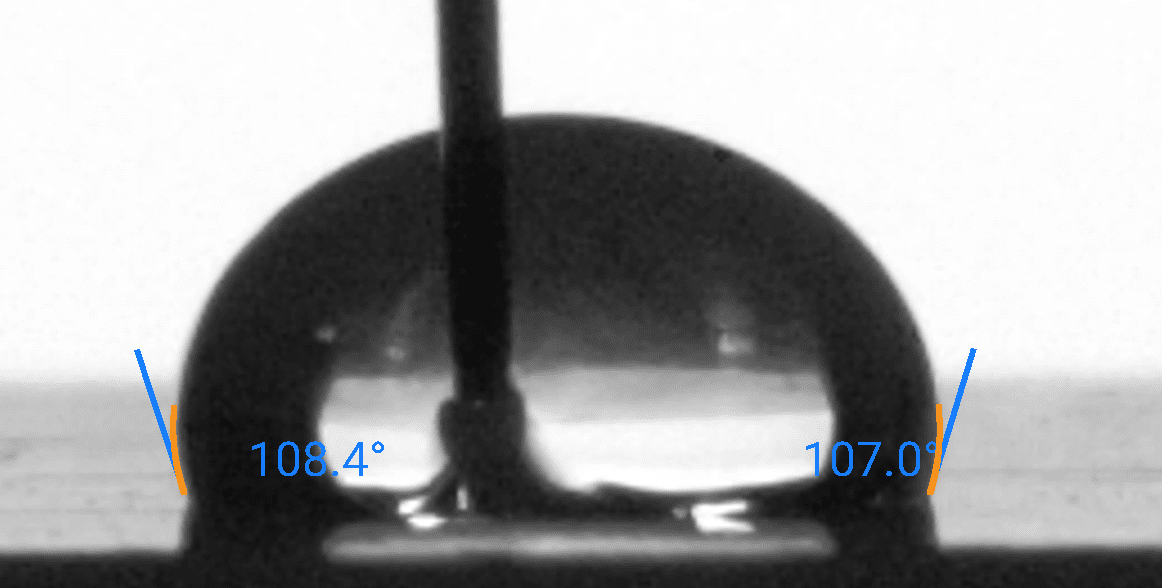
The contact angle quantifies the wettability of a surface by representing the angle between a liquid’s surface and a solid surface.
Dropletlab Research

Sample Image taken from Droplet Lab Tensiometer.

Young – Laplace Method

Polynomial Method

Dynamic Contact Angle

Ideally, when we place a drop on a solid surface, a unique angle exists between the liquid and the solid surface. We can calculate the value of this ideal contact angle (the so-called Young’s contact angle) using Young’s equation. In practice, due to surface geometry, roughness, heterogeneity, contamination, and deformation, the contact angle value on a surface is not necessarily a single consistent value but rather falls within a range. The upper and lower limits of this range are known as the advancing and receding contact angles, respectively. The values of advancing and receding contact angles for a solid surface are highly sensitive to many parameters, such as temperature, humidity, homogeneity, and minor contamination of the surface and liquid. For example, the advancing and receding contact angles of a surface can differ at different locations.

Dynamic Contact Angle versus Static Contact Angle

Practical surfaces and coatings naturally show contact angle hysteresis, indicating a range of equilibrium values. When we measure static contact angles, we get a single value within this range. Solely relying on static measurements poses problems, like poor repeatability and incomplete surface assessment regarding adhesion, cleanliness, roughness, and homogeneity.

In practical applications, we need to understand how easily a liquid spreads (advancing angle) and how easily it is removed (receding angle), such as in painting and cleaning. Measuring advancing and receding angles offers a holistic view of liquid-solid interaction, unlike static measurements, which yield an arbitrary value within the range.

This insight is crucial for real-world surfaces with variations, roughness, and dynamics, aiding industries like cosmetics, materials science, and biotechnology in designing effective surfaces and optimizing processes.

Learn how Contact Angle measurement is done on our Tensiometer

For a more complete understanding of Contact Angle measurement, read our Contact Angle measurement: The Definitive Guide

Open Benchmark Data: Contact Angle & Surface Energy

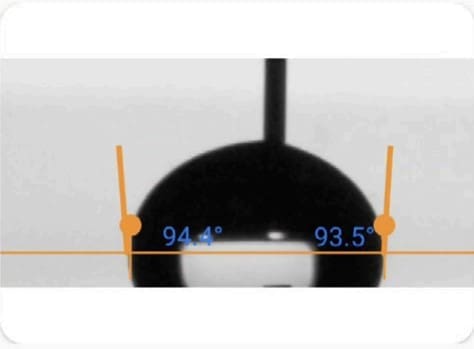
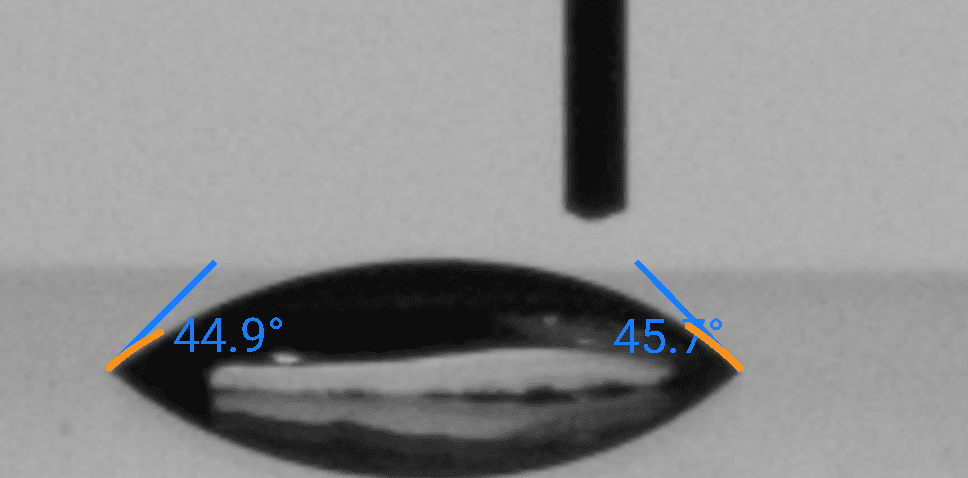
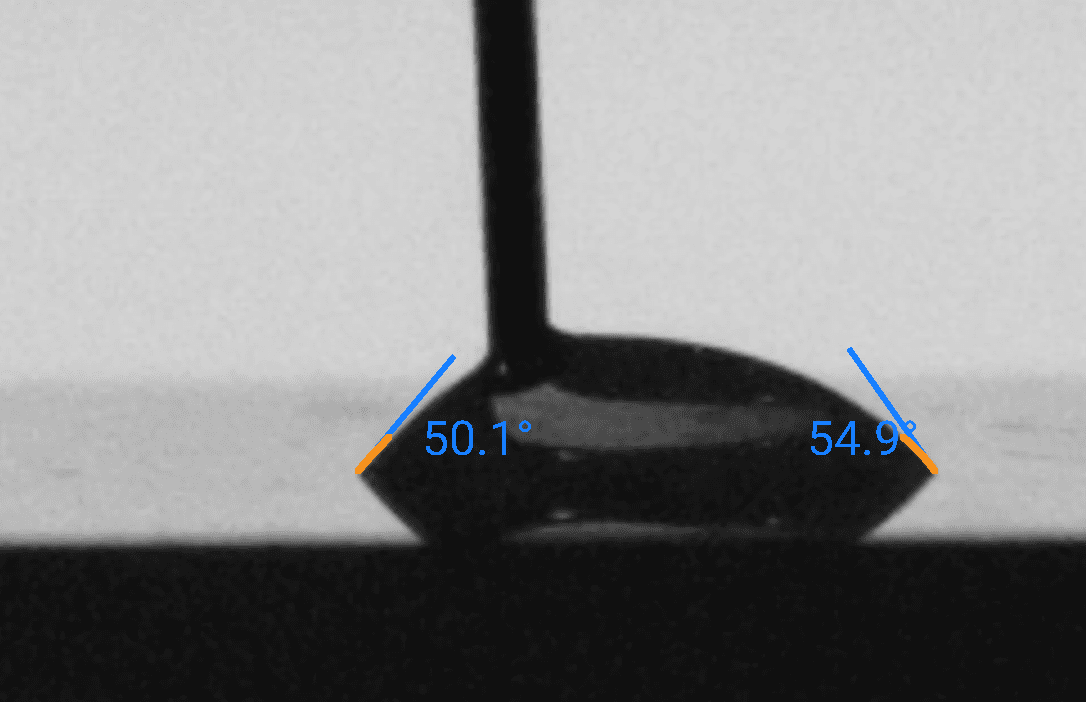
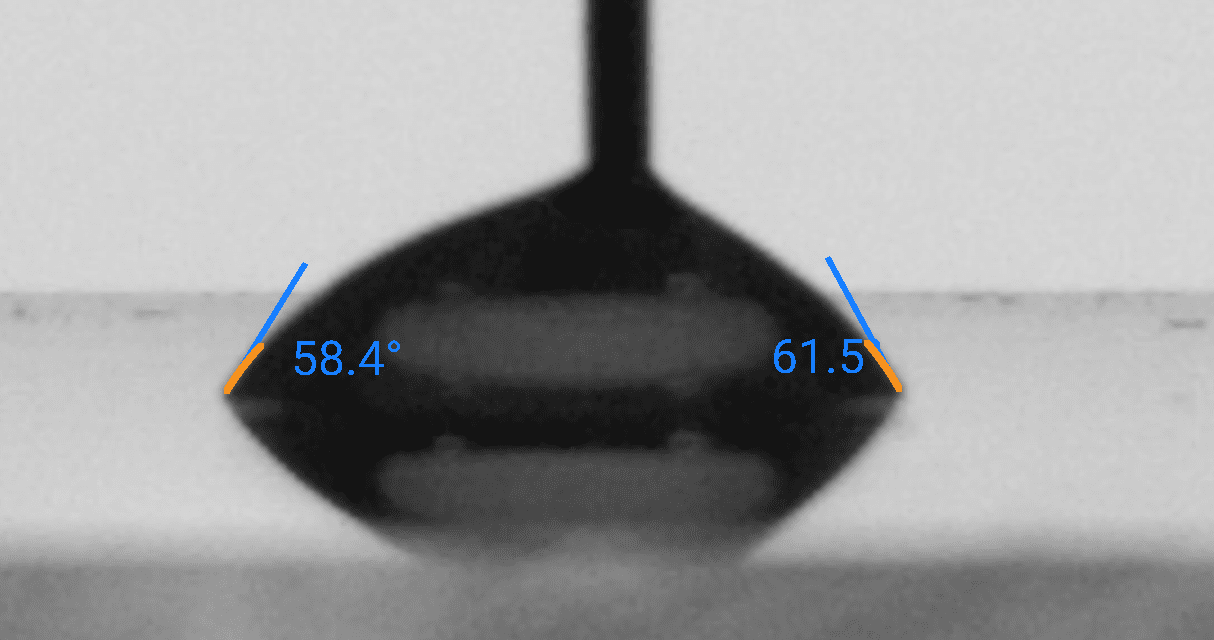
These reference measurements show how deionized water wets four standard substrates measured with the Droplet Lab Dropometer. Use them as visual and numerical benchmarks when you're checking your own sample preparation, treatments, and chemistry.

Full contact angle and surface energy datasets (including additional liquids and statistics) are available on our dataset hub.

Glass - DI Water
Glass - DI Water
Nylon - DI Water
Nylon - DI Water
PMMA - DI Water
PMMA - DI Water
Teflon - DI Water
Teflon - DI Water

The droplet images above are taken from the same benchmark series as our open dataset. For each substrate and probe liquid we report:

● Advancing and receding contact angles (and hysteresis)
● Derived surface energy (SFE) values based on multi-liquid measurements
● Measurement conditions, uncertainties, and sample preparation details

Comparing your own droplet shapes and angles against these references is a fast way to spot contamination, treatment drift, or unexpected changes in wettability.

Chapter 3: Surface Tension Measurement

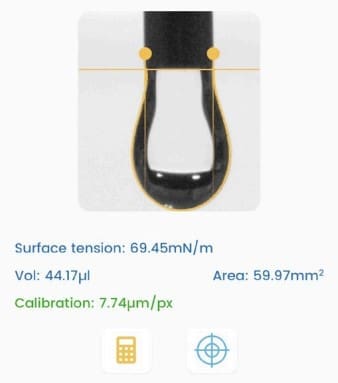
This property measures the force that acts on the surface of a liquid, aiming to minimize its surface area.

Surface Tension Measurement

Sample Image taken from Droplet Lab Tensiometer

Dynamic Surface Tension

Dynamic surface tension differs from static surface tension, which refers to the surface energy per unit area (or force acting per unit length along the edge of a liquid surface).

Static surface tension characterizes the equilibrium state of the liquid interface, while dynamic surface tension accounts for the kinetics of changes at the interface. These changes could involve the presence of surfactants, additives, or variations in temperature, pressure, and composition at the interface.

When to use Dynamic Surface Tension Measurement

Dynamic surface tension is essential for processes that involve rapid changes at the liquid-gas or liquid-liquid interface, such as droplet and bubble formation, coalescence (change in surface area), the behavior of foams, and the drying of paints (change in composition, e.g., evaporation of solvent). It is measured by analyzing the shape of a hanging droplet over time.

Dynamic surface tension applies to various industries, including cosmetics, coatings, pharmaceuticals, paint, food and beverage, and industrial processes, where understanding and controlling the behavior of liquid interfaces is essential for product quality and process efficiency.

Learn how Surface Tension measurement is done on our Tensiometer

For a more complete understanding of Surface Energy measurement, read our Surface Tension measurement: The Definitive Guide

Chapter 4: Surface Energy Measurement

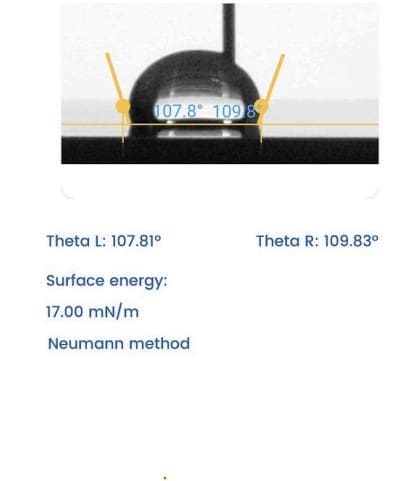
Surface energy refers to the energy required to create a unit area of a new surface.
231

Sample Image taken from Droplet Lab Tensiometer

Learn how Surface Energy measurement is done on our Tensiometer

For a more complete understanding of Surface Energy measurement, read our Surface Energy measurement: The Definitive Guide

For benchmark contact angle and surface energy values on glass, nylon, PMMA, and Teflon, see the Open Benchmark Data panel above or visit our Dataset Hub for full CSV downloads.

Chapter 5: Sliding Angle Measurement

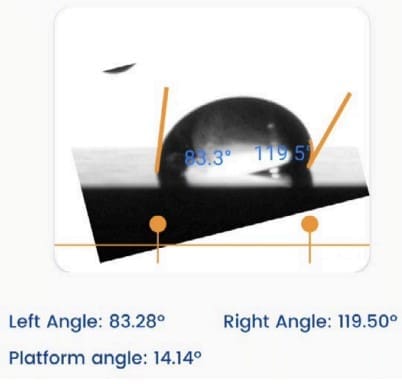
The sliding angle measures the angle at which a liquid film slides over a solid surface. It is commonly employed to assess the slip resistance of a surface.

sliding angle 1

Sample Image taken from Droplet Lab Tensiometer

Learn how Sliding Angle measurement is done on our Tensiometer

For a more complete understanding of Sliding Angle measurement, read our Sliding Angle Measurement: The Definitive Guide

Chapter 6: Real-World Applications

Within the Biotechnology industry, several case studies exemplify the advantages of conducting surface property measurements.

Buffer-Dependent Wetting and Surface Energy Tuning of Polyserotonin Biointerfaces for Biomedical Coatings

This study evaluates how buffer choice during serotonin polymerization influences the physicochemical properties of polyserotonin nanoparticles (PSeNP) and polyserotonin films, which are bioinspired materials with potential biomedical and coating applications. The authors demonstrate that buffer molecules can become incorporated into the forming polyserotonin matrix, supported by experimental surface/chemical analyses and density functional theory calculations. While nanoparticle elasticity remains similar across buffer systems, polyserotonin films show buffer-dependent differences in nanoscale surface properties, consistent with solvent/buffer effects on surface functional groups. Overall, the work provides guidance for selecting synthesis conditions to rationally tailor polyserotonin material properties toward specific applications.

Role of the Droplet Lab Goniometer

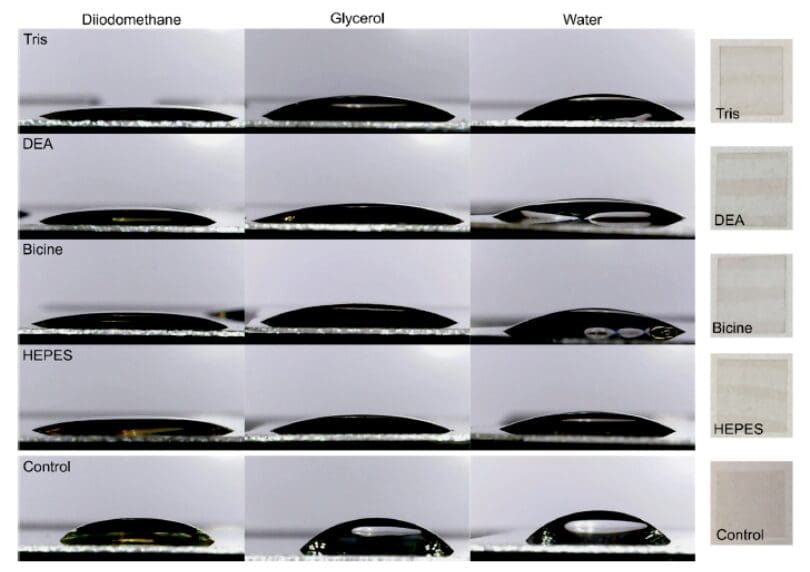
The Droplet Lab goniometer (cited in the paper as “Droplet Smart Tech, Markham, ON, Canada”) was used to measure static contact angles on polyserotonin-coated glass films using 20 µL droplets of milli-Q water, glycerol, and diiodomethane (Materials & Methods, Section 2.2, page 3). Those contact angle measurements were then used to calculate surface energy via the Owens–Wendt–Rabel–Kaelbel (OWRK) model, enabling quantitative comparison of buffer-dependent film wettability and surface energetics (Results/Discussion, Section 3.4, pages 7–8; Supplementary Figure S5 and Table S1 are referenced for the contact angle and surface energy data).

Key Findings

  • Buffer components can incorporate into polyserotonin frameworks during synthesis (evidence supported by chemical/surface characterization and DFT).
  • Nanoparticle size distribution depends on buffer choice (e.g., Tris produced the most uniform size distribution; other buffers yielded broader distributions).
  • Nanoparticle stiffness (apparent Young’s modulus) showed no significant dependence on buffer type when particles of comparable size were analyzed.
  • Polyserotonin films alter surface wetting: the film coating makes glass more hydrophilic, decreasing water contact angle by >15° and increasing surface energy from ~47 to ~61 mJ/m² (Section 3.4, pages 7–8).
  • The increase in surface energy for coated glass is driven more by the dispersive component than the polar component (Section 3.4, pages 7–8).
  • Buffer choice also affects film thickness and nanoscale surface interactions (e.g., Tris produced thinner films; HEPES produced thicker films per the referenced supplemental table).

Why It Matters

In biotechnology workflows such as biointerface coatings, nanoparticle-enabled delivery systems, and surface engineering for reduced fouling or controlled adsorption; small shifts in wettability, surface energy, and surface chemistry can change protein adsorption, cell interactions, and coating performance. This paper shows that buffer selection during synthesis is a practical “knob” to tune film surface properties (quantified via contact angle and surface energy) without materially changing nanoparticle stiffness, helping teams define synthesis specifications and QC targets that align with downstream biological performance.

Method Snapshot

Polyserotonin films on glass were evaluated using static contact angles: 20 µL droplets of water, glycerol, and diiodomethane were manually placed on the films and imaged (page 3, Section 2.2). Surface energy was calculated using the OWRK model, which uses the known surface tension components of the probe liquids (surface tension not measured directly in this study).

Data Note

Contact angle images of diiodomethane, glycerol, and water on PSe films formed on glass coverslips. A panel of alternating strips of PSe films formed on the glass coverslips on the right.

Figure

Citation (APA Format)

Jeon, K., Asuncion, J. A., Corbett, A. L., Yuan, T., Patel, M., Andoy, N. M. O., Kreis, C. T., Voznyy, O., & Sullan, R. M. A. (2022). Buffer components incorporate into the framework of polyserotonin nanoparticles and films during synthesis. Nanomaterials, 12(12), 2027. https://doi.org/10.3390/nano12122027

View Publication →

The Dance of Dissolved Oxygen Sensors in Fermentation

Glycolipid biosurfactants from yeast represent a sustainable innovation in chemical production. Various industries, from food to cosmetics, rely on these surfactants. Crucially, dissolved oxygen plays a key role in their synthesis. It provides microorganisms with sufficient oxygen and creates the ideal environment for proper growth. Therefore, membranes that monitor dissolved oxygen levels must achieve the right balance: hydrophobic enough to repel cell debris but not so hydrophobic that they trap air bubbles. Researchers use tools like the tensiometer developed by Droplet Lab to assess the surface properties of these membranes and the fermentation solution, ensuring a seamless and precise production process.

The Dance of Dissolved Oxygen Sensors in Fermentation

Creating Life with Surface Coatings

Medical implants, scaffolds, and biosensors are transforming our lives and becoming everyday reality. Understanding how different biomaterial surfaces interact with water, either attracting (hydrophilic) or repelling (hydrophobic) it, is crucial. This knowledge directly impacts everything from cell adhesion to tissue regeneration. For example, by carefully adjusting the surface energy and roughness of a substrate, we can significantly enhance cell growth. Surface tension plays a key role in fabricating hybrid materials. We can combine 3D printed polymers with cell-laden hydrogels to create fully biocompatible, 3D structures of living tissues. This innovative approach utilizes surface-wetting forces to suspend liquid films across the openings of a mesh, which can then be converted into a solid coating or hydrogel.

Creating Life with Surface Coatings

Nano Magic: Targeting Treatment

It's easy to dismiss nanoparticles as insignificant due to their small size, but looks can be deceiving. Despite their tiny size, they're revolutionizing the biotech industry with their remarkable versatility. Their large surface area to volume ratio, coupled with adjustable surface chemistry, makes them ideal for drug delivery systems. Take glaucoma treatment, for example. Both the medication itself and its delivery method play crucial roles in its effectiveness. By analyzing contact angles, researchers can precisely control how drug-loaded nanoparticles interact with the eye's surface. This leads to optimized formulations that not only improve patient outcomes but also ensure sustained and efficient drug delivery.

Nano Magic: Targeting Treatment

Bioprocess Purification: Where Precision Meets Efficacy

Modern bioprocesses offer fascinating journeys, transforming raw materials into potentially life-saving drugs or vital enzymes. However, the initial stages often present inclusion bodies or crystals. These bioprocesses create a complex liquid phase, a melting pot of diverse bioparticles ranging from cell debris and whole cells to particulate biocatalysts and by-products. Separating these valuable entities from the surrounding other particles is no easy feat, with the contact angle of each bioparticle playing a crucial role in this purification process.
Surface properties take center stage here, as a particle's surface dictates its interactions with its environment. This is where our tools come into play, providing researchers with the detailed insights needed to optimize the purification process. For example, drying and re-dispersing these particles present significant challenges. Without understanding the capillary forces at play – forces directly influenced by surface tension – particles can easily aggregate or films can crack. By providing precise measurements, we empower researchers to avoid these pitfalls and achieve the highest possible product quality.

Bioprocess Purification: Where Precision Meets Efficacy

We are your partners in solving your Business & Technological challenges

If you are interested in implementing these or any other applications, please contact us.

Chapter 7: Standards and Guidelines

In an industry where precision reigns supreme, how can Biotechnology manufacturers ensure their products withstand scrutiny? The answer lies in standards and guidelines: the compass that guides them through the complex maze of quality and performance.

ASTM D1331 — Surface & Interfacial Tension of Solutions (Du Noüy Ring / Wilhelmy Plate Force Methods)

What it is

ASTM D1331 is a method-defined standard for measuring surface tension and interfacial tension of liquids using force tensiometry, where a Du Noüy ring or Wilhelmy plate is pulled from a liquid or across an interface. Results may be called “ASTM D1331” only when generated using these ring/plate force methods (optical pendant-drop results are not D1331 as-written).

When to use it

Release/spec or customer-required reporting

Use when a customer, contract, or internal specification explicitly requires a value reported as “ASTM D1331” (ring/plate force tensiometry is required).

Reference method for method-bridging

Use as the periodic “truth” method to validate or calibrate faster internal screening methods (e.g., Dropometer pendant-drop) by building correlation bands against D1331 results.

In-scope / Out-of-scope

In scope
  • Surface tension of liquid formulations measured by Du Noüy ring or Wilhelmy plate force tensiometry.
  • Interfacial tension between two liquid phases (e.g., aqueous/organic, aqueous/oil) using ring/plate force tensiometry.
  • Comparative QC/R&D testing when the same geometry, corrections, and temperature control are used consistently.
  • Solutions that may include surfactants/additives (common in biotech formulations), provided handling, cleanliness, and equilibration are controlled and documented.
Out of scope
  • Optical pendant-drop (Young–Laplace) methods (e.g., Dropometer pendant drop) and any other non-force optical techniques.
  • Sessile-drop contact angle or solid-surface wettability/surface energy determinations.
  • Dynamic surface tension methods (e.g., maximum bubble pressure) unless your SOP explicitly defines how they relate (they are not D1331).
  • Labeling non-ring/plate results as “ASTM D1331” (method name is not interchangeable with the property name).

Minimum you must report (checklist)

  • Sample identity (formulation name, lot/batch, concentration of key excipients/surfactants, age/time since mixing).
  • Property measured: surface tension or interfacial tension; for interfacial, identify both phases.
  • Instrument + method geometry: Du Noüy ring or Wilhelmy plate; include ring/plate material and dimensions (as applicable).
  • Temperature and control method (setpoint, measured value, equilibration time).
  • Cleaning/conditioning protocol for ring/plate and sample vessel (and any acceptance check).
  • Replicate plan + statistics (n, mean/median, SD/IQR, outlier rule if used).
  • Correction/processing details used for force data (e.g., any correction factor approach and inputs required).
  • Deviations from ASTM D1331 or your internal SOP (and why).

Note: Dropometer (optical pendant-drop Young–Laplace) can measure the same property (surface/interfacial tension) but it does not comply with ASTM D1331 because D1331 requires ring/plate force tensiometry. Use pendant drop for internal trending/screening and reserve ring/plate for any result that must be labeled “ASTM D1331.”

How to interpret results (guardrails)

  • Treat γ as method-defined: do not compare pendant-drop γ and D1331 γ as interchangeable unless you have a validated bridge dataset.
  • Use correlation bands for QC decisions: build Green/Yellow/Red limits from paired measurements (Dropometer vs D1331) and re-verify periodically.
  • Watch repeatability as a signal: increased scatter often indicates contamination, poor cleaning, bubbles/particles, or unstable interfaces—investigate before releasing decisions.
  • Standardize time + temperature in biotech fluids: surfactant/protein systems can be time-dependent; control equilibration timing and report it consistently.

Now It’s Your Turn

We hope this guide showed you how to apply surface science in the Biotechnology industry.

Now we’d like to turn it over to you: 

Feel free to leave a comment below—we’d love to hear from you.

Leave a Reply

Your email address will not be published. Required fields are marked *


Download Experiment