



Contents

Contact Angle Buyer's Guide

Best for Occasional, One-Time or Lowest-Budget Testing

Our pick when you need one answer, once, and buying an instrument would be the wrong decision. Nothing on this page requires a capital request. Every score is derived from published weights and criterion scores that you can check or replace with your own.

Scored 1–5 against 11 weighted criteria; full calculation shown on this page. Specifications and pricing last reviewed May 2026.

Abhimanyu Photo
Written by
Abhimanyu Bhandankar
Holds an MBA from Schulich School of Business and a BE in IT. He joined Droplet Lab in July 2019 and now leads sales and marketing.
CEO at Droplet Lab
Read More
Gurdeep-Saini-Photo
Technical Review by
Gurdeep Singh Saini
Holds a BASc in Mechanical Engineering from Ryerson University (now Toronto Metropolitan University) and an MASc from York University. He develops the automatic edge and baseline detection behind the Dropometer's analysis.
COO at Droplet Lab
Read More
Abhimanyu Photo
Written By

Abhimanyu Bhandankar

CEO at Droplet Lab

Holds an MBA from Schulich School of Business and a BE in IT. He joined Droplet Lab in July 2019 and now leads sales and marketing.

Gurdeep-Saini-Photo
Reviewed By

Gurdeep Singh Saini

COO at Droplet Lab

Holds a BASc in Mechanical Engineering from Ryerson University (now Toronto Metropolitan University) and an MASc from York University. He develops the automatic edge and baseline detection behind the Dropometer's analysis.

The short answer

For genuinely occasional testing the deciding factor is not measurement quality but whether the spend can be justified at all, so total cost of ownership carries 34 percent here and portability 16 percent. Scores on this page are lower across the board than on our capability-focused guides, and deliberately so: the best answer for occasional testing is a tool that gives up capability on purpose. If you will run this measurement more than a few times a year, this is the wrong page, and the value-for-money guide is the right one.

The ranking

Three low-commitment options, from a free DIY method to a pocketable threshold check and an entry benchtop for occasional users who still want a real instrument.

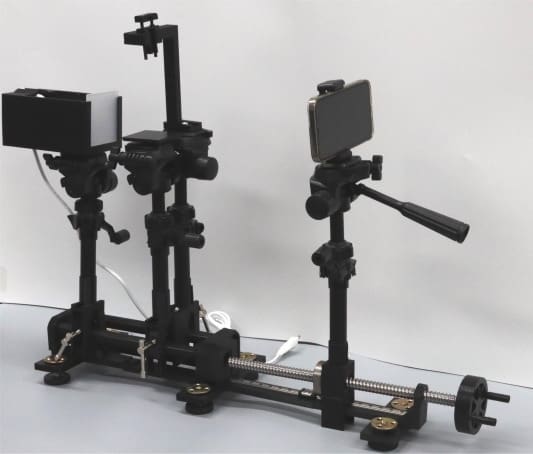
DIY (camera + ImageJ / LB-ADSA)

Top pick

DIY (camera + ImageJ / LB-ADSA)

Self-assembled

3.8/ 5

For a one-off static angle or a tight-budget proof of concept, nothing beats a camera and free software. There is no capital outlay, so it takes the maximum 5 out of 5 on cost at a 34 percent weight, and unlike a threshold pen it returns an actual numeric angle and a saved image. It is slow and operator-dependent, but for genuinely occasional use that rarely matters.

Where it wins

About $150 to $300 in parts beyond a camera you already own, with free open-source analysis and published, citable protocols; ±1° achievable with careful lighting and technique; produces a numeric result and a saved image, which a threshold pen does not.

Where it loses ground

Time-consuming manual workflow; static contact angle only without custom add-ons; strong sensitivity to lighting, optics and operator technique; no calibration or traceability, so results are difficult to defend to a customer or auditor.
Dyne test pens

Runner-up

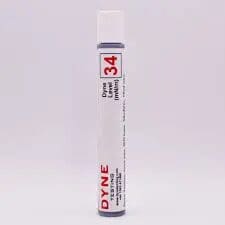
Dyne test pens

Threshold pens

3.7/ 5

Dyne pens are the fastest and cheapest way to answer exactly one question: is this surface above a given surface energy. They score a full 5 out of 5 on portability, speed and cost. They fall 0.1 behind because a pen returns no angle at all: where a DIY rig scores 4 on measurement scope for this use case, a pen scores 2. Note that a single pen answers only one threshold, so a usable 16-level set at about $109 is the realistic entry cost.

Where it wins

About $7 to $11 per pen direct from the manufacturer, or roughly $109 for the 16-level set you need to bracket a surface, with no training required; instant visual go/no-go; pocket-sized and field-ready; recognised threshold method aligned with ISO 8296 and ASTM D2578.

Where it loses ground

Qualitative only, with no contact angle, surface tension or hysteresis value; operator-dependent interpretation; hazardous fluids with a six-month shelf life, so a set bought for one job may not survive to the next; no digital logging or export, so nothing survives the test.

Ossila Contact Angle Goniometer

Third

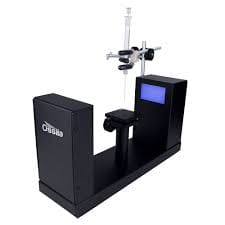
Ossila Contact Angle Goniometer

Entry benchtop

3.1/ 5

Ossila is comfortably the best instrument on this page and still ranks last, which is the weighting doing its job. It scores 4 to 4.5 on scope, optics and accuracy, higher than either option above it. It ranks third because it scores 2.5 on total cost of ownership at a 34 percent weight: about $3,000 for a measurement you may run once is a poor fit for this use case, however good the instrument is.

Where it wins

±1° stated accuracy with repeatable image-based results; integrated software removes the manual tracing step; two-year warranty; no per-test consumable cost; the only option here that scales if occasional turns into regular.

Where it loses ground

About $3,000 for a measurement you may run once; requires bench space, mains power and a Windows laptop; static contact angle and pendant-drop surface tension only; no upgrade path.

How we arrived at these scores

Every instrument is scored from 1 to 5 against the same 11 criteria, where 3 means it meets what this use case requires and 5 means it exceeds it. Each criterion then carries a weight for occasional or one-time testing, and the weights sum to 100 percent. Most of the requirement levels here are deliberately low, because this use case gives up capability on purpose. Multiply each score by its weight, add the rows, and you get the headline score. Every input is published below, so you can check the arithmetic or substitute your own weights.

Side-by-side specification comparison

Compare the three low-commitment options across the specifications that decide whether occasional testing is worth any spend at all.

SpecificationDIY (camera + ImageJ)Dyne test pensOssila
Cost$0 software plus about $150 to $300 for the rigAbout $7–$11 per pen; about $109 for a usable 16-level setAbout US $3,000
Result typeNumeric contact angle plus saved imageQualitative pass/fail against a thresholdNumeric plus image
Measurement scopeStatic contact angle onlySurface-energy threshold onlyStatic contact angle; pendant-drop surface tension
Typical accuracyAbout ±1°, operator dependentQualitative only±1° stated
Time per testAbout 3.4 minutesInstantAbout 1 minute
Training requiredModerate, technique mattersMinimalLow
Record keptImage files, manually organisedNoneImages on the host laptop
Shelf life or consumablesNoneHazardous fluids, six-month shelf lifeStandard laboratory liquids
Setup requiredCamera, lighting, stable rigNoneBench, mains power, Windows laptop

Expert perspective

The honest answer to an occasional measurement is often that you should not buy an instrument for it. A free method that takes an afternoon, or a sample sent to someone who already owns the equipment, is usually a better decision than a capital purchase that will sit in a cupboard.

Droplet Lab Editorial TeamBuyer's guide methodology note

If you need a defensible number once rather than a repeatable capability, consider sending samples out for measurement instead of buying anything. Droplet Lab will run up to five samples on a Dropometer using our validated workflow and return the raw data free of charge. Our own instrument is not ranked on this page because it is the wrong purchase for occasional testing.

Frequently Asked Questions

Because scores measure fit, and this use case deliberately forgoes capability to avoid spend. A DIY rig takes the maximum score on cost and scores 1.5 to 4 on everything else. On our capability-weighted guides it scores closer to 2. A 3.8 here means it is the right answer for this specific job, not that it is a good instrument.

Roughly when the cumulative manual analysis time exceeds the cost of an instrument, or when someone outside your team starts asking for the numbers. At that point traceability becomes the requirement rather than cost, and the ranking on this page reverses.

It can support a simple threshold check, but it creates no numeric digital record and the interpretation stays operator-dependent. Confirm with your quality lead whether that evidence level satisfies your system before relying on it.

On cost they are level: a usable 16-level set is about $109 against $150 to $300 for a rig, and both score the maximum. The 0.1 gap comes from what you get back. A DIY rig returns a numeric angle and a saved image; a pen returns a visual pass or fail against one threshold and no record.

Not sure this is your use case?

Configure a Dropometer for your workflow and see a live price, or compare the full range side by side.