

Contents

Surface tension tensiometer buyer's guide

Best Tensiometer Under $5,000

Under $5,000 a tensiometer means an optical pendant drop kit, free software with your own camera, or glassware. This guide ranks the four real options on 9 weighted criteria and says when the cheapest is the better buy.

Scored 1 to 5 on 9 weighted criteria. Prices and specifications checked 25 October 2026. Made with Claude Opus 5.5 and reviewed by Droplet Lab.

Last reviewed 25 October 2026

Abhimanyu Photo
Written by
Abhimanyu Bhandankar
Holds an MBA from Schulich School of Business and a BE in IT. He joined Droplet Lab in July 2019 and now leads sales and marketing.
CEO at Droplet Lab
Read More
Gurdeep-Saini-Photo
Technical Review by
Gurdeep Singh Saini
Holds a BASc in Mechanical Engineering from Ryerson University (now Toronto Metropolitan University) and an MASc from York University. He develops the automatic edge and baseline detection behind the Dropometer's analysis.
COO at Droplet Lab
Read More
Abhimanyu Photo
Written By

Abhimanyu Bhandankar

CEO at Droplet Lab

Holds an MBA from Schulich School of Business and a BE in IT. He joined Droplet Lab in July 2019 and now leads sales and marketing.

Gurdeep-Saini-Photo
Reviewed By

Gurdeep Singh Saini

COO at Droplet Lab

Holds a BASc in Mechanical Engineering from Ryerson University (now Toronto Metropolitan University) and an MASc from York University. He develops the automatic edge and baseline detection behind the Dropometer's analysis.

The short answer

The Dropometer pendant drop tensiometer (US$4,990) is our pick under $5,000. It is the only option here with a published surface tension accuracy, ±0.03 mN/m, and it adds interfacial tension and contact angle. The Ossila goniometer (US$3,000) is the runner up for labs that already own a PC and mainly need contact angle.

We make the Dropometer, so every weight and score is below for you to check. For a few liquids a year, capillary rise glassware at US$370.47 can be enough. New to the method? Read our surface tension measurement guide and how the Young–Laplace equation turns a drop shape into a number.

The ranking

Four ways to measure surface tension for under $5,000, from a complete pendant drop kit to a glass capillary.

Pick by situation

  • If you need a published accuracy figure and interfacial tension: Dropometer. US$4,990 with a 5 year warranty.
  • If you mainly measure contact angle and want pendant drop as a second method: Ossila goniometer. US$3,000 plus a lab PC.
  • If you have a good camera and want to learn the method: OpenDrop. Free software; you build and align the rig.
  • If you test a few liquids a year and can read a meniscus by eye: KIMBLE capillary rise apparatus. US$370.47 from DWK.

Also checked and not ranked: the KRÜSS K6 manual ring tensiometer and the Kibron range are quote only; Kibron's price page says automated systems start from €6,000. CSC Scientific's manual ring tensiometers show different prices on two CSC pages, and its store marks them not available. First Ten Angstroms says its DCA-100 is under $20,000 but publishes no model price. None has a published price under $5,000.

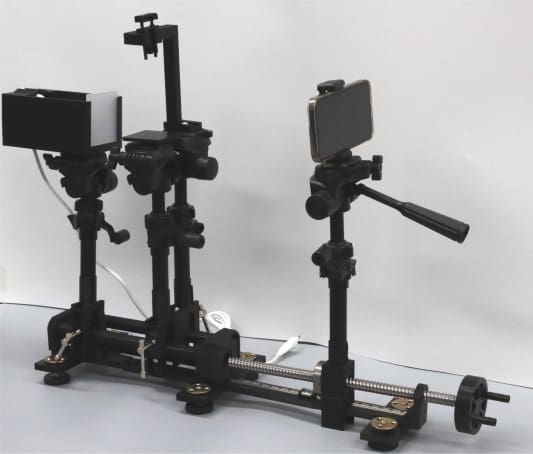
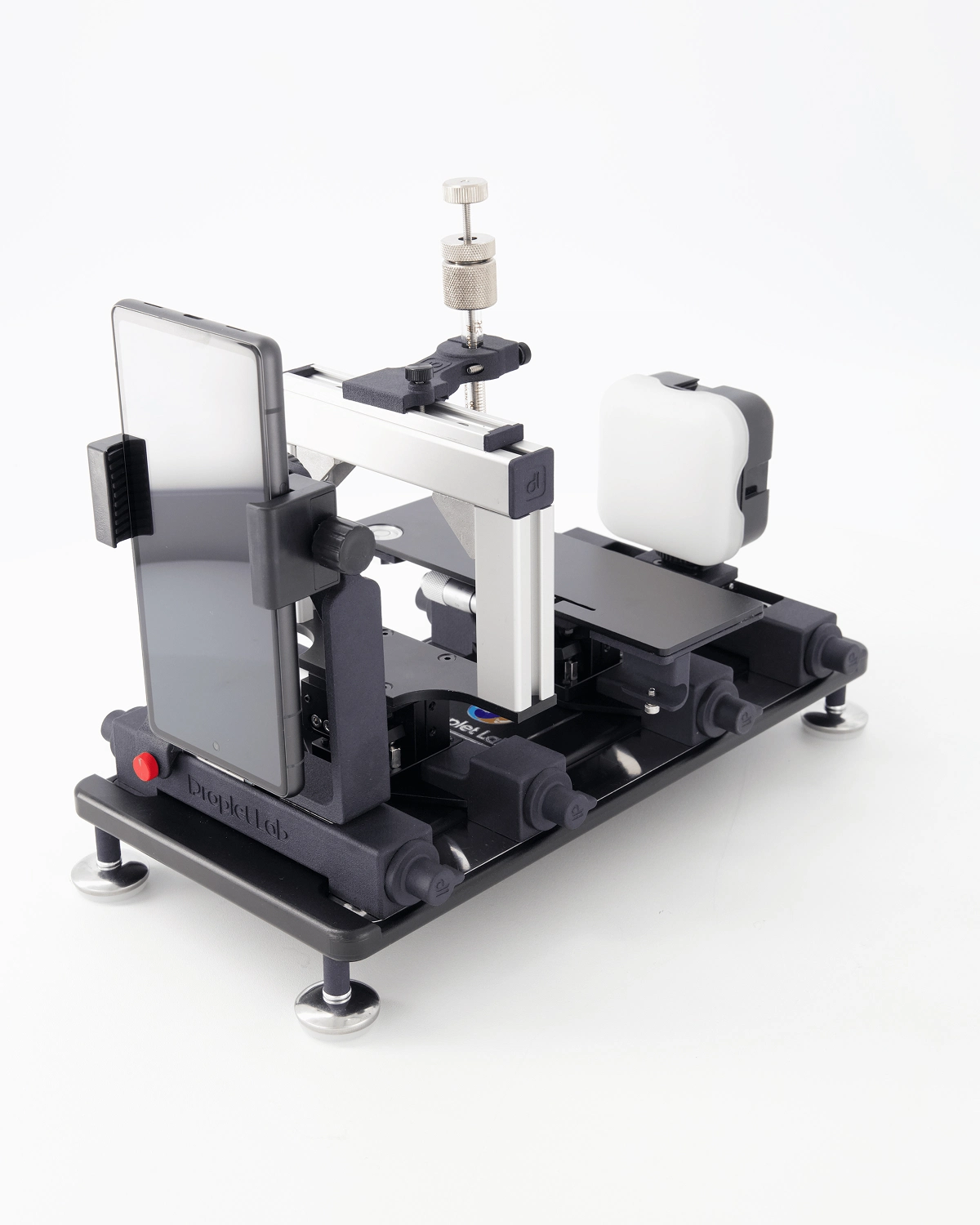
Dropometer pendant drop tensiometer: smartphone on a stage beside a pendant drop at a needle tip

Top pick

Dropometer

US$4,990 list price, base kit · checked 25 October 2026 · Droplet Lab quote configurator

4.23/ 5

The Dropometer pendant drop tensiometer ranks first because it is the only option under $5,000 with a published surface tension accuracy. It also measures interfacial tension, contact angle and surface free energy. It scores lowest on cost because it uses almost the whole budget.

Where it wins

  • Surface tension accuracy ±0.03 mN/m on its datasheet; drop shape method compared with a KRÜSS DSA100E in peer review
  • Surface and interfacial tension up to 75 mN/m, plus contact angle and surface free energy
  • Runs on battery for up to 8 hours and sets up in about 2 minutes; no PC needed
  • 5 year warranty and a lifetime software licence
  • Add an automatic dropper or a temperature chamber later instead of buying again

Where it loses ground

  • US$4,990 uses almost the whole budget
  • Range up to 75 mN/m
  • You mark the needle contact point before the fit runs
  • Not named in ASTM D1331, which uses the ring and the plate
Ossila Contact Angle Goniometer (L2004A1)

Runner up

Ossila Contact Angle Goniometer (L2004A1)

US$3,000 excluding VAT, PC not included · checked 25 October 2026 · Ossila product page

3.27/ 5

Ossila's goniometer measures pendant drop surface tension as well as contact angle, for about US$2,000 less than the Dropometer. It loses ground because Ossila publishes no surface tension range or accuracy, and it needs mains power and a lab PC.

Where it wins

  • US$3,000, about US$2,000 less than the Dropometer
  • Contact angle 5 to 180°, ±1° stated by Ossila
  • Two year warranty
  • Calibration sphere included

Where it loses ground

  • No surface tension range or accuracy published
  • Needs mains power through its 24 V adapter and a Windows PC from your lab
  • Ossila's product page and manual list different PC requirements
  • Interfacial tension not listed
DIY: camera and OpenDrop

Third

DIY: camera and OpenDrop

Free software (GPL); camera about US$20 to US$1,000 per the OpenDrop authors · checked 25 October 2026 · OpenDrop paper (camera cost)

3.08/ 5

OpenDrop is free, open source pendant drop software for surface and interfacial tension and contact angle. It costs the least of the optical options. Results depend on your camera, lighting and alignment, and there is no published accuracy.

Where it wins

  • Free software, described in a peer reviewed software paper (JOSS 2021)
  • Surface tension, interfacial tension and contact angle
  • Works with USB webcams and industrial cameras
  • A good way to learn drop shape analysis

Where it loses ground

  • No published accuracy; it depends on your optics
  • You build, align and calibrate the rig yourself
  • No warranty or support
  • Results vary with setup and operator
DWK KIMBLE Surface Tension Apparatus (capillary rise)

Fourth

DWK KIMBLE Surface Tension Apparatus (capillary rise)

US$370.47, made to order · checked 25 October 2026 · DWK KIMBLE product page

2.29/ 5

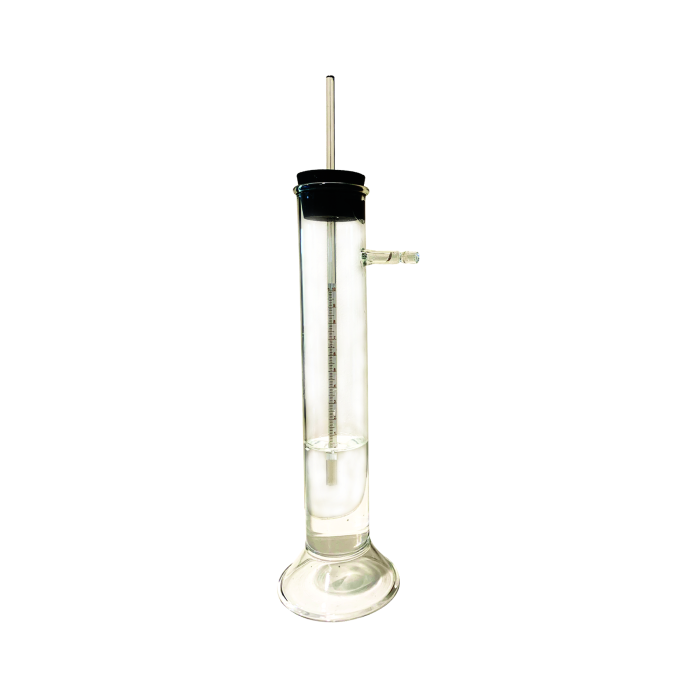
Capillary rise is the oldest way to measure surface tension: the liquid climbs a thin glass tube and you read the height. It is by far the cheapest option. You read the meniscus by eye and calculate the result yourself.

Where it wins

  • US$370.47 from DWK
  • No power, software or calibration file
  • Shows students and new staff the physics directly

Where it loses ground

  • No published accuracy; read by eye on a 1 mm scale
  • Surface tension only, no interfacial tension
  • Needs a clean capillary and the liquid density
  • No records beyond your notebook

How we arrived at these scores

Each option is scored from 1 to 5 on the same 9 criteria. A 3 means it meets what a lab buying its first tensiometer on a budget under $5,000 needs; a 5 means it exceeds it. Weights reflect a single budget purchase and add to 100 percent. Multiply each score by its weight, add the rows and divide by 100: that is the headline score.

Weighted scorecard
CriterionWhat it measuresWeight (%)DropometerOssila Contact Angle Goniometer (L2004A1)DIY: camera and OpenDropDWK KIMBLE Surface Tension Apparatus (capillary rise)Why these scores
Published accuracyA surface tension accuracy figure from the maker or a peer reviewed comparison5221.5Dropometer: ±0.03 mN/m on its datasheet and a peer reviewed comparison with a KRÜSS DSA100E. Ossila publishes contact angle accuracy only. OpenDrop and the KIMBLE apparatus publish none.
Measurement scopeSurface tension, interfacial tension, contact angle and surface free energy from one purchase53.53.51Dropometer covers all four. Ossila covers pendant drop surface tension and contact angle. OpenDrop covers surface and interfacial tension and contact angle. Capillary rise gives surface tension only.
Cost to buyPublished price against the $5,000 budget2.53.54.55KIMBLE US$370.47. OpenDrop free plus a camera. Ossila US$3,000 plus a PC if you lack one. Dropometer US$4,990 with phone and licence included.
Operator independenceThe same sample gives the same number whoever measures it43.531.5Dropometer fits the drop contour automatically once you mark the needle point. Ossila and OpenDrop fit in software after manual setup. Capillary rise is read by eye.
Sample volumeHow little liquid each reading uses4.54.542A pendant drop needs a few microlitres. Ossila ships a 25 µL syringe. OpenDrop uses whatever syringe you fit. Capillary rise needs enough liquid to stand the tube in.
Time per sampleHands on time from loading the liquid to a recorded result4432Both instruments fit the drop in software. A DIY rig needs checks between samples. Capillary rise means waiting for the rise and cleaning the tube.
WarrantyWarranty length54115 years against 2 years. OpenDrop has none; DWK publishes no warranty for the apparatus.
Power and setupWhat you need before the first measurement4.532.54Dropometer runs on battery and sets up in about 2 minutes. Ossila needs mains power and a PC. A DIY rig needs building and aligning. Glassware needs only cleaning.
Upgrade pathCapability you can add later without a new instrument5231Dropometer: Precision Dropper US$1,495, tilt stage US$695, temperature chamber built to order. Ossila lists no add on stages. OpenDrop takes a better camera. Glassware has none.
Weighted total / 54.233.273.082.29

Side-by-side specification comparison

The specifications that decide value under $5,000, from each maker's own pages and data sheets. Checked 25 October 2026.

SpecificationDropometerOssila goniometerOpenDrop (DIY)KIMBLE capillary rise
PriceUS$4,990 base kit (phone included)US$3,000 excluding VAT (PC not included)Free software; camera about US$20 to US$1,000US$370.47
MethodPendant drop (Young–Laplace)Pendant drop and sessile dropPendant drop and sessile dropCapillary rise
Surface tension rangeUp to 75 mN/mNot publishedNot publishedTube graduated 0 to 10 cm
Published accuracy±0.03 mN/m (datasheet)Not published for surface tensionNot publishedNot published
Interfacial tensionYesNot listedYesNo
Contact angle10° to 175°, 0.35°5° to 180°, ±1°YesNo
Power and computer5 V battery, up to 8 h; runs on the included phone24 V mains adapter; Windows PC from your labYour computer and cameraNone
Warranty5 years2 yearsNoneNot published

Verified on 25 October 2026

Sources: Dropometer product page, Droplet Lab quote configurator, Ossila product page, Ossila manual, OpenDrop (Huang et al., 2021), DWK KIMBLE apparatus. All checked 25 October 2026. When not to buy a Dropometer

Expert perspective

Not all contact-angle measurements are created equal: the right method depends on the application. A sessile drop and a tilted plate can give very different, and equally correct, numbers.

Dr. Alidad AmirfazliCo-founder and Scientific Advisor, Droplet Lab, Professor of Mechanical Engineering, York University

Frequently Asked Questions

What is the cheapest way to measure surface tension?

Capillary rise glassware, such as the DWK KIMBLE apparatus at US$370.47. You read the height of the liquid in a thin tube and calculate the surface tension from the tube radius and the liquid density. It suits occasional checks; it has no published accuracy. Our pendant drop experiment shows what makes a reading trustworthy.

Is a pendant drop tensiometer as accurate as a ring tensiometer?

It can be. The Dropometer's drop shape method was compared with a KRÜSS DSA100E in two peer reviewed papers, and its datasheet states ±0.03 mN/m. If your method or customer requires ASTM D1331, use the ring or the plate, which that standard names. Our ASTM D1331 summary explains the four methods.

Can I use free software with my own camera?

Yes. OpenDrop is free and open source, and its authors put the camera at about US$20 to US$1,000. Expect to build, align and calibrate the rig yourself, and to check results against a liquid of known surface tension. See how we measure surface tension with a smartphone.

What does the Dropometer measure besides surface tension?

Interfacial tension by pendant drop, static and dynamic contact angle, and surface free energy. Sliding angle needs the US$695 tilt stage. Customers publish with it: see the agrochemical formulation case study and the client measurement dataset.

Which liquids need more than $5,000 of instrument?

Liquids above 75 mN/m, very viscous samples that do not form a stable drop, and work that needs millisecond surface ages. Force and bubble pressure tensiometers cover these, and they are quote only.

What should I check besides the purchase price?

Whether a PC is included, whether the software licence is perpetual, what the warranty covers, and what calibration is needed. Compare totals over five years rather than list prices.

References

1.
Dropometer product page and specifications, Droplet LabPrice, range, accuracy and add ons; checked 25 October 2026
2.
Droplet Lab validation papersPeer reviewed comparisons with a KRÜSS DSA100E
3.
Ossila Contact Angle Goniometer (L2004A1)Price, range, warranty, power; checked 25 October 2026
4.
Ossila contact angle goniometer manualPC requirements and calibration
6.
DWK Life Sciences KIMBLE Surface Tension ApparatusPrice and graduation; checked 25 October 2026
7.
Kibron tensiometer pricesAutomated systems from €6,000; checked 25 October 2026
8.
ASTM D1331-20 (reapproved 2024)Ring and Wilhelmy plate methods

See it on your own samples

Book a 15-minute consult and we will measure a liquid like yours on a call, or configure a kit and get a price.