

This is a practical guide to Surface Science for researchers working in the Construction Industry.
In this all-new guide you’ll learn all about:
Let’s dive right in.
Concrete is the most widely used material in the global construction industry. It is cost-effective, offers high compressive strength, is durable, has a relatively simple production process, and requires minimal maintenance. Despite these advantages, concrete has a hydrophilic, porous structure that can pose challenges during construction. One major issue is the corrosion of steel reinforcement due to concrete’s water absorption, which reduces the lifespan of concrete structures. Additionally, there is a growing demand for intelligent, resilient, and sustainable buildings and infrastructures that focus on reducing greenhouse gas emissions. To meet these demands, new concrete materials such as low carbon footprint cement, self-compacting concrete, self-healing and self-sensing concrete, and superhydrophobic cementitious materials with self-cleaning capabilities have been developed. Modifying surface properties plays a crucial role in addressing the challenges of traditional concrete and in creating this new class of advanced materials.
We use the following surface properties to understand the behavior of Construction products and improve their quality.
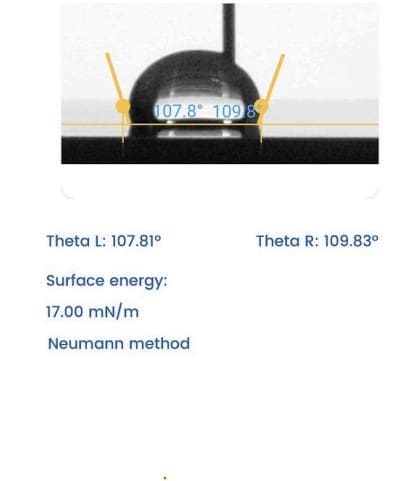
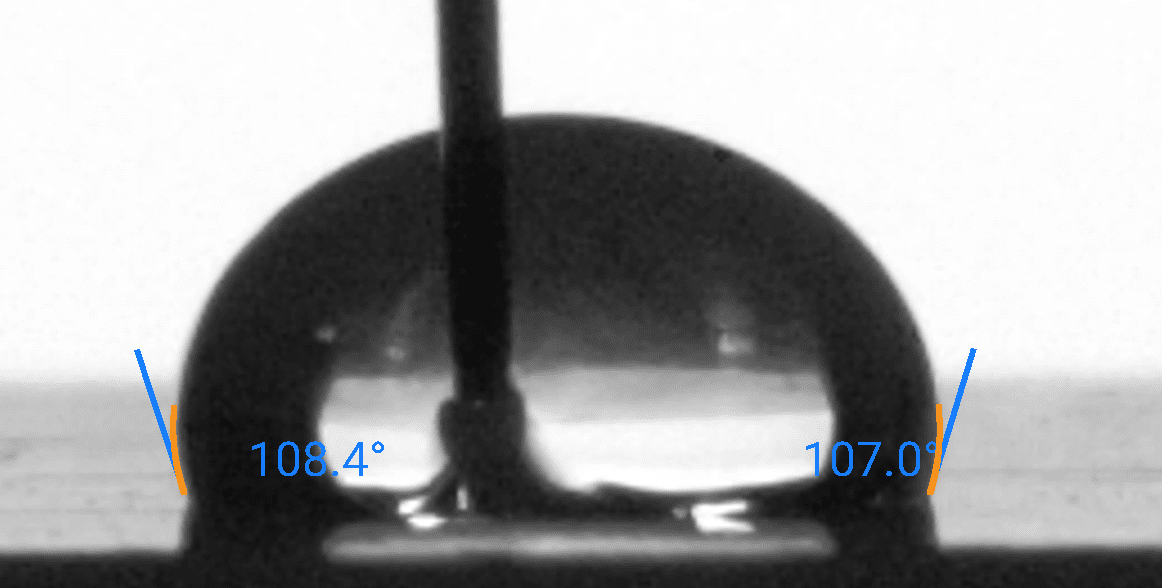
Sample Image taken from Droplet Lab Tensiometer.
Young – Laplace Method
Polynomial Method
Ideally, when we place a drop on a solid surface, a unique angle exists between the liquid and the solid surface. We can calculate the value of this ideal contact angle (the so-called Young’s contact angle) using Young’s equation. In practice, due to surface geometry, roughness, heterogeneity, contamination, and deformation, the contact angle value on a surface is not necessarily a single consistent value but rather falls within a range. The upper and lower limits of this range are known as the advancing and receding contact angles, respectively. The values of advancing and receding contact angles for a solid surface are highly sensitive to many parameters, such as temperature, humidity, homogeneity, and minor contamination of the surface and liquid. For example, the advancing and receding contact angles of a surface can differ at different locations.
Practical surfaces and coatings naturally show contact angle hysteresis, indicating a range of equilibrium values. When we measure static contact angles, we get a single value within this range. Solely relying on static measurements poses problems, like poor repeatability and incomplete surface assessment regarding adhesion, cleanliness, roughness, and homogeneity.
In practical applications, we need to understand how easily a liquid spreads (advancing angle) and how easily it is removed (receding angle), such as in painting and cleaning. Measuring advancing and receding angles offers a holistic view of liquid-solid interaction, unlike static measurements, which yield an arbitrary value within the range.
This insight is crucial for real-world surfaces with variations, roughness, and dynamics, aiding industries like cosmetics, materials science, and biotechnology in designing effective surfaces and optimizing processes.
Learn how Contact Angle measurement is done on our Tensiometer
For a more complete understanding of Contact Angle measurement, read our Contact Angle measurement: The Definitive Guide
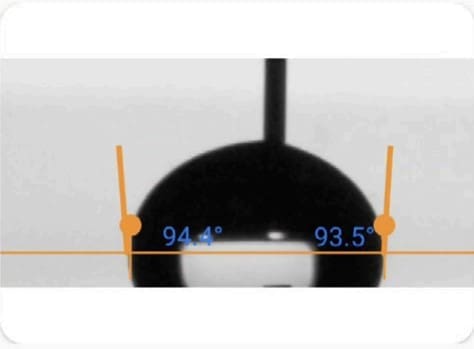
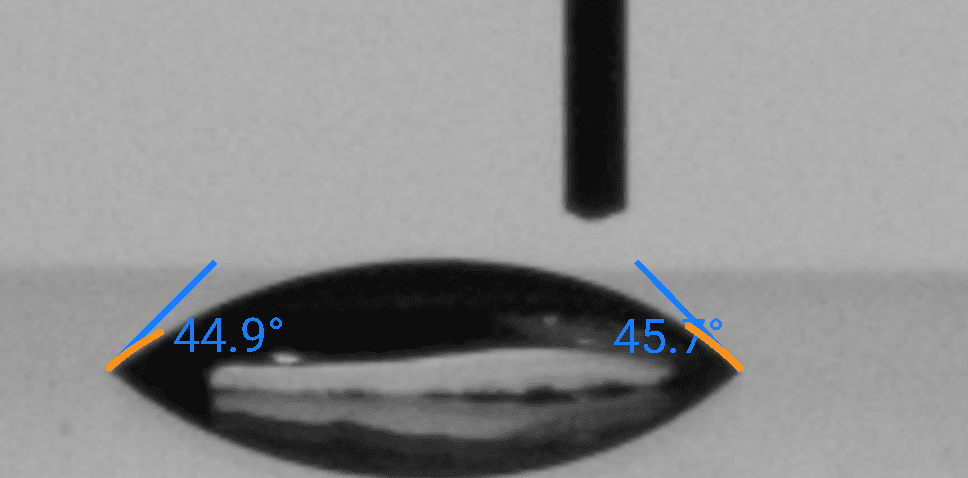
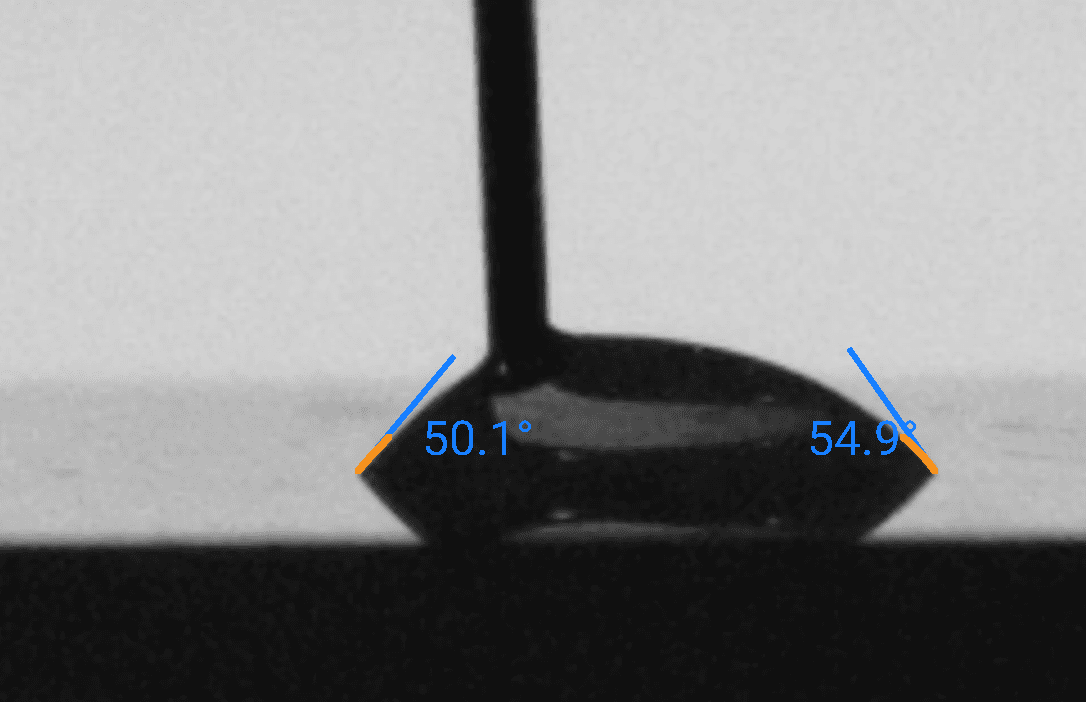
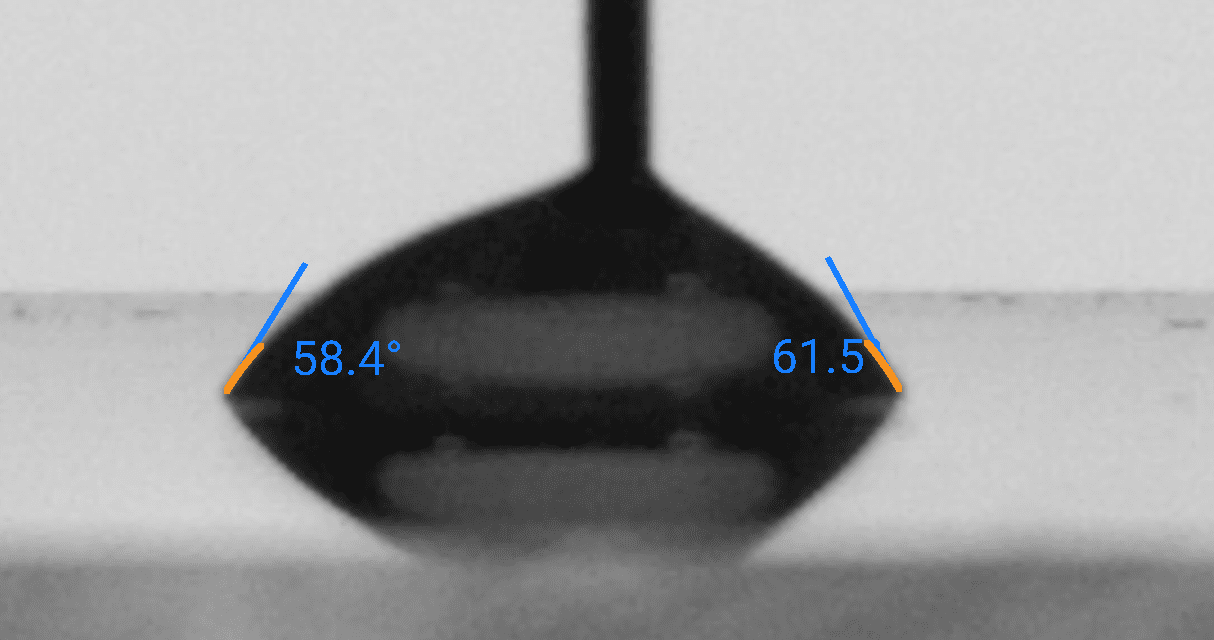
These reference measurements show how deionized water wets four standard substrates measured with the Droplet Lab Dropometer. Use them as visual and numerical benchmarks when you're checking your own sample preparation, treatments, and chemistry.
Full contact angle and surface energy datasets (including additional liquids and statistics) are available on our dataset hub.
The droplet images above are taken from the same benchmark series as our open dataset. For each substrate and probe liquid we report:
● Advancing and receding contact angles (and hysteresis)
● Derived surface energy (SFE) values based on multi-liquid measurements
● Measurement conditions, uncertainties, and sample preparation details
Comparing your own droplet shapes and angles against these references is a fast way to spot contamination, treatment drift, or unexpected changes in wettability.
Measurements were performed with the Droplet Lab Dropometer under controlled laboratory conditions. Treat these values as sanity checks and starting points for your own process targets, not as product specifications.
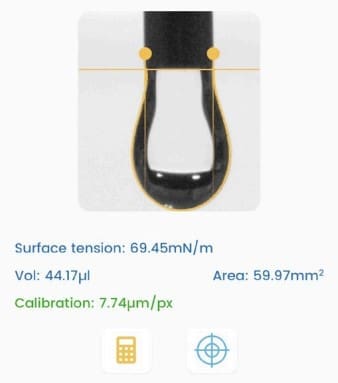
This property measures the force that acts on the surface of a liquid, aiming to minimize its surface area.
Sample Image taken from Droplet Lab Tensiometer
Dynamic Surface Tension
Dynamic surface tension differs from static surface tension, which refers to the surface energy per unit area (or force acting per unit length along the edge of a liquid surface).
Static surface tension characterizes the equilibrium state of the liquid interface, while dynamic surface tension accounts for the kinetics of changes at the interface. These changes could involve the presence of surfactants, additives, or variations in temperature, pressure, and composition at the interface.
When to use Dynamic Surface Tension Measurement
Dynamic surface tension is essential for processes that involve rapid changes at the liquid-gas or liquid-liquid interface, such as droplet and bubble formation, coalescence (change in surface area), the behavior of foams, and the drying of paints (change in composition, e.g., evaporation of solvent). It is measured by analyzing the shape of a hanging droplet over time.
Dynamic surface tension applies to various industries, including cosmetics, coatings, pharmaceuticals, paint, food and beverage, and industrial processes, where understanding and controlling the behavior of liquid interfaces is essential for product quality and process efficiency.
Learn how Surface Tension measurement is done on our Tensiometer
For a more complete understanding of Surface Energy measurement, read our Surface Tension measurement: The Definitive Guide
Sample Image taken from Droplet Lab Tensiometer
Learn how Surface Energy measurement is done on our Tensiometer
For a more complete understanding of Surface Energy measurement, read our Surface Energy measurement: The Definitive Guide
For benchmark contact angle and surface energy values on glass, nylon, PMMA, and Teflon, see the Open Benchmark Data panel above or visit our Dataset Hub for full CSV downloads.
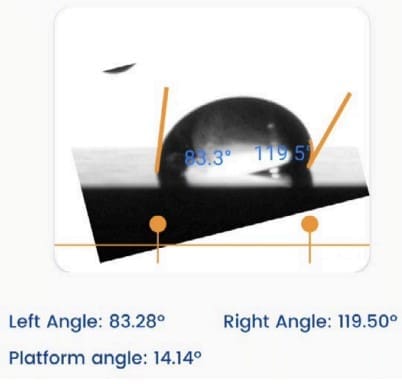
The sliding angle measures the angle at which a liquid film slides over a solid surface. It is commonly employed to assess the slip resistance of a surface.
Sample Image taken from Droplet Lab Tensiometer
Learn how Sliding Angle measurement is done on our Tensiometer
For a more complete understanding of Sliding Angle measurement, read our Sliding Angle Measurement: The Definitive Guide
Within the Construction industry, several case studies exemplify the advantages of conducting surface property measurements.
Challenge: Dust and pollution accumulated on the solar panels of a commercial building, reducing their energy generation efficiency.
Solution: Applying a hydrophobic and oleophobic coating to the solar panels increased the contact angle, causing rainwater to bead up and carry away dust and pollutants. This self-cleaning effect improved energy generation efficiency and reduced maintenance costs.

Challenge: Water leakage in an underground parking structure was causing vehicle damage and structural deterioration.
Solution: A waterproofing membrane with low surface tension was applied to the concrete surfaces. This membrane provided effective water repellency, preventing water infiltration and preserving the integrity of the parking structure while protecting the vehicles.

Challenge: Slippery pedestrian walkways in a shopping mall led to slip and fall accidents during rainy weather.
Solution: The mall management installed textured, slip-resistant tiles with superhydrophobic surfaces. These tiles, characterized by a water static contact angle above 150° and a sliding angle below 10°, provided better traction even when wet, significantly reducing slip and fall incidents. This increased safety for shoppers and employees and decreased the mall's liability for accidents.

Challenge: Engineers faced adhesion problems between the steel and concrete components in a steel-concrete composite structure due to incompatible surface energies.
Solution: The engineering team applied a bonding agent to the steel beams to modify their surface energy. This agent enhanced compatibility between the steel and concrete, resulting in a robust bond. The composite structure exhibited improved load-bearing capacity and durability, ensuring the building's safety and longevity.

Challenge: An automotive assembly plant experienced paint adhesion problems on metal components, leading to defects and reduced vehicle durability.
Solution: The engineering team improved paint adhesion by selecting a suitable metal pretreatment process. They tested various processes and chose plasma cleaning, which had the lowest surface tension. This solution ensured a durable, long-lasting finish on the vehicles.

If you are interested in implementing these or any other applications, please contact us.
In an industry where precision reigns supreme, how can Construction manufacturers ensure their products withstand scrutiny? The answer lies in standards and guidelines: the compass that guides them through the complex maze of quality and performance.
European standard method to determine a solid surface’s wettability and surface free energy (or critical surface tension) by measuring static contact angles of one or more probe liquids on a plane test surface. The resulting metrics support predictions of adhesive wet-out and help characterize surfaces before pretreatment, coating, or bonding.
Use contact angle + surface free energy to quickly flag low-wet-out substrates (metals, plastics, glass, coated parts) before you spend time on full lap-shear/peel trials.
Use repeatable, multi-liquid measurements to detect contamination, treatment drift (plasma/corona/flame/primer), and surface aging/recovery that can drive adhesion failures.
Note: EN 828 tells you how to measure and calculate wettability/SFE, but it does not define universal “good bonding” thresholds—your limits must be calibrated to your adhesive + substrate + pretreatment and validated against bond tests. Roughness and chemical non-uniformity can bias static angles, so consistent surface prep, replication, and drop-quality QC are essential.
We hope this guide showed you how to apply surface science in the Construction industry.
Now we’d like to turn it over to you:
Feel free to leave a comment below—we’d love to hear from you.